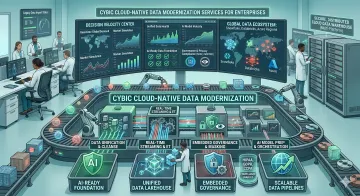
What does cloud-native data modernization actually involve for an enterprise?
Cloud-native data modernization involves migrating legacy data infrastructure including on-premises data warehouses, ETL pipelines, and siloed applications to scalable cloud platforms like Snowflake, Databricks, or Azure. The process includes data architecture redesign, pipeline optimization, governance framework implementation, and integration with AI and analytics tools to make enterprise data actionable in real time.
How long does a typical enterprise data modernization engagement take?
Timelines vary based on infrastructure complexity, data volume, and regulatory requirements. A focused warehouse migration or pipeline modernization can take 8-16 weeks, while a comprehensive data platform transformation spanning multiple systems, governance frameworks, and AI integration typically spans 4-9 months. Cybic begins every engagement with a structured assessment and roadmap to establish realistic milestones.
Will modernization disrupt our ongoing business operations?
Cybic's modernization methodology is designed to minimize business disruption. We use phased migration strategies, parallel-run environments, and incremental cutover approaches so that core operations remain uninterrupted throughout the transition. Legacy systems are decommissioned only after the new cloud-native infrastructure has been validated and stabilized in production.
Which cloud platforms does Cybic support for data modernization?
Cybic supports all major enterprise cloud platforms, including AWS, Microsoft Azure, and Google Cloud, as well as leading data platforms such as Snowflake, Databricks, and Looker. Solutions are designed to be infrastructure-agnostic, meaning we can architect for single-cloud, multi-cloud, or hybrid environments depending on your organization's existing footprint and strategic direction.
How does Cybic handle data governance and regulatory compliance during modernization?
Governance is embedded at the architectural level and not retrofitted after deployment. Cybic builds frameworks aligned to GDPR, HIPAA, and CCPA, incorporating role-based access controls (RBAC), encrypted data protection in transit and at rest, audit trails, and data ownership policies. For regulated industries like healthcare and financial services, compliance requirements are scoped into the modernization roadmap from day one.
Can Cybic modernize our data infrastructure without replacing our entire technology stack?
Yes. Cybic designs modernization paths that integrate with existing enterprise systems including ERPs, CRMs, and industry-specific platforms rather than requiring full replacement. We use API-led integration, incremental migration, and modular architecture to extend the life and capability of core systems while progressively transitioning data infrastructure to cloud-native components.
How does data modernization enable AI and machine learning adoption?
AI and ML models are only as effective as the data they consume. Modernizing your data infrastructure creates a clean, governed, high-velocity data foundation with unified schemas, real-time pipelines, and consistent data quality that enables reliable model training, inference, and automated decision-making. Cybic architects data platforms specifically to be AI-ready, reducing time-to-deployment for enterprise AI initiatives.
What industries does Cybic specialize in for data modernization projects?
Cybic has deep vertical expertise in healthcare, oil & gas, manufacturing, retail, and the public sector. Each industry presents distinct data challenges such as clinical data governance in healthcare, real-time sensor data in energy, demand forecasting in retail and Cybic's modernization frameworks are tailored to address the specific regulatory, operational, and analytical requirements of each sector.