What is data engineering in healthcare?
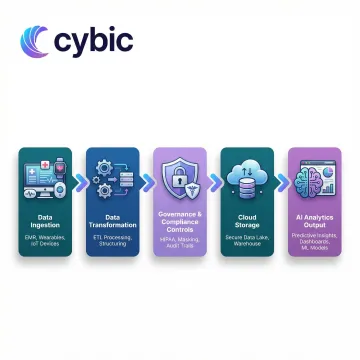
Data engineering in healthcare involves designing, building, and maintaining the infrastructure that collects, transforms, stores, and delivers clinical, operational, and financial data. This includes ETL/ELT pipelines, data warehouses, and governance frameworks, all architected to handle Protected Health Information (PHI) securely, meet HIPAA requirements, and make data accessible for analytics and AI-driven decision-making.
How does Cybic ensure HIPAA compliance in data engineering projects?
Cybic embeds HIPAA compliance at the architectural level, not as an afterthought. This includes encrypting PHI in transit and at rest, implementing role-based access controls (RBAC), establishing audit trails for all data access and transformations, conducting data classification during design, and building automated compliance monitoring into the pipeline infrastructure from the start.
What types of healthcare data sources can Cybic integrate?
Cybic integrates a wide range of healthcare data sources including EHR and EMR systems, billing and claims platforms, laboratory information systems, medical imaging repositories, patient portals, IoT health devices, and operational databases, unifying them into a single governed data layer on cloud or hybrid infrastructure.
What cloud platforms do you support for healthcare data engineering?
Cybic supports AWS, Microsoft Azure, and Google Cloud, as well as hybrid and on-premises environments. Our infrastructure-agnostic approach means we design solutions that align with your existing technology investments and cloud strategy without locking you into a single vendor ecosystem.
Can Cybic modernize our existing legacy healthcare data warehouse?
Yes. Cybic specializes in migrating and modernizing legacy EDW systems to modern cloud platforms such as Snowflake, Databricks, and Azure Synapse. The process includes ETL/ELT pipeline optimization, data lake integration, performance tuning, and embedding HIPAA-compliant governance controls, all while minimizing disruption to ongoing clinical and operational workflows.
How long does a typical healthcare data engineering engagement take?
Timelines vary based on scope and complexity. A focused pipeline build or data warehouse migration typically takes 8–16 weeks. Larger engagements involving full data strategy design, governance framework implementation, and multi-system integration can span 3–6 months. Cybic provides a structured roadmap and phased delivery plan at the outset of every engagement.
Does Cybic train AI or ML models on our proprietary healthcare data?
No. Cybic maintains a strict policy of no model training on proprietary enterprise or healthcare data. Your PHI and organizational data remain yours. All AI and ML systems are built using governed, access-controlled pipelines, and any model development is conducted on approved, de-identified datasets in alignment with your data governance policies.
What governance capabilities does Cybic build into healthcare data systems?
Cybic's governance frameworks include data lineage tracking, automated data quality monitoring, role-based access controls, policy enforcement layers, audit logging for regulatory reviews, and data ownership definitions. These are aligned with HIPAA, GDPR, and CCPA requirements, ensuring your data infrastructure meets both current compliance mandates and future regulatory demands.