What is Semantic Kernel and why is it used for building AI agents?
Semantic Kernel is Microsoft's open-source SDK that connects large language models like Azure OpenAI GPT-4 with enterprise tools, memory stores, and APIs through a plugin-based architecture. It enables developers to build AI agents that can plan, reason, and execute multi-step tasks making it the foundation for production-grade agentic systems that integrate with real enterprise infrastructure.
What types of AI agents can be built with Azure OpenAI and Semantic Kernel?
A wide range of agents can be built, including document intelligence agents, customer service copilots, automated approval agents (e.g., loan or claims processing), supply chain coordination agents, IT helpdesk agents, and multi-agent systems where specialized sub-agents collaborate on complex enterprise tasks. The architecture adapts to your specific workflow requirements and data sources.
How do multi-agent systems differ from single AI agents?
Single agents handle one task domain, while multi-agent systems deploy multiple specialized agents that communicate, delegate, and execute tasks in parallel. This enables complex orchestration such as one agent retrieving data, another applying business logic, and a third triggering downstream actions dramatically increasing throughput, accuracy, and adaptability for enterprise workflows.
How does Cybic ensure enterprise data security within AI agent systems?
Cybic embeds security at the architectural level implementing role-based access controls (RBAC), encrypted data protection in transit and at rest, auditability of all AI-driven actions, and strict data governance policies including no model training on proprietary enterprise data. These controls are built into the system from the start, not applied as afterthoughts.
Can AI agents built with Semantic Kernel integrate with our existing enterprise systems?
Yes. Cybic's integration approach connects AI agents to your existing CRMs, ERPs, data lakes, internal APIs, and knowledge bases via custom plugin development within Semantic Kernel. This means agents operate with contextual, real-time access to enterprise data without requiring significant changes to your underlying infrastructure or workflows.
What industries does Cybic build AI agent solutions for?
Cybic develops AI agent solutions for healthcare, financial services, manufacturing, oil and gas, retail, and the public sector. Use cases include clinical workflow automation, intelligent loan processing, supply chain coordination, predictive maintenance, and regulatory compliance monitoring each solution tailored to the specific data environment, compliance requirements, and operational context of the industry.
How long does it typically take to develop and deploy an enterprise AI agent?
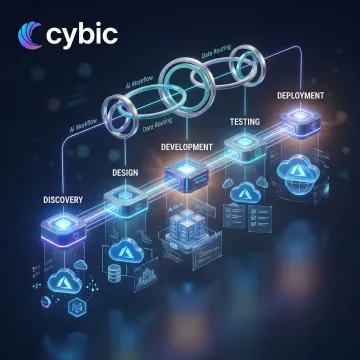
Timeline depends on the complexity of the agent's task scope, the number of integrations required, and the governance controls needed. A focused single-agent deployment on Azure OpenAI with Semantic Kernel typically takes 6–12 weeks from discovery to production. Multi-agent systems with complex orchestration and enterprise integrations generally require 12–24 weeks for full deployment.
Does Cybic provide ongoing support and monitoring after AI agent deployment?
Yes. Post-deployment, Cybic provides continuous performance monitoring, auditability tracking, model updates, and iterative improvements based on real-world usage data. Our teams ensure that agents remain accurate, compliant, and effective as your data, workflows, and business requirements evolve with defined SLAs and escalation paths for production issues.