Introduction
AI agent platforms have moved from experimental deployments to core enterprise infrastructure fast. Gartner predicts that 40% of enterprise applications will be integrated with task-specific AI agents by end of 2026, up from less than 5% in 2025. That's eight times the deployment footprint in a single year.
The pricing that comes with it bears almost no resemblance to traditional SaaS. You won't find a clean per-seat table or a predictable annual subscription. Costs vary based on the pricing model chosen, workload type, agent autonomy, integration depth, and governance requirements - and those variables interact in ways that catch most enterprises off guard.
What follows is a direct breakdown of the dominant pricing models, what drives costs up or down, the full total cost of ownership, and how to build a realistic budget before you commit to a platform.
Key Takeaways
- Cost range is wide - from free developer tiers to enterprise contracts with seven-figure three-year TCO
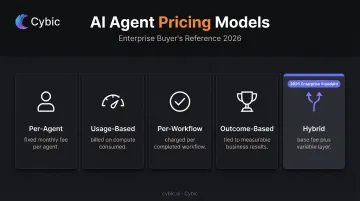
- Five pricing models dominate: usage-based, per-agent, per-workflow, outcome-based, and hybrid - pick based on workload, not headline price
- Governance, integration, and model maintenance are the hidden cost drivers most organizations underestimate
- Hybrid pricing (base fee + variable layer) is the dominant enterprise standard in 2026
- Match the model to the workload - not to the lowest headline number
How Much Does an AI Agent Development Platform Cost?
There is no fixed price. The final number depends on the pricing model chosen, deployment scale, agent autonomy level, integration complexity, and governance requirements. Those factors compound - they don't scale predictably with volume or complexity.
Three budgeting mistakes come up repeatedly:
- Underbudgeting for ongoing compute and model maintenance after go-live
- Over-investing in enterprise tiers before validating agent ROI at smaller scale
- Getting surprised by infrastructure costs - integration, orchestration, guardrails - that never appeared in the initial quote
Typical Cost Ranges in 2026
| Tier | What's Included | Typical Fit |
|---|---|---|
| Entry / lightweight | Low-code builder, limited autonomy, cloud-hosted, minimal governance. Example: CrewAI Basic is free with 50 workflow executions/month; LangSmith Developer is $0/seat | Small teams, proof-of-concept, single-use-case agents |
| Mid-range / departmental | Multi-agent support, moderate integrations, usage-based billing. Example: Microsoft Copilot Studio at $200/month per 25,000 Copilot Credits; Salesforce Agentforce at $2/conversation | One or two business functions, moderate workflow complexity |
| Enterprise / governed | Full orchestration, multi-system integrations, RBAC, compliance layers, hybrid/on-prem options. Platforms like Relevance AI Enterprise and IBM watsonx Orchestrate are custom-quoted | Large organizations, regulated industries, agents running across critical operations |
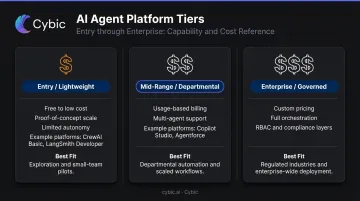
The jump between tiers is architectural, not just financial. Entry-level platforms typically lack the governance controls and integration depth that regulated industries require.
The Main Pricing Models for AI Agent Platforms in 2026
BCG notes that agentic AI is pushing software pricing away from traditional seat-based licensing toward models tied to usage, agents, interactions, jobs completed, and financial outcomes. The shift makes sense: agent compute costs vary dynamically with task complexity, not with how many people have logins.
Per-Agent Pricing (Digital Worker Model)
A fixed monthly or annual fee per deployed agent - each agent treated like a digital employee with a defined role.
Works best when agent workloads are predictable and steady: a claims processor, an onboarding agent, a compliance checker running consistent daily volumes. The practical advantage is that it draws from headcount budgets rather than software budgets, making it easier to justify to finance teams who already think in terms of FTE cost.
Best for: Stable, high-volume workflows with predictable throughput.
Usage-Based Pricing
Bills for actual compute consumed - tokens processed, API calls made, workflow steps executed, or documents handled.
The most transparent model for variable, compute-heavy workloads. The risk: without spend controls and metering in place, monthly bills become difficult to forecast. A single spike in agent activity - an end-of-quarter processing burst, a compliance audit cycle - can produce an outsized bill.
Per-Workflow or Per-Action Pricing
Charges each time an agent completes a defined workflow end-to-end. Zendesk, for example, now prices its AI agents on automated resolutions rather than message volume.
This model ties directly to operational KPIs and unit economics. The challenge is definitional clarity: what counts as a "completed" workflow needs precise agreement upfront, or billing disputes follow.
Outcome-Based Pricing
Payment tied to measurable business results - tickets resolved, fraud flagged, leads qualified, costs saved.
Highest alignment for buyers - and the hardest to implement. Attribution is complex, baseline definitions require negotiation, and providers carry real performance risk.
It works well for agents with well-defined, trackable outputs in stable workflows. It breaks down when output quality can't be cleanly attributed to the agent alone.
Hybrid Pricing (The 2026 Enterprise Standard)
A predictable base fee (platform access, committed agent or seat tier) layered with a variable component (usage overages, per-workflow charges, or performance bonuses).
BCG expects broad near-term adoption of hybrid approaches that blend established subscription structures with emerging agentic pricing models. In practice, this is already the default for complex, multi-team enterprise deployments - it balances budget predictability with the flexibility to scale without re-negotiating the entire contract. it balances budget predictability with the flexibility to scale without re-negotiating the entire contract. For most enterprise buyers, structuring a hybrid deal means locking in a committed tier that covers baseline agent capacity, then letting usage charges absorb volume spikes - keeping procurement simple while preserving room to grow.
Key Factors That Drive AI Agent Platform Pricing
The pricing model is just the billing mechanism. What the bill actually says depends on the architecture and operational scope underneath it.
Agent Autonomy and Complexity
A lightweight assistive agent (surfacing a summary, answering a question) costs far less per run than a fully autonomous agent reasoning across multi-step workflows, calling external APIs, and making decisions without a human in the loop.
Anthropic's own documentation notes that agentic systems often trade latency and cost for better task performance. OpenAI recommends using smaller, faster models for simple tasks precisely because orchestration cost scales with reasoning depth. More autonomy means more tokens, more context, more compute - and every step compounds the bill.
Integration Depth and System Connectivity
The number and complexity of system integrations (CRMs, ERPs, data warehouses, industry-specific tools) drives both initial setup cost and ongoing per-call infrastructure costs. Unstructured data inputs (contracts, clinical notes, emails) require heavier model reasoning than structured inputs, increasing per-run cost asymmetrically.
AWS has documented that poorly defined tool schemas trigger irrelevant API calls, expand context windows, and escalate costs through redundant LLM calls. Integration quality directly affects inference bills.
Cybic's Drava platform addresses this by connecting CRMs, ERPs, data lakes, and LLM-powered tools through custom API development, getting the integration architecture right from the start rather than correcting it under production load.
Scale, Volume, and Concurrency
Peak workload patterns (seasonal spikes, month-end processing bursts, multi-team simultaneous deployments) determine which pricing tier you need and how much overage exposure you carry.
- Predictable steady-state workloads → committed tiers minimize waste
- Bursty, variable workloads → hybrid or usage-capped models reduce overage risk
- Multi-team concurrent deployments → orchestration infrastructure costs multiply
Governance, Security, and Compliance Requirements
This is where regulated industries pay a meaningful premium - and where shortcuts create larger costs downstream.
IBM reports that 63% of breached organizations lacked AI governance policies, with shadow-AI incidents adding as much as $670K to average breach cost. Gartner predicts that by 2027, 40% of enterprises will demote or decommission autonomous AI agents because of governance gaps identified after production incidents.
Those incidents translate directly into budget. Governance requirements add real cost: RBAC, audit logging, encryption in transit and at rest, private cloud deployment, and compliance documentation. Platforms that treat governance as a deployment afterthought consistently generate higher long-term compliance costs than those where controls are built in at the architectural level.
Drava embeds governance (RBAC, audit trails, encrypted data protection, SOC 2/HIPAA/ISO/GDPR alignment) from day one, reducing the rework cost that accumulates when compliance is bolted on after the fact.
Model Selection and Infrastructure Stack
The underlying LLM choices have direct cost implications. On AWS Bedrock, Claude 3.5 Sonnet runs at $6.00/1M input tokens and $30.00/1M output tokens. Meta Llama 2 Chat 13B runs at $0.75/1M input tokens and $1.00/1M output tokens. That's a 30x+ difference in output token cost between models.
Add infrastructure components (Bedrock Guardrails text filters at $0.15/1,000 text units, Flows at $0.035/1,000 node transitions) and the per-run cost picture adds up fast. Infrastructure-agnostic platforms that support multi-model routing and can operate across cloud, hybrid, or on-prem give organizations more levers to manage inference costs over time.
Total Cost of Ownership: What's Not in the Quote
The quoted platform price is almost never the total spend. Forrester's three-year Total Economic Impact analysis for a 25,000-employee enterprise using Microsoft Copilot Studio projected $24.4M in total costs over three years. The subscription itself accounted for $3.1M of that. The rest:
| TCO Component | What It Includes |
|---|---|
| Platform licensing | Recurring platform access, agent licenses, base infrastructure - the number that appears in procurement discussions |
| Integration & implementation | Connecting to CRMs, ERPs, data sources, legacy tools; data cleaning; workflow mapping; API configuration. Forrester projected ~$720K annually in professional services for the composite enterprise |
| Ongoing compute & inference | Token consumption, model calls, orchestration steps - fluctuates with usage and is consistently the most underestimated line item |
| Model maintenance & governance upkeep | Prompt tuning, guardrail adjustments, re-training triggers, audit review cycles. Forrester found IT developers may spend 20% of their time maintaining and updating existing agents |
| Planning, development & maintenance | Forrester projected $8.2M of the $24.4M total in this category alone |
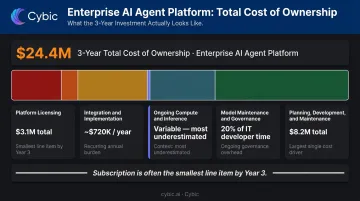
Forrester also notes that AI TCO extends beyond subscriptions to cloud egress, storage for proprietary data, and internal development resources - with chargeback models where business units pay token and AI staff costs while IT handles build and training costs.
For most enterprises, the subscription is the smallest line item by year three. The integration, inference, and maintenance costs are what determine whether an AI agent deployment stays financially viable at scale.
How to Estimate the Right Budget - and What Most Get Wrong
The goal isn't to find the cheapest option. It's to match platform capability and pricing model to the actual workload, governance requirements, and operational context from the start.
Factors to Consider When Estimating Budget
- Workload pattern: Steady workloads suit per-agent or committed-tier models. Variable, spiky, or cross-departmental usage needs hybrid or usage-capped structures. If outcomes aren't measurable yet, outcome-based pricing isn't appropriate - regardless of how well the incentive structure appears to align at the scoping stage.
- Governance and compliance baseline: For healthcare (HIPAA), public sector (data sovereignty), and energy or manufacturing (safety compliance), governance is a non-negotiable cost input. Budget it as fixed infrastructure. Platforms that build governance in by design - rather than bolt it on post-deployment - consistently generate lower long-term compliance costs.
- Total cost horizon: Plan across 24–36 months, not first-year licensing alone. Account for integration, maintenance, and compute scaling. Organizations that assemble point solutions and patch gaps after deployment tend to absorb significantly higher hidden costs than those who architect for operational reality from day one.
Common Mistakes That Inflate or Misallocate Budget
- Focusing only on the licensing fee while ignoring compute, integration, and maintenance - leading to budget exhaustion mid-deployment
- Choosing the cheapest entry-level tool without evaluating whether it meets governance, security, or scalability requirements - resulting in costly platform migrations later
- Over-specifying at launch (buying enterprise tiers before validating agent ROI) or under-specifying governance controls (adding compliance layers retroactively at higher cost)
Frequently Asked Questions
How much does an AI agent development platform cost in 2026?
Costs range from free developer tiers (CrewAI Basic, LangSmith Developer) to consumption-billed departmental tools (Copilot Studio at $200/month per credit pack, Agentforce at $2/conversation) to enterprise contracts with custom quotes and seven-figure three-year TCO. The pricing tier breakdown earlier in this article maps those ranges to workload type.
What is the difference between usage-based and outcome-based pricing for AI agent platforms?
Usage-based charges for compute consumed - tokens processed, API calls made, workflows executed - and bills accumulate as agents run. Outcome-based ties payment to measurable business results like resolved tickets or qualified leads. That model requires clear baseline definitions and attribution frameworks; without them, billing disputes and misaligned incentives follow.
Which AI agent pricing model works best for enterprise deployments?
Hybrid pricing - a predictable base fee layered with a variable usage or performance component - is the most common enterprise choice in 2026. It balances budget predictability with the flexibility to scale across teams and workloads without renegotiating contracts as usage patterns shift.
What hidden costs do enterprises most often miss when budgeting for AI agent platforms?
The four most consistently underestimated cost categories: ongoing compute and inference costs (which fluctuate with agent activity), model maintenance and prompt tuning, integration scope for connecting agents to existing enterprise systems, and governance and compliance upkeep as regulations and policies evolve post-deployment.
How is AI agent platform pricing different from traditional SaaS pricing?
SaaS charges for access - seats, tiers, user licenses. AI agent platforms charge for work performed: tokens consumed, workflows completed, or outcomes delivered. Because agent compute costs vary dynamically with task complexity and volume, not user count, the billing logic is fundamentally different - and more variable.
Is outcome-based pricing worth it for enterprise AI agents?
Outcome-based pricing offers the highest alignment between buyer and provider, but requires measurable baselines, clear attribution rules, and agents with mature, stable performance. It works best for well-defined, trackable outputs - a support ticket resolution, a KYC check - where reliable baselines already exist.