Introduction
Most enterprises don't have an AI governance problem - they have an AI speed problem. Models get deployed faster than policies get written, and accountability gaps fill the space between.
The consequences are real. In 2023, the EEOC settled a discriminatory hiring case against iTutorGroup after recruiting software allegedly rejected candidates based on age, resulting in a $365,000 settlement. That same year, the FTC banned Rite Aid from using facial recognition technology for five years after the retailer deployed it without reasonable safeguards.
These aren't edge cases. McKinsey's 2025 global survey reports that 51% of organizations using AI have experienced at least one negative consequence, with nearly a third reporting issues from AI inaccuracy alone.
Regulation is tightening in parallel. The EU AI Act entered into force in August 2024 (the first binding legal framework for AI globally), with penalties reaching €35 million or 7% of global turnover. US state laws, sector-specific rules, and international standards are following.
This guide covers the core principles, major frameworks, and a practical roadmap for building AI governance that holds up when speed, scale, and regulatory scrutiny all arrive at once.
Key Takeaways
- AI governance covers the policies, processes, and controls that keep AI systems ethical, transparent, and compliant across their full lifecycle
- Core principles: fairness, transparency, accountability, privacy, and built-in safeguards
- Key frameworks to know: NIST AI RMF, EU AI Act, ISO 42001, and OECD AI Principles
- Governance must be cross-functional - no single team can own it alone
- The most scalable approach builds governance into the architecture from day one - not bolted on after deployment
What Is AI Governance and Why Does It Matter Now
AI governance is the set of policies, procedures, and technologies organizations implement to ensure AI systems operate ethically, transparently, and in compliance with regulatory requirements - from development and training through deployment, monitoring, and eventual retirement.
That lifecycle scope matters. A model that passes pre-deployment review can still drift, produce unexpected outputs, or be used outside its intended context months later. Governance covers the whole arc, not just the launch.
The business case is as strong as the compliance case. According to the IBM Institute for Business Value, **80% of business leaders identify AI explainability, ethics, bias, or trust as a major roadblock to generative AI adoption** - and roughly half say their organization lacks the governance structures to manage generative AI's ethical challenges. Poor governance is what stalls adoption, not governance itself.
The Regulatory Shift
The EU AI Act, in force since August 1, 2024 and fully applicable from August 2026, is the first comprehensive binding regulation for AI worldwide. It's not the only one - healthcare, finance, and public services face tightening sector-specific rules across multiple jurisdictions simultaneously.
Gartner data adds a performance dimension: organizations with high AI maturity keep AI projects operational for at least three years at more than double the rate of low-maturity organizations (45% vs. 20%). Governance maturity and sustained production performance move together.
Core Principles of Effective AI Governance
Five principles underpin every credible governance framework. They're not abstract - each maps to concrete controls.
Fairness and Bias Mitigation
Bias enters AI systems through multiple channels: non-representative training data, feature selection that encodes historical inequities, and deployment contexts that differ from the environments where models were tested. NIST SP 1270 classifies AI bias into systemic, statistical/computational, and human-cognitive sources, which means it's rarely a data problem alone.
Governance programs should require:
- Fairness assessments before deployment, measured across demographic subgroups (not just aggregate metrics)
- Documentation of known limitations and performance gaps by subgroup
- Ongoing monitoring for bias drift once a model is live in production
The iTutorGroup settlement is a useful calibration point: automated screening tools can produce age or demographic-based exclusion even without explicit bias in the code.
Transparency and Explainability
Transparency doesn't mean demanding access to a vendor's proprietary model weights. In practice, it means documenting:
- What models or APIs are being used
- What data is passed to them and how it's preprocessed
- How prompts are structured or how models are fine-tuned
- How outputs are filtered, overridden, or acted upon at the application layer
Different stakeholders need different explanations. Regulators need audit trails. Executives need risk summaries. End users need enough context to trust or override outputs. A single explainability document won't serve all three.
Accountability, Privacy, and Safeguards
These three principles are grouped because they share a common failure mode: organizations assign them to no one, or assign them to everyone, which amounts to the same thing.
- Accountability: Every AI system needs named individuals or teams responsible for outcomes and policy compliance, covering the full operational lifecycle. Define which decisions require human review before action
- Privacy and security controls: RBAC, PII filtering, encryption in transit and at rest, and output filtering must be built into the AI lifecycle at the architecture stage, not retrofitted at deployment
- Built-in safeguards: Input validation, content moderation, and output filtering should be calibrated by risk tier - lighter controls for internal summarization tools, stricter ones for models influencing loan approvals or clinical decisions
The Major AI Governance Frameworks You Should Know
No single framework covers everything. Most enterprises combine two or more, using one as an operational backbone and layering others where regulatory obligations demand it.
| Framework | Type | Core Structure |
|---|---|---|
| NIST AI RMF | Voluntary (US) | Govern, Map, Measure, Manage |
| EU AI Act | Binding regulation | Risk tiers: unacceptable, high, limited, minimal |
| ISO/IEC 42001 | Certifiable standard | AI management system requirements |
| OECD AI Principles | Non-binding guidelines | 5 values-based principles, 47 country adherents |
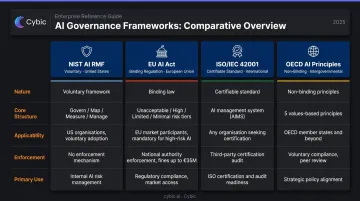
NIST AI RMF
The most widely adopted US framework. Its four functions - Govern, Map, Measure, Manage - provide a practical, risk-based approach adaptable across industries. The Govern function is cross-cutting: it integrates into the other three rather than sitting separately, giving organizations a consistent oversight layer across every stage of the AI lifecycle.
EU AI Act
The first binding AI regulation globally, with a risk-tiered classification system. High-risk applications in healthcare, finance, and critical infrastructure face strict conformity requirements. Non-compliance penalties reach €35 million or 7% of global annual turnover (whichever is higher). Any enterprise operating in or serving EU markets needs to understand where their AI systems fall in the risk hierarchy.
ISO 42001 and Regional Frameworks
ISO/IEC 42001 is the first international standard specifically designed for AI management systems, providing certifiable requirements for establishing and improving AI governance practices. It's most valuable to enterprises that must demonstrate governance maturity to customers, partners, or regulators.
At the regional level, the patchwork is growing fast:
- Colorado SB24-205: High-risk AI protections for consumers, effective February 2026
- Canada's Directive on Automated Decision-Making: Applies to federal automated decision systems
- Singapore's Model AI Governance Framework: Covers internal governance, human oversight, and stakeholder communication; Singapore revised it for generative AI in 2024
- China's CAC regulations: Generative AI services rules in force since August 2023
For global enterprises, that means governance architecture built with jurisdiction-switching in mind - where a single policy layer can be applied selectively depending on which regulations apply to a given system or market.
How to Build Your AI Governance Framework: A Practical Roadmap
Step 1: Classify AI Systems by Risk Tier
Not every AI system needs the same level of oversight. A chatbot summarizing public documents carries different risk than a model approving credit applications or prioritizing medical cases. Applying uniform governance controls across all systems creates bottlenecks without proportionate risk reduction.
Use the EU AI Act's risk categories for regulatory classification and the NIST AI RMF's Map and Measure functions to structure your internal risk workflow. Your classification criteria should cover:
- Who is affected by the system's outputs
- What decisions the system influences (and whether those decisions are reversible)
- What happens if the system fails or produces biased results
- What regulatory obligations apply to the use case
Step 2: Establish Cross-Functional Governance Roles
Governance that sits with one team doesn't scale. Define accountability using a RACI model across:
- Data science and ML engineering own model documentation, evaluation, and performance monitoring
- Legal and compliance handle regulatory obligations, contractual requirements, and incident escalation
- Privacy and security manage data handling controls, PII management, and access governance
- Business stakeholders hold use case approval, risk acceptance, and outcome ownership
Common structural elements include an AI governance committee for cross-functional decisions, named model owners for each production system, and defined human-in-the-loop requirements for high-risk decisions before action is taken.
Step 3: Embed Governance at the Architectural Level
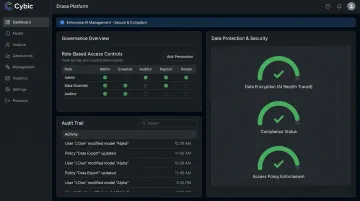
Retrofitting governance onto deployed systems is expensive and unreliable. The most scalable approach is governance by design: building RBAC, audit trails, data lineage, access controls, and compliance checkpoints into system architecture before the first line of production code is written.
Cybic's Drava platform is built on this principle. RBAC, encrypted data protection, auditability of AI-driven actions, and a strict no-training-on-proprietary-data policy are embedded at the architectural level rather than applied after deployment. In regulated industries, that distinction matters - retroactive compliance fixes can halt operations entirely.
Gartner research supports the operational impact: organizations conducting regular AI system assessments are more than three times as likely to achieve high generative AI value compared to those that don't (Gartner, 2024).
Step 4: Define Concrete Policies and Standards
With roles established and architecture in place, the next gap is usually documentation. Vague standards force teams to invent local interpretations. Effective policies specify:
- Required documentation and artifacts for each risk tier
- Approval thresholds and who holds sign-off authority
- Monitoring cadence and breach escalation procedures
- Audit expectations and reporting timelines
Step 5: Scale with a Centralized-Federated Model
Policies only hold if teams can actually follow them at scale. As AI adoption spreads across business units, a central governance team defines the standards and risk frameworks while domain teams apply them locally and own their outcomes. This model prevents governance from becoming a bottleneck while maintaining consistency. Training programs are essential here - practitioners need to understand their governance responsibilities as part of daily execution, not as a separate compliance exercise.
Operationalizing AI Governance: Monitoring, Audits, and Incident Response
Continuous Monitoring in Production
Governance cannot end at deployment. The NIST AI Risk Management Framework (AI RMF 1.0) identifies several production-stage challenges organizations must plan for: detecting performance degradation, handling data drift, managing fragmented logging across distributed infrastructure, and responding when systems receive inputs or produce outputs outside their intended scope.
Define monitoring governance to include:
- Metrics, thresholds, and review cadence before deployment
- Escalation paths for breach conditions (retraining, usage restriction, rollback)
- Ownership of monitoring responsibility post-launch - not just the team that built the system
Audit Readiness and Documentation
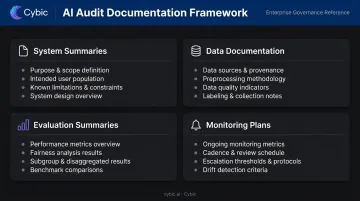
Standardized documentation reduces audit effort and creates a decision record for regulatory reporting. At minimum, maintain:
- System summaries: Purpose, scope, intended users, and known limitations
- Data documentation: Sources, preprocessing steps, and data quality constraints
- Evaluation summaries: Performance metrics, fairness assessments, and subgroup results
- Monitoring plans: Defined metrics, cadence, and escalation procedures
Incident Response Playbooks
Every AI system should have a documented incident response playbook covering:
- How to classify incidents (biased outputs, data exposure, unsafe behavior, regulatory concerns)
- Who owns response, communication, and containment
- How post-incident findings feed back into updated risk assessments and governance controls
The Coalition for Secure AI (CoSAI), an OASIS Open project, offers industry guidance on structuring enterprise AI incident response - covering classification criteria, response roles, containment procedures, and post-incident review processes.
Overcoming Common Barriers to AI Governance Adoption
Three barriers appear consistently across enterprises:
1. Fragmented ownership. When no single team owns AI outcomes, no one owns controls. Shadow AI deployments multiply. According to Microsoft and LinkedIn's 2024 Work Trend Index, 78% of AI users bring their own AI tools to work - and most of those tools operate entirely outside governance oversight.
2. Governance perceived as friction. When incentives reward shipping quickly, review cycles look like delays rather than risk reduction. Cisco's 2024 Data Privacy Benchmark Study found 48% of respondents admitted entering non-public company information into generative AI tools - a direct result of teams working around governance they see as an obstacle.
3. Legacy technical debt. Older pipelines often lack the metadata, monitoring hooks, and documentation that governance frameworks expect. Retrofitting competes with new development priorities and rarely wins.
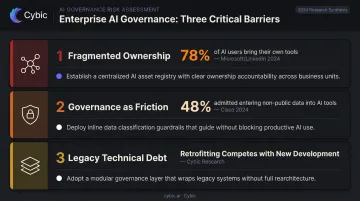
Each barrier is solvable. The key is making governance visible as a value driver rather than a bottleneck.
How to shift the dynamic:
- Pilot governance controls on a small set of high-impact systems; proving that governance reduces rework and prevents production incidents is more persuasive than policy mandates
- Integrate governance requirements into existing workflows rather than creating parallel processes
- Use Gartner's finding as an internal business case: organizations that conduct regular AI assessments are more than three times as likely to achieve high generative AI value
- Invest in training so practitioners treat governance as part of their role, not an extra burden on their workload
Frequently Asked Questions
What are the 7 Sutras of AI governance?
The "7 Sutras" come from India's AI Governance Guidelines, released in early 2026 by the Ministry of Electronics and Information Technology. The seven principles are: Trust is the Foundation, People First, Innovation over Restraint, Fairness and Equity, Accountability, Understandable by Design, and Safety, Resilience and Sustainability. These map closely to both the NIST AI RMF and OECD AI Principles.
What is the difference between AI governance and AI compliance?
AI compliance is about meeting specific external requirements - EU AI Act, GDPR, HIPAA, and similar regulations. AI governance is the broader internal framework of policies, roles, and controls that makes compliance possible. Governance is proactive and structural; compliance is the measurable output. You can't sustain compliance without governance underneath it.
What are the most commonly used AI governance frameworks?
The NIST AI Risk Management Framework, EU AI Act, ISO/IEC 42001, and OECD AI Principles are the most widely referenced. Most enterprises don't choose just one - they use NIST AI RMF as an operational backbone and layer EU AI Act compliance or ISO 42001 certification where their geography or industry requires it.
Who is responsible for AI governance within an enterprise?
Governance is cross-functional. Executive leadership (CEO, CISO, CRO) sets strategy; data scientists, compliance, and security teams implement controls; and every person deploying AI carries accountability for responsible use. Concentrating ownership in one team reliably creates blind spots everywhere else.
How does AI governance differ across industries like healthcare and manufacturing?
Industry context shapes which risks get prioritized. Healthcare governance centers on patient safety, HIPAA compliance, and explainability of diagnostic outputs. Manufacturing governance focuses on operational safety, equipment monitoring integrity, and supply chain data accuracy. Risk tiers and regulatory obligations differ substantially by sector even when the underlying principles are shared.
What is the first step in building an AI governance framework?
Start by inventorying your existing AI use cases and classifying each by risk level - who is affected, what decisions are influenced, and what failure looks like. Assign accountable owners to each system, then pilot governance controls on your highest-impact deployments before scaling organization-wide.