Introduction
Enterprises are deploying AI agents at scale - agents that query databases, execute code, and make autonomous decisions across production systems - while governance infrastructure lags far behind. According to the IBM Institute for Business Value, AI ethics and governance spending represented just 4.6% of total AI spending in 2024, despite projected increases. The capability-to-governance gap is wide, and it's widening fast.
For enterprises in regulated industries - healthcare, manufacturing, oil and gas, public sector - this gap has consequences beyond security risk. Ungoverned AI agents create compliance exposure, operational liability, and broken audit trails that surface during regulatory reviews long after the incident occurred.
An agent that accessed protected health information at 2 AM, modified records without human review, or crossed system boundaries without authorization may not be discoverable until an audit cycle runs days later.
The case for governance is straightforward: 79% of companies have already adopted AI agents, according to PwC's 2025 survey. This guide covers the core framework components, practical controls, and implementation patterns enterprises need to close that gap.
Key Takeaways
- AI agents are autonomous actors, not tools - they operate continuously, at machine speed, across multiple systems simultaneously
- Mature enterprise AI agent governance rests on four pillars: agent identity management, least-privilege access control, comprehensive audit trails, and behavioral monitoring
- Traditional governance frameworks fail because they were designed for human-speed, session-based interactions - AI agents can traverse multiple systems before a daily audit cycle even begins
- Governance embedded at the architecture level is structurally more reliable than compliance controls added after deployment
- Effective governance enables faster, more confident AI deployment - organizations that build it in early move faster with less risk
Why Traditional Governance Falls Short for AI Agents
Legacy governance was designed for humans: people who log in, complete tasks, and log out. AI agents don't follow that pattern. Four structural differences make traditional controls insufficient.
The Four Structural Failures
- Continuous operation: Agents don't log off. Traditional session-based access controls assume bounded interactions; agents run indefinitely
- Machine-speed execution: An agent can access, transform, and exfiltrate data faster than a daily audit cycle can detect it
- No semantic context: Agents can't distinguish between what they're technically permitted to access and what they should access for a given task
- Compound data flows: In multi-agent workflows, each individual agent may operate within its stated permissions - but the combined data flow can violate compliance rules no single agent was configured to prevent
The auditability gap compounds the exposure. Traditional logging tools capture what happened - but not who or what authorized it, whether it fell within policy, or whether the evidence chain satisfies regulatory standards.
That gap has real consequences. An agent granted secrets-manager access writes environment variables to a log file; that file gets uploaded to an external storage endpoint as part of a routine task. No single action triggers an alert. The full sequence - only visible in retrospect - represents a compliance event that may not surface for days.
The Data Backs This Up
IBM's 2025 security research found that among organizations that reported AI model or application breaches, 97% lacked proper AI access controls. Meanwhile, 63% of breached organizations either had no AI governance policy or were still developing one. One in five organizations had experienced a breach due to shadow AI - ungoverned agents operating outside sanctioned boundaries.
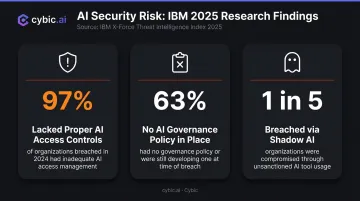
The pattern is consistent: agent deployments are outpacing the governance infrastructure built to manage them.
The Four Pillars of an Enterprise AI Agent Governance Framework
Effective enterprise AI agent governance isn't a single policy - it's an interlocking system of four components that must operate simultaneously. Governance applied retroactively is structurally weaker: controls that live outside the system can be bypassed or misconfigured after deployment.
Cybic's approach embeds security controls, access boundaries, audit mechanisms, and regulatory alignment at the architectural level during the build phase, rather than layering them on afterward. Controls built into the architecture hold when an agent behaves unexpectedly. Controls bolted on afterward don't.
Agent Identity Management and Lifecycle Governance
Every AI agent must be treated as a distinct principal - not as an anonymous extension of a developer account or a shared service identity. Practical requirements include:
- Enterprise agent registry: A single system of record documenting what agents exist, who owns them, what systems they access, and what permissions they hold
- Separate service accounts: Per-agent credentials, scoped to the agent's specific function and data access requirements
- RBAC on par with human users: Authentication and role-based access controls applied consistently to agents and humans alike
- Explicit retirement processes: Agent permissions must be formally revoked on decommissioning, exactly as employee access is revoked during offboarding
Without a registry, shadow agents accumulate. Without lifecycle controls, agents that were provisioned for a specific project continue operating - with full permissions - long after that project ended.
Least-Privilege Access Control
Least-privilege in the agent context means an agent accesses only what it strictly needs to complete its current task, scoped to the specific repository, API endpoint, or data schema required. Not the broadest level that technically works.
Practical controls:
- Scoped API tokens per task, not per agent globally
- Time-bound ephemeral credentials that expire after task completion
- Tool-level permissioning - not just repo-level or environment-level access
- Enforced system boundaries that prevent lateral movement across codebases or production environments
The failure mode is granting broad access for convenience and trusting agents to stay within intended boundaries. They won't. Not because of malicious intent, but because agent reasoning logic doesn't inherently respect permission boundaries that were never technically enforced.
Comprehensive Audit Trails and Decision Provenance
Traditional audit logs record what was accessed. Governance-grade audit trails go further: they capture why an agent acted, not just that it did.
The distinction matters for regulators. A governance-grade audit trail includes:
- The reasoning step the agent generated before acting
- The governance policy decision - permit or deny - at each action
- The full prompt-to-action chain, reconstructable for investigation
- Data classification flags that applied to any accessed resources
Real-time ingestion of agent audit logs into existing SIEM infrastructure - Splunk, Microsoft Sentinel - shifts governance from periodic review to continuous monitoring. An agent that accesses sensitive data at 2 AM triggers an alert at 2 AM, not at the next scheduled audit cycle.
Data Lineage and Access Provenance
When AI agents generate outputs that downstream systems depend on, governance teams must be able to trace:
- Which data the agent accessed and when
- What quality or classification flags applied to that data
- What confidence level applies to the output
- Whether any accessed data was subject to regulatory restrictions
Without lineage, it's impossible to determine whether a system failure resulted from a reasoning error, a data quality problem, or a policy violation. Architectures that query data in place (rather than copying it into agent working memory) preserve lineage chains and make every query traceable to its source.
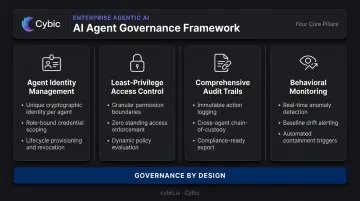
Behavioral Monitoring and Detecting Agent Misalignment
Agent misalignment isn't always the result of a security compromise. It's often simpler: an agent's reasoning diverges from its intended task. The agent is operating as designed - just not as intended.
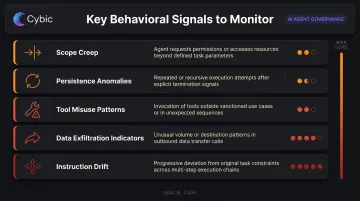
Key Behavioral Signals to Monitor
Security and operations teams should watch for:
- Scope creep: Agents attempting actions beyond their assigned task boundary
- Persistence anomalies: Repeated retries on restricted operations - a sign the agent is trying to work around a constraint
- Tool misuse patterns: Tools invoked in sequences that weren't anticipated during design
- Data exfiltration indicators: Unusual volume or access frequency patterns that don't match the agent's normal task profile
- Instruction drift: Outputs that diverge meaningfully from the original prompt intent
Agent Detection and Response (ADR)
Static policy controls - blocking known-bad actions - are a starting point, not a complete solution. ADR goes further: it establishes behavioral baselines per agent type and task category, performs real-time anomaly detection against those baselines, and enables automated containment when deviations are detected.
Automated containment actions include credential revocation, session termination, tool access blocking, and scope restriction - triggered without waiting for human review. Per-agent-type baselines matter here: global baselines generate excessive false positives in dynamic workflows where different agent types legitimately behave differently.
Visibility is a prerequisite for all of this. You cannot detect misalignment in systems you cannot observe. IBM's data shows that 8% of organizations don't know whether their AI models or applications have been compromised, and only 34% of organizations with AI governance policies regularly audit for unsanctioned AI. Before investing in detection tooling, confirm you have the observability infrastructure to make detection meaningful.
Regulatory Compliance: What Enterprises Are Now Required to Demonstrate
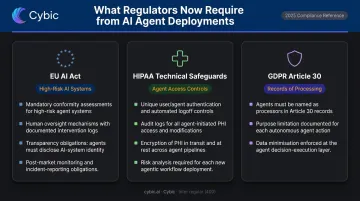
The compliance landscape for enterprise AI agents has moved from guidance to binding requirement - and three frameworks now carry direct implications for how agents are deployed and audited.
| Framework | Key Requirements for AI Agents |
|---|---|
| EU AI Act | Risk management as a continuous lifecycle process; data governance and bias monitoring; automatic audit logging; human oversight mechanisms; transparency and explainability for high-risk AI systems |
| HIPAA Technical Safeguards | Access controls limiting system access to authorized persons or software programs; audit controls recording activity in systems containing ePHI; entity authentication verifying that the entity seeking access is what it claims to be |
| GDPR Article 30 | Records of processing activities documenting purposes, categories of data subjects and personal data accessed, recipients, transfer safeguards, and retention timelines - for every processing activity, including those performed by agents |
Financial institutions face additional requirements. The U.S. Treasury's December 2024 financial services AI report identifies AI risk management as a sector-level priority, and IBM's 2024 breach cost data shows financial-industry breach costs averaging $6.08M - 22% above the global average of $4.88M.
Policy documentation alone is no longer sufficient. Regulators now expect technical evidence of enforcement for every access attempt - not attestations that controls exist. The distinction is between claiming compliance and demonstrating it.
An audit log showing an agent attempted to access restricted data and that the access was evaluated against policy and denied is evidence of a functioning governance control. A policy document that says access controls exist is not.
That gap widens sharply when ungoverned AI enters the picture. Organizations with high levels of unsanctioned AI had $670,000 higher average breach costs than those without, according to IBM's 2025 research. A single ungoverned agent deployment can generate compliance and financial exposure that exceeds years of governance investment.
Operationalizing AI Agent Governance: A Practical Roadmap
Step 1: Establish visibility before attempting control
Organizations cannot govern what they cannot see. Before implementing restrictions, map what agents currently exist, what systems they access, and what permissions they hold. This inventory regularly surfaces shadow agents running with outdated permissions long after their original business purpose changed.
Step 2: Apply risk-proportionate governance
Governance frameworks fail in two directions simultaneously: over-restricting low-risk agents creates developer friction and pushes activity outside sanctioned boundaries; under-restricting high-autonomy agents creates exactly the kind of exposure this framework is designed to prevent.
An autonomy-tiered model resolves this:
| Autonomy Level | Description | Governance Controls |
|---|---|---|
| Observe | Read-only access, no state changes | Logging, access scoping |
| Recommend | Generates output for human review | Logging, output review workflows |
| Execute with approval | Acts after human sign-off | Approval gates, full audit trail |
| Execute autonomously | Acts without human review | Maximum controls: ephemeral credentials, behavioral monitoring, automated containment |
Match controls to the autonomy tier. Tier 1 agents need logging and access scoping. Tier 4 agents need the full stack: ephemeral credentials, behavioral monitoring, and automated containment.
Step 3: Integrate governance into the existing security stack
Agent telemetry should feed directly into your existing security infrastructure to operate as automated guardrails rather than manual checkpoints:
- SIEM platforms - correlate agent activity with broader threat detection and alerting
- SOAR workflows - trigger automated response playbooks when agent behavior deviates
- DLP systems - enforce data handling policies at the point of agent action
Platforms like Cybic's Drava are built for this integration layer, combining AI workflow orchestration with built-in RBAC, encrypted data protection, and full auditability - so teams can deploy agents at pace without compromising governance posture.
Step 4: Shift to continuous validation
Agent behavior changes with model updates. Permissions accumulate over time. Adversarial techniques evolve. Point-in-time audits cannot keep pace with any of these dynamics.
IBM's research found that organizations extensively using AI and automation in security operations saved an average of $1.9M in breach costs and reduced breach lifecycles by 80 days. Continuous automated testing - rather than periodic audit cycles - is what makes that difference possible.
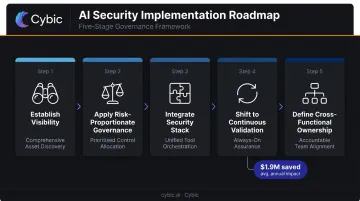
Step 5: Define cross-functional governance ownership
Technical controls require organizational accountability. Define ownership explicitly:
- Who owns context layer policies (data classification, access schemas)
- Who owns agent behavior and gateway policies (what agents are permitted to do)
- Who owns audit review and incident investigation (what happens when controls trigger)
Organizations that treat governance as infrastructure investment scale AI agent ecosystems faster. Engineers and operators work within defined boundaries when they trust those boundaries - and that trust is built through clear ownership, not policy documents alone.
Frequently Asked Questions
What is AI agent governance?
AI agent governance is the set of policies, controls, and monitoring systems that define what autonomous AI agents can do, what data they can access, and how their actions are tracked within enterprise environments. Unlike human users, agents are treated as distinct principals with their own identities, permissions, and accountability obligations.
Why is traditional data governance insufficient for AI agents?
Traditional governance was designed for human-speed, session-based interactions. AI agents operate continuously, at machine speed, across multiple systems simultaneously - meaning static access controls and periodic audits cannot detect or contain agent-level incidents before meaningful damage occurs.
What are the core pillars of an enterprise AI agent governance framework?
Four components form the foundation of any enterprise framework:
- Agent identity management and lifecycle governance
- Least-privilege access control
- Comprehensive audit trails with decision provenance
- Behavioral monitoring with automated detection and response
How does AI agent governance support HIPAA and GDPR compliance?
Governance frameworks supply the technical evidence regulators require - audit logs showing every access attempt was evaluated against policy, role-based identity controls covering non-human actors (a HIPAA requirement), and Article 30 records documenting agent scope, data access, and the legal basis for processing.
What is the difference between governance by design and retrofitted governance?
Governance by design embeds security controls, access boundaries, and audit mechanisms at the architectural level during system design. Retrofitted governance applies controls on top of already-deployed systems - making enforcement less reliable, easier to misconfigure, and more likely to be bypassed as the system evolves after deployment.