Introduction
Enterprise adoption of AI agents has moved from curiosity to operational priority. Gartner predicts that 40% of enterprise applications will include task-specific AI agents by the end of 2026 - up from less than 5% in 2025. That's not gradual adoption; it's a fundamental shift in how enterprises think about automation.
For most organizations, the harder question isn't whether to invest - it's choosing the right development partner.
The gap shows up in production. Generic tools lack compliance readiness, polished prototypes collapse against legacy infrastructure, and vendors who shine in demos often can't execute when the work shifts to regulated environments at scale.
This article evaluates the top AI agent development companies in 2026 across four practical criteria - engineering execution capability, governance architecture, industry-specific expertise, and proven production deployment - not brand size or marketing presence.
Key Takeaways
- AI agents differ from traditional automation - they observe context, reason across systems, and execute multi-step tasks adaptively, rather than following fixed rules
- The partner matters more than the platform - governance depth, integration capability, and domain expertise determine whether agents actually deliver operational value
- Selection criteria: production deployment track record, governance architecture, domain expertise, integration capability, and post-launch support
- Companies featured span enterprise consultancies and specialized engineering firms - each suited to different organizational needs
- For regulated verticals (Oil & Gas, Manufacturing, Healthcare, Retail, Public Sector), embedding AI into real workflows is non-negotiable
What Is an AI Agent Development Company - and Why Does the Partner Matter?
What AI Agents Actually Are
An AI agent is a software system that observes its environment, reasons about a goal, and executes multi-step tasks across enterprise systems with minimal human intervention at each step. Unlike traditional rule-based automation that follows predetermined decision trees, agents interpret context, plan sequences of actions, and adapt when conditions change.
A rules-based system routes an invoice based on predefined logic. An AI agent reads the invoice, cross-references vendor history, flags anomalies, initiates an approval workflow, and escalates exceptions without a human specifying each step in advance.
What AI Agent Development Companies Actually Do
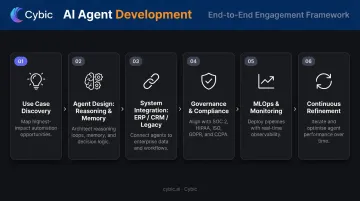
Building production AI agents requires full-lifecycle capability across strategy, engineering, integration, and operations. Competent development partners cover:
- Identifying which workflows justify agent deployment (use case discovery and strategy)
- Designing reasoning, memory, and tool-use capabilities for specific operational contexts
- Connecting agents to ERP, CRM, legacy platforms, and data pipelines
- Embedding access controls, auditability, data isolation, and compliance alignment
- Managing agent performance after deployment through MLOps and monitoring
- Refining agent behavior as workflows and data evolve
The Risk of Choosing Wrong
McKinsey reports that while 62% of organizations are experimenting with agentic AI, only 23% have scaled a system anywhere in the enterprise. The gap between experimentation and production is where most partners fall short.
Common failure modes include:
- Vendors who deliver polished PoCs but cannot handle real integration complexity
- Governance gaps that surface after deployment - Gartner warns that 40% of enterprises may demote or decommission autonomous AI agents by 2027 due to governance failures found post-launch
- Vendor lock-in that constrains infrastructure flexibility as requirements evolve
- Compliance failures in regulated industries where auditability isn't optional
Each criterion in this list maps directly to one of these failure modes. Use them as your filter.
Top AI Agent Development Companies in 2026
These companies were evaluated on engineering execution capability, governance and security design, production deployment track record, industry expertise, and infrastructure flexibility.
Cybic
Cybic is a US-based AI engineering company (headquartered in Frisco, TX) that designs and deploys enterprise AI solutions for complex industries including Oil & Gas, Manufacturing, Healthcare, Retail, and Public Sector. Its technology ecosystem includes partnerships with NVIDIA, AWS, Google Cloud, Microsoft Azure, Snowflake, and Databricks.
The differentiation: Governance is embedded at the architectural level - not bolted on after deployment. Every engagement ships with:
- Role-based access controls (RBAC) for secure system access
- Encrypted data protection in transit and at rest
- Full auditability of AI-driven actions
- A strict policy against training models on proprietary enterprise data
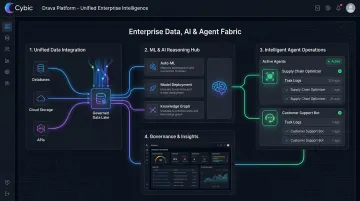
The company's Drava platform unifies enterprise data, machine learning, AI reasoning, and intelligent agents into a single governed automation system - eliminating the disconnected toolchains and incompatible data silos that stall most enterprise AI programs. Deployments run across cloud, hybrid, and on-premises environments without locking clients into a single infrastructure stack.
Cybic's delivery model is engineering-led: the same engineers who design the architecture build and integrate it, eliminating the translation gap between strategy and execution that consulting-led models routinely produce.
| Key Services | Custom AI agents, enterprise LLM applications, AI workflow orchestration, intelligent automation, generative AI copilots, data intelligence and integration |
| Industry Focus | Oil & Gas, Manufacturing, Healthcare, Retail, Public Sector |
| Best For | Enterprise organizations in regulated or operationally complex industries requiring governed, infrastructure-agnostic AI systems built by engineers |
Accenture
Accenture operates a dedicated Agentic AI practice at global scale, serving Fortune 500 enterprises and government organizations across 120+ countries. Its AI Refinery platform - including the Distiller framework for multi-agent orchestration - is designed to industrialize agent deployment across complex enterprise environments.
Why it stands out: Scale and geographic reach are Accenture's primary advantages. When an enterprise needs coordinated multi-agent rollouts spanning multiple business units and geographies, few partners can match its operational footprint.
The company launched AI Refinery for Industry in early 2025 with 12 industry-specific agent solutions, with expansion to 100+ planned by year-end. Internally, Accenture deployed 14 AI-powered agents within its own marketing function, reporting 25–55% faster speed-to-market.
| Key Services | Multi-agent system design, AI strategy and governance, enterprise AI integration, generative AI development, large-scale transformation |
| Industry Focus | Financial services, healthcare, manufacturing, retail, energy, government |
| Best For | Large enterprises seeking a single partner capable of leading broad, multi-country agentic AI rollouts with enterprise-grade governance |
IBM Consulting
IBM Consulting combines decades of enterprise IT experience with the watsonx platform suite, delivering modular agentic AI architecture through IBM Consulting Advantage. The firm has particular depth in environments where reliability and auditability are non-negotiable.
Where it's genuinely distinctive: IBM's mainframe integration capability sets it apart from every other firm on this list. In 2025, IBM introduced agentic AI for IBM Z - including watsonx integration with Db2 and CICS - enabling agents to operate within core banking and telecom infrastructure other vendors cannot reach.
Egypt's National Organization for Social Insurance achieved a 94% reduction in time to analyze COBOL code using IBM's agentic mainframe tooling. Human-in-the-loop controls and hybrid cloud deployment make IBM Consulting a practical choice where data residency compliance drives architecture decisions.
| Key Services | Agentic AI architecture, multi-agent orchestration, hybrid cloud AI deployment, governance and monitoring, enterprise legacy integration |
| Industry Focus | Financial services, telecommunications, healthcare, manufacturing, public sector |
| Best For | Enterprises operating complex legacy environments where governance, auditability, and cross-cloud/on-prem AI agent operation are essential |
Cognizant
Cognizant is the first IT services provider to achieve ISO/IEC 42001:2023 accredited certification for AI management systems - a meaningful governance credential in an industry where certifications are often marketing noise. Its Neuro AI Multi-Agent Accelerator enables organizations to design, deploy, and govern multi-agent systems on existing enterprise platforms.
The governance angle: The ISO/IEC 42001 certification reflects a governance-first organizational posture, not just a product feature. Cognizant's Responsible AI framework includes safe and reliable operation, transparency, explainability, human oversight, security, fairness, and accountability - applied systematically across its multi-agent deployments.
The accelerator-based approach means enterprises can add multi-agent capability to existing platforms without undertaking major system overhauls.
| Key Services | Multi-agent design and orchestration, AI strategy, data modernization, intelligent automation, AI operations and monitoring |
| Industry Focus | Banking and financial services, healthcare, insurance, retail, manufacturing |
| Best For | Fortune 500 companies in regulated industries requiring certified, governance-driven multi-agent deployments on existing enterprise data platforms |
DevCom
DevCom is a Florida-based custom software and AI development company founded in 2000, with 25+ years of experience building complex enterprise systems. The firm carries a 4.9/5 rating across 24 verified reviews on Clutch, reflecting consistent delivery across mid-market and enterprise clients.
What makes it a fit: DevCom's value is tailored engineering for organizations that need custom agents built from scratch and integrated into existing - often messy - enterprise environments. The firm covers AI readiness assessment, custom agent development, LLM fine-tuning, multi-agent orchestration, and post-launch optimization. Independent reviews consistently describe its delivery as reliable and technically thorough.
| Key Services | Custom AI agent development, multi-agent orchestration, LLM fine-tuning, AI copilots, enterprise system integration, ongoing optimization |
| Industry Focus | Finance, healthcare, logistics, retail, SaaS |
| Best For | Mid-market to enterprise organizations needing fully custom AI agents designed, built, and integrated into complex or legacy business environments with strong post-launch support |
How We Chose the Best AI Agent Development Companies
The Common Mistake in Partner Selection
Most organizations evaluate AI development partners based on brand recognition, demo quality, or proposal polish. The predictable result: vendors who deliver compelling prototypes but stall when integration complexity, regulatory constraints, or post-launch performance management become the actual work.
Deloitte reports that only 21% of enterprises have a mature governance model for agentic AI - meaning the majority are deploying agents without the infrastructure to manage what happens when they behave unexpectedly. Choosing a partner without strong governance architecture compounds this problem significantly.
Evaluation Criteria Used
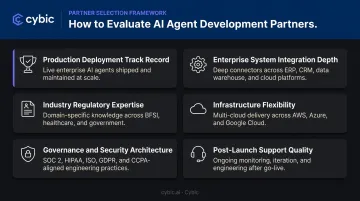
Each company on this list was assessed against the following factors:
- Production deployment track record - real case studies with measurable outcomes, not just PoC references
- Industry-specific regulatory expertise - demonstrated understanding of compliance requirements in target verticals
- Governance and security architecture - access controls, auditability, data protection, and compliance alignment
- Enterprise system integration depth - ERP, CRM, legacy platforms, cloud-native and hybrid environments
- Infrastructure flexibility - ability to deploy without locking clients into a single cloud or vendor ecosystem
- Post-launch support quality - monitoring, optimization, and ongoing performance management
What Good Looks Like
The best AI agent development partners share a few non-negotiable characteristics:
- Connect agents to real workflows quickly, reducing time-to-value without months of scoping
- Build on open or infrastructure-agnostic architectures that avoid vendor lock-in
- Deliver measurable efficiency, compliance, and performance gains - not just working prototypes
- Treat post-launch performance management as part of the engagement, not an afterthought
Selecting a partner is a business operations decision. The technology is secondary to whether that partner can execute inside your environment, under your constraints, at production scale.
Conclusion
The partner you choose will shape how AI actually functions inside your organization - not just during the pilot, but when it hits production constraints, compliance reviews, and operational edge cases. Fit with your existing infrastructure and governance requirements matters more than portfolio size or brand recognition.
Before committing to a long-term engagement, run a controlled pilot. Validate the partner's integration depth, governance approach, and ability to move from PoC to production within a defined timeframe and scope. In regulated industries especially, governance gaps tend to surface after launch - not during the sales process.
Cybic designs and deploys governed AI agent systems for Oil & Gas, Manufacturing, Healthcare, Retail, and the Public Sector. If your organization is ready to move from experimentation to production-grade intelligent automation, connect with Cybic to explore what that looks like for your workflows and infrastructure.
Frequently Asked Questions
What is an AI agent development company?
These firms design, build, and deploy AI agents integrated into enterprise workflows - covering the full lifecycle from strategy and use case discovery through custom development, system integration, governance frameworks, and ongoing optimization. They differ from generic software agencies in their focus on autonomous, multi-step systems that operate across enterprise environments.
How much does it cost to build a custom AI agent for enterprise use?
Costs vary based on the number of agents, autonomy level, integration depth, data readiness, compliance requirements, and whether the scope covers a PoC or full production deployment. Legacy system integration and governance requirements are typically the primary cost drivers.
How long does it take to deploy an enterprise AI agent?
Enterprise RFP-to-implementation cycles range from 2 to 18 months depending on scope. A basic PoC typically takes weeks; a fully integrated, production-grade agent system operating across enterprise infrastructure generally takes several months. Legacy system complexity, data readiness, and governance requirements are the main timeline variables.
How do AI agents integrate with existing enterprise systems?
Integration happens through secure APIs, connectors to ERP and CRM platforms, data pipelines, and access control frameworks. The quality of this integration - including how cleanly agents connect to legacy systems and how well data flows between them - is one of the clearest differentiators between AI agent development partners.
What industries benefit most from custom AI agent development?
Regulated and operationally complex verticals see the highest ROI: Manufacturing, Healthcare, Financial Services, Oil & Gas, Retail, and the Public Sector. McKinsey reports that 82% of healthcare leaders expect positive ROI from generative AI, and Deloitte projects agentic AI in US life insurance distribution could add $2B in annual incremental premiums by 2030.
How do I evaluate whether an AI agent development company is the right fit?
Look for verified production case studies in your industry, transparent governance practices, integration experience with your specific systems, and a clearly defined post-launch support model. Technical credentials matter - but working systems deployed in environments similar to yours are the most reliable signal.