Introduction
Healthcare startups face a compliance reality that has hardened into a business-critical requirement: investors want to see HIPAA documentation before signing term sheets, enterprise health systems require it before procurement conversations go anywhere meaningful, and OCR enforcement has been consistent. In 2024 alone, OCR resolved 13 compliance reviews with settlements totaling over $8.7 million - and that's before counting individual complaint resolutions.
The challenge for startups is specific. You need audit-ready compliance fast, on a seed or Series A budget, often without a dedicated compliance officer. Most general GRC platforms were built for teams with six-figure compliance budgets and months to spare.
That gap is exactly what this guide addresses. It evaluates the top HIPAA compliance platforms through a startup lens: affordable pricing, fast implementation, self-service capability, and documentation that holds up under investor scrutiny - for teams at seed stage through Series B.
Key Takeaways
- HIPAA compliance applies the moment your startup handles patient data - size and revenue don't create a threshold.
- The best startup platforms combine Security Risk Assessment (SRA), policy management, employee training, and BAA tracking in one place.
- Healthcare-native tools like Accountable HQ and Compliancy Group offer deeper HIPAA specificity; general GRC platforms like Vanta or Sprinto suit startups pursuing SOC 2 at the same time.
- Developer-led startups building PHI-handling products should consider infrastructure-level solutions.
- No software makes you "HIPAA certified" (HHS confirms no such certification exists), but the right platform builds a defensible, audit-ready compliance posture.
What Healthcare Startups Need in HIPAA Compliance Software
The Five Core Criteria
Startup compliance needs differ from enterprise needs in one practical way: there's no compliance department. A founder, an engineer, or an ops lead is handling this alongside everything else. The software needs to carry most of the work, not just organize it.
The five things that matter most:
- Affordable pricing - ideally under $5,000/year at early stages, with room to scale
- Fast setup - deployable in days or weeks, not a months-long implementation
- Self-service workflows - guided templates and prebuilt policies that don't require a compliance background
- A real Security Risk Assessment - OCR requires an accurate and thorough assessment of risks to all ePHI you create, receive, maintain, or transmit; checklist tools don't satisfy this
- A scale-up path - coverage that grows with your team, data volume, and regulatory complexity
The Investor Due Diligence Reality
Healthcare-focused investors and strategic buyers treat HIPAA documentation as a standard due diligence item. What they typically want to see:
- A completed Security Risk Assessment with documented findings
- Written privacy and security policies
- Employee training records with attestation
- Active BAA management for all vendors handling PHI
- Documented incident response procedures
Spreadsheet-based compliance documentation rarely survives serious scrutiny. A software-generated audit trail - with timestamps, version history, and automated evidence collection - holds up. Spreadsheets don't.
That documentation gap is also where platform choice starts to matter. Not all compliance tools produce the same quality of evidence.
HIPAA-Native vs. General GRC: Which Do You Need?
| HIPAA-Native Platforms | General GRC Platforms | |
|---|---|---|
| Examples | Accountable HQ, Compliancy Group | Vanta, Sprinto |
| HIPAA depth | Administrative, physical, and technical safeguards with healthcare-specific workflows | HIPAA mapped onto SOC 2 framework |
| Best for | Digital health, telehealth, clinical tools | Tech startups pursuing HIPAA + SOC 2 simultaneously |
| Tradeoff | Less useful if you also need SOC 2 automation | Less prescriptive for healthcare-specific compliance |
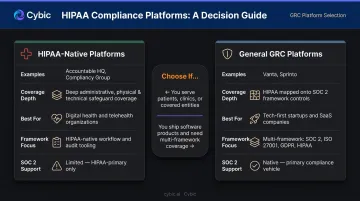
The right choice comes down to your product's core identity. Healthcare-first startups get better coverage faster from a dedicated HIPAA platform. Tech-first companies handling health data - especially those with investors pushing for SOC 2 - are better served by a multi-framework GRC tool that handles both at once.
Best HIPAA Compliance Software for Healthcare Startups 2026
These five tools were selected based on startup-specific criteria: pricing accessibility, implementation speed, self-service capability, healthcare focus, and real-world suitability for early-stage companies.
Accountable HQ
Accountable HQ is a healthcare-native compliance platform built specifically for organizations that need comprehensive HIPAA coverage without a full-time compliance team. It's used by over 10,000 healthcare organizations, including early-stage digital health startups.
What makes it stand out for resource-constrained teams: it combines Security Risk Assessment, policy management, employee training, vendor management, BAA tracking, and breach monitoring in one platform, all within a self-service interface. The AI-powered Compliance Copilot can draft policies, kick off risk assessments, manage vendors, and create remediation plans without requiring compliance expertise.
| Attribute | Details |
|---|---|
| Starting Price | $199/month ($169/month billed annually, from $2,028/year) |
| Best For | Early-stage digital health startups, telehealth platforms, and health tech SaaS companies wanting a single platform covering all HIPAA pillars |
| Standout Feature | AI-powered Compliance Copilot that guides teams through compliance tasks and automates SRA workflows |
Vanta
Vanta is a security compliance automation platform that maps HIPAA requirements within a broader multi-framework structure: SOC 2, ISO 27001, HIPAA, and others. It's popular among venture-backed health tech startups that need to satisfy both investor and customer compliance requirements simultaneously.
Its strength is integration breadth. With 300+ pre-built integrations across AWS, GCP, Azure, HR tools, and identity providers, Vanta automates evidence collection and provides continuous control monitoring, a significant time-saver for engineering-led teams. The tradeoff: it's not healthcare-native, and Vanta's own documentation notes that SOC 2 compliance doesn't automatically satisfy HIPAA's administrative and physical safeguard requirements.
| Attribute | Details |
|---|---|
| Starting Price | Custom pricing (demo required); some user reviews reference contracts in the $15,000–$18,000+ range, better suited to Series A+ than pre-seed |
| Best For | Tech-first healthcare startups (digital health SaaS, health analytics) pursuing SOC 2 Type II and HIPAA compliance simultaneously |
| Standout Feature | Automated evidence collection from 300+ integrations with continuous control monitoring and a live compliance dashboard |
Sprinto
Sprinto is a compliance automation platform designed for cloud-native companies. It supports HIPAA alongside SOC 2, ISO 27001, GDPR, and 200+ other frameworks, making it well-suited for growth-stage startups managing multiple compliance obligations at once.
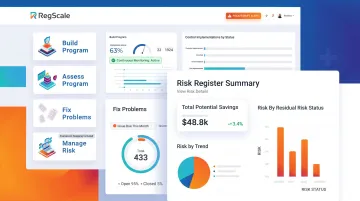
Sprinto's core differentiator is program structure. Rather than handing you a checklist, it provides guided HIPAA control implementation with a built-in risk register, continuous compliance monitoring, and automated alerts when policy drift or control failures occur. For Series A/B teams scaling their engineering and compliance functions in parallel, that real-time visibility is worth the investment.
| Attribute | Details |
|---|---|
| Starting Price | Custom pricing (contact required); scales with organizational complexity and number of frameworks |
| Best For | Series A/B healthcare startups scaling compliance programs alongside engineering growth, especially those managing multiple frameworks |
| Standout Feature | Structured HIPAA program implementation with continuous monitoring and automated evidence collection built for cloud-native infrastructure |
Compliancy Group
Compliancy Group is a HIPAA-specific platform with a coach-driven model, pairing compliance software with access to dedicated compliance coaches who guide teams through the required HIPAA security audits. It's a strong option for non-technical founders who want expert guidance without hiring a full-time compliance officer.
Unlike self-service platforms, Compliancy Group walks you through the process in virtual coaching sessions. The platform includes prebuilt policies, video training with attestation tracking, incident management, and BAA management, all mapped directly to HIPAA rather than repurposed from a SOC 2 framework.
| Attribute | Details |
|---|---|
| Starting Price | $99/month billed annually + $8/employee/month (Foundation tier); coaching access varies by plan |
| Best For | Non-technical healthcare founders or small clinical teams wanting expert guidance through HIPAA compliance without hiring a compliance officer |
| Standout Feature | Dedicated compliance coach support paired with software-guided HIPAA audit workflows covering all required security assessments |
TrueVault
TrueVault has historically positioned itself as a developer-centric HIPAA solution, providing a managed, pre-configured PHI database and API layer that allows engineering teams to embed HIPAA-compliant data handling directly into their product architecture. Its GitHub developer documentation describes built-in encryption, access controls, and audit logging accessible via SDK.
Important note: Current TrueVault marketing materials (as of 2026) focus primarily on broader US privacy compliance rather than specifically emphasizing the managed HIPAA PHI database product. Startups evaluating TrueVault for infrastructure-level HIPAA data storage should verify current product availability and capabilities directly with their team before committing.
| Attribute | Details |
|---|---|
| Starting Price | $9,000/year (one price, no limits on traffic, users, or requests) |
| Best For | Developer-led healthcare startups and digital health app builders needing HIPAA-compliant data handling at the infrastructure level |
| Standout Feature | Pre-configured compliance infrastructure with encryption, audit logging, and access controls accessible via API/SDK (verify current availability) |
How We Selected These Tools
Evaluation Criteria
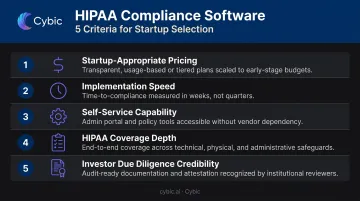
Each tool was assessed against five startup-specific factors:
- Startup-appropriate pricing - accessible contracts that don't require enterprise procurement cycles
- Implementation speed - can a small team reach baseline compliance in days or weeks?
- Self-service capability - low dependency on external consultants or in-house compliance expertise
- HIPAA coverage depth - does it address administrative, physical, and technical safeguards, or just technical controls mapped from SOC 2?
- Investor due diligence credibility - does it generate documentation that holds up under OCR review and investor scrutiny?
Common Mistakes to Avoid
Most startups stumble in predictable ways when choosing HIPAA compliance software:
- Selecting a general GRC tool without checking HIPAA coverage - many tools handle technical controls well but leave administrative and physical safeguards largely unaddressed
- Prioritizing lowest price over completeness - gaps discovered during investor due diligence or customer procurement are far more expensive than the savings
- Waiting for a customer or investor to request compliance documentation - by the time you have a deal on the table, implementation timelines create real friction
The cost of getting this wrong is concrete. Northeast Radiology paid a $350,000 OCR settlement in 2025 after failing to conduct an adequate risk analysis. MedEvolve settled for the same amount in 2023 after an unsecured server exposed PHI for over 230,000 individuals. Neither was a large enterprise.
What Was Excluded
This list intentionally excludes enterprise-only platforms requiring multi-month implementations and $20,000+ annual contracts designed for hospital systems. It also excludes point solutions - secure email tools, compliant form builders, encrypted file storage - that address a single HIPAA requirement rather than the full compliance program a startup actually needs.
Conclusion
The right HIPAA compliance platform depends on three things: your team's technical capability, your current budget stage, and whether you need HIPAA alone or HIPAA alongside SOC 2.
Healthcare-native tools like Accountable HQ and Compliancy Group offer deeper HIPAA specificity and more prescriptive guidance through administrative and physical safeguards. General GRC platforms like Vanta and Sprinto work better when multi-framework compliance is a priority - particularly for tech-first startups where SOC 2 is also on the investor checklist.
For startups building AI-powered clinical workflows or healthcare automation, HIPAA compliance software addresses the regulatory documentation layer. The underlying AI infrastructure is a separate challenge. Cybic's AI engineering practice builds RBAC, data encryption, audit trails, and regulatory alignment directly into healthcare AI system architecture - so compliance is designed in from day one, not patched in after deployment.
HIPAA compliance isn't a one-time checkbox. It requires continuous monitoring, updated policies, and ongoing employee training as your team and data footprint grow. Start with the right platform now - so when the next funding round or enterprise deal arrives, compliance is an asset in the conversation rather than a fire drill.
Frequently Asked Questions
Do healthcare startups need HIPAA compliance from day one?
Yes. HIPAA applies to covered entities and business associates from the moment they handle, process, or transmit protected health information - there is no size or revenue threshold. A digital health app, telehealth platform, or health analytics tool handling patient data must be compliant immediately, not once it reaches a certain scale.
What is the difference between a HIPAA-specific platform and a general GRC tool?
HIPAA-specific platforms are built around healthcare workflows, administrative and physical safeguards, and OCR audit protocols. General GRC tools like Vanta and Drata apply HIPAA as a secondary framework mapped onto SOC 2 - functional, but less prescriptive for healthcare-specific compliance needs.
How much should a healthcare startup budget for HIPAA compliance software?
Startup-friendly platforms range from roughly $2,000/year (Accountable HQ Basic) to $9,000/year (TrueVault), with Compliancy Group priced lower upfront but scaling with employee count. HIPAA civil monetary penalties range from $145 to over $2 million per violation - the cost of a solid compliance program is almost always lower than the cost of a breach or a failed due diligence process.
Can a startup manage HIPAA compliance without a dedicated compliance officer?
Yes. Most modern HIPAA compliance platforms are built for exactly this scenario - guided workflows, prebuilt policy templates, and optional expert coaching mean founders, engineers, or ops leads can manage compliance without dedicated compliance staff. Compliancy Group's coach model is specifically designed for non-technical founders.
What happens if a healthcare startup is found non-compliant?
OCR penalties are tiered by negligence level, running from $145 to $2,190,294 per violation under 2026 CMP schedules. Beyond fines, enterprise health system customers require compliance documentation before procurement - making non-compliance a direct barrier to sales, not just a regulatory concern.
Do investors require HIPAA compliance documentation during due diligence?
Healthcare-focused investors and strategic acquirers routinely request a completed Security Risk Assessment, active BAA management, employee training records, and documented incident response procedures. Software-generated audit trails with timestamps and version history carry more weight than manually maintained spreadsheets.