This guide is for software developers, engineering leads, health tech CTOs, and AI/data platform teams building applications that handle patient or clinical data. It covers what HIPAA compliance means for software, who must comply, what technical controls are required, and how to build it correctly from the start.
Key Takeaways
- HIPAA compliance means engineering systems that protect PHI through access controls, encryption, audit logging, and backup
- Two categories must comply: covered entities (providers, insurers, clearinghouses) and business associates (vendors and third parties handling PHI)
- 45 CFR 164.312 requires role-based access, multi-factor authentication, end-to-end encryption, and tamper-resistant audit trails
- Business Associate Agreements (BAAs) are legally required before any vendor can lawfully access or handle PHI
- Civil penalties range from $145 to $2,190,294 per violation; healthcare breaches cost an average of $9.77M per IBM's 2024 Cost of a Data Breach Report
What Is HIPAA Compliance for Software Development?
HIPAA compliance in the software context means engineering your system to protect PHI in accordance with three rules: the Privacy Rule, the Security Rule, and the Breach Notification Rule. HIPAA compliance in the software context means engineering your system to protect PHI in accordance with three rules: the Privacy Rule, the Security Rule, and the Breach Notification Rule. Understanding what qualifies as PHI is the first place most developers get tripped up.
What Counts as PHI?
The scope is broader than most developers expect. HHS identifies 18 categories of identifiers that make health information individually identifiable:
- Names, geographic subdivisions smaller than a state, dates (other than year) and ages over 89
- Phone numbers, fax numbers, email addresses, IP addresses, URLs
- Social Security numbers, medical record numbers, health plan beneficiary numbers
- Account numbers, certificate/license numbers, vehicle and device identifiers
- Biometric identifiers, full-face photographs, and any unique identifying code
If your software touches any of these alongside health information, it touches PHI.
The Three Rules That Matter Most to Developers
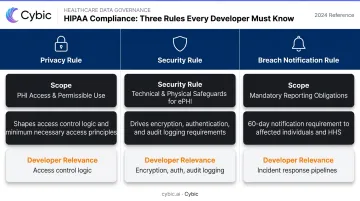
| Rule | What It Covers | Developer Relevance |
|---|---|---|
| Privacy Rule | Who can access PHI and for what purpose | Shapes access control logic and permissible use cases |
| Security Rule | Technical and physical safeguards for electronic PHI | Drives encryption, authentication, audit logging, and contingency planning requirements |
| Breach Notification Rule | Mandatory reporting when PHI is compromised | Business associates must notify covered entities within 60 days of breach discovery |
Who Needs HIPAA-Compliant Software?
Covered Entities
Covered entities are health plans, healthcare clearinghouses, and healthcare providers that conduct specified electronic transactions. Any software these organizations use internally to handle electronic PHI must meet HIPAA standards - including internal tools, analytics dashboards, and administrative systems.
Business Associates
Business associates are vendors, developers, SaaS providers, or any third party that creates, receives, maintains, or transmits PHI on behalf of a covered entity. This captures most healthcare software developers, cloud platforms, and AI/ML service providers in health tech.
HHS is clear: a software vendor is not automatically a business associate by selling software alone. The trigger is PHI access. These activities create business associate obligations:
- Hosting patient data on behalf of a covered entity
- Accessing PHI for troubleshooting, support, or maintenance
- Retaining or processing health data as part of service delivery
Transient vs. Persistent PHI Access
The conduit exception is narrow. HHS limits it to transmission-only services with truly transient PHI access (think postal services). Most modern software components don't qualify:
- Message queues, caches, and data pipelines that retain ePHI - even briefly - likely don't qualify as conduits
- Persistent access (EHR integrations, clinical analytics platforms, AI inference systems) triggers full business associate compliance, including BAAs and organizational HIPAA programs
- Cloud storage providers are business associates even when data is encrypted and they hold no decryption key
Core Technical Requirements for HIPAA-Compliant Software
The HIPAA Security Rule (45 CFR 164.312) identifies administrative, physical, and technical safeguards. Developers are primarily responsible for the technical layer. Here's what each requirement demands in practice:
Access Controls and Role-Based Permissions
HIPAA requires that ePHI access be limited to authorized persons and software programs only. The minimum necessary standard applies: users access only what their role requires, nothing more.
Implementation approach:
- Role-based access controls (RBAC) mapped to specific data categories and functions
- Unique user identification for every individual accessing the system
- Automatic logoff after periods of inactivity
- Emergency access procedures for break-glass scenarios
Cybic embeds RBAC directly into the architecture of healthcare AI platforms - built into the access control layer at the architecture stage, before any application logic is written.
User Authentication
HIPAA requires verifying the identity of anyone seeking ePHI access. While the regulation doesn't mandate a specific method, shared credentials are a common violation and a serious audit risk.
Best practices recognized by OCR:
- Multi-factor authentication (MFA) for all workforce and admin access
- Phishing-resistant MFA where possible (aligned with NIST AAL2)
- Service and workload identity verification for API-to-API communication
Audit Controls and Activity Logging
45 CFR 164.312(b) requires hardware, software, or procedural mechanisms to record and examine activity in systems containing ePHI. Logs must capture:
- Access events (who accessed what, when)
- Modifications to PHI records
- Failed login attempts
- Admin and API activity
Logs must be continuous and tamper-resistant - they function as both a compliance artifact and a forensic tool during breach investigations. Security Rule documentation must be retained for six years under 45 CFR 164.316.
Cybic's governance-by-design approach means auditability and traceability are engineered into the system architecture from day one - every access event and AI-driven action is traceable by default.
Encryption and Transmission Security
PHI must be encrypted at rest and in transit. HHS maps valid encryption to specific NIST standards:
- At rest: NIST SP 800-111
- In transit: NIST SP 800-52, 800-77, 800-113, or FIPS 140-2 validated processes
What this looks like in practice:
- TLS/HTTPS enforced across all API endpoints and data channels
- Encryption enabled on all cloud storage (S3 buckets, Azure Blob containers, etc.)
- Mobile health app push notifications must never expose PHI in unencrypted form
Data Backup, Disaster Recovery, and Disposal
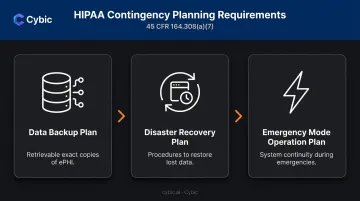
45 CFR 164.308(a)(7) requires three distinct plans:
- Data backup plan - retrievable exact copies of ePHI
- Disaster recovery plan - procedures to restore lost data
- Emergency mode operation plan - how the system functions during an emergency
When media is retired, ePHI must be rendered irretrievable. HHS cites NIST SP 800-88 for media sanitization standards, covering both digital purging and physical hardware destruction.
How to Build HIPAA-Compliant Software: Step-by-Step
Retrofitting compliance after development is more expensive and more error-prone than building it in from day one. The five steps below cover the sequence that matters.
Step 1: Conduct a Security Risk Assessment Before Writing Code
45 CFR 164.308(a)(1)(ii)(A) marks risk analysis as Required - not addressable. It must cover:
- All PHI data flows and storage locations
- Access points and authentication mechanisms
- Third-party dependencies and their PHI exposure
- Potential threats to confidentiality, integrity, and availability
Risk analysis is not a one-time exercise. HHS says it should be updated when new technologies are planned, after security incidents, or following material operational changes.
Step 2: Design Access Architecture and Authentication Controls
Before implementation, map out:
- Which user roles exist and what PHI categories each role requires
- Under what conditions access is granted or elevated
- Session management policies and timeout thresholds
Establish RBAC logic, MFA requirements, and session controls in the architecture phase, before QA surfaces them as gaps.
Step 3: Implement Encryption and Secure Data Transmission
Specific engineering actions required:
- Enforce HTTPS/TLS across all API endpoints, without exception
- Encrypt PHI at rest in databases, object stores, and backup media
- Configure cloud storage (AWS S3, Azure Blob, GCS) with encryption enabled and least-privilege access policies scoped correctly
- Manage encryption keys separately from the data they protect
The encryption configuration is the developer's responsibility regardless of the underlying cloud infrastructure. AWS, Azure, and Google Cloud provide the infrastructure layer and their own BAAs, but application-level configuration remains with the engineering team.
Step 4: Build Audit Trails, Incident Response, and Contingency Capabilities
Audit logging must be built into the application layer with structured, tamper-evident logs for every PHI access and modification event.
An incident response plan must include:
- Detection and classification of potential breaches
- Containment and documentation procedures
- Breach notification to the covered entity within 60 calendar days of discovery (45 CFR 164.410)
A contingency plan must cover hardware failures, environmental disasters, and deliberate attacks, with documented recovery procedures and defined RTO/RPO targets.
Step 5: Execute Business Associate Agreements and Establish Organizational Compliance
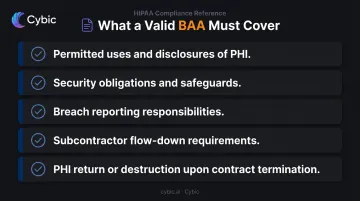
A BAA is legally required before any vendor can create, receive, maintain, or transmit ePHI. Per 45 CFR 164.504(e), a valid BAA must cover:
- Permitted uses and disclosures of PHI
- Security obligations and safeguards
- Breach reporting responsibilities
- Subcontractor flow-down requirements
- PHI return or destruction upon contract termination
BAAs flow downstream. If your cloud provider handles PHI (which it does if you store ePHI there), you need a BAA with them too. AWS, Azure, and Google Cloud all offer HIPAA BAAs for their eligible services.
Organizational requirements accompanying software compliance:
- Employee HIPAA training and documented updates
- Internal policies and procedures
- A remediation plan tied to risk assessment findings
Common HIPAA Compliance Mistakes in Software Development
"We Use AWS/Azure/GCP, So We're Covered"
This is the most dangerous misconception. As Microsoft explicitly states, using cloud services does not automatically guarantee HIPAA compliance. The cloud provider covers the infrastructure layer. The developer retains full responsibility for:
- How PHI is accessed and logged at the application layer
- Whether storage buckets are misconfigured or publicly accessible
- Whether encryption is actually enabled (not just available)
- Whether access controls are implemented in the application code
A BAA with AWS is necessary but nowhere near sufficient.
Treating Compliance as a One-Time Certification
HIPAA compliance is continuous. Required ongoing activities include:
- Periodic security risk assessments (after incidents, system changes, or at regular intervals)
- Employee training updates
- Policy and procedure reviews
- Audit log monitoring
Regulations evolve too. HHS issued a Security Rule NPRM in December 2024 proposing major changes - including mandatory encryption of ePHI at rest and in transit, vulnerability scanning every six months, and penetration testing annually. Software must keep pace as regulations are updated.
The AI De-identification Misconception
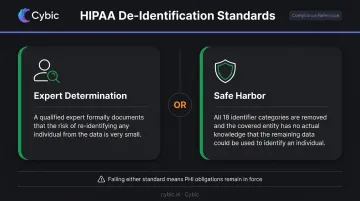
Teams building ML features on healthcare data sometimes assume that "anonymized" data removes all HIPAA obligations. It doesn't - unless de-identification meets one of two specific HIPAA standards:
- A qualified expert documents that re-identification risk is very small (Expert Determination)
- All 18 identifier categories are removed and the covered entity has no knowledge the remaining data can identify an individual (Safe Harbor)
Using PHI to train AI models without meeting one of these standards is a serious violation. Any AI platform with persistent access to PHI qualifies as a business associate and must comply accordingly. Cybic's policy of no model training on proprietary enterprise data directly addresses this risk. Client PHI stays isolated from training pipelines by architectural design.
Conclusion
HIPAA compliance for software is an engineering discipline. Access controls, encryption, audit logging, backup procedures, and breach response capabilities must be designed into the architecture from the start - not added when a healthcare contract requires them.
The stakes are real. Healthcare data breaches cost an average of $7.42M, and civil penalties for HIPAA violations reach $2,190,294 per violation. Non-compliant vendors don't just face fines - they lose healthcare contracts entirely.
Teams building AI-driven or data-intensive healthcare platforms, where PHI flows through multiple systems, pipelines, and models, need governance embedded at the architectural level - not bolted on after deployment. Cybic works with healthcare organizations on exactly this: designing security controls, RBAC, encryption, and audit trails into the system architecture from the first sprint, so compliance isn't a last-mile problem.
Frequently Asked Questions
How do you build HIPAA-compliant software?
Start with a formal security risk assessment, then design access controls, encryption, and audit logging into the architecture before writing application code. Execute Business Associate Agreements with any covered entity clients, and treat compliance as an ongoing obligation - not a pre-launch checklist.
How much does it cost to build HIPAA-compliant software?
Costs vary based on application complexity, PHI volume, and whether compliance is built in from the start or retrofitted. The framing that matters most: the average healthcare data breach costs $7.42M. Proactive compliance investment is substantially cheaper than breach response, penalties, and contract loss.
What is the difference between a covered entity and a business associate under HIPAA?
Covered entities are healthcare providers, health plans, and clearinghouses directly regulated by HIPAA. Business associates are vendors or service providers - including software developers - that handle PHI on a covered entity's behalf; both must comply with HIPAA and have a signed BAA in place before PHI is accessed.
What happens if your software is found to be non-compliant with HIPAA?
Civil penalties range from $145 per violation (unknowing) up to $2,190,294 per violation for uncorrected willful neglect. Criminal penalties under 42 USC 1320d-6 reach $250,000 and 10 years imprisonment for malicious or commercial violations. Non-compliant vendors also face disqualification from healthcare contracts.
Does HIPAA compliance apply to AI and machine learning systems in healthcare?
Yes. AI systems with persistent access to PHI qualify as business associates and must comply with all applicable HIPAA requirements. Using PHI to train AI models requires proper de-identification under the Expert Determination or Safe Harbor standard - anything short of that is a violation, and it's an increasingly common one.
What is a Business Associate Agreement (BAA) and why does a software developer need one?
A BAA is a legally required contract between a software vendor and its healthcare client that defines permitted PHI uses, security obligations, and breach reporting responsibilities. Without a valid BAA, the vendor cannot lawfully access or handle PHI.