Introduction
Most development teams treat HIPAA compliance as a legal checkbox - something to hand off to counsel before launch. That assumption is expensive.
HIPAA-compliant app development means designing and building healthcare applications with the legal, technical, and operational controls required to protect Protected Health Information (PHI). The engineering decisions involved - access controls, encryption strategies, audit logging schemas, and more - are architectural, not administrative. Getting them wrong carries real consequences.
According to OCR's 2024 Annual Report to Congress, 663 large breaches were reported in 2024, affecting approximately 242.9 million individuals. Hacking and IT incidents accounted for 81% of those events. OCR resolved 12 investigations through settlements totaling $7.8 million that same year.
For healthcare technology teams, digital health founders, and enterprise software engineers, the message is clear: HIPAA compliance is an operational requirement, not a formality. This guide covers what it actually requires in code and architecture - and how to build it in from the start.
Key Takeaways
- HIPAA compliance covers two layers - infrastructure and application - and your engineering team is responsible for both.
- PHI is broader than most developers expect: IP addresses, device IDs, and dates of service all trigger compliance obligations.
- Every vendor that touches PHI needs a signed BAA - not just your cloud provider, but analytics tools, error monitors, and AI APIs too.
- Retrofitting compliance onto a live product costs far more than building it in from sprint one.
- No government HIPAA certification exists; compliance is demonstrated through implemented safeguards, documented policies, and third-party audits.
What HIPAA Actually Requires of App Developers
The Four Rules That Shape Engineering Decisions
| Rule | What It Means for Your Team |
|---|---|
| Privacy Rule | Governs PHI use and disclosure; requires minimum necessary access and consent flows |
| Security Rule | Mandates technical, administrative, and physical safeguards for electronic PHI (ePHI) |
| Breach Notification Rule | Requires individual notification within 60 calendar days of breach discovery |
| Omnibus Rule (2013) | Extended direct HIPAA liability to business associates and their subcontractors |
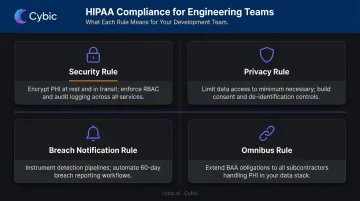
The Security Rule is where the majority of engineering decisions live. It's technology-neutral - it specifies required outcomes like access control, audit controls, and transmission security without naming specific tools. In practice, that means your team chooses the controls and documents why they're appropriate - there's no checklist to check off.
PHI Is Broader Than Most Teams Assume
HIPAA covers far more than clinical records. If your app touches patient data in any form, it almost certainly handles PHI.
HHS's Safe Harbor de-identification method requires removing 18 identifiers before data loses its PHI status. Many of these appear routinely in application logs, analytics events, and device metadata:
- IP addresses and device identifiers
- Dates of service (beyond year)
- URLs and geographic subdivisions smaller than a state
- Any unique identifying code or characteristic
If your app logs a patient lookup event with a user ID, timestamp, and IP address - that log entry may be PHI. Design your schemas, analytics pipelines, and debug logs with this in mind from day one.
That logging reality extends directly to how you structure your team's obligations - which depends on whether you're a covered entity or a business associate.
Covered Entities vs. Business Associates
Most digital health startups and enterprise healthcare software teams are business associates - not covered entities. A business associate is any person or entity performing functions for a covered entity that involve PHI.
This distinction has direct legal weight. HHS confirmed that business associates are directly liable for:
- Security Rule compliance
- Impermissible PHI disclosures
- Breach notification obligations
- Failure to execute required subcontractor BAAs
Being a vendor doesn't reduce your obligations. You carry the same Security Rule requirements as the hospital you're building for.
Why HIPAA Compliance Cannot Be Retrofitted
The Structural Problem
Access control hierarchies, encryption schemes, audit logging, and data model design are foundational decisions. You can't add them in a sprint - rearchitecting them in a live system means touching core components across every service, database, and integration point.
NIST's Secure Software Development Framework (NIST SP 800-218) puts a number on it: integrating security throughout the development lifecycle reduces released vulnerabilities and cuts the cost of post-production remediation - which routinely runs 6–30x higher than fixing issues during development.
The enforcement record confirms this isn't theoretical. OCR settled with MedEvolve - a healthcare software vendor - for $350,000 after a server containing PHI for 230,572 individuals was left unsecured and accessible on the public internet. OCR does not distinguish between early-stage companies and established ones when investigating.
The Commercial Risk of Waiting
Beyond enforcement, there's a procurement reality:
- Enterprise healthcare buyers - hospital systems, insurers, large provider groups - require documented compliance posture before vendor evaluation, not after
- A breach during beta using real patient data carries the same legal penalties as a breach affecting a mature product
- Reputational damage from a healthcare breach often exceeds the direct financial penalties
The moment real PHI enters your system - even a single user during a limited beta - full HIPAA obligations apply.
Build It In From Sprint One
Those commercial and legal consequences have a single practical implication: security architecture, PHI data flow mapping, and BAA agreements must precede production code. The sections below cover each of these requirements in detail - starting with access controls and encryption, through audit logging, to vendor agreements.
Core Technical Safeguards Every HIPAA-Compliant App Needs
HIPAA's Security Rule organizes requirements across three safeguard categories: technical, administrative, and physical. This section focuses on the technical layer, where engineering decisions have the most direct impact.
Application-Layer Controls You Must Build in Code
No infrastructure platform implements these for you. Each one is an engineering design decision:
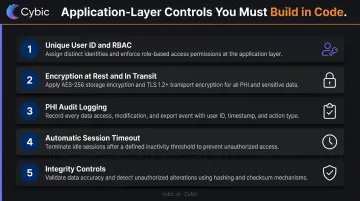
Unique user identification and RBAC: Shared accounts are a direct HIPAA violation (45 CFR 164.312(a)(2)(i)). Every user must have a unique identifier, and role-based access controls must enforce minimum necessary access across every PHI-handling endpoint.
Encryption at rest and in transit: AES-256 at rest and TLS 1.2+ in transit are the accepted implementation standards, aligned with NIST FIPS 197 and SP 800-52 Rev. 2. Apply these across device-to-server, server-to-database, and all inter-service communication paths. Note: HIPAA does not mandate these specific algorithms by statute - they are NIST-aligned standards your team should document as your chosen implementation approach.
PHI audit logging: 45 CFR 164.312(b) requires mechanisms that record and examine activity in systems containing ePHI. Each log entry should capture who accessed which record, what action was taken, from which device, and when. Store logs in tamper-evident, append-only storage - separate from the application database.
Automatic session timeout: HIPAA includes automatic logoff as an addressable specification under access controls. Fifteen minutes of inactivity is the high-assurance NIST benchmark (NIST SP 800-63B, AAL3) and the accepted standard for sensitive healthcare web applications.
Integrity controls: Access restrictions on writes, modification logs, and database-level constraints detect unauthorized PHI modification and support breach scoping.
One engineering pattern most teams miss: Application logs, error messages, and third-party SDK event data are among the most common sources of unintentional PHI exposure. Deliberately exclude PHI from debug logs and stack traces. Error responses must not echo back patient identifiers. These are design decisions, not cleanup tasks.
Infrastructure-Layer Controls and BAA Coverage
Your infrastructure layer must handle:
- AES-256 encryption at rest across all storage (databases, backups, file storage)
- TLS enforcement within the environment
- Network isolation - production databases must not be reachable from the public internet
- OS patching and vulnerability management
- Tamper-evident audit log storage
AWS, Azure, and GCP all offer HIPAA-eligible services and will sign BAAs. But signing a BAA with your cloud provider is necessary - not sufficient. Under the Shared Responsibility Model, configuration is your team's responsibility. An unencrypted storage bucket or a misconfigured security group is your violation, not the provider's.
BAA coverage extends well beyond your hosting provider. Any service that could receive PHI requires a signed BAA. Walk through your full vendor stack:
| Vendor Category | Examples | BAA Required? |
|---|---|---|
| Error monitoring | Sentry, Datadog | Yes, if PHI appears in traces |
| Log management | Splunk, Loggly | Yes |
| Analytics | Mixpanel, Amplitude | Yes, if health data flows through |
| Email / messaging | SendGrid, Twilio | Yes |
| AI APIs / LLMs | OpenAI, Anthropic endpoints | Yes |
| Video conferencing | Zoom, Teams | Yes, for telehealth |
| Customer support | Intercom, Zendesk | Yes, if PHI in tickets |
A vendor who refuses to sign a BAA cannot be used in any PHI-handling context - regardless of their other capabilities. For healthcare AI deployments, this vendor review extends to every AI API, LLM endpoint, and orchestration layer in your stack. Cybic's healthcare AI engagements address this directly: RBAC, encrypted data handling, and full audit traceability are built into the architecture from the start, not retrofitted after a BAA conversation.
Best Practices for Structuring Your HIPAA-Compliant Development Process
HIPAA compliance should be embedded as a development process - not managed as a separate compliance workstream running in parallel. Here's how compliant healthcare systems are actually built.
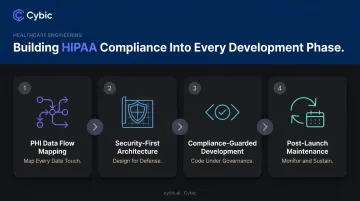
Phase 1: PHI Data Flow Mapping and Risk Assessment
Before writing a single line of production code, map every PHI touchpoint:
- Where does PHI enter the system?
- How does it move between services?
- Where does it rest - databases, caches, file storage, backups?
- Which third parties access it, intentionally or through telemetry?
- Which APIs or integrations create new PHI pathways?
This data flow map is both a required component of the Security Rule's risk assessment and the foundation for every subsequent architecture decision. Cybic's data strategy and governance engagements start here: a data landscape audit and gap analysis that aligns architecture with HIPAA requirements before any implementation begins.
Phase 2: Security-First Architecture
This phase produces the structural decisions that are hardest to change later:
- Design RBAC hierarchies and access policies before building data models
- Select HIPAA-eligible infrastructure and sign BAAs before any PHI enters the environment
- Define encryption strategies for every storage and transit path
- Design audit logging schemas that capture every PHI interaction
Cybic's governance-embedded design approach builds security, access controls, and auditability into system architecture from this phase forward. This directly reflects the Security Rule's requirement for implemented safeguards, not planned ones.
Phase 3: Compliance-Guarded Development and Testing
In each sprint:
- Encryption implemented from sprint one, not deferred
- MFA and session controls built into authentication flows at the start
- Automated compliance checks integrated into CI/CD pipelines
- PHI deliberately excluded from application logs by design
- External penetration testing before the first production PHI deployment
- Point-by-point compliance audit against HIPAA Security Rule before launch
Phase 4: Post-Launch Compliance Maintenance
Post-launch compliance requires ongoing, structured maintenance:
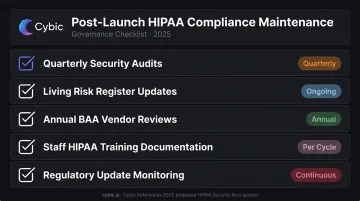
- Quarterly security audits
- Living risk register updated after every system change or incident
- Annual BAA reviews across the full vendor stack
- Documented staff HIPAA training
- Monitoring for regulatory updates (a 2025 proposed Security Rule update is in progress)
Teams that retrofit compliance consistently carry higher ongoing maintenance costs. The quarterly audit burden is measurably lighter when controls were designed in from the start.
Common Mistakes That Lead to HIPAA Failures in App Development
"The Cloud Provider Handles It"
AWS, Azure, and GCP offer HIPAA-eligible services. They do not make your application HIPAA-compliant. HIPAA Journal documented a case where a misconfigured AWS S3 bucket exposed sensitive data belonging to breast cancer patients - a configuration error, not a cloud platform failure.
The Shared Responsibility Model is explicit: the cloud provider secures the underlying infrastructure; you secure everything you build and configure on top of it.
PHI Ending Up in Application Logs
A developer adds debug logging to a patient lookup endpoint. The logs capture:
- User ID and query parameters
- A timestamp tied to a specific patient record
- Automatic streaming to a third-party log management service with no BAA
The result is simultaneously a PHI exposure and a BAA violation.
HHS's 2024 guidance on online tracking technologies confirms that PHI-bearing telemetry flows to third-party vendors without BAAs are a HIPAA risk pattern - applying to web apps, mobile apps, analytics, and crash reporting. PHI must be stripped from logs before they leave your environment, or the destination service must be covered by a BAA.
Missing BAAs With Secondary Vendors
Most teams get a BAA from their hosting provider. Few ask the same question about every other vendor in their stack.
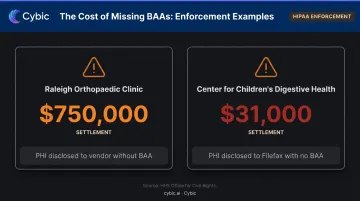
OCR settled with Raleigh Orthopaedic Clinic for $750,000 after PHI was disclosed to a vendor without a BAA. The Center for Children's Digestive Health paid $31,000 for the same failure pattern - PHI disclosed to Filefax with no BAA in place. The vendor audit is not optional: every downstream service that could receive PHI needs a signed agreement or must be removed from PHI-handling workflows.
Shared Admin Accounts and Missing Audit Logs
Shared credentials for database or admin access mean no meaningful audit trail exists. You cannot reconstruct who accessed what - or revoke access for a specific individual. That's a direct violation of 45 CFR 164.312(a)(2)(i).
The audit log problem compounds this. When a breach occurs, logs are the primary tool for scoping what was accessed, by whom, and when. An application that captures errors but not every PHI access event - with sufficient context - leaves you unable to answer the questions OCR will ask.
Frequently Asked Questions
What types of healthcare apps require HIPAA compliance?
Any app that creates, receives, maintains, or transmits PHI on behalf of a covered entity requires HIPAA compliance. Common examples include:
- Telemedicine platforms and EHR/EMR systems
- Patient portals and remote patient monitoring tools
- E-prescribing apps and mental health apps storing clinical data
The determining factor is PHI handling, not the app category.
What is the difference between HIPAA-eligible and HIPAA-compliant?
HIPAA-eligible is a vendor's claim that their service can be configured for HIPAA use and that they'll sign a BAA. HIPAA-compliant describes your organization's posture - meaning safeguards are implemented, documented, and demonstrable. A HIPAA-eligible cloud provider is a prerequisite for building on, not proof of your own compliance.
Do I need a BAA with every vendor in my tech stack?
Yes - any vendor that could receive, store, or process PHI requires a signed BAA. This commonly includes:
- Error monitoring tools and analytics platforms
- Email service providers and video conferencing services
- AI APIs and third-party integrations that touch PHI data
A vendor who refuses to sign a BAA cannot be used in PHI-handling workflows.
Can I launch an MVP before achieving full HIPAA compliance?
If your MVP uses only synthetic or de-identified data, HIPAA does not apply. The moment real PHI enters the system - even from a single beta user - full compliance obligations apply. Retrofitting compliance onto an existing codebase costs significantly more than building it in from the start.
How does HIPAA apply when using AI or machine learning in a healthcare app?
Four rules apply when AI touches PHI:
- Train models only on properly de-identified data
- Require a signed BAA from every third-party AI API or model that processes PHI
- Log and maintain audit trails for all AI-driven decisions involving PHI
- Apply data minimization - send the model only the minimum PHI the task requires
What are the penalties for HIPAA violations?
HHS's 2024 penalty tiers range from $141 per violation for unknown violations up to $2,134,831 per violation category annually for willful neglect left uncorrected. Beyond fines, losing enterprise healthcare contracts and reputational damage often represent the larger business cost.