Introduction
Enterprise spending on generative AI is accelerating fast. Gartner forecasts worldwide GenAI spending will reach $644 billion in 2025 - up 76.4% from 2024 - with GenAI services spending projected to grow 162.6% year over year.
Yet the production gap is real. At least 50% of GenAI projects were abandoned after proof of concept by the end of 2025, according to Gartner. Organizations produce demos and prototypes without difficulty. Converting them into governed, integrated, measurable systems is where most stall.
Most pilots are built outside existing workflows, scoped without compliance requirements, and measured against the wrong outcomes. The gap between experiment and production is an architectural problem - not an ambition problem.
This guide is for decision-makers who need to move past the experiment phase. It covers:
- How enterprise GenAI differs from consumer AI
- Where the highest-ROI use cases actually are
- How to build a strategy that reaches production
- Why governance must be designed in from day one
- How to measure success with metrics that hold up at scale
Key Takeaways
- Global GenAI spending hits $644B in 2025, but 50%+ of projects never leave the proof-of-concept stage
- Enterprise GenAI requires governed integration into existing systems, not standalone chat tools
- Highest ROI comes from high-effort manual tasks where AI output can be validated before action
- Governance must be embedded at the architectural level, not layered on after deployment
- Measure success with task-level throughput, decision speed, and total cost of ownership - not headcount reduction alone
What Is Enterprise Generative AI (And How It Differs From Consumer AI)
Generative vs. Predictive AI in the Enterprise
Enterprise generative AI refers to AI systems that produce new outputs (text, code, summaries, decisions, workflow actions) built to operate within enterprise-grade security, compliance, and integration requirements. This is categorically different from consumer tools like ChatGPT used ad hoc by individual employees.
dimensions:
| Dimension | Consumer AI | Enterprise AI |
|---|---|---|
| Data privacy | May train on user inputs | Proprietary data never used for model training |
| System integration | Standalone tool | Connects to ERP, CRM, ITSM workflows |
| Access control | User-level permissions | Role-based governance across teams and data types |
| Auditability | No decision trail | Every AI-driven action is traceable |
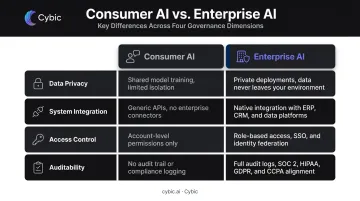
This matters especially in regulated industries. Lenovo/IDC research across 900 mid-to-large organizations found 65% primarily use on-premises or hybrid environments for AI workloads - a direct signal that infrastructure flexibility and data control aren't optional features.
Where Enterprise GenAI Delivers Real ROI: High-Impact Use Cases by Industry
The use cases worth pursuing share two characteristics: they require significant human effort to complete manually, and the risk of AI error is manageable if a human reviews the output before action is taken. Most organizations underestimate how much that second condition shapes which deployments succeed.
Industry-Specific Applications
GenAI-generated maintenance narratives, shift handover reports, and anomaly summaries reduce the cognitive load on engineers who would otherwise parse raw data by hand.
Oil & Gas and Energy Distributed energy infrastructure creates expensive manual oversight problems. Safety compliance documentation, inspection reporting, and field operations summaries are high-volume, high-stakes, and hard to standardize across dispersed teams.
McKinsey identifies oil and gas, electric power, and chemicals among the sectors best positioned for GenAI in operations - specifically where documentation volume and regulatory requirements create the most friction.
Retail and Supply Chain McKinsey estimates GenAI applied to customer care could increase productivity by 30% to 45%. Beyond customer service, the supply chain applications are compelling: demand forecasting narratives synthesized from real-time ERP data, personalized communications at scale, and exception reporting that surfaces anomalies without requiring analysts to hunt through dashboards.
Horizontal Use Cases Across All Industries
These apply regardless of sector:
- Developers complete tasks up to twice as fast with GenAI coding assistance, per McKinsey
- RAG-based assistants surface documents, policies, and institutional knowledge across systems on demand
- Customer service workflows handle routing, resolution, and escalation for routine issues without full human handling
- Content and communications teams generate first drafts, summaries, and compliance-ready documents at scale
Building Your Enterprise GenAI Strategy: From Pilot to Production
Why Pilots Fail to Scale
The 50% abandonment rate isn't random. Gartner's earlier 2024 prediction pointed to four specific causes: poor data quality, inadequate risk controls, escalating costs, and unclear business value. These are scoping failures, not execution failures. Projects built outside existing infrastructure and compliance requirements hit these walls predictably.
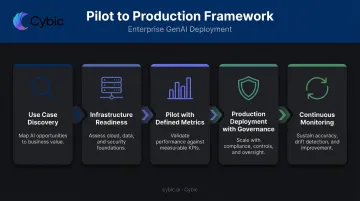
A phased framework prevents that:
- Use case discovery and prioritization - identify high-effort, low-validation-risk candidates across workflows
- Infrastructure readiness - assess data availability, quality, and integration requirements before building
- Pilot with defined success metrics - measured against the specific baselines you set upfront, not just whether the system functions
- Production deployment with embedded governance - compliance and access controls designed in, not added later
- Continuous monitoring and iteration - 90-day measurement intervals against operational KPIs
Build vs. Buy: How to Decide
Gartner notes that CIOs are increasingly opting for commercial off-the-shelf GenAI capabilities to reach production faster and with more predictable outcomes. That's the right default for most organizations.
Custom builds are justified under three specific conditions:
- Proprietary data creates a genuine competitive advantage that a generic model can't replicate
- Workflow requirements are too unique for available platforms to accommodate
- Regulatory constraints prevent use of third-party model APIs entirely
Infrastructure-agnostic architecture is essential regardless of build vs. buy. Any strategy that creates vendor lock-in or can't support hybrid and on-premises deployment will face resistance in regulated industries, where most enterprise AI workloads run on hybrid or on-premises infrastructure.
Drava: A Purpose-Built Architecture for This Problem
Cybic's Drava platform is designed for exactly this integration challenge. Rather than functioning as an isolated AI project, Drava connects enterprise data, machine learning, AI reasoning, and intelligent agents into a single governed system.
Key architectural capabilities include:
- Built-in workflow orchestration, security controls, and governance frameworks
- Deployment across AWS, Azure, Google Cloud, hybrid, and on-premises environments
- Data residency support for organizations with strict regulatory requirements
Governance, Security, and Responsible AI: The Foundation, Not an Afterthought
Why Governance Must Be Designed In
Cisco's 2024 Data Privacy Benchmark Study found 27% of organizations had banned GenAI applications at least temporarily over privacy and data security concerns. Cisco also reported that users were entering internal process details (62%), non-public company information (48%), and employee details (45%) into GenAI tools - often without policy guardrails in place.
Gartner predicts that by 2027, more than 40% of AI-related data breaches will arise from improper cross-border GenAI use. These aren't hypothetical risks.
Governance layered on post-deployment is insufficient. By the time a system is in production, data flows, model interactions, and user behaviors are already established. Retrofitting controls creates gaps, slows adoption, and exposes the organization to compliance risk.
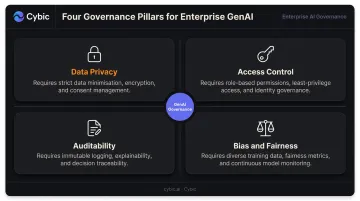
Four Governance Pillars Every Deployment Needs
| Pillar | What It Requires |
|---|---|
| Data privacy | Proprietary data never used to train underlying models |
| Access control | Role-based permissions governing who interacts with which AI systems and data |
| Auditability | Every AI-driven action is traceable - what decision, when, based on what |
| Bias and fairness | Model outputs monitored for discriminatory or inaccurate results in high-stakes workflows |
Security Requirements in Practice
Enterprise GenAI deployments require:
- Encrypted data protection in transit and at rest
- Isolation of enterprise data from public model training pipelines
- Secure API integration with existing ITSM, ERP, and operational systems
- Compliance alignment with relevant frameworks (SOC 2, HIPAA, ISO 42001, GDPR, CCPA)
Cybic's governance-by-design approach builds RBAC, auditability, encrypted data protection, and strict data governance (including a no-training-on-proprietary-data policy) directly into system architecture. For regulated industries like healthcare, oil and gas, and public sector, that architectural foundation is the difference between a system that can actually be deployed and one that stalls at the compliance review stage.
When NOT to Use Generative AI: Understanding the Limits
GenAI is not the right tool for every AI problem. Treating it as a universal solution is one of the fastest ways to produce the kind of ROI inconsistency that causes organizations to abandon projects entirely.
Four Categories Where GenAI Underperforms or Introduces Unacceptable Risk
- Numerical prediction and forecasting - traditional ML models consistently outperform LLMs on structured prediction tasks. Use GenAI to narrate or summarize forecasts, not generate them
- High-stakes autonomous decisions without human review - clinical diagnosis, financial credit decisions, legal determinations. The Air Canada chatbot case - where the airline was found liable for inaccurate fare information provided by its AI - illustrates the legal and reputational consequences of insufficient human oversight
- Sensitive or classified data in public-model environments - the data isolation requirements rule out most consumer or semi-enterprise APIs for genuinely sensitive workloads
- Data-sparse domains - where training examples are limited and relationships between variables are poorly understood, GenAI outputs are unreliable and difficult to validate
The HBS/BCG field experiment with consultants found that while AI users completed 12.2% more tasks and worked 25.1% faster on average, they were 19 percentage points less likely to produce correct solutions on tasks outside the AI's suitable frontier. That degradation is invisible without measurement.
The Broader AI Toolkit
GenAI belongs in an integrated AI strategy alongside predictive ML, rule-based automation, and human decision-making - not as a replacement for prior AI investment. Applying GenAI indiscriminately - what Gartner calls "random acts of digital" - produces exactly the unclear business value that drives project abandonment.
Two questions determine fit:
- Is this task high-effort manually? If not, the efficiency gains don't justify the complexity.
- Can a human validate the output before action is taken? If not, predictive ML or rule-based automation is a safer fit.
Both need to be true for GenAI to be worth evaluating.
Measuring GenAI Success: Metrics That Actually Matter
Why Traditional ROI Metrics Fall Short
Headcount reduction and cost-per-transaction are the default ROI metrics in enterprise technology. For GenAI, they're both insufficient and misleading. They take months to materialize, are difficult to attribute cleanly to AI versus other operational changes, and often cause finance teams to pull the plug on initiatives that are actually working.
A Lenovo/IDC study found 36% of management among AI adopters is neutral or has reservations specifically because of inconsistent ROI and tangible business outcomes. That's a measurement failure, not a GenAI failure - and it's fixable with the right framework.
A More Useful Measurement Framework
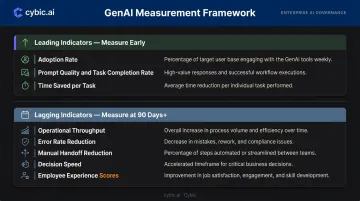
Build your baseline before deployment, then track at 90-day intervals:
Leading indicators (measure early):
- Adoption rate - are people actually using the system?
- Prompt quality and task completion rate
- Time saved per knowledge worker task compared to baseline
Lagging indicators (measure at 90 days and beyond):
- Operational throughput improvement
- Error rate reduction
- Reduction in manual handoffs between teams
- Decision speed improvement on defined workflow steps
- Employee experience scores on AI-assisted tasks
TCO: What Most Organizations Miss
Per-token inference costs are manageable at small scale. Multiply them across thousands of users and hundreds of use cases, and the licensing fee becomes the smallest line item. A complete TCO calculation includes:
- Model inference costs at scale
- Compliance review overhead
- Retraining and fine-tuning costs
- Integration maintenance as underlying systems change
- Internal change management investment
Organizations that skip TCO modeling at the scoping stage routinely discover that their per-seat cost projections were 30-50% below actual operating cost at scale. Build the full model before you commit to production deployment.
Frequently Asked Questions
What is enterprise generative AI?
Enterprise generative AI refers to AI systems that generate text, code, decisions, and workflow outputs - built for enterprise environments with data governance, system integrations, access controls, and auditability that consumer AI tools don't address. The defining difference from consumer tools is governed integration into operational workflows, not standalone chat capability.
What is an example of enterprise AI?
Two concrete examples: an AI system that generates clinical documentation from physician-patient conversations and writes directly into the EHR; or a GenAI assistant that synthesizes supply chain exception reports from real-time ERP data for operations managers. Both illustrate governed AI embedded into existing workflows - not tools running alongside them.
What are the four types of generative AI?
The four primary model types are: large language models (LLMs) for text and reasoning, image generation models, code generation models, and multimodal models that process across text, image, and audio. LLMs are the most mature and widely deployed in enterprise contexts today, though multimodal capabilities are advancing quickly.
What is the difference between generative AI and predictive AI in the enterprise?
Generative AI creates new outputs from learned patterns - drafting a report, summarizing a document, generating a response. Predictive AI uses historical data to forecast future outcomes - equipment failure, demand shifts, churn probability. The most effective enterprise AI strategies combine both rather than treating them as alternatives.
How do enterprises measure ROI from generative AI?
Measure ROI through operational metrics (time saved per task, manual handoff reduction, throughput) and strategic indicators (decision speed, error rate, employee satisfaction). Total cost of ownership must include inference, compliance, and change management - not just software licensing - to avoid budget surprises at scale.
What are the biggest risks of using generative AI in the enterprise?
The four primary risks are hallucination (confident but wrong outputs), data privacy exposure via public model APIs, inherited bias from training data, and lack of auditability. Enterprises address these through governance-embedded architecture, human-in-the-loop validation, and strict data isolation that keeps proprietary data out of public model training pipelines.