Introduction
Most enterprise leaders have approved at least one generative AI pilot. Many have approved a dozen. Yet according to BCG, 74% of companies still struggle to achieve and scale AI value - and only 26% have the capabilities to move beyond proofs of concept.
The gap isn't technological. The models work. The problem is that organizations are evaluating AI use cases theoretically, deploying them in isolation, and treating governance as something to sort out later.
This article cuts through that. It covers real-world generative AI use cases across healthcare, manufacturing, retail, oil & gas, and the public sector - with actual outcome data where it exists. It also covers what separates enterprise AI deployments that generate durable operational value from the ones that stall out before reaching production.
The deployments generating durable returns share a pattern: AI embedded into the operational core, connected to proprietary data, with governance built into the architecture from the start.
Key Takeaways
- 74% of enterprises struggle to scale AI value; the bottleneck is execution and integration, not the technology
- Industry-specific use cases (clinical documentation, field safety, factory floor diagnostics) produce the strongest measurable outcomes
- Cross-industry applications like knowledge management, customer support, and financial analysis deliver consistent ROI across verticals
- AI governance and security must be architectural decisions, not post-deployment patches
- Moving from pilot to production requires defined KPIs, deep integration, and error-detection built in before launch
What Generative AI Actually Means for Enterprise Operations Today
Traditional AI and generative AI solve different problems. Traditional (predictive) AI forecasts outcomes from historical patterns - think demand forecasting or fraud scoring. Generative AI creates new content, synthesizes complex inputs, and reasons across multiple data sources to produce reports, responses, code, and recommendations.
That distinction matters when evaluating use case fit:
- Predictive AI: Anomaly detection in manufacturing telemetry, fraud scoring, demand forecasting
- Generative AI: Translating machine error codes into plain-language diagnostics, synthesizing multi-source reports, generating code and recommendations
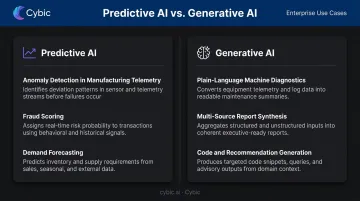
Conflating the two leads to misaligned deployments - and wasted investment.
The enterprise context also demands something consumer AI doesn't: scale, auditability, multi-system integration, regulatory compliance, and the ability to work with proprietary data without exposing it. McKinsey's 2025 State of AI report found 71% of organizations regularly use generative AI - but regular use at the function level is not the same as operational integration at scale.
The maturity gap is widening. Organizations that have moved generative AI into production workflows are compounding their advantages. Those still running isolated pilots are losing ground - access to models was never the barrier. Integration, governance, and change management are.
Generative AI Use Cases Across Enterprise Industries
The same underlying AI capability - document processing, natural language querying, anomaly summarization - delivers different value depending on operational context. A healthcare system and an oil field operator both need to surface critical information fast, but the data sources, regulatory exposure, and failure consequences are entirely different.
Here's how that plays out across five sectors:
Oil & Gas
Field safety and operations is one of the clearest enterprise AI wins in energy. ADNOC's ENERGYai platform applies LLM technology to seismic analysis, geological modeling, and real-time process monitoring - compressing analysis workflows that previously took months into days. Cognite's Atlas AI platform reports greater than 70% efficiency gains in root-cause analysis for rotating equipment using conversational troubleshooting agents.
AVEVA's Industrial AI Assistant enables natural-language queries across engineering data, letting field teams ask questions about equipment, process states, and 1D/2D/3D documentation without needing specialist technical knowledge. The result: faster fault resolution and fewer escalations to domain experts.
For infrastructure decision-making, AI is improving demand forecasting and supply chain coordination. The higher-impact application is putting natural language interfaces on top of legacy SCADA and ERP systems. Field operators get operational intelligence without learning query languages or navigating fragmented dashboards.
Manufacturing
On the factory floor, Siemens and Schaeffler deployed the Industrial Copilot directly into production machines. It helps automation engineers generate PLC code from natural-language input and helps shopfloor workers identify and resolve errors by accessing manuals through a conversational interface.
Siemens' Electronics Factory Erlangen uses a similar system to translate machine error codes into plain language and suggest solutions in real time.
For workflow coordination, Siemens Teamcenter Manufacturing Easy Plan uses LLM-based AI to translate assembly work instructions across languages, compressing what previously took weeks into hours while preserving technical terminology. For global manufacturers with distributed facilities, this alone removes a significant operational bottleneck.
What's consistent across manufacturing deployments: AI is embedded into existing MES and ERP environments, not replacing them. The value comes from AI adding reasoning and language capability on top of systems that already hold the operational data.
Healthcare
Clinical documentation is the healthcare AI use case with the strongest verified evidence. Microsoft's 2024 survey of 879 clinicians using DAX Copilot found 5 minutes saved per encounter on average, with 77% reporting improved documentation quality and 70% reporting reduced burnout. A separate JAMA Network Open study of 263 clinicians using Abridge found burnout rates dropped from 51.9% to 38.8% and after-hours documentation fell by nearly an hour per day.
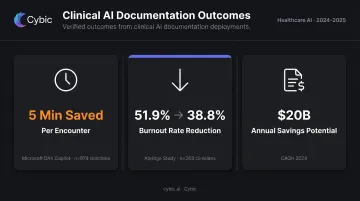
On the administrative side, the CAQH 2024 Index found that fully electronic workflows, including prior authorization, could unlock $20 billion in annual healthcare cost savings and save 70 minutes per patient visit on average.
One non-negotiable in this vertical: HIPAA-compliant, governed AI architecture is not optional. HHS requires administrative, physical, and technical safeguards for all electronic protected health information. Enterprises deploying AI in healthcare without governance embedded at the architectural level aren't just taking a compliance risk - they're taking an operational one.
Retail
Retailers are deploying generative AI for personalized customer experiences at catalog scale. Key examples from recent deployments:
- Carrefour launched Hopla, a GPT-4-based shopping assistant, alongside AI-generated product descriptions for more than 2,000 brand products
- Michaels, using Persado's AI personalization approach, achieved a 41% CTR lift on SMS campaigns
- Walmart is scaling AI across product catalog improvement, AR, and immersive commerce
A 2024 Google Cloud survey found 95% of retail decision-makers believed generative AI would affect customer experience, with 72% saying they were ready to deploy within the year.
The operational use cases (inventory forecasting, supplier communication, shelf intelligence) are where integration depth matters most. The best retail AI deployments connect directly into ecommerce platforms and POS systems. AI running alongside these systems, rather than inside them, produces marginal value.
Public Sector
Government agencies are deploying generative AI for citizen services at multiple levels. The City of Amarillo launched Emma, a bilingual AI assistant handling questions about city services in English and Spanish. The 2024 Federal AI Use Case Inventory consolidated 2,133 AI use cases across 41 US federal agencies.
Pennsylvania's experience is instructive for internal government deployment: a ChatGPT Enterprise pilot grew from 175 employees to over 3,000 Commonwealth employees using generative AI tools in daily work within a year. For internal government operations such as policy document review, contract analysis, and compliance reporting, the productivity case is clear. But data sovereignty requirements in this vertical are especially strict, and governance architecture must reflect that from the start.
Cross-Industry Generative AI Use Cases That Drive Broad Value
Beyond vertical-specific applications, several enterprise AI use cases generate consistent ROI regardless of industry. These are typically the right starting points for organizations still evaluating where to begin.
Customer Support and Intelligent Agents
Modern AI customer support agents are handling complex, multi-turn queries with context from customer history, product data, and policy documents, capabilities that far exceed the scripted chatbots of five years ago.
Klarna's AI assistant handled 2.3 million conversations in its first month, two-thirds of all customer service chats, doing the equivalent work of 700 full-time agents. Resolution time dropped from 11 minutes to under 2 minutes. Gartner predicts agentic AI will autonomously resolve 80% of common customer service issues by 2029, cutting operational costs by 30%.
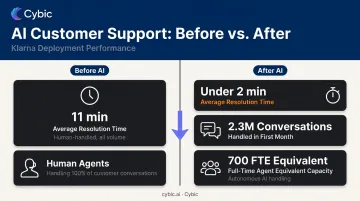
That said, Gartner also found 64% of customers would prefer companies not use AI for customer service. The right response isn't to avoid deployment - it's to build in visible escalation paths and human fallback from the start.
Knowledge Management and Document Intelligence
Most enterprises have a knowledge problem: critical institutional knowledge is buried in unstructured documents, legacy systems, and the heads of people who've been there for 20 years. Generative AI changes the retrieval equation.
McKinsey's internal Lilli platform reports 20-30% time saved on information gathering and synthesis across 500,000+ prompts answered. Morgan Stanley moved from effectively answering 7,000 questions to handling queries across a corpus of 100,000 documents for financial advisors.
Those results depend on how the underlying system is built. Cybic builds LLM-powered document intelligence systems that handle contract clause extraction, legal document summarization, and knowledge retrieval across enterprise data sources - with RBAC, encrypted data handling, and audit trails built in so organizations retain precise control over what gets accessed and by whom.
Financial Forecasting and Analysis
58% of finance functions used AI in 2024, up 21 percentage points from the prior year. The shift is from data analysts manually running queries to business users asking questions in plain language and getting synthesized answers.
Applications generating the most value:
- Automated variance analysis and reconciliation (Microsoft Copilot for Finance integrates with Dynamics 365, Business Central, and SAP)
- Natural language querying of financial data
- Cash flow forecasting and budget anomaly detection
- AI-assisted audit preparation across large document sets
Code Generation and Developer Productivity
GitHub's research found developers using GitHub Copilot completed coding tasks 55% faster - 1 hour 11 minutes versus 2 hours 41 minutes without it. Task completion rates also improved from 70% to 78%.
For enterprise software teams, the practical value extends beyond speed. Developers shift time away from repetitive implementation and toward architecture, system design, and problems that actually require human judgment.
HR and Talent Operations
IBM's AskHR agent handles more than 2.1 million employee conversations annually, with a 40% reduction in HR operational costs over four years and 94% containment for common employee questions. Resume parsing, onboarding material generation, employee policy chatbots, and workforce analytics are all generating operational ROI across large enterprises.
What Separates Successful Enterprise AI Deployments from Costly Pilots
Most enterprises can identify AI use cases. Fewer know how to evaluate which ones are ready to deploy and what conditions make them succeed or fail.
Integration Into Existing Infrastructure and Workflows
AI systems that operate in isolation - disconnected from the data sources and workflows employees already use - deliver minimal sustained value. The value equation is simple: AI reasoning applied to accessible, trusted operational data produces outcomes. Without that connection, you get a demo, not a deployment.
The diagnostic question to ask before approving any enterprise AI initiative: Does this application connect to the data and tools where work actually happens?
Successful deployments embed into existing ERP, CRM, SCADA, or data platforms. They don't require parallel systems or data migration as a prerequisite. Cybic's approach to AI engineering starts from this principle - connecting AI capabilities to existing infrastructure rather than building alongside it.
Governance, Security, and Auditability as Architecture - Not Afterthought
This is where most enterprise AI deployments get into trouble. Governance that gets bolted on after deployment is governance that doesn't hold under operational pressure.
What governance at the architectural level looks like in practice:
- Role-based access controls (RBAC) restricting system access by role and responsibility
- Encrypted data handling in transit and at rest
- Audit trails for all AI-driven actions and automated decisions
- Strict data governance - including a formal policy that proprietary enterprise data is never used to train public models
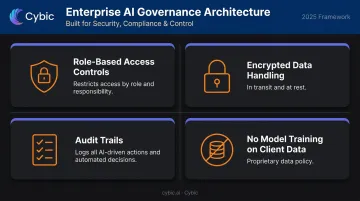
Regulated industries - healthcare, energy, public sector - have zero tolerance for governance gaps. But even in less-regulated contexts, governance failures create operational liabilities that are far more expensive than getting it right from the start.
Cybic embeds these controls at the architectural level across every engagement, covering SOC 2, HIPAA, ISO, and GDPR compliance where applicable. The no-model-training-on-client-data policy is a foundational design requirement built into every engagement from day one.
Moving From Pilot to Production: The Execution Gap
Most enterprise AI failures happen at the transition from pilot to production. The pilot works in a controlled environment. Production exposes everything the pilot didn't: integration gaps, edge cases, error propagation, user adoption friction, and the absence of any mechanism to catch AI mistakes before they cause operational or compliance damage.
Before scaling any deployment, ask: Is there a mechanism to catch errors before they cause operational or compliance damage?
Gartner points to poor data quality, inadequate controls, escalating costs, and unclear business value as the primary reasons generative AI projects fail. None of those are technology problems. All of them get addressed - or missed - at the architecture and planning stage.
MIT Sloan's research frames AI deployment decisions at the task and economic-feasibility level - the full cost of automation, not just licensing. That framing is right. The real cost includes integration engineering, governance infrastructure, change management, and ongoing monitoring.
Aligning Every AI Initiative to Measurable Business Outcomes
AI initiatives without defined success metrics don't sustain investment. The pattern is predictable: pilot shows promise, gets approved for production, then goes live without clear KPIs. It generates activity metrics ("prompts answered") instead of business metrics ("cycle time reduced by X%") - and gets deprioritized when the next budget cycle arrives.
Define KPIs before deployment. Tie them to specific business functions:
- Cost per resolved support interaction
- Clinical documentation time per encounter
- Cycle time from purchase order to invoice
- Error rate in automated document processing
This approach also lets organizations prioritize. High-volume, repetitive processes with clear error baselines are where AI generates the fastest, most measurable ROI. Low-volume, judgment-heavy processes take longer to prove value and carry higher governance requirements.
Moving From Isolated AI Tools to Integrated Enterprise Intelligence
The next phase of enterprise AI isn't more tools. It's integration.
Organizations running five separate AI tools - one for support, one for documents, one for financial queries, one for HR, one for code - are managing five governance frameworks, five integration points, and five sets of vendor dependencies. The administrative overhead alone undercuts the productivity gains.
The architecture that creates compound value does four things through a single platform rather than a collection of point solutions:
- Connects enterprise data - structured and unstructured - into a unified foundation
- Orchestrates AI workflows across functions and systems
- Enforces governance rules with auditability built in
- Exposes AI capabilities to the teams and systems that need them
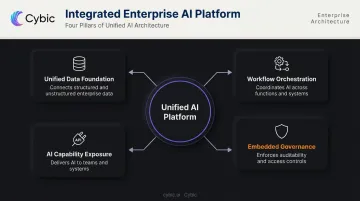
That's the design principle behind Cybic's Drava platform. Drava connects enterprise data, machine learning, AI reasoning, and intelligent agents into a governed system that runs across cloud, hybrid, and on-premises environments. AI reasoning is applied to actual operational data, with workflow orchestration, security controls, and traceability embedded throughout - not bolted on afterward.
McKinsey found only 21% of organizations had fundamentally redesigned workflows despite widespread AI adoption. The organizations that close that gap - and embed AI into operational processes rather than running it alongside them - are the ones that will compound their advantage over the next three years.
The differentiator isn't the number of AI tools deployed. It's whether those tools share a data foundation, operate under consistent governance, and connect directly to how work gets done.
Frequently Asked Questions
What are enterprise use cases for generative AI?
Enterprise generative AI use cases span customer support automation, clinical documentation, document processing, knowledge retrieval, financial reporting, code generation, and supply chain optimization. Applications exist across both operational execution (automating tasks) and decision support (synthesizing data for human judgment) functions in every major industry.
What is the difference between generative AI and traditional AI for enterprises?
Traditional AI uses historical patterns to forecast outcomes (fraud scoring, demand prediction, classification). Generative AI creates new content and synthesizes complex inputs to produce reports, responses, recommendations, and code. Enterprises need both, but the right choice depends entirely on the task.
How do enterprises ensure AI governance and data security when deploying generative AI?
Governance requires role-based access controls, encrypted data handling, audit trails, and a firm policy against training public models on proprietary data. These controls must be embedded at the architectural level and designed to meet applicable standards (SOC 2, HIPAA, GDPR) from the start, not retrofitted after deployment.
Which industries are seeing the most impact from generative AI?
Healthcare (documentation burden), manufacturing (operational complexity and multilingual workflows), retail (customer volume and catalog scale), financial services (data-intensive analysis), and energy are leading. Each is driven by a combination of high task volume, structured data availability, and clear measurable outcomes.
How long does it typically take to implement generative AI in an enterprise environment?
Pilot deployments run weeks to a few months. Production-ready, fully integrated systems typically take several months to a year, depending on data readiness, integration complexity, and governance requirements.
What is the ROI of generative AI for enterprise organizations?
ROI varies by use case and implementation quality. Highest returns come from high-volume applications (customer support, documentation, data processing) where AI is integrated into existing workflows rather than running alongside them. Use cases with clear error-rate baselines and measurable cycle times produce the fastest, most defensible ROI.