Agentic AI represents a qualitative shift. Unlike traditional automation that executes predefined scripts, agentic AI systems independently plan and execute complex, multistep tasks interpreting high-level goals, adapting when conditions change, and navigating exceptions without breaking. For enterprises managing cross-functional workflows with high coordination costs, this isn't incremental improvement. It's a fundamental change in how work gets orchestrated.
Key Takeaways
- Agentic AI owns end-to-end workflows by interpreting objectives and adapting mid-process, not just running scripts
- Productivity gains concentrate in complex, cross-system work: ERP orchestration, customer operations, finance monitoring, and supply chain management
- Redesign workflows before selecting tooling; governance must be embedded architecturally from the start
- Regulated industries carry the highest governance stakes and stand to gain the most from reduced coordination overhead
- Enterprises that treat agentic AI as a product with clear ownership, auditability, and human-in-the-loop controls consistently outperform those that treat it as a standard software rollout
Agentic AI vs. Traditional Automation: Why the Distinction Matters
Traditional automation including robotic process automation (RPA) follows a deterministic model. It executes predefined scripts in fixed sequences. When an invoice arrives in an unexpected format or a supplier isn't in the system, the bot breaks. The workflow stops. Someone gets an alert. Manual intervention begins.
Agentic AI operates differently. It interprets intent, decomposes goals into steps, and selects or adjusts actions based on real-time conditions. The underlying components that make this possible include:
- Large language models for reasoning and understanding unstructured inputs
- Machine learning for pattern recognition across historical data
- Tool-use capabilities for interacting with external systems (APIs, databases, ERPs)
- Memory and context retention across multi-step workflows
These components shift how exceptions get handled. Rather than stopping and waiting for human input, an agent can re-route, escalate to the right person, or attempt an alternative path completing processes end-to-end without constant supervision.
Copilots vs. Agents: Not the Same Thing
Many organizations conflate generative AI copilots with agentic AI. Copilots assist humans like drafting emails, summarizing documents, suggesting next steps. Agentic AI executes tasks autonomously toward a goal, escalating to humans only at defined decision points. The practical gap: a copilot helps someone approve an invoice; an agent processes, validates, and routes it before a human ever needs to look.
Gartner warns that many vendors engage in "agent washing"rebranding existing chatbots or RPA tools without substantial agentic capabilities. According to Gartner's analysis, the vast majority of vendors claiming agentic capabilities lack the underlying architecture to support genuine autonomous operation.
What This Looks Like in Practice
A traditional RPA bot routes invoices based on fixed rules: vendor name, amount threshold, department code. Change the invoice format, and the bot fails.
An agentic workflow handles the same scenario differently. It detects the anomaly, cross-references supplier history and contract terms, and routes the invoice to the right approver with a flagged rationale and confidence score. If something still doesn't match, it investigates further before escalating. No human needs to initiate the process.
Where Agentic AI Is Transforming Enterprise Productivity
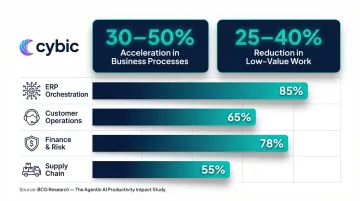
Productivity gains from agentic AI aren't evenly distributed. They concentrate in workflows with high coordination complexity, frequent exceptions, or cross-system complexity. Research from BCG shows that effective AI agents can accelerate business processes by 30% to 50% and cut employees' low-value work time by 25% to 40%. The verticals below show where those gains are largest.
Workflow Orchestration in ERP and CRM Platforms
AI agents embedded in ERP and CRM environments auto-resolve service tickets, reroute inventory to cover shortfalls, and trigger procurement workflows without human initiation. A global distributor cut sales-order cycle time by 40% after agents began orchestrating credit checks, inventory confirmations, and pricing approvals across its ERP.
Customer Operations and Case Management
Agents handle end-to-end case resolution from document intake and triage through escalation or payout in insurance and healthcare. UK insurer Aviva rolled out AI models that cut liability assessment time for complex cases by 23 days and reduced customer complaints by 65%.
Finance, Risk, and Compliance Monitoring
Agents continuously monitor transactional data, detect anomalies, forecast cash positions, and recommend reallocations. In AML transaction monitoring, AI-driven approaches reduced false positive alert volumes by 31% to 33% while maintaining 100% true positive recall. That frees compliance teams to focus on higher-risk investigations instead of chasing noise.
Industry-Specific Productivity Gains
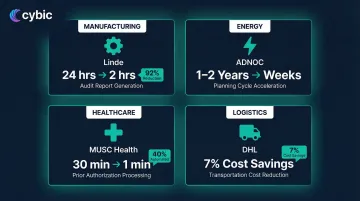
- Manufacturing: Linde's multi-agent system cut audit report creation from 24 hours to 2 hours, a 92% reduction by automating data gathering across production systems
- Energy/Oil & Gas: ADNOC's ENERGYai compressed development planning from 1-2 years to weeks by running multiple infrastructure and safety scenarios in parallel
- Healthcare: MUSC Health's agents handle 40% of prior authorizations without human involvement, cutting a 30-minute task to roughly one minute
- Retail/Logistics: DHL saved 7% on transportation costs through agentic supply chain optimization across vehicle routing and stop planning
What It Actually Takes to Implement Agentic AI at Scale
The most common failure mode is treating agentic AI as a software deployment rather than a workflow redesign. Organizations that succeed start by mapping which processes have the highest coordination overhead and exception rates. They design agent boundaries what the agent owns, what it escalates before selecting tooling.
Closing the Talent Gap
Implementing agentic AI requires AI/ML engineers, data engineers who ensure clean and structured pipelines, and domain experts who map agent actions to real operational logic. Most organizations underestimate the domain-expert requirement. The World Economic Forum reports that 63% of employers cite skills gaps as the key barrier to business transformation.
Integrating with Legacy Infrastructure
Most enterprise environments run on systems not designed for autonomous agents. The practical approach uses AI as smart middleware LLM-powered connectors that translate between modern agent interfaces and legacy infrastructure rather than requiring full re-platforming.
Start Narrow, Then Expand
Large enterprise-wide deployments stall because they aim too broad. Identify a high-friction, high-visibility process as a first deployment target. One company pivoted from an enterprise-wide AI assistant campaign to a narrow vendor onboarding agent. Within three months, it cut onboarding time by 40%, giving leadership the confidence to fund broader use cases.
Cybic's Drava platform addresses this complexity directly. It connects enterprise data, machine learning, AI reasoning, and intelligent agents into a single operational layer one that integrates with existing infrastructure from day one, without requiring organizations to re-architect before they can begin.
Governance and Control: The Make-or-Break Layer
Governance is the primary reason agentic AI projects stall or get canceled. Gartner predicts over 40% of agentic AI projects will be canceled by end of 2027 due to unclear business value or inadequate governance. The problem isn't technical capability, it's the absence of accountability structures around it.
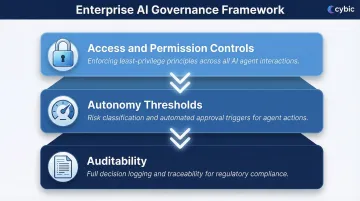
Three essential control layers:
- Access and permission controls : Agents operate on least-privilege principles, accessing only what their function requires
- Autonomy thresholds : Classify agent actions by risk level and set approval requirements for high-impact decisions
- Auditability : Log every agent decision and rationale so compliance, legal, and operations teams can reconstruct what happened and why
In regulated industries, auditability isn't optional. Specific mandates include:
- HIPAA: Requires technical security measures and audit controls for systems accessing protected health information
- Federal Reserve: Mandates ongoing monitoring and outcomes analysis for model risk management
- NERC CIP: Requires documented incident response processes for automated systems
Cybic embeds governance by design. Role-based access controls, encrypted data protection, and full auditability of AI-driven actions are built into the architecture from the start. The platform also maintains a strict policy of no model training on proprietary enterprise data, a critical assurance for regulated-industry customers where data leakage is not an acceptable risk.
Is Your Organization Ready for Agentic AI?
Four readiness indicators signal an organization is positioned to benefit:
- Identified high-friction workflows : You've mapped specific processes with measurable coordination overhead and exception rates
- Structured, accessible data : Your enterprise data is clean enough to feed agent reasoning (note: only 7% of enterprises say their data is completely ready for AI)
- Executive ownership : At least one leader willing to take accountability for AI-driven outcomes
- Defined escalation paths : Clear understanding of which decisions require human judgment versus which the agent can own
Missing even one of these foundations such as data readiness, clear ownership, or defined autonomy boundaries is how organizations end up in the failure statistics rather than the success stories.
The end state is AI-orchestrated operations: agents that don't just support workflows but run them, with humans accountable for outcomes rather than coordination. Organizations that build governance and data infrastructure now will be the ones expanding deployments when the technology matures and not starting from scratch.
Frequently Asked Questions
What is the difference between agentic AI and RPA or traditional workflow automation?
RPA follows fixed scripts and breaks on exceptions, requiring manual intervention to resume. Agentic AI interprets goals, adapts to changing conditions, and navigates complex multi-step processes autonomously making it the right fit for workflows where variability and judgment are unavoidable.
Which enterprise functions see the greatest productivity gains from agentic AI?
ERP/workflow orchestration, customer operations and case management, finance and risk monitoring, and supply chain management show the highest impact. Gains scale with coordination complexity: processes with high exception rates and cross-system dependencies benefit most.
How do you maintain control over autonomous AI agents in regulated industries?
Three controls are non-negotiable:
- Least-privilege access limiting what each agent can read, write, or execute
- Tiered autonomy thresholds requiring human approval before high-risk actions
- Full audit logging capturing every agent decision for traceability
All three must be embedded architecturally, not retrofitted after deployment.
What are the most common reasons agentic AI implementations fail?
The most frequent failure points:
- Inadequate governance structures from the outset
- Poor data quality or fragmented data accessibility
- Deploying too broadly before proving value in a narrow use case
- Underestimating the need for domain expertise alongside technical talent
Over 40% of projects fail due to one or more of these gaps.
How long does it take to see measurable ROI from an agentic AI deployment?
Narrow, well-scoped deployments targeting a single high-friction workflow can deliver measurable results within one to three months. Enterprise-wide transformation typically requires 12-24 months depending on data readiness and governance maturity.
Is agentic AI suitable for industries like healthcare, energy, or manufacturing?
Yes. These sectors rank among the highest-value deployment targets due to operational complexity and coordination overhead. That said, governance, auditability, and compliance alignment must be embedded from the start strict regulatory requirements leave no room for retrofitting controls later.