Introduction
Enterprise AI adoption has never moved faster - McKinsey's 2025 Global Survey reports that 71% of organizations now use AI regularly across at least one business function, up from 33% in 2023. Yet that same research found only 1% of executives describe their AI rollouts as "mature."
Closing that gap requires more than a capable model. Strategy, governance, and integration determine whether AI reaches production or stalls after the pilot. Gartner predicts at least 30% of generative AI projects will be abandoned after proof of concept by end of 2025, citing poor data quality, inadequate risk controls, and unclear business value as the primary causes.
This guide covers what enterprise AI development services actually include, where enterprise AI gets genuinely hard, how to build a deployment strategy that reaches production, and what to look for when evaluating partners.
Key Takeaways
- 71% of enterprises use AI, but only 1% have mature rollouts - the gap is strategy and governance, not technology
- Enterprise AI demands data readiness, compliance alignment, and stakeholder buy-in before any model gets built
- Core services cover custom model development, agentic automation, system integration, predictive analytics, and MLOps infrastructure
- A focused 60–90 day pilot scoped to one business outcome consistently outperforms organization-wide rollout attempts
- Evaluate partners on end-to-end delivery capability, governance practices, and evidence of production deployments, not polished demos
What Are Enterprise AI Development Services?
Enterprise AI development services cover the full range of technical and strategic capabilities a vendor provides to help large organizations build, deploy, and scale AI systems within complex operational environments. That spans initial consulting and data readiness assessment through custom model development, system integration, and ongoing optimization.
This is distinct from general commercial AI tools. Enterprise-grade solutions must account for:
- Data governance and regulatory compliance
- Integration with legacy systems and existing tech stacks
- Role-based access controls and security architecture
- Scalability across business units and geographies
- Auditability of AI-driven decisions
Generic tools aren't built for this - they lack the governance architecture, integration depth, and compliance alignment that enterprise environments require.
Core Service Categories
The primary service types enterprises should expect from a vendor covering the full engagement - from strategy through deployment:
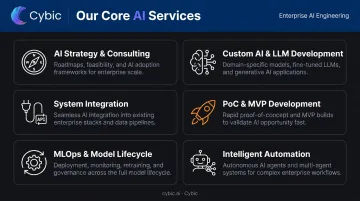
- AI strategy and consulting - use case prioritization, feasibility assessment, ROI frameworks, and transformation roadmaps
- Custom AI and LLM development - domain-specific models fine-tuned on enterprise data, generative AI copilots, and reasoning systems
- System integration - embedding AI into ERPs, CRMs, data lakes, and BI platforms via APIs and data pipelines
- Proof-of-concept and MVP development - scoped pilots to validate value before broader deployment
- MLOps and model lifecycle management - automated retraining, performance monitoring, model versioning, and CI/CD deployment pipelines
- Intelligent automation and workflow orchestration - AI agents that execute multi-step workflows across enterprise systems with minimal human input
What Makes Enterprise AI Development Uniquely Complex?
Most AI projects aren't technically difficult in isolation. The complexity comes from the environment they have to operate in.
Structural and Data Complexity
Large enterprises run on multiple business units, highly customized tech stacks, and workflows spanning regions and regulatory jurisdictions. Any AI solution has to integrate into this environment without disrupting existing operations.
Data is often the harder problem. Enterprise data tends to be siloed, inconsistently structured, and inaccessible across systems. Gartner explicitly lists poor data quality as a leading reason AI projects fail after proof of concept - and IDC data shows 90% of enterprise data is unstructured, with volumes growing at a 30% annual rate.
Data readiness - quality, governance, and accessibility - is typically the single biggest determinant of whether an AI project succeeds or gets abandoned.
Regulatory and Governance Constraints
Enterprises in healthcare, energy, and finance operate under frameworks that are non-negotiable:
| Framework | Relevant For |
|---|---|
| HIPAA Security Rule | Healthcare AI systems handling patient data |
| GDPR / CCPA | Any AI processing personal data in EU or California |
| SOC 2 | Enterprise SaaS and cloud-deployed AI systems |
| NERC CIP / FERC | Energy sector cybersecurity controls |
| EU AI Act | High-risk AI systems deployed in the EU |
| NIST AI RMF | Voluntary risk management for AI governance |
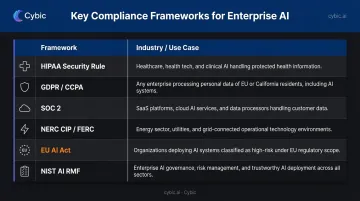
These frameworks can't be layered on after development. Governance, auditability, and access controls need to be built into the architecture before a single line of production code is written.
Stakeholder and Change Management
Accenture reports that 65% of executives say they lack the expertise to lead generative AI transformations, and 63% of employers identify skill gaps as a major scaling hurdle. Even technically sound AI initiatives fail when IT, legal, operations, and executive leadership aren't aligned. Without cross-functional alignment, a well-engineered system still gets shelved at deployment.
Core Enterprise AI Services: What You Can Build
Custom AI and LLM Application Development
Proprietary language models fine-tuned on enterprise data consistently outperform generic off-the-shelf models for specialized use cases. Generic models lack the domain context that matters in regulated industries - context-specific training is what separates useful AI from liability.
Cybic's custom LLM development builds models tailored to legal, healthcare, finance, and enterprise contexts, using secure, scalable pipelines for training, deployment, and monitoring. Core use cases include:
- Compliance reasoning and regulatory interpretation
- Operational decision support in BFSI and manufacturing
- Domain-specific document intelligence for legal and healthcare workflows
Intelligent Automation and Agentic AI
Modern enterprise automation goes well beyond RPA bots handling repetitive tasks. Agentic AI systems can execute multi-step workflows, orchestrate data pipelines, and trigger actions across enterprise systems with minimal human input.
Cybic's Drava platform takes this integrated approach, connecting enterprise data, machine learning, AI reasoning, and intelligent agents into a single governed automation layer. Rather than isolated AI tools, Drava gives organizations workflow orchestration, security controls, and auditability in one deployable system.
AI Integration, Predictive Analytics, and Governance
Beyond agentic systems, complete enterprise AI deployments depend on three additional service layers:
AI integration services connect AI capabilities to existing systems - ERPs, CRMs, data lakes, BI platforms - through custom APIs and data pipelines. Teams get AI outputs inside the tools they already use, without requiring workflow changes.
Predictive analytics and ML solutions convert historical enterprise data into forward-looking operational intelligence: demand forecasting, predictive maintenance, anomaly detection, churn modeling, and risk scoring. According to McKinsey, industrializing machine learning through proper MLOps practices can reduce production timelines by 8–10x and cut development resource requirements by up to 40%.
AI governance and responsible AI frameworks must be built into the architecture from the start - not retrofitted after deployment. Enterprise-grade systems require:
- Role-based access controls (RBAC)
- Encrypted data handling in transit and at rest
- Audit trails on AI-driven decisions
- Strict data governance, including no model training on proprietary customer data without explicit controls
Cybic embeds these controls at the architectural level from day one, covering SOC 2, HIPAA, ISO, and GDPR compliance where applicable.
Industry-Specific AI Use Cases
Enterprise AI isn't a generic capability. Effective deployment depends on industry context, regulatory environment, and operational workflow specifics.
Oil & Gas and Energy
Unplanned downtime for refineries or pipelines can cost operators over $1M per day. Key AI applications include:
- Predictive equipment failure detection - reducing unscheduled downtime by as much as 90% according to McKinsey
- Real-time production monitoring integrated with legacy SCADA and IoT sensor networks
- Safety compliance automation across field operations
- Maintenance copilots that reduce maintenance labor costs by up to one-third
AI in this sector must operate with zero tolerance for unplanned downtime, which means integration with existing SCADA infrastructure and strict reliability requirements - not pilot-grade prototypes.
Manufacturing
AI applications across the manufacturing floor span the full production lifecycle. Core use cases include:
- Production workflow coordination and real-time scheduling optimization
- Computer vision quality inspection that catches defects at line speed
- Demand forecasting and supply chain visibility to reduce stockouts and overstock
- Predictive maintenance across equipment fleets
McKinsey notes that large-scale predictive maintenance in a single plant often requires well over 100 models. That scale makes custom development and dedicated MLOps infrastructure a technical requirement, not an afterthought.
Healthcare
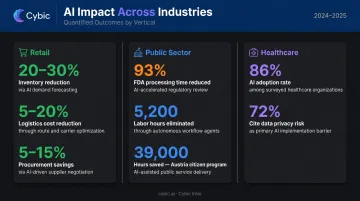
86% of healthcare organizations already use AI in some capacity, according to HIMSS/Medscape - but 72% cite data privacy as a significant adoption risk. Use cases span clinical workflow enhancement, operational efficiency improvements, and diagnostic support through image analysis and predictive analytics. HIPAA compliance and explainability are prerequisites in clinical AI - not features to bolt on after deployment.
Retail and Public Sector
In retail and distribution, McKinsey reports AI can reduce inventory levels by 20–30%, logistics costs by 5–20%, and procurement spend by 5–15%. Applications include demand forecasting, personalized recommendations, and dynamic pricing.
Public sector deployments show similarly concrete results. The FDA reduced application intake processing time by 93%, eliminating 5,200 manual labor hours through intelligent document processing. Internationally, Austria's automated child benefit program saved citizens 39,000 hours - a benchmark for what document intelligence can achieve at scale. For US government agencies, citizen services automation and document intelligence represent the highest-value entry points.
Building Your Enterprise AI Strategy: A Step-by-Step Approach
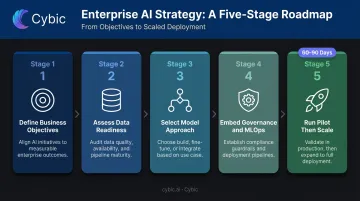
Step 1: Define Business Objectives First
Start with a concrete business problem, not a technology. Use an impact/feasibility framework to identify the highest-value, most achievable AI initiative. Enterprises that define one outcome and scale sequentially consistently outperform those attempting broad AI transformation simultaneously.
Step 2: Assess Data Readiness
Data readiness means evaluating:
- Data quality and consistency across systems
- Accessibility - can the right data reach the model at inference time?
- Labeling requirements for supervised learning use cases
- Governance policies and whether they permit AI use of specific datasets
- Whether existing infrastructure can support training and inference at scale
This step is where most organizations discover unexpected scope: data quality gaps, missing labels, or governance policies that block entire dataset categories from AI use.
Step 3: Select the Right Model Approach
The decision between pre-trained models, fine-tuned open-source LLMs, and fully custom models depends on:
| Factor | Consideration |
|---|---|
| Accuracy requirements | Generic models may underperform on specialized enterprise tasks |
| Data sensitivity | On-prem or private cloud deployment may be required |
| Cost constraints | Fine-tuning is significantly cheaper than full custom development |
| Explainability needs | Regulated industries often require interpretable outputs |
Infrastructure decisions (cloud-native, on-premises, hybrid, or multi-cloud) should be made alongside model decisions - not separately.
Step 4: Embed Governance and MLOps from the Start
A production-grade MLOps foundation requires:
- Automated model retraining pipelines
- Performance monitoring and drift detection
- Model versioning and rollback capability
- CI/CD deployment integration
Governance controls - RBAC, audit trails, encrypted data handling, and compliance reporting - must be architectural requirements, not retrofits. Adding them afterward is expensive, often incomplete, and creates audit exposure.
Gartner predicts 80% of data and analytics governance initiatives will fail by 2027 due to lack of urgency and organizational commitment. Organizations that build governance into the architecture from day one avoid the costly rework - and the compliance gaps - that come from bolting it on later.
Step 5: Run a Focused Pilot, Then Scale
Don't attempt enterprise-wide deployment before validation. A focused 60–90 day pilot, scoped to one use case with clear success metrics, gives you the data to build a credible business case for broader rollout. Gartner reports the average AI prototype-to-production timeline is 8 months - a scoped pilot compresses that by removing integration ambiguity before it compounds.
How to Choose the Right Enterprise AI Development Partner
Technical Depth and Full-Lifecycle Delivery
Evaluate whether the vendor can handle the entire AI lifecycle - strategy, data engineering, model development, system integration, deployment, and ongoing optimization - or whether they're a point-solution provider that will leave handoff gaps between phases.
Ask specifically for evidence of production-deployed systems, not proof-of-concept work. Only 48% of AI projects make it into production (per Gartner's AI deployment research), which means many vendors have extensive PoC portfolios and thin production track records. Look for partners whose engagements are structured around working deployments in real operational environments, not polished presentations or isolated pilots.
Industry Expertise and Governance Maturity
Assess whether the vendor has verifiable experience in your specific industry and understands its regulatory requirements. Then evaluate how they approach governance - are security, access controls, auditability, and compliance alignment embedded by design, or added after development?
Ask directly:
- Do they train models on your proprietary data?
- What are their specific data handling protocols?
- How are audit trails generated and stored?
- What compliance frameworks are they certified or aligned against?
Infrastructure Flexibility
Governance requirements don't exist in isolation - they shape where and how systems can be deployed. Confirm the vendor can operate across your preferred environment (cloud, hybrid, or on-premises) and integrate with your existing technology stack without requiring infrastructure replacement. Vendor lock-in carries real long-term cost; treat infrastructure flexibility as a firm requirement from the start of any evaluation.
Frequently Asked Questions
What is the difference between enterprise AI and general AI?
Enterprise AI is built for complex organizational environments: legacy system integration, regulatory compliance, data governance, and multi-stakeholder workflows. General AI tools prioritize broad accessibility without those constraints. An enterprise chatbot and a consumer chatbot may share similar underlying models, but their governance, integration, and security requirements are fundamentally different.
How much does enterprise AI development typically cost?
Cost depends on use case complexity, data readiness, model type, and deployment environment. Gartner cites $5M–$20M for large-scale generative AI transformations, but targeted production systems can be scoped for far less. A focused pilot is the most effective way to establish ROI before committing to full-scale investment.
How long does an enterprise AI development project take?
Gartner reports the average prototype-to-production timeline is 8 months. Proof-of-concept projects can run 60–90 days; full production deployments typically take 6–18 months depending on data availability, integration complexity, and organizational readiness.
What should enterprises look for when evaluating AI development partners?
Prioritize partners with end-to-end delivery capability, industry-specific regulatory experience, and governance embedded at the architectural level. Infrastructure flexibility across cloud and on-prem environments matters, as does concrete evidence of production deployments, not just demos or proof-of-concept repositories.
How do enterprises maintain AI governance and data security?
Governance must be built into the architecture through RBAC, encrypted data handling, audit trails on AI actions, and strict data governance policies - including explicit controls on whether proprietary data can be used for model training. Post-development bolt-on governance is consistently less effective and more expensive to maintain.
What are the most common reasons enterprise AI initiatives fail?
The most consistent failure modes: starting with tools instead of business outcomes, underestimating data readiness, insufficient alignment across IT, legal, and operations, and treating governance as an afterthought. Gartner's research ties these patterns directly to the gap between the 71% of enterprises using AI and the 1% that describe their rollouts as mature.