Introduction
Healthcare organizations are under pressure from every direction. Physician burnout affected 41.9% of doctors in 2025, administrative costs consume between 15% and 25% of total US health expenditures - $600B to $1T annually - and national health spending hit $5.3 trillion in 2024. Generic software wasn't built to absorb that kind of strain.
Most healthcare technology wasn't designed around how healthcare actually works. Fragmented EHR environments, regulatory constraints, clinical workflow complexity, and the operational reality of care delivery at scale each demand something generic platforms weren't built to handle.
Building effective AI for healthcare requires more than machine learning capability. It demands healthcare domain knowledge, regulatory alignment from the architecture up, and engineering teams who can deploy into real clinical environments - tested against real workflows, not controlled demos.
This article covers what AI development services for healthcare actually involve, where they create measurable impact, and what to look for in a development partner.
Key Takeaways
- Healthcare AI covers clinical automation, predictive analytics, NLP, and data integration - scope it to your highest-priority operational gaps
- Administrative costs alone represent up to 25% of US health expenditures, making revenue cycle and workflow automation high-ROI targets
- Compliance with HIPAA and FDA SaMD must be architected in from day one - retrofitting it post-deployment creates regulatory and patient safety risk
- Regulated clinical environments require demonstrable model explainability and active bias monitoring - not just acknowledgment of the problem
- The right AI partner builds and integrates directly - no handoff between strategy and engineering teams
What AI Development Services for Healthcare Actually Involve
"AI development services for healthcare" covers a wide spectrum. The right scope isn't determined by what's technically available - it's determined by the operational problem you're solving.
The core categories:
Clinical Workflow Automation
Repetitive, rule-based tasks consume a disproportionate share of clinical staff time. Prior authorizations alone require physicians and their staff to spend roughly 12 hours per week per physician, completing an average of 43 authorizations - time pulled directly from patient care.
AI can automate these processes: routing prior auth requests, managing appointment scheduling logic, orchestrating care coordination tasks across teams. The result isn't just time savings - it's measurable throughput improvement and reduced cognitive load on clinical staff.
Predictive Analytics and Risk Stratification
Machine learning models trained on EHR data, lab results, and patient history can identify patients at elevated risk for readmission, clinical deterioration, or chronic disease progression - before the event occurs. That shift from reactive to proactive care is where predictive analytics has the most direct impact on outcomes and cost.
Clinical Documentation and NLP Applications
Unstructured clinical notes, physician dictation, and patient communications contain critical information that standard systems can't act on. Natural language processing pipelines transform that content into structured, actionable data. LLM-based applications are now automating documentation and medical coding tasks that previously required manual review - reducing turnaround time and coder workload in production deployments.
Healthcare Data Integration and Intelligence Platforms
Most healthcare AI initiatives stall on data problems - fragmented records, siloed systems, and inconsistent data quality that makes models unreliable in real-world deployment. Effective AI development for healthcare addresses this directly:
- Data pipeline engineering to consolidate and normalize clinical data at scale
- EHR integration using FHIR and HL7 standards for interoperability across systems
- A unified data layer that gives AI models consistent, production-ready inputs
Medical Imaging and Diagnostic AI
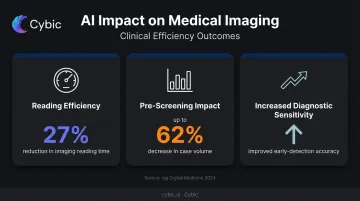
In radiology and pathology, the evidence for AI assistance is specific. A 2024 meta-analysis in npj Digital Medicine found that AI reduced imaging reading time by 27% and decreased case volume by up to 62% when used as a pre-screening tool - while increasing relative diagnostic sensitivity. For departments already stretched thin on radiologist capacity, that's a meaningful operational lever.
High-Impact Use Cases for AI in Medical and Clinical Settings
The use cases below aren't theoretical. They represent operational problems healthcare organizations are actively solving with custom AI.
Clinical Decision Support
AI-powered clinical decision support systems (CDSS) surface relevant patient data at the point of care, flag potential drug interactions, and recommend evidence-based treatment pathways. The goal is reducing diagnostic variability across provider teams and catching errors before they reach the patient.
A 2024 systematic review found that 90% of drug-drug interaction alerts are overridden by physicians - a signal that alert design and clinical relevance matter as much as the underlying model. Effective CDSS implementation requires tuning alert thresholds to reduce noise, not just deploying detection logic.
Administrative and Revenue Cycle Automation
Administrative spending in US healthcare reached approximately $950 billion in 2019, with 94% concentrated in five functional areas including financial transactions, claims processing, and clinical administrative support. Prior authorization, medical coding, and denial management are among the highest-friction workflows in revenue cycle operations.
These workflows are also among the strongest AI automation opportunities: rule-intensive, high-volume, and expensive when errors occur. Intelligent automation here typically produces faster ROI than clinical AI projects because the feedback loop between input and outcome is shorter and more measurable.
Remote Patient Monitoring and Continuous Care
AI systems connected to wearable devices and RPM platforms can analyze patient vitals continuously, trigger care team alerts, and support proactive chronic disease management outside clinical settings. A 2024 systematic review found that digital sensor alerting systems produced a 9.6% mean decrease in hospitalizations and a 3% mean decrease in all-cause mortality - with some patient groups seeing index hospital length of stay reduced by 1.6 days.
Patient Engagement and Operational Intelligence
Two more areas where custom AI delivers measurable impact:
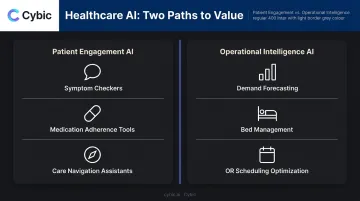
- Symptom checkers, medication adherence tools, and care navigation assistants extend clinical team reach and reduce no-show and readmission rates without adding headcount
- Demand forecasting for staffing and supplies, bed management, and OR scheduling optimization improve operational efficiency without requiring changes to clinical workflows
Why Governance and Compliance Must Be Built Into Healthcare AI From Day One
Healthcare AI operates in a regulated environment where a biased model output, an unauditable recommendation, or a data breach carries legal, financial, and patient safety consequences. Compliance is a design requirement - one that must be scoped into architecture before a single model is trained.
HIPAA, FDA, and Regulatory Alignment
HIPAA compliance in AI development extends well beyond encryption. It encompasses access controls, audit logging, data minimization, and ensuring that AI-driven decisions are traceable to their inputs. Systems that can't demonstrate this create liability exposure regardless of their clinical performance.
The FDA's framework for Software as a Medical Device (SaMD) adds another layer of complexity. The agency published its AI/ML-Based SaMD Action Plan in 2021 and has since issued guidance on Predetermined Change Control Plans - frameworks that govern how AI-enabled medical software can be modified after deployment while maintaining safety and effectiveness. Any AI system intended to support clinical decisions needs to be scoped against these frameworks from the start, not retroactively.
Algorithmic Bias and Model Explainability
The risk of biased AI in healthcare is well documented. A Nature Medicine study found that AI chest X-ray classifiers systematically underdiagnosed underserved patient populations - including Black patients, Hispanic patients, patients under 20, and Medicaid patients. A Science study found a widely used health management algorithm would have increased the share of Black patients identified for extra care from 17.7% to 46.5% simply by correcting its proxy measure for health need.
Bias compounds across intersectional groups and propagates through clinical decisions at scale. Effective mitigation requires:
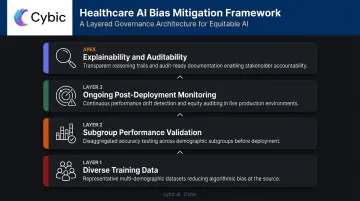
- Diverse training data that represents the full patient population
- Subgroup performance validation across demographic cohorts
- Ongoing monitoring post-deployment to catch drift and emerging disparities
Addressing bias also requires that models are explainable. FDA's Clinical Decision Support guidance requires that non-device CDS allow healthcare professionals to independently review the basis for software recommendations. NIST's AI Risk Management Framework identifies explainability as a core characteristic of trustworthy AI.
In practice, this means models must be auditable. Clinicians and compliance teams need to understand why a recommendation was made - not just what it was.
Data Governance and Auditability
Healthcare organizations must ensure their proprietary patient data is never used to train vendor AI models. This should be an architectural guarantee, not just a contractual clause.
Thorough data governance in healthcare AI includes:
- Role-based access controls (RBAC) restricting data access by function and role
- Encryption in transit and at rest
- Data residency controls that keep patient data within defined boundaries
- Complete audit trails of AI-driven actions, recommendations, and workflow interventions
Cybic's governance-by-design approach embeds all of these controls at the architecture level. Audit logging, RBAC, encryption, and the strict policy of no model training on proprietary client data are structural decisions made during the build phase - not compliance layers added before go-live. When regulators or internal compliance teams request an audit trail, the system produces one immediately - because the logging infrastructure was built in from day one, not assembled under pressure.
What to Look for in an AI Development Partner for Healthcare
The difference between firms that sell AI tooling and firms that engineer integrated AI systems is significant, and it becomes apparent quickly in healthcare environments.
Healthcare Domain Depth and Engineering Execution
The most common failure mode in healthcare AI projects is a gap between what consultants design and what engineers can actually deploy inside existing clinical infrastructure. A partner needs to handle all three simultaneously:
- Clinical workflow constraints - understanding how care teams actually operate, not just how systems are documented
- Regulatory requirements - HIPAA compliance, audit trails, and data governance built into architecture, not bolted on
- EHR integration standards - native capability with Epic, Cerner, and FHIR/HL7 from day one
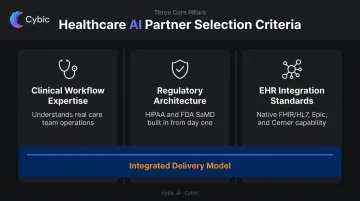
Partners who hand off between strategy and delivery teams introduce translation gaps that surface as scope creep, deployment delays, and systems that work in demos but fail in production.
Cybic's delivery model is explicitly engineering-led. The same technical team that designs the architecture builds and integrates it, eliminating the interpretation layer between what was specified and what gets deployed.
Compliance-First Architecture and Infrastructure Flexibility
Many healthcare organizations have compliance or contractual constraints that prohibit fully cloud-based deployments. A development partner must be able to operate across cloud, hybrid, and on-premise environments without treating on-prem as an exception case.
Cybic builds across AWS, Microsoft Azure, Google Cloud, Databricks, and Snowflake, and designs infrastructure-agnostic architectures that deploy equally across cloud, hybrid, and on-premise environments, with HIPAA compliance embedded into each configuration.
Proven Integration Capability
EHR integration is a baseline requirement, not a differentiator. AI systems that can't connect to existing infrastructure don't get deployed. A partner's integration capability - with Epic, Cerner, and FHIR/HL7 standards - determines whether a system reaches production or stalls as a proof-of-concept.
How Cybic Builds AI for Healthcare Organizations
Cybic's approach to healthcare AI is engineering-led and operationally grounded. The underlying principle is that AI systems must function in real healthcare environments - handling existing data structures, working within established regulatory frameworks, and fitting into clinical workflows without requiring organizations to rebuild what's already functional.
Clinical Workflow Integration and Intelligent Automation
Cybic designs AI systems that integrate directly into existing clinical workflows - automating repetitive tasks, orchestrating multi-step processes, and deploying AI copilots that support clinical and administrative teams. The objective is meaningful automation without requiring workflow redesign from scratch.
This covers:
- Intelligent document processing for clinical records and intake
- AI workflow orchestration across care coordination tasks
- Enterprise AI copilots that surface relevant information to clinical and administrative staff at the point of need
Governance, Security, and Responsible AI Embedded by Design
Cybic's governance methodology means that security controls, data protections, and compliance requirements are architected into the system during the build phase - not added after the fact. Core governance elements include:
- Role-based access controls (RBAC) for secure, tiered system access
- Encrypted data protection in transit and at rest
- Full audit trails for AI-driven actions and decisions
- A strict no-training-on-client-data policy embedded at the architecture level
The Drava platform (Cybic's enterprise Data Intelligence to Automation platform) connects enterprise data, machine learning, AI reasoning, and intelligent agents under a governed automation framework. In healthcare contexts, this gives organizations full visibility and auditability over how clinical data flows through every layer - from source systems to automated decisions.
Frequently Asked Questions
What types of AI development services are most valuable for healthcare organizations?
The highest-impact categories include:
- Clinical workflow automation
- Predictive analytics and risk stratification
- Clinical NLP and documentation AI
- Administrative and revenue cycle automation
The right starting point depends on your organization's most pressing operational problems, not on what's technically available.
How does HIPAA compliance affect the AI development process for healthcare?
HIPAA shapes AI architecture from the start - covering data access controls, audit logging, encryption requirements, and restrictions on how patient data can be used in model training. Treating it as a design-level requirement from day one is what separates compliant systems from ones that fail at the final review.
What is the difference between a general AI development company and a healthcare-specialized one?
Healthcare-specialized AI development requires domain knowledge of clinical workflows, regulatory frameworks (HIPAA, FDA SaMD), EHR integration standards (FHIR/HL7), and the operational constraints of care delivery environments. General machine learning capability is necessary but not sufficient.
How long does it typically take to build and deploy a custom AI solution for a healthcare organization?
Timelines vary significantly by scope - from several months for focused automation tools to over a year for enterprise-grade platforms. Integration complexity, compliance validation, and clinical testing typically add time compared to general software projects.
Can AI development services work with our existing EHR and clinical systems?
Modern healthcare AI development is built around integration with existing infrastructure using FHIR and HL7 standards. Organizations should not need to replace core systems to benefit from AI - integration capability with what's already deployed is a baseline requirement.
How do healthcare organizations ensure AI models don't introduce bias into clinical decisions?
Bias mitigation requires several layers of oversight:
- Diverse, representative training data across patient populations
- Performance validation across patient subgroups before deployment
- Ongoing model monitoring after go-live
- Explainability mechanisms so clinicians can review AI reasoning
- Governance frameworks that flag anomalous model behavior over time