& Process Automation](https://file-host.link/website/cybic-3idvzv/assets/blog-images/eaee3dfe-7dab-4e82-9d43-15287dbecab2/1780329359257505_32650d6514974ec5b8f2c0eaa3492be2/360.webp)
Introduction
Most enterprises aren't short on ambition when it comes to AI. They're short on execution.
According to McKinsey's 2025 State of AI survey, 88% of organizations now use AI in at least one business function. Yet only 39% report measurable EBIT impact at the enterprise level. That gap, between widespread adoption and actual results, is where most transformation programs break down.
The pattern is familiar: a pilot shows promise, stakeholders get excited, then the project stalls moving from a controlled proof of concept into real operating conditions. The breakdown usually traces to the same causes:
- Data is messier than the pilot environment revealed
- Governance requirements weren't factored in at design
- Integration with existing systems is harder than anyone planned
AI consulting for digital transformation exists to close that gap by engineering and deploying systems that work in production, not by producing strategy documents. This article covers what that engagement process actually looks like, which industries are seeing the most impact, and how to identify a consulting partner that delivers working systems rather than slides.
Key Takeaways
- 88% of companies use AI, but only 39% see financial impact - the gap is an execution and methodology problem, not a technology problem
- Effective AI consulting spans strategy, engineering, and governance - recommendations alone don't close the gap
- Discovery, architecture design, and change management carry equal weight to the technical build
- Manufacturing, healthcare, energy, and public sector show the strongest measurable ROI from AI-driven automation
- The right consulting partner builds integrated systems with governance embedded from day one - across cloud, hybrid, and on-prem
What AI Consulting for Digital Transformation Actually Means
AI consulting in a transformation context is not general IT advisory. It doesn't end with a roadmap. The work spans strategy, AI engineering, workflow redesign, and systems integration - and the measure of success is a deployed, operational system, not a presentation.
The distinction matters because traditional digital transformation - migrating to cloud, digitizing paper records, modernizing legacy infrastructure - is fundamentally different from AI-driven transformation. The latter embeds intelligence directly into operations: predictive decision-making, automated exception handling, generative AI copilots, real-time data reasoning across live workflows.
Process automation in an AI context also looks different from legacy RPA. Traditional rule-based automation executes defined tasks rigidly and stops when it encounters anything outside its ruleset. AI-powered automation handles exceptions, processes unstructured inputs like documents and voice data, and adapts based on patterns rather than fixed instructions.
The Three Layers of AI Consulting Engagements
| Layer | Focus | Key Deliverables |
|---|---|---|
| Strategy & Readiness | Infrastructure, data quality, and automation maturity assessment | Readiness audits, gap analysis, ROI prioritization frameworks, transformation roadmaps tied to operational outcomes |
| Engineering & Deployment | Building and integrating AI systems into existing environments | Custom LLMs, autonomous agents, ML models, and generative AI copilots embedded into ERP, CRM, and operational platforms via custom API development across AWS, Azure, and Google Cloud |
| Governance & Operations | Security, compliance, and auditability designed into architecture | Security controls, audit trails, role-based access, and compliance frameworks built in from day one - not retrofitted after deployment |
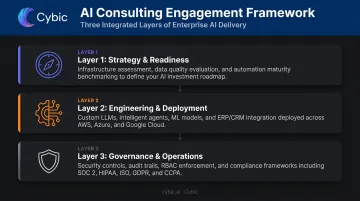
The governance layer deserves particular emphasis. In regulated industries like healthcare, financial services, and government, compliance frameworks cannot be added after the fact. They have to be architectural decisions made before a single model is deployed.
Why Businesses Need an External AI Consulting Partner
Most enterprises have data and a genuine desire to automate. What they typically lack is the cross-functional AI engineering expertise, the implementation methodology, and the change management experience required to move from pilot to production at scale.
McKinsey estimates that up to 70% of AI development effort goes toward wrangling and harmonizing data before any model work begins. Separately, Gartner projects that 60% of AI projects unsupported by AI-ready data will be abandoned through 2026. Both figures point to the same root cause: planning and methodology gaps, not technology limitations.
The three failure modes that external AI consulting partners help organizations avoid:
- Prioritizing visible but low-value workflows over high-volume, high-error processes with measurable ROI potential
- Building AI in isolation from existing ERP, CRM, or operational infrastructure - producing parallel systems that never get adopted
- Treating compliance as a post-deployment checklist in regulated industries where it's an architectural constraint from day one
A structured consulting engagement built around engineering delivery - not slide decks - addresses all three at the planning stage, before integration debt and governance gaps accumulate.
The AI Consulting Methodology: From Discovery to Deployment
Methodology, not the technology stack, is what separates AI consulting engagements that generate verified ROI from those that generate reports. The sequence below reflects how rigorous engagements are structured.
Phase 1 - Discovery and Process Mapping
Discovery is where the actual analytical work begins. Consultants map existing workflows, identify automation candidates by volume and error rate, assess data availability and quality, and estimate ROI per workflow. Treating discovery as a formality is the single most reliable predictor of a failed automation project.
Outputs from a structured discovery phase include:
- A process inventory documenting current workflows and handoffs
- A prioritized automation candidate shortlist ranked by ROI potential
- An integration requirements map covering existing systems and data sources
- A business case with projected return per automation initiative
Cybic's discovery process incorporates data landscape audits, architecture assessment, and gap analysis as structured inputs to the automation roadmap - not as administrative checkboxes.
Phase 2 - Strategy, Architecture, and Governance Design
The automation roadmap is built on three decisions: which processes to tackle first (highest ROI, lowest integration complexity), what AI systems to build or integrate (custom LLMs, agents, ML models, or platform-native tools), and what architecture ensures the solution works across the organization's existing infrastructure.
Infrastructure-agnostic design matters here. Solutions built to run only on one cloud platform create future constraints. Cybic designs across cloud, hybrid, and on-premises environments - including Snowflake, Databricks, Azure, AWS, and Google Cloud - so organizations retain flexibility as requirements change.
In regulated industries, governance must be embedded at the architectural level - not addressed after deployment:
- RBAC - role-based access controls limiting system access by function and authorization level
- Encrypted data handling - protection in transit and at rest
- Auditability - traceability of every AI-driven action and workflow decision
- Regulatory alignment - HIPAA, SOC 2, ISO, GDPR, and CCPA embedded at the architectural level, not bolted on after deployment
- No training on proprietary data - a strict governance policy protecting client intellectual property
Phase 3 - Implementation, Integration, and Change Management
Engineering-led implementation covers the full deployment cycle: building and integrating automation systems with existing ERP/CRM/operational tools, configuring monitoring and escalation logic, and validating performance under real operating conditions before full rollout. Projects run directly by experienced engineers - without translation through project management layers - close the gap between design intent and deployed reality.
Implementation steps in this phase typically include:
- Build and deploy automation systems against the defined architecture
- Integrate with existing ERP, CRM, and operational platforms
- Configure monitoring thresholds, alerting, and human escalation logic
- Validate performance in production-equivalent conditions before full rollout
Deployment success depends as much on people as on systems. Prosci research shows that projects with excellent change management are up to 7x more likely to achieve their objectives. Role redesign, team training, and adoption monitoring determine whether automated systems are used as intended - or quietly worked around.
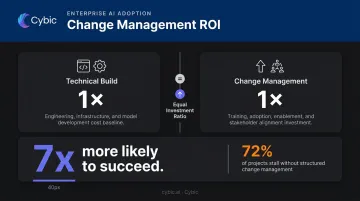
McKinsey data reinforces this: 72% of companies stall at the stage of replicating adoption across different environments, and organizations should plan to spend at least $1 on user adoption for every $1 spent on development.
Industries Leading AI-Driven Digital Transformation
Manufacturing and Energy/Oil & Gas
These industries operate in complex, high-stakes environments where AI must integrate with physical infrastructure, not just software systems.
In manufacturing, AI-driven automation is delivering measurable outcomes at scale. World Economic Forum data from 172 Global Lighthouse manufacturing sites shows an average 50% labor productivity boost, with AI-assisted process modeling reducing energy consumption by 22%, inventory by 27%, and scrap by 55%.
Siemens' Erlangen facility - running over 100 AI algorithms and digital twins - improved labor productivity by 69% and cut energy usage by 42%.
For energy and oil & gas, McKinsey estimates generative AI could create $390B to $550B in additional value across energy and materials sectors. Specific applications include:
- Predictive maintenance using unstructured inspection records previously unusable by traditional systems
- Seismic data interpretation using specialized generative AI models
- Safety workflow automation and real-time compliance documentation
Cybic deploys AI-powered asset monitoring, predictive maintenance, and field operations systems for oil & gas clients - with real-time visibility and workflow automation built directly into energy infrastructure.
Healthcare and Public Sector
Healthcare's automation opportunity is large and largely untapped. McKinsey data shows physicians and staff spend an average 13 hours per week on prior authorization alone - a process where AI can automate 50% to 75% of manual tasks.
Among health plan executives, 93% expect AI to add value through prior authorization automation.
The constraint isn't capability - it's governance. HIPAA compliance, PHI protection, and auditability requirements mean AI systems must be designed with regulatory controls embedded from the start. Cybic's healthcare deployments incorporate HIPAA-aligned governance frameworks, encrypted data handling, and strict policies against training on proprietary patient data - all designed into the architecture from day one.
In the public sector, federal AI adoption is accelerating sharply. Recent data points illustrate the pace:
- GAO data shows reported AI use cases nearly doubled from 571 in 2023 to 1,110 in 2024
- Generative AI use cases across federal agencies grew nine-fold in the same period
- Gartner predicts over 60% of government organizations will prioritize business process automation by 2026
Retail and Supply Chain
Retail and supply chain operations benefit most from AI systems that unify data from multiple sources into integrated intelligence - not isolated automation tools running in parallel.
Key automation opportunities include:
- Demand forecasting - time-series models predicting inventory needs across distributed networks
- Inventory optimization - ML-driven models reducing carrying costs and stockouts
- Supplier communication - automated coordination workflows triggered by supply chain signals
- Operational visibility - real-time dashboards connecting warehouse, logistics, and demand data
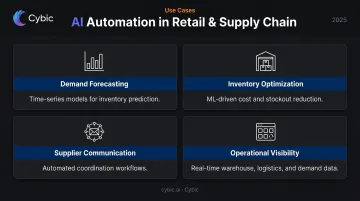
McKinsey's 2024 State of AI found that supply chain and inventory management was the function where organizations most commonly reported revenue increases of more than 5% from analytical AI.
What to Look for in an AI Consulting Partner
Not all AI consulting engagements are structured the same way. These five criteria separate partners that deploy operational systems from those that deliver expensive documents.
| Criterion | What to Ask |
|---|---|
| Engineering-led delivery | What percentage of your engagements result in production-deployed systems? |
| Governance embedded by design | How do you handle no-training-on-proprietary-data requirements and AI traceability for compliance audits? |
| Infrastructure-agnostic capability | Can your solutions operate across our existing cloud, hybrid, or on-prem environment without vendor lock-in? |
| Integrated intelligence vs. point tools | Do you build unified systems connecting data, automation logic, and AI models - or assemble collections of bolt-on tools? |
| Defined outcomes before build | How do you establish baseline metrics, and how are milestones tied to verified results rather than deliverable completion? |
The integrated intelligence criterion matters more than it appears. The gap between a unified AI platform and a collection of point tools widens with every new use case. Cybic's Drava platform connects enterprise data, machine learning, AI reasoning, and intelligent agents into a single governed operating layer. Separate tools require independent management, monitoring, and compliance tracking - costs that compound silently over time.
The engineering-led question is just as diagnostic. McKinsey research on digital leaders points to a 4:1 ratio of engineers to managers as a marker of execution capability. Every layer of project management between client requirements and technical delivery creates distance between what was designed and what actually ships.
Frequently Asked Questions
What are the four stages of process automation?
The four stages are: (1) task digitization, (2) rule-based RPA, (3) AI-enhanced automation with intelligent exception handling, and (4) autonomous process orchestration with self-improving AI agents. Most enterprises currently operate at stage 2 and need structured consulting support to advance to stages 3 and 4 effectively.
Will RPA be replaced by AI?
RPA isn't being replaced outright - it handles structured, rule-based tasks well and the market grew 14.5% to $3.6B in 2024. But AI-native automation is superseding RPA for complex workflows where exceptions, unstructured inputs, and adaptive decision-making are involved. Most of the remaining automation value sits in exactly those areas.
How long does an AI consulting engagement typically take?
Timelines vary by scope. Discovery phases typically run 2–6 weeks. Initial production deployments for targeted workflows can be achieved in 60–90 days. Enterprise-wide transformation programs generally run 6–18 months with phased rollouts across business units and functions.
How do you identify which business processes should be automated first?
Prioritization focuses on three factors:
- Process volume - high-frequency tasks yield faster ROI
- Error rate - manual processes with high error rates have the clearest business case
- Data availability - clean, accessible data reduces execution risk and time-to-value
What is the difference between AI consulting and digital transformation consulting?
Digital transformation consulting addresses broader organizational change - technology modernization, process redesign, operating model shifts. AI consulting specifically applies machine learning, LLMs, agents, and intelligent automation to embed intelligence into those operations. The strongest engagements combine both, with AI capabilities deployed within a broader transformation architecture.
How is AI governance handled in regulated industries like healthcare or energy?
Governance in regulated industries requires architectural-level controls: role-based access, encrypted data handling, auditability of AI-driven actions, and regulatory alignment with HIPAA, SOC 2, and sector-specific frameworks. These controls - including strict policies around proprietary data - must be designed in from the start; retrofitting them after deployment is expensive and rarely sufficient for audit requirements.