: Expert Guide](https://file-host.link/website/cybic-3idvzv/assets/blog-images/3d8a4706-d5f6-442b-89a2-04bdca974ee8/1780329374308522_4cf2d1521cbb4b669c4a421ad811326f/360.webp)
Introduction
Most US enterprises aren't debating whether to transform anymore. The question is why transformation keeps falling short despite growing budgets, expanded tooling, and executive commitment.
According to Gartner's 2024 survey, only 48% of digital initiatives meet or exceed business outcome targets. Meanwhile, BCG found that 74% of companies struggle to achieve and scale AI value - with just 26% capable of moving beyond proofs of concept into production systems that generate real returns.
The gap isn't technological. Organizations have more AI tools available than any prior generation of enterprise decision-makers. The gap is structural: strategy without execution, AI deployed on broken data, governance bolted on after launch.
AI and technology consulting for digital transformation exists specifically to close that gap - bridging the distance between AI ambition and the working systems that actually move the business forward.
Key Takeaways
- Most digital transformation failures stem from poor data readiness, absent governance, and AI applied to unresolved workflow problems - not inadequate technology.
- Effective AI consulting is engineering-led: it delivers working systems embedded in core operations, not strategy decks.
- Data infrastructure, governance, and workforce alignment must be in place before AI deployment.
- Industry-specific expertise matters; generic implementations consistently underdeliver in regulated or operationally complex environments.
- Evaluate partners on delivery evidence, infrastructure flexibility, and governance methodology - not presentation quality.
What AI and Technology Consulting for Digital Transformation Actually Means
AI and technology consulting for digital transformation starts with operational problem diagnosis and ends with AI systems embedded in core business workflows - not software purchases or platform migrations.
Advisory vs. Engineering: A Critical Distinction
Many organizations hire AI strategy consultants expecting AI implementation partners. The difference matters enormously:
- AI strategy consulting delivers roadmaps, vendor assessments, use case prioritization, and executive alignment frameworks.
- AI engineering and implementation consulting architects, builds, integrates, and deploys systems - then monitors them in production.
Firms like Cybic are differentiated precisely because they operate in the second category. Their stated principle - "execution over presentation" - means every engagement is structured around delivering working systems, not recommendations about working systems.
What Transformation Actually Changes
Done properly, AI-driven transformation reshapes more than technology stacks. It changes:
- How decisions are made (AI-assisted vs. manual judgment)
- How data flows across the organization
- How teams interact with automated processes
- How risk is monitored and managed
Consultants reframe transformation from an IT initiative to an enterprise-wide operational change. That framing affects resourcing, sponsorship, and accountability from the start.
Typical Engagement Scope
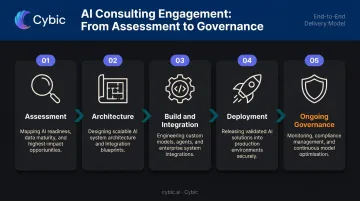
A structured AI and technology consulting engagement generally covers:
- Assessment: Map current workflows, evaluate data quality, and audit AI readiness before any architecture decisions are made.
- Architecture: Design the technology stack, prioritize use cases, and estimate total build cost.
- Build and integration: Develop data pipelines, train or fine-tune AI models, and connect systems via APIs.
- Deployment: Run pilot optimization, execute production rollout, and validate quality at each stage.
- Ongoing governance: Monitor model performance, track KPIs, and enforce compliance continuously.
The most effective engagements are infrastructure-agnostic. Cybic, for example, is designed to operate across cloud, hybrid, and on-premises environments without locking organizations into a single vendor ecosystem - which matters when integrating with diverse legacy infrastructure.
Why Most Digital Transformation Efforts Fail Without Structured AI Consulting
BCG reported that only 30% of digital transformations succeed. The primary reason isn't technology selection - it's that organizations treat transformation as a deployment project rather than an operational change initiative.
The "AI on Broken Workflows" Problem
This is the single most common and expensive error consultants are called in to fix retroactively. Deploying machine learning models or generative AI on top of fragmented, inconsistent, or incomplete data environments produces poor outputs regardless of how capable the underlying technology is.
IBM's 2024 research identified the top barriers to AI adoption as:
- Limited AI skills and expertise (33%)
- Too much data complexity (25%)
- Integration and scaling difficulty (22%)
These aren't technology problems. They're data, architecture, and organizational readiness problems - and they precede any AI deployment decision.
Leadership and Workforce Failure Modes
When executives sponsor transformation as an IT initiative rather than an enterprise priority, several predictable failures follow: conflicting signals across teams, absent governance, and resources misallocated toward tools rather than capability.
The workforce dimension compounds this. BCG found that only 30% of managers and 28% of frontline employees had been trained on how AI would change their jobs. When staff who previously understood processes manually are displaced by automation they can't interpret or correct, errors in automated workflows go undetected at scale.
Both failure modes - executive misalignment and undertrained workforces - have a compounding effect on the third: the infrastructure those teams are supposed to transform.
Legacy System Complexity
A substantial portion of enterprise infrastructure is decades old. ERP platforms, manufacturing execution systems, and financial processing environments can't be replaced wholesale.
The right consulting approach identifies where integration layers (middleware, APIs, carefully designed data pipelines) can introduce AI capabilities without destabilizing existing operations. Cybic's legacy modernization methodology, for instance, explicitly focuses on re-engineering workflows and integrating modern APIs around existing systems rather than requiring full replacement.
How AI Consulting Accelerates Enterprise Transformation: Core Service Areas
Operational Assessment and AI Readiness Audit
Before any technology is selected, consultants map current workflows, assess data quality across systems, and determine which constraints AI can realistically address versus which require process redesign first. This sequencing prevents wasted budget and failed rollouts.
Cybic's assessment phase specifically evaluates data landscape and quality, existing architecture, integration gaps, and AI readiness. The output is a structured roadmap that ranks use cases by business impact, so engineering effort starts where it delivers the most.
Data Infrastructure and Pipeline Architecture
AI systems require data that is complete, consistently formatted, and accessible across the organization. Consultants design and build:
- Unified data platforms (Snowflake, Databricks, Azure)
- ETL/ELT pipelines for real-time data ingestion and transformation
- Governance layers that enforce data ownership and access controls
- Compliance-aligned architecture for SOC 2, HIPAA, ISO, and GDPR
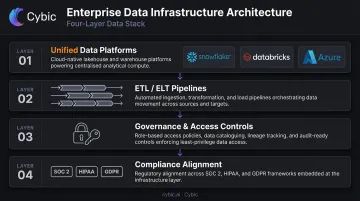
Cybic's Drava platform illustrates what this looks like in practice: it connects enterprise data, machine learning, and AI reasoning into a single governed system, replacing the fragmented tool stacks that most organizations inherit.
Custom AI and LLM Application Development
Off-the-shelf AI tools rarely address industry-specific operational requirements. Custom development includes:
- Domain-specific LLMs fine-tuned to a client's terminology and workflows
- Predictive models and computer vision systems for operational environments
- Enterprise copilots designed around specific decision-making structures
- Compliance-embedded model deployment with no training on proprietary client data
Intelligent Automation and Workflow Orchestration
Effective AI consulting goes beyond automating individual tasks. It designs orchestrated systems where automation logic, real-time data signals, and human decision points work together - with governance embedded throughout.
Cybic builds across RPA bots, intelligent document processing, and autonomous AI agents capable of goal-based reasoning and multi-agent collaboration, all within frameworks that maintain full auditability and oversight.
Measurement Frameworks Tied to Operational Outcomes
Each of these service areas requires defined success criteria from day one. Deloitte's 2024 research found that organizations using more than 80% of a structured KPI set were 22 percentage points more likely to realize value from digital investments. Effective consulting defines those metrics before deployment. Operational benchmarks include:
- Reduction in processing time
- Improvement in forecast accuracy
- Decrease in compliance incidents
- Error rates in automated workflows
Technology milestones like "system go-live" are delivery checkpoints, not success measures.
AI Governance and Data Readiness: The Non-Negotiables Before Deployment
Governance is an architectural requirement - and it must be designed in before deployment, not retrofitted after.
Why Governance Must Be Embedded from Day One
Without role-based access controls, AI decision auditability, data encryption, and clear output ownership, organizations face regulatory exposure they cannot retroactively remediate. IBM's 2024 research highlights the gap starkly: 83% of IT professionals say AI explainability is important, but only 41% are actually ensuring they can explain AI decisions.
Adding governance after deployment means rebuilding architecture. The cost is disproportionate to the cost of designing it in from the start.
Data Readiness as a Foundational Prerequisite
Organizations that skip data readiness assessments consistently hit the same wall: models that perform well in testing and break down in production. Cleaning, standardizing, and unifying data across legacy systems determines whether deployed AI produces reliable outputs. Cybic conducts data landscape audits and gap analysis before any model development begins.
Responsible AI and Regulated Industry Requirements
In healthcare, energy, and the public sector, governance must include:
- Continuous bias detection and fairness monitoring across model outputs
- Full traceability across every step of the decision chain
- Record-level auditability of automated decisions
- Strict data governance, with no model training on proprietary enterprise data
Cybic operationalizes these requirements through its core values of transparency, accountability, fairness, and security, embedded directly into architecture. Solutions align against SOC 2, HIPAA, ISO, GDPR, and CCPA from the design phase.
Industry-Specific AI Transformation Across Key Sectors
AI transformation is not uniform. The regulatory constraints, legacy infrastructure, and operational workflows of each industry require different expertise to navigate. Generic implementations underdeliver in regulated or complex environments.
| Industry | AI Maturity Signal | Key Use Cases |
|---|---|---|
| Manufacturing | 57% piloting AI; 28% in operational deployment (MLC, 2024) | Predictive maintenance, production monitoring, workflow coordination |
| Healthcare | 86% report AI use in their organizations (HIMSS/Medscape, 2024) | Clinical workflow automation, data governance, compliance-embedded AI |
| Oil & Gas | Compliance-intensive, distributed operations | Real-time safety monitoring, infrastructure surveillance, intelligent automation |
| Retail | Clear supply chain benchmarks | Demand forecasting, inventory optimization, operational visibility |
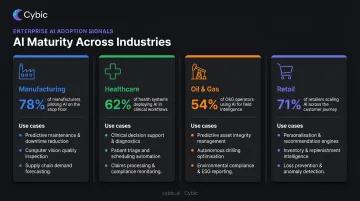
McKinsey estimates AI can reduce retail inventory levels by 20–30% through improved demand forecasting - a concrete benchmark that illustrates what operational AI looks like when the data and systems are properly configured.
In manufacturing, the top AI adoption obstacles are data issues (65%) and lack of appropriate skills (43%). Both are consulting prerequisites, not deployment-phase problems. In healthcare, ONC's HTI-1 rule establishes transparency requirements for AI in certified health IT, making governance expertise a structural requirement.
These sector-specific constraints are why solution design must be tailored from the start. Cybic works across manufacturing, healthcare, oil and gas, retail, and public sector engagements - designing compliance-aligned healthcare platforms and real-time infrastructure monitoring systems for energy operations built to each sector's operational and regulatory requirements.
How to Choose the Right AI and Technology Consulting Partner
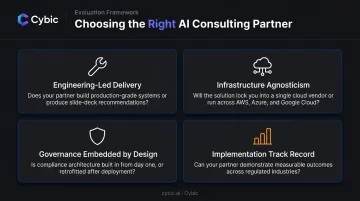
Choosing the wrong consulting partner doesn't just delay results - it can lock your organization into architectures and dependencies that take years to undo. Evaluate any prospective partner against these criteria before engaging:
- Engineering-led delivery - Can the partner build and deploy, or do they stop at strategy?
- Infrastructure agnosticism - Do their solutions work across your existing environment without forcing vendor replacement?
- Governance embedded by design - Is compliance architectural, or is it bolted on?
- Implementation track record - Can they show operational metrics improvement from prior engagements in your sector?
Practical Questions to Ask
Before committing to a consulting engagement, put these questions to any prospective partner:
- Do you begin with an operational audit or a platform pitch?
- Can you integrate with our existing infrastructure without requiring full replacement?
- How do you handle AI model governance and monitoring after deployment?
- Can you demonstrate examples of operational metrics improvement - not just go-live dates - from clients in our industry?
- What is your policy on training models on proprietary client data?
- How are your engineers structured relative to your strategists - who actually builds?
A firm that answers question 6 by describing a handoff between strategy and implementation teams has just told you where accountability ends. When the people who design the solution aren't the ones building it, gaps appear - and your organization absorbs the cost.
The red flags below follow the same logic: they signal consulting models built around billable hours, not delivered outcomes.
Watch for These Red Flags
- Long-term lock-in required before any results are demonstrated
- Solutions that require full infrastructure replacement rather than integration
- Governance described as a post-deployment step
- Portfolio dominated by strategy documents rather than working systems
- No demonstrated experience with your industry's specific regulatory environment
Frequently Asked Questions
What is AI and technology consulting for digital transformation?
AI and technology consulting for digital transformation embeds AI into core business workflows to produce measurable operational outcomes. It spans AI engineering, data infrastructure design, and change management - starting with operational problem diagnosis and ending with governed AI systems running in production.
How is AI consulting different from traditional digital transformation consulting?
AI consulting adds specific expertise in data readiness, model deployment, intelligent automation, and governance frameworks. The most effective modern consulting merges both disciplines - the operational change management of traditional transformation work with the engineering depth required to deploy AI reliably.
What are the most common reasons digital transformation projects fail?
The leading failure modes are treating transformation as an IT project rather than an enterprise-wide program, deploying AI on unprepared data environments, skipping governance design, and underinvesting in workforce capability alignment. Technology selection is rarely the root cause.
How long does an AI-driven digital transformation engagement typically take?
Phased engagements that start with high-ROI use cases can deliver measurable operational results within the first quarter. Broader deployment follows as data infrastructure and governance mature - exact timelines depend on organizational readiness, legacy complexity, and migration scope.
What is AI governance and why does it matter in digital transformation?
AI governance is the operational framework controlling how AI is used, who oversees its outputs, and how decisions are audited. Without it, organizations face regulatory exposure, cannot explain or correct AI-influenced outcomes, and lose the ability to catch errors in automated workflows before they compound.
How do you assess whether your organization is ready for AI-driven transformation?
Evaluate data quality and accessibility, executive alignment on transformation goals, and whether governance infrastructure exists. If data is fragmented across siloed systems and no one owns AI output accountability, that foundational work must come before any deployment timeline.