Introduction
US manufacturers are being squeezed from multiple directions at once. Labor costs are climbing, supply chains remain volatile, and global competition keeps intensifying. According to Deloitte's 2024 Manufacturing Industry Outlook, over 80% of manufacturing executives cite workforce and operational efficiency as their top strategic priorities. The manufacturers responding most effectively aren't waiting for conditions to stabilize - they're using AI workflow automation to reduce their exposure now.
But recognizing the need to automate and actually automating are two different problems. Most manufacturers have the intent, and many have run pilots. Far fewer have working systems in production. That gap - between a proof of concept and an operational system embedded in real workflows - is exactly where AI consulting earns its value.
This article covers where AI consulting delivers measurable ROI in manufacturing, why off-the-shelf AI consistently fails on the factory floor, what a credible engagement actually looks like phase by phase, and what to demand from any consulting partner before committing.
Key Takeaways
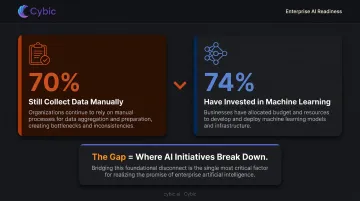
- 70% of manufacturers still collect data manually - making data architecture the first consulting priority, not model selection
- Predictive maintenance, quality inspection, production scheduling, and supply chain coordination deliver the highest documented ROI from AI automation
- Off-the-shelf AI fails in manufacturing environments where legacy systems are fragmented, data entry is manual, and physical constraints don't bend to generic models
- The right consulting partner combines manufacturing domain expertise, engineering execution, and governance built into the architecture from day one
- Cybic's engineering-led model delivers working systems in production - not strategy decks waiting for someone else to build them
The Manufacturing Automation Gap: Why the Window Is Narrow
The Data Problem Nobody Talks About
According to NAM's Manufacturing Leadership Council, 70% of manufacturers still collect data manually - even as 74% have invested or planned to invest in machine learning. That gap between AI ambition and data reality is where most automation initiatives break down before they start.
The volume pressure compounds the problem. Forty-four percent of manufacturing leaders report their collected data has at least doubled over the prior two years. More data, manually captured, flowing into fragmented systems: that's the foundation most AI initiatives are being built on.
Adoption is accelerating regardless. Industrial IoT infrastructure costs have dropped, ML tooling has matured, and the performance gap between early movers and late adopters is widening every quarter. Manufacturers who establish production-grade AI workflows now will compound efficiency gains for years. Those who wait are losing ground they won't recover easily.
Pilot Purgatory: The Real Bottleneck
That data foundation problem doesn't just delay AI initiatives - it kills them. Gartner predicted in 2024 that at least 30% of GenAI projects would be abandoned after proof of concept by end of 2025, citing poor data quality, inadequate risk controls, escalating costs, and unclear business value.
The problem isn't the AI. It's what surrounds it:
- Pilots run in isolated environments with no connection to live MES or ERP systems
- No defined ownership, audit framework, or escalation path for AI-driven decisions
- Operators excluded from design don't trust the output and don't use it
AI consulting exists specifically to close these gaps. A model that performs well in a demo environment but can't connect to your MES or scale past a single line has delivered nothing. The consulting engagement is what bridges the gap between a demo that works and a system that runs in production - with governance, integration, and operator buy-in built in from the start.
Key Manufacturing Workflows AI Consulting Can Automate
Predictive Maintenance
This is consistently the highest-ROI starting point for manufacturing AI. Models trained on sensor data - vibration, temperature, pressure, acoustic signatures - shift maintenance from calendar-based to condition-based, catching failures before they cause unplanned stops.
The business case is concrete. Unplanned downtime costs the world's 500 largest companies approximately $1.4 trillion annually, equivalent to 11% of revenue, according to Siemens' 2024 downtime report. In automotive specifically, idle-line downtime has reached $2.3M per hour. Even modest downtime reduction produces returns that justify the consulting investment within months.
Cybic's AI automation and predictive maintenance capabilities are designed specifically for production monitoring across complex manufacturing environments, connecting sensor data to actionable maintenance signals within the existing operational workflow.
Quality Control and Visual Inspection
Computer vision systems can inspect parts at full production speed, flagging defects that manual inspection misses or can't physically check at scale. Audi's AI spot-weld quality system analyzes approximately 1.5 million spot welds from 300 vehicles per shift - a volume no human inspection process can match.
Before the rollout, staff checked roughly 5,000 spot welds per vehicle manually. The system now routes them to anomalies rather than routine checks.
Two points matter for implementation:
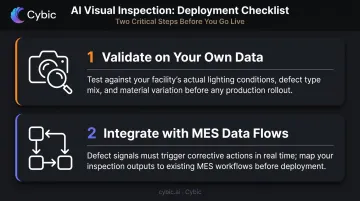
- Accuracy figures from vendor demos don't transfer directly to your production environment. Lighting conditions, defect types, and material variation all affect performance. Validation on your own data is non-negotiable before go-live.
- Visual inspection AI only closes the quality loop when it integrates with MES data flows, so defect signals actually trigger corrective actions rather than just generating alerts nobody acts on.
Production Scheduling and Workflow Orchestration
Static, spreadsheet-based scheduling creates real capacity constraints: it can't respond to machine states, shifting order priorities, or supply disruptions in real time. AI-driven scheduling systems dynamically allocate machines, labor, and materials against real-time demand signals, accounting for the constraint changes that spreadsheets handle poorly.
A Siemens case presented at Gartner's 2025 Supply Chain Planning conference documented a 20% boost in factory output attributed to intelligent scheduling. One case, not a universal benchmark, but it shows what becomes possible when scheduling logic runs on real-time production data rather than yesterday's plan.
Cybic's Drava platform connects enterprise data, ML models, and intelligent agents into unified production workflows, bridging ERP, MES, and supply chain systems so scheduling decisions reflect operational reality rather than last week's plan.
Supply Chain and Inventory Coordination
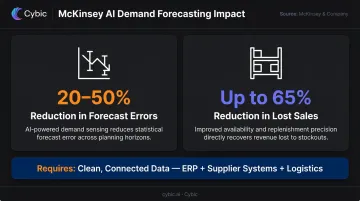
McKinsey's operations analysis found that AI-driven supply-chain forecasting can reduce forecast errors by 20% to 50% and reduce lost sales and product unavailability by up to 65%. For manufacturers dealing with raw material cost volatility - 40.52% of manufacturers cited increased raw material costs as a top concern in NAM's Q4 2024 survey - better forecasting directly protects margin.
That performance depends on one prerequisite: clean, connected data. ML forecasting models need integrated inputs from ERP, supplier systems, and logistics platforms. Building that integration layer is consulting work that has to happen before the models can run.
Back-Office and Compliance Automation
Purchase order processing, invoice matching, payroll exception flagging, and regulatory compliance tracking don't generate headlines, but they often deliver faster ROI than shop-floor automation. The reason: the underlying data is already structured, and the systems are more accessible than SCADA or legacy machine controllers.
Cybic's intelligent automation capabilities, including RPA, Intelligent Document Processing, and AI-powered rule-based task handling, handle these workflows end-to-end, with governance controls ensuring auditability across every automated action.
Why Generic AI Solutions Fail in Manufacturing Environments
The Legacy System Reality
Most plant floors run SCADA systems, MES, ERP platforms, and proprietary machine controllers from different eras - none designed to share data. Approximately 75% of firms still use factory historians, according to Siemens, and those historians often require contextualization before AI workflows can use them.
Generic AI solutions assume clean, standardized, accessible data. That assumption fails in most manufacturing environments. Deloitte's 2025 research found nearly 70% of manufacturers cite data quality, contextualization, and validation as the most significant obstacles to AI implementation.
This is why credible consulting engagements begin with a data architecture audit - not a model selection conversation.
Physical Constraints Don't Negotiate
The shop floor tolerates less ambiguity than almost any other AI deployment context. A language model can hedge; a quality inspection system on an automotive line cannot. When a weld needs to meet specification, there is no confidence interval that satisfies the requirement.
Generic models trained on broad industrial datasets introduce accuracy risk in precision environments. Effective shop-floor AI must be validated against the specific materials, tolerances, and conditions of that plant. That demands:
- Manufacturing domain knowledge to interpret process data correctly
- Engineering rigor to validate model outputs against physical tolerances
- Plant-specific calibration - not broad industrial averages
The Tribal Knowledge Problem
Consider the technician who knows Machine 7 runs hot above a certain humidity, or the process engineer who can diagnose a bearing failure by sound. That expertise - built over years - exists entirely in people's heads. When those workers retire, it disappears.
RAG-based systems applied to shift logs, maintenance records, and SOPs can preserve this knowledge as a queryable operational asset. Every operator and engineer on the floor gains access to decades of practical insight - instead of watching it walk out the door at retirement. For many manufacturers, this is where AI consulting delivers its clearest, fastest return.
Governance and Safety Gaps
Manufacturing environments involve regulated processes, safety-critical decisions, and proprietary production data. AI systems deployed without role-based access controls, audit trails, and data governance frameworks create compliance exposure - not just operational risk.
Generic AI tools aren't built with these constraints in mind. Governance must be embedded at the architectural level - not patched in after deployment. Cybic's manufacturing engagements include:
- Role-based access controls (RBAC) scoped to operational roles and data sensitivity
- Encrypted data protection in transit and at rest
- Full auditability of AI-driven actions and workflow decisions
- A strict no-training policy - proprietary production data is never used to train models
What an AI Consulting Engagement for Manufacturing Actually Looks Like
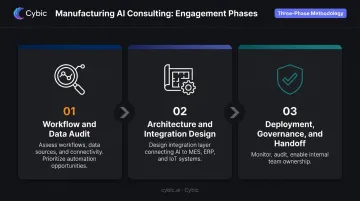
A credible manufacturing AI engagement follows three phases. The sequence matters - skipping Phase 1 is how pilots become expensive failures.
Phase 1 - Workflow and Data Audit
Assessment covers existing workflows, data sources, system connectivity, and automation readiness. The output is a prioritized list of which workflows are high-value, data-accessible, and low-risk to automate first - and which require infrastructure groundwork before any AI can be applied.
This phase surfaces the real constraints: where data is manual, where systems don't connect, and where governance requirements will shape architecture choices.
Phase 2 - Architecture and Integration Design
Before any model is built, the integration layer connecting AI outputs to operational systems (MES, ERP, IoT feeds) must be designed. This is where most internal teams lack capacity.
It's also where engineering-led consulting firms separate from strategy-only advisors. A firm that delivers a design document and hands implementation to the client leaves a gap between what was recommended and what actually gets built. Cybic's engineering-led model means the same team that designs the architecture builds and integrates it - closing that gap by design.
Phase 3 - Deployment, Governance, and Handoff
Production deployment in manufacturing requires:
- Monitoring frameworks that catch model drift and data quality issues
- Human-in-the-loop checkpoints for high-stakes decisions
- Audit trails for every AI-driven action
- Internal team enablement so the client can own and maintain the system after go-live
A complete engagement delivers all of this. Without it, even a well-trained model becomes a liability the moment something breaks in production.
What to Look for in an AI Consulting Partner for Manufacturing
| Criteria | What to Ask |
|---|---|
| Manufacturing domain experience | Ask for case studies from manufacturing specifically - not analogous verticals |
| Engineering execution | Ask who owns integration work and how the firm handles the design-to-deployment gap |
| Governance architecture | Ask how RBAC, audit trails, and data governance are embedded - not added after deployment |
| Infrastructure flexibility | Ask whether solutions are locked to a single cloud vendor or can operate across configurations |
MES, PLM, ERP, and industrial IoT ecosystems have specific behaviors and constraints that domain-naive teams consistently underestimate. Integration timelines stretch. Assumptions about data availability prove wrong. Consultants without direct manufacturing experience encounter these problems after the engagement has started - which is when they become expensive.
Engineering execution separates firms that deliver from firms that present. The key question is direct: does your team build and deploy, or do you hand off after design? Cybic structures every engagement around working systems - not strategy decks - with engineers who architect, build, and integrate without translation gaps.
For manufacturing environments handling proprietary production data or regulated processes, governance built in from day one is non-negotiable. Cybic's governance-by-design approach embeds security controls at the architecture level, including:
- Role-based access controls (RBAC)
- Encrypted data protection in transit and at rest
- Full auditability of AI-driven actions
- A strict no-training-on-client-data policy
This is the baseline manufacturers should require from any AI partner - not a feature bolted on after deployment.
Infrastructure flexibility protects long-term optionality. Vendor lock-in creates real costs when requirements shift - whether that means adding an on-premise layer for sensitive production data or migrating between cloud providers. Cybic deploys across AWS, Azure, Google Cloud, hybrid, and on-premise configurations, giving manufacturers control over their environment as needs evolve.
Frequently Asked Questions
Which AI is best for workflow automation in manufacturing?
The right approach depends on the workflow, data availability, and existing system architecture. Production-grade manufacturing automation typically combines ML models for prediction, computer vision for inspection, and orchestration layers that connect AI outputs to MES and ERP systems.
How much does an AI consulting engagement cost?
Costs vary based on scope, workflow complexity, integration requirements, and whether the partner handles full deployment or strategy only. Key drivers include the number of lines or plants, data readiness, MES/SCADA/ERP integration complexity, and governance requirements - so require an itemized scope and cost-to-value model before committing.
What manufacturing workflows are best suited for AI automation?
Predictive maintenance, quality inspection, production scheduling, and supply chain coordination have the most documented ROI. Back-office processes (purchase order matching, invoice processing, compliance tracking) are often faster to automate because the underlying data is already structured and more accessible than shop-floor systems.
Can AI consulting partners integrate with existing MES and ERP systems?
Experienced partners design integrations into MES, ERP, SCADA, and PLM systems as a core deliverable - not an add-on. This integration architecture phase is typically what separates partners who deliver working production systems from those whose implementations stall at pilot.
How long does AI workflow automation take to implement in manufacturing?
Back-office automations with structured data can reach production in 8–12 weeks. Complex shop-floor deployments involving MES integration, sensor infrastructure, and model validation typically take 4–9 months for the first production-ready workflow. Data readiness and the number of system integrations are the primary timeline drivers.
What's the difference between AI consulting and traditional IT consulting for manufacturing?
Traditional IT consulting focuses on system selection, implementation, and support within defined parameters. AI consulting covers workflow analysis, model development, integration architecture, and ongoing governance of systems that learn and adapt. That scope requires different skills and a longer post-deployment ownership model than conventional IT projects.