Introduction
78% of organizations now use AI in at least one business function, yet only 1% of executives describe their AI rollouts as mature. That gap is an integration problem, not a technology one.
Generic AI tools can summarize documents and answer questions. What they can't do is connect to your proprietary data, enforce your compliance policies, or operate within the specific logic that makes your workflows function - which is why most deployments stay shallow.
This guide covers:
- What custom AI application development involves and when it outperforms off-the-shelf tools
- How the development process works, phase by phase
- What governance and cost decisions look like in practice
- The patterns that separate enterprise AI projects that reach production from those that stall in pilot
Key Takeaways
- Generic AI tools fail in enterprise contexts because they can't access proprietary data or enforce compliance requirements
- Custom AI apps are architecturally integrated with internal data, access controls, and business logic from the ground up
- Gartner predicts at least 30% of gen AI projects will be abandoned after proof of concept - poor data quality and skipped governance are the main causes
- Most development timelines run 6 weeks to 12+ months depending on complexity
- Governance, security, and monitoring must be embedded at the architecture stage, before a single line of production code is written
What Is AI Custom Application Development?
Custom AI application development means designing and building software that embeds AI capabilities specifically tailored to an organization's workflows, data environment, and business logic - built from the ground up or by substantially extending existing systems.
Unlike off-the-shelf tools, custom AI is architecturally integrated with:
- Internal data sources (databases, document repositories, operational systems)
- Access control frameworks specific to the organization
- Existing enterprise infrastructure - ERP, CRM, SCADA, or otherwise
- Domain-specific decision logic that generic models don't have
What Gets Built
The types of custom AI applications enterprises are actually deploying today:
- AI copilots for internal decision support, surfacing relevant context to analysts, clinicians, or operations staff
- Automated workflow orchestration systems that coordinate multi-step processes across departments or systems
- Predictive and diagnostic tools built on proprietary historical data - maintenance forecasting, demand prediction, risk scoring
- Document intelligence platforms that extract, classify, and act on information from unstructured text
- Domain-specific conversational AI trained on proprietary content and constrained by organizational policy
Cybic engineers solutions across these categories, deploying on cloud, hybrid, and on-premises environments depending on data residency and compliance requirements.
Custom AI Apps vs. Off-the-Shelf AI Tools
Off-the-shelf AI tools are designed for broad, generalizable use cases. For simple tasks, that's useful. For enterprise operations, it's a hard constraint.
A generic tool doesn't know your product catalog, your maintenance history, your regulatory obligations, or the decision context your analysts work in. It produces outputs, but those outputs lack the business logic and operational context that make them actionable. The comparison below captures where that gap becomes a real decision point.
The Core Trade-Offs
| Dimension | Off-the-Shelf Tools | Custom AI Applications |
|---|---|---|
| Deployment speed | Weeks | Months to a year+ |
| Upfront cost | Lower | Higher |
| Data integration | Limited or none | Full integration with internal sources |
| Business logic fit | Generic | Built to your specific workflows |
| Compliance control | Vendor-dependent | Architecturally embedded |
| Vendor dependency | High | Minimal |
| Long-term ROI | Diminishing past basic use | Compounds with operational depth |
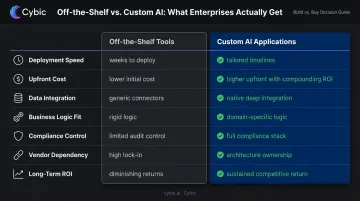
McKinsey data confirms the speed tradeoff is real: highly customized projects are 1.5x more likely to take five or more months compared to off-the-shelf approaches. That's a real cost. It's also what separates a tool that supports your operations from one that's built to run them.
When Custom Development Is the Right Path
Four signals indicate custom is the appropriate choice:
- The business process is unique to your organization and doesn't map to any generic tool's assumptions
- Data cannot leave internal infrastructure - whether due to regulation, policy, or competitive sensitivity
- The AI must integrate with legacy systems that off-the-shelf tools don't support
- The application must operate under specific compliance mandates (HIPAA, GDPR, SOC 2, industry-specific standards)
If none of those apply, off-the-shelf may be the faster and cheaper answer.
Key Use Cases: Where Custom AI Apps Deliver the Most Value
Custom AI delivers outsized value where operational complexity, data sensitivity, and regulatory requirements make generic tools inadequate - and the evidence is clearest in energy, manufacturing, healthcare, public sector, and retail supply chain.
Operational AI in Energy and Manufacturing
Predictive maintenance is one of the strongest-evidenced AI use cases in industrial settings. Deloitte reports that AI-driven predictive maintenance can increase equipment uptime by 10–20%, reduce maintenance planning time by 20–50%, and cut overall maintenance costs by 5–10%.
Those results depend on access to the right data: sensor telemetry, maintenance logs, historical work orders, equipment specifications. Generic tools can't reach that data. Custom applications built to integrate with operational databases and asset monitoring systems can.
What this looks like in practice:
- Real-time production monitoring with anomaly detection
- Safety compliance automation across distributed infrastructure
- AI-assisted maintenance copilots that surface relevant history before technicians engage equipment
- Workflow coordination across factory floors and field operations
Healthcare and Public Sector Intelligence
Predictive AI adoption in U.S. non-federal acute care hospitals rose from 66% in 2023 to 71% in 2024, according to ONC/HealthIT. The growth is real, and so is the compliance burden that comes with it.
HIPAA's technical safeguard requirements are specific: access controls, audit controls, integrity controls, and transmission security must all be addressed for any system processing electronic protected health information. Off-the-shelf AI tools cannot reliably enforce these controls. Purpose-built applications can, when governance is embedded at the architecture level from day one.
Healthcare and public sector use cases Cybic builds for:
- Clinical workflow augmentation - AI that reads structured and unstructured patient data to surface clinically relevant context
- Healthcare data governance platforms with full HIPAA alignment
- Public sector document processing (the GAO uses AI to identify legislation and flag audit mandates - a direct parallel to what enterprise public-sector clients need)
- Inter-agency data integration with role-based access and audit trails
Retail and Supply Chain Optimization
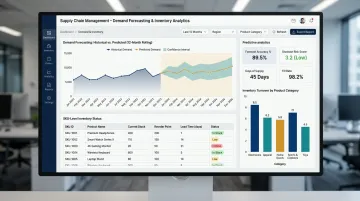
The value in retail AI comes from proprietary data - not generic market signals. An organization's own order history, SKU-level demand patterns, supplier lead times, and inventory positions contain signal that no external dataset replicates.
McKinsey research on supply chain AI shows inventory reductions of 20–30% through improved demand forecasting with dynamic segmentation and machine learning. In the same research, 53% of respondents reported revenue increases and 61% reported cost reductions in supply chain functions.
Custom AI applications for retail and supply chain typically involve:
- Demand forecasting models trained on proprietary SKU, supplier, and historical order data
- Intelligent inventory management that integrates with existing ERP and warehouse systems
- Supply chain visibility platforms that surface anomalies and recommend corrective actions
The AI Custom Application Development Process
Custom AI development isn't a single event. It's an iterative, phased process. The most common reason projects fail is skipping discovery and architecture to jump straight to model selection or code.
Discovery and Requirements Definition
This phase does more than gather requirements. Done well, it determines whether the project is even viable.
Key activities:
- Define the specific business problem the application must solve (not the AI features - the actual operational problem)
- Map the user journey and all workflows the AI will touch
- Inventory data sources: internal databases, APIs, documents, operational systems
- Document compliance and access control requirements
- Set measurable success criteria before any architecture decisions are made
This phase also surfaces the right technical approach. Whether RAG, fine-tuning, agentic orchestration, or a combination is appropriate depends entirely on the data environment and the problem being solved - not on which technology is newest.
Architecture and AI Model Strategy
With requirements defined, architectural decisions follow:
- RAG vs. fine-tuning vs. custom-trained models: RAG is the right choice when answers must come from authoritative internal documents. Fine-tuning fits better when the model needs to perform specific task types consistently. Both can be combined for complex applications.
- Data pipeline design: how internal data sources connect to the AI layer, what transformation is required, and how freshness is maintained
- Agent orchestration: for multi-step workflows, how agents are structured to execute and coordinate tasks
- Infrastructure: cloud, hybrid, or on-premises, driven by data residency requirements, latency needs, and compliance obligations
Cybic architects across AWS, Azure, and Google Cloud, as well as hybrid and on-premises configurations for clients where data can't leave controlled environments.
Integration, Development, and Governance
This is where the application gets built - and where governance decisions made at the architecture stage pay off.
The build phase covers:
- Integrating the AI layer with existing systems (ERP, CRM, operational databases, document repositories)
- Implementing RBAC across all data access paths
- Setting up encrypted data pipelines (in transit and at rest)
- Embedding auditability and traceability of AI-driven decisions
- Enforcing data governance policies - including ensuring proprietary data is not used to train external models
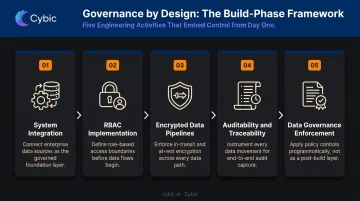
Cybic's governance-by-design approach means these controls are architectural requirements, not compliance checklists.
The Drava platform, Cybic's enterprise Data Intelligence to Automation platform, embeds AI workflow orchestration, security controls, and governance frameworks at the foundation level rather than layering them on after the core system is built.
Testing, Evaluation, and Deployment
Testing AI applications differs from testing traditional software. Non-deterministic outputs require rubrics and scoring criteria, not simple pass/fail checks. Evaluation should cover:
- AI output accuracy against representative real-world inputs
- Edge case coverage for failure modes relevant to the specific domain
- User acceptance testing with actual end users, not proxy testers
- Automated evaluation runs for consistency and regression detection
Passing evaluation doesn't end the process. Post-launch monitoring is an operational requirement, not an afterthought.
Model drift (where performance degrades as real-world data distributions shift over time) is a documented risk in production AI systems. Monitoring should cover accuracy regression, input distribution changes, and compliance adherence, with retraining or prompt refinement cycles triggered by defined thresholds rather than ad-hoc reviews.
Cost, Timeline, and Governance
Understanding Cost Factors
No reliable industry benchmark exists for categorical custom AI development pricing - costs vary too much based on scope. The primary drivers to budget for:
- Discovery and architecture design
- Data preparation and pipeline engineering (often the most underestimated line item)
- Model selection, fine-tuning, or RAG implementation
- Integration with existing systems
- Security and governance framework setup
- Testing, evaluation, and user acceptance work
- Post-deployment monitoring and maintenance
Simpler automation-focused applications cost significantly less than complex multi-agent platforms with deep data integrations and regulated data environments. Gartner identifies escalating costs, alongside poor data quality and unclear business value, as a top reason AI projects are abandoned after proof of concept. Scoping and cost control start in discovery, not development.
How Long Does Custom AI App Development Take?
A realistic framework by project complexity:
| Project Type | Typical Timeline |
|---|---|
| Simple AI-powered workflow automation | 6–12 weeks |
| Mid-complexity RAG or agentic application | 3–6 months |
| Full enterprise platform with multi-system integration and compliance | 6–12+ months |
The longest phases are typically data preparation and compliance review, not the model layer. Organizations that underestimate data readiness work consistently find it becomes the project's critical path.
Governance, Security, and Compliance as Non-Negotiables
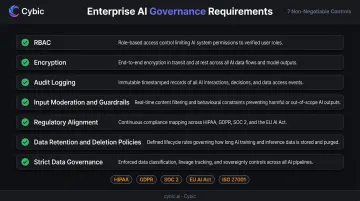
For enterprise AI applications, governance is not a post-launch concern. The controls that need to be architecturally embedded from day one:
- RBAC for all data access paths
- Encryption in transit and at rest
- Audit logging of AI-driven decisions and actions
- Input moderation and guardrails appropriate to the domain
- Regulatory alignment - HIPAA, GDPR, SOC 2, EU AI Act, NIST AI RMF, and applicable industry standards
- Data retention and deletion policies defined before data flows into the system
- Strict data governance including no proprietary data used to train external models
Build vs. Partner: When to Engage an AI Engineering Firm
Internal teams can build custom AI applications when they have strong ML engineering, data engineering, DevOps, and governance capabilities working together. Most enterprise teams have some of these skills in place. Few have all of them.
Engaging an external AI engineering partner makes sense when:
- The project involves complex multi-system integration that the internal team hasn't executed before
- The application operates in a regulated industry with compliance requirements that must be architecturally enforced
- No established ML infrastructure exists internally
- Delivery timeline is a constraint and the team can't staff the specialized skills quickly enough
Best Practices for Successful Custom AI Development
Start Narrow, Then Scale
Enterprise AI projects most often stall because of scope, not technical failure. Pursuing too many capabilities at once means nothing reaches production.
Identify the single highest-leverage use case: the workflow where AI provides the clearest, most measurable value. Build a focused MVP around that. Expand only after it's in production and delivering results.
Prioritize Data Readiness Before Model Selection
The ceiling on any custom AI application's quality is the quality of the data it can access. Before any model decisions are made:
- Inventory and audit all relevant internal data sources
- Address completeness, labeling consistency, and quality issues
- Establish governance policies for how data flows into and out of the AI system
Model selection should follow data strategy, not precede it.
Embed Security and Governance from Day One
Data readiness and security go hand in hand. The controls that should be in place at launch:
- RBAC for all data access paths
- Encryption in transit and at rest
- Input moderation and output guardrails
- Audit logging of all AI-driven decisions
- Defined data retention and deletion policy
Controls retrofitted after development are more expensive to implement and less effective than those built into the architecture from the start.
Plan for Monitoring and Iteration as Ongoing Work
Custom AI applications are not ship-and-forget products. Model drift is real - JAMA Health Forum defines it as the degradation of initially accurate model performance over time through dataset and concept drift. IEEE review evidence confirms that monitoring production ML applications is necessary to detect drift, data distribution changes, and silent failures.
Teams should budget for ongoing monitoring, periodic evaluation cycles, and structured feedback loops from launch. Post-launch maintenance is a core operational function, not an optional addition.
Frequently Asked Questions
Frequently Asked Questions
How much does AI custom application development cost?
Costs vary significantly by complexity. Focused automation tools start in the tens of thousands of dollars; full-scale enterprise platforms run into the hundreds of thousands or more. The main cost drivers are data integration complexity, model strategy, governance requirements, and ongoing maintenance scope.
How can I use AI for custom application development?
There are two approaches: building custom applications that embed AI capabilities (LLMs, ML models, intelligent automation) directly into workflows, or using AI-assisted tools to accelerate the build process itself. The right path depends on whether the goal is an AI-powered product or faster software delivery.
What is the difference between custom AI apps and off-the-shelf AI tools?
Off-the-shelf AI tools are built for general use cases and cannot integrate with proprietary data, specific compliance requirements, or unique business logic. Custom AI applications are engineered from the ground up to operate within an organization's infrastructure, workflows, and regulatory environment - not adapted from a generic model.
How long does it take to build a custom AI application?
Simple workflow automation typically takes 6–12 weeks. Mid-complexity applications with RAG or agentic workflows run 3–6 months. Full enterprise platforms with multi-system integration and compliance requirements take 6–12+ months. Data preparation and compliance review are usually the longest phases, not the model layer.
What industries benefit most from custom AI application development?
The industries that benefit most are those where operational complexity, data sensitivity, or regulatory requirements exceed what off-the-shelf tools can handle - manufacturing, healthcare, energy/oil and gas, retail supply chain, and public sector. Deep data integration needs and compliance mandates are the consistent triggers.
What are the biggest risks of custom AI application development?
The primary risks are scope creep from over-ambitious initial builds, inadequate data quality undermining model performance before development starts, governance and security gaps when controls aren't embedded architecturally, and model drift post-deployment if monitoring isn't planned from the outset.