Introduction
Most enterprises buying cloud software face the same problem: the software was built for someone else's business. Generic SaaS products are designed around the median use case, which means healthcare providers, oil and gas operators, manufacturers, and public sector agencies routinely find themselves bending their actual workflows to fit a vendor's predefined feature set.
Pendo's Feature Adoption Report found that 80% of features in the average software product are rarely or never used - and just 12% of features generated 80% of daily usage. That mismatch is exactly what custom cloud application development is designed to solve.
This guide is written for enterprise decision-makers, IT leaders, and technology stakeholders where off-the-shelf software consistently falls short.
It covers what custom cloud application development actually is, why organizations pursue it, how the end-to-end process works, what separates successful projects from failed ones, and where the approach is most commonly misapplied.
Key Takeaways
- Custom cloud application development means building software to fit your workflows - not adapting your operations to fit a vendor's product
- It matters most in regulated, data-intensive industries where SaaS creates compliance gaps, integration failures, or workflow misalignment
- The process runs from discovery through architecture, development, testing, deployment, and continuous monitoring
- The most common failure points: security bolted on late, integration complexity underestimated, and governance skipped at the architecture stage
What Is Custom Cloud Application Development?
Custom cloud application development is the end-to-end practice of designing, building, and deploying software applications specifically designed and built for cloud environments. Two categories are frequently confused with it - and neither qualifies.
Lift-and-shift migration moves an existing application to a cloud server. The software runs in a new location, but the underlying constraints - data models, access controls, integration limitations - stay exactly as they were.
SaaS procurement means subscribing to a prebuilt product and accepting the vendor's data model, feature roadmap, and security assumptions. Custom development starts from the business's actual requirements, not a vendor's interpretation of the average customer.
Where It Fits Among Related Concepts
| Term | What It Means | Relationship to Custom Cloud Development |
|---|---|---|
| Cloud-native development | A delivery philosophy using containers, microservices, and managed services | A methodology applied within custom development |
| Cloud migration | Moving existing workloads to cloud infrastructure | A separate operational effort; may or may not produce custom applications |
| SaaS | Subscribing to prebuilt software hosted by a vendor | An alternative approach; not custom development |
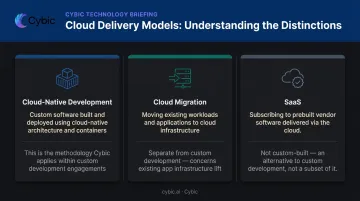
The distinction shapes every decision that follows - from architecture choices to compliance requirements - which is what the rest of this guide covers.
Why Enterprises Choose Custom Cloud Applications
Off-the-shelf SaaS products are engineered for the median enterprise. For many businesses, that's fine. For industries with specific compliance obligations, complex legacy systems, or workflows that don't map to standard feature sets, it creates persistent friction.
Operational Alignment
Generic software is built around how most businesses work, not how yours works. A manufacturing plant's shift reporting cycle, a healthcare provider's patient data governance structure, or an oil and gas operator's field monitoring infrastructure all have operational logic that doesn't fit cleanly into a standard product. Custom applications are built around those realities from day one.
Compliance and Data Sovereignty
Regulated industries often cannot meet their obligations within shared-tenant SaaS environments. HIPAA requires that any cloud service provider handling electronic protected health information (ePHI) execute a Business Associate Agreement, and the application architecture must support auditability and access controls that many SaaS products weren't designed to provide. NERC requires organizations to define the exact security control boundary between vendor and entity.
Custom development allows compliance frameworks to be embedded at the architectural level, not bolted on later. That includes:
- Role-based access controls and audit trails
- Data residency configurations and encryption standards
- Clear vendor/entity security demarcations for frameworks like NERC
Integration with Existing Enterprise Systems
Enterprise environments don't start from a blank slate. ERP systems, SCADA infrastructure, IoT platforms, data warehouses, and legacy applications are already in place. A global study of 650 IT leaders found that 84% said integration challenges slowed their digital transformation efforts.
Custom applications are built to connect directly with the actual technology stack - eliminating the data silos and manual handoffs that generic software creates when it can't cleanly interface with existing systems.
Cost and Control Over Time
The upfront investment in custom development is higher than a SaaS subscription. The multi-year picture is more nuanced. SaaS licensing compounds annually and rarely aligns with what a specific organization actually needs. Custom solutions address this directly:
- No "feature tax" for functionality the organization will never use
- Full control over update cycles, infrastructure scaling, and security patching
- No dependency on a vendor's release schedule for critical operational changes
How Custom Cloud Application Development Works
Custom cloud application development moves through a structured sequence of interconnected phases. Decisions made early - particularly around architecture and governance - compound downstream: what gets defined (or skipped) in week two shows up as cost or rework in month six.
Unlike SaaS procurement, every phase requires active business stakeholder involvement. The application is being built to mirror your operational logic, not a predefined feature set someone else designed.
Step 1: Discovery and Requirements Definition
This phase maps the specific business problem the application needs to solve. It identifies all user types and workflows, inventories systems the application must integrate with, and defines compliance and data governance requirements.
Skipping or compressing this phase is the most common source of downstream rework. Requirements that seem obvious during build often turn out to be misunderstood - and changes made after architecture is set are far more expensive than changes made before it begins.
Cybic's engagement methodology starts with a structured assessment of the current operational state, gap analysis, and strategic roadmapping before architecture design begins.
Step 2: Architecture and Cloud Platform Design
With requirements defined, architecture translates them into a technical blueprint. This is also where governance and security get built in from the start, not bolted on after the fact.
Key decisions made in this phase:
- Structural pattern - microservices, serverless, or container-based architecture
- Cloud platform - AWS, Azure, or Google Cloud, selected based on existing enterprise agreements, regulatory requirements, and infrastructure needs
- Deployment model - public cloud, private cloud, hybrid, or multi-cloud
- Data and security design - storage architecture, encryption standards, access controls, API design, and audit trail configuration
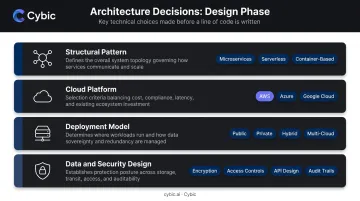
Cybic designs infrastructure-agnostic architectures that operate across cloud, hybrid, and on-premises environments - embedding RBAC, encrypted data protection, and compliance alignment (SOC 2, HIPAA, ISO, GDPR) at the architecture phase, not after the application is built.
Step 3: Development, Integration, and Testing
Development follows the architecture blueprint using cloud-native tooling. CI/CD pipelines enable iterative releases rather than a single launch event - the CNCF 2024 Annual Survey found 60% of organizations use CI/CD for most or all applications, with 29% pushing code multiple times per day.
Testing spans multiple environments and types:
- Unit testing - individual components behave as expected
- Integration testing - connections to existing enterprise systems work correctly
- Performance testing - the application holds up under real operating conditions
- Security testing - vulnerabilities are caught before production, not after
AI-assisted coding tools have shortened implementation cycles for discrete development tasks. That said, those gains apply to coding work specifically - architecture, integration design, compliance validation, and security review remain human-led.
Step 4: Deployment and Ongoing Optimization
Deployment into production is a managed, staged process - moving through development, staging, and production environments to catch issues before full rollout. Post-deployment, the application requires:
- Continuous performance monitoring
- Usage analytics and optimization cycles
- Planned security patch and update schedules
- Compliance audit support
Unlike a SaaS subscription, the organization owns the release schedule and can prioritize operational needs over a vendor's roadmap. That ownership also means internal accountability for security patching and compliance updates - which is an operational commitment, not just a benefit.
Key Factors That Shape Development Outcomes
Two organizations can follow an identical development process and arrive at very different results. The differentiating variables are mostly decisions made before a line of code is written.
Governance and Security Architecture
Security embedded at the design phase produces fundamentally different applications than security added at the end. Embedded governance means:
- Role-based access controls defined before development begins
- Encrypted data pipelines baked into the architecture
- Audit trails built into data models, not added as logging afterthoughts
- Compliance-aligned data structures that satisfy regulatory requirements by design
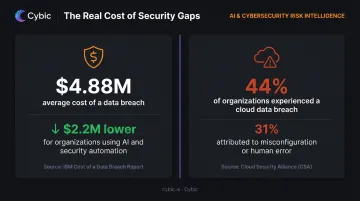
IBM's 2024 Cost of a Data Breach Report found the global average breach cost reached $4.88 million. Organizations using security AI and automation came in $2.2 million lower than those that didn't.
CSA reported that 44% of organizations experienced a cloud data breach, with 31% attributing it to misconfiguration or human error. When security is treated as a checklist rather than an architectural input, those numbers are the predictable result.
Integration Complexity and Legacy Dependencies
Integration is consistently where timelines and budgets expand unexpectedly. The depth and quality of connections to existing systems - ERP, SCADA, IoT platforms, data warehouses - is the most common source of cost overruns. McKinsey's analysis of more than 5,400 IT projects found that large projects over $15M averaged 45% budget overrun and 56% less value delivered than predicted.
The mitigation is treating integration as a dedicated workstream from discovery onward, not as plumbing addressed after core functionality is built.
Team Structure and Engineering Accountability
The gap between architecture design and actual implementation is where many projects fail. Engagements that hand off between strategy layers and execution teams introduce translation gaps that compound over time. Cybic's engineering-led model keeps the engineers who design the architecture directly responsible for building and deploying it - the same team carries accountability from requirements definition through production.
Common Pitfalls and Misconceptions
"This Is Primarily a Technology Problem"
The most persistent mistake is treating custom cloud development as a technical exercise rather than a business-alignment problem. Technically sound applications that don't match actual workflows get abandoned or worked around. Requirements built without input from the people who will operate the system almost always need to be rebuilt.
"The Cloud Provider Handles Security"
The shared responsibility model is widely misunderstood. AWS, Azure, and Google Cloud secure the underlying infrastructure. Application owners remain responsible for data protection, identity management, access policies, application configurations, and compliance controls - depending on the service model, that's a substantial security surface. Treating the cloud provider's infrastructure security as a substitute for application-layer security is one of the most common sources of misconfiguration breaches.
"Custom Development Costs More Than SaaS"
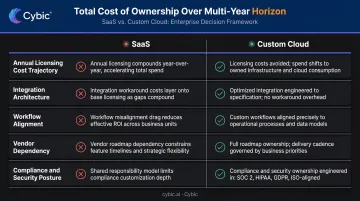
The upfront build cost is higher. The multi-year picture depends on the factors being counted. SaaS licensing compounds annually, integration workarounds add engineering cost, and workflow misalignment creates productivity drag that rarely appears in the initial cost comparison.
A complete total cost of ownership analysis should include:
- Licensing costs avoided
- Integration and workaround engineering overhead
- Cloud consumption costs
- Security and compliance support
- Productivity impact of workflow fit - or misfit - over a multi-year horizon
"Custom Development Takes Too Long"
AI-assisted coding, pre-built cloud-native components, and CI/CD pipelines have shortened delivery timelines compared to traditional approaches. Simple applications can be delivered in weeks. Enterprise-grade systems with complex integrations and compliance requirements typically take several months - far shorter than the indefinite cost of permanently adapting operations to software that was never designed for your workflows.
Frequently Asked Questions
What is custom cloud application development?
It's the process of designing and building software tailored to a business's specific workflows and operational requirements, then hosting and running it on cloud infrastructure. It's distinct from subscribing to prebuilt SaaS products and from simply moving an existing application to a cloud server without redesigning it.
How do you develop custom cloud applications?
Development runs through five connected phases: requirements and governance definition, architecture design on a chosen cloud platform, build and enterprise system integration, testing (unit, integration, performance, and security), and staged deployment with continuous monitoring post-launch.
How long does it take to build a custom cloud application?
Timelines depend on scope and complexity. Simple applications may take weeks; enterprise systems with complex integrations and compliance requirements typically run several months. AI-assisted development and pre-built cloud-native components have shortened build phases, but architecture and compliance work still require structured investment.
What are the main security considerations?
The cloud provider secures the underlying infrastructure - application owners are responsible for data protection, access controls, identity management, and application configurations. Role-based access controls, encryption in transit and at rest, audit logging, and compliance frameworks should all be embedded at the architecture phase, not added after functionality is built.
When should a business choose custom cloud development over SaaS?
Custom development makes the most sense when the business operates in a regulated industry with specific compliance requirements, has complex integrations with existing enterprise systems, needs workflows that generic software cannot support, or requires full control over data sovereignty and security architecture.
How much does custom cloud application development cost?
Cost varies widely based on scope, complexity, and team structure. The more useful frame is total cost of ownership over a multi-year horizon - factoring in SaaS licensing avoided, integration overhead, cloud consumption, compliance support, and the productivity impact of workflow alignment.