Introduction
Most enterprises are sitting on underused data, disconnected tools, and manual workflows that drain productivity and slow decision-making. Off-the-shelf AI tools promise quick wins, but they rarely map to how your business actually operates. Generic platforms force you to bend processes to fit the software, creating workarounds that undercut the efficiency gains you expected.
AI adoption is accelerating across industries, yet 95% of enterprise AI pilots deliver no measurable P&L impact. The difference between deploying AI and benefiting from it is fit how well the system aligns with real workflows, data environments, and compliance requirements.
This article breaks down seven operational benefits of custom AI development what it delivers when built around your specific business.
Key Takeaways
- Custom AI is built around your data, workflows, and business logic and not the other way around
- Key benefits: workflow-specific automation, faster decisions, built-in governance, and scalability without vendor lock-in
- Each solution targets the exact KPIs, data sources, and compliance requirements your industry demands
- Industries with complex compliance, high data volumes, or operational nuance gain the most
- Value compounds over time when AI is embedded into operations and not bolted on as an afterthought
What Is Custom AI Development?
Custom AI development is the practice of designing, building, and deploying AI systems built around an organization's data, processes, and goals rather than bought off the shelf. This includes machine learning models, LLM applications, predictive analytics, and intelligent automation.
This approach applies across a range of enterprise use cases:
- Enterprise workflow automation and intelligent process orchestration
- Decision-support systems and predictive operations
- Customer intelligence and personalization engines
- AI-powered copilots embedded into core business functions
The goal is operational outcomes reduced costs, faster decisions, better compliance and not technology adoption for its own sake.
Generic AI tools are designed to serve the broadest possible user base. Custom AI reverses this, modeling the system on your existing workflows, business rules, and data structures.
7 Benefits of Custom AI Development for Your Business
The benefits below focus on measurable, operational impact across cost, efficiency, risk, and growth tied to outcomes business leaders actually track.
Benefit 1: AI Built Precisely Around Your Workflows
Generic AI tools require businesses to bend their processes to fit the software. Custom AI reverses this, modeling the system on your actual workflows, business rules, and data structures.
How custom AI creates this advantage:
- Maps to actual operational logic approval hierarchies, exception handling, industry-specific data formats
- Eliminates workarounds and manual interventions that off-the-shelf tools require
- Trains on the organization's own data, not generic datasets
Why this matters operationally:
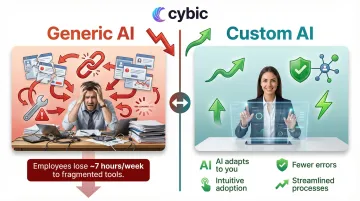
Processes run faster, adoption rates improve because the system feels intuitive, and fewer errors occur. Employees lose nearly seven hours every week to complicated processes and fragmented tools nearly a full workday. Custom AI eliminates this waste by fitting the way your team already works.
KPIs impacted:
- Task completion time
- Error rates
- Employee adoption rate
- Process cycle time
When this advantage matters most:
Organizations with complex multi-step processes, industry-specific compliance requirements, or highly variable operational contexts where no standard tool captures the full workflow.
Benefit 2: Intelligent Automation of Business-Specific Tasks
Custom AI enables automation of tasks unique to your business and not just generic automation like form routing, but context-aware automation that understands business rules, exceptions, and priorities.
How this works in practice:
AI models trained on historical operational data can handle invoice processing with domain-specific validation, route field service requests based on technician skills and location, or flag quality deviations against product-specific tolerances. AI-enabled prior authorization in healthcare can automate 50 to 75 percent of manual tasks, boosting efficiency and freeing clinicians to focus on complex cases.
Operational impact:
When automation is calibrated to real-world conditions, exception rates drop, human review is reserved for genuinely complex cases, and the cost per processed task falls significantly.
KPIs impacted:
- Operational cost per unit
- Manual intervention rate
- Throughput volume
- Error escalation rate
When this matters most:
High-volume transactional environments, industries with strict operational rules (manufacturing, healthcare, financial services), and organizations scaling operations without adding headcount.
Benefit 3: Faster, More Accurate Decision-Making
Custom AI built on your organization's own data produces predictive models directly relevant to the decisions your business actually makes. That means demand forecasting from real historical sales patterns, risk scoring calibrated to your own risk history, and maintenance predictions trained on your specific equipment and not generic benchmarks.
How this creates decision advantage:
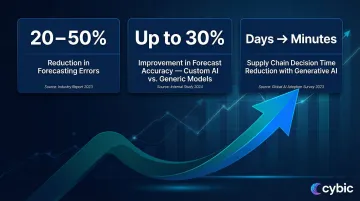
Instead of dashboards showing lagging indicators, leaders get forward-looking signals aligned to the KPIs they track. Machine learning reduces forecasting errors by 20-50% compared to traditional methods. Custom AI can improve forecast accuracy by up to 30% while integrating seamlessly with existing ERP and inventory systems.
Business risk and speed:
The ability to act on accurate, contextualized predictions before competitors or before a problem escalates is a structural advantage generic analytics tools cannot replicate. Generative AI in supply chain management can cut decision-making time from days to minutes.
KPIs impacted:
- Forecast accuracy
- Time-to-decision
- Cost of delayed action
- Planning cycle length
Benefit 4: Embedded Governance, Security, and Compliance
Custom AI allows governance and security requirements to be embedded at the architectural level, built into how the system operates rather than layered on afterward. Role-based access controls, data encryption, auditability of AI-driven actions, and regulatory alignment are built into how the system operates from day one.
Cybic's approach to custom AI development makes governance a design requirement including strict data protection policies and a firm commitment to never training models on proprietary enterprise data.
Real-world impact:
In regulated industries such as healthcare, energy, and financial services, an AI system that cannot produce an audit trail or enforce data access policies creates liability. Organizations with high levels of shadow AI faced an average of $670,000 in additional breach costs, and 97% of breached organizations that experienced an AI-related security incident lacked proper AI access controls.
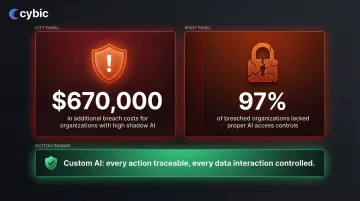
Custom AI eliminates this risk by ensuring every action is traceable and every data interaction is controlled.
When this matters most:
Organizations operating under HIPAA, GDPR, SOC 2, industry-specific safety regulations, or those managing sensitive customer, patient, or operational data at scale.
Benefit 5: Seamless Integration with Existing Systems
Custom AI is built to connect with your organization's existing technology stack like ERP, CRM, SCADA systems, data warehouses, cloud platforms without requiring wholesale replacement of current infrastructure.
Operational impact:
Data flows between systems without manual re-entry or reconciliation, AI models receive live data for real-time inference, and teams continue using familiar tools while AI augments their output. Poor data quality costs organizations at least $12.9 million a year on average, and 80% of IT leaders report that data silos are hindering their digital transformation efforts.
Custom AI breaks down these silos by integrating directly with existing systems, eliminating the fragmentation that creates these costs.
When this matters most:
Organizations with mature but legacy-heavy environments, or those running hybrid cloud/on-prem infrastructure who cannot afford or justify full platform migration.
Benefit 6: Scalability Without Vendor Lock-In
Custom AI systems are designed to scale with the business handling growing data volumes, additional use cases, new geographies without requiring a new vendor contract, a new licensing tier, or a platform migration each time needs evolve.
Infrastructure-agnostic advantage:
Custom AI can be deployed across cloud, hybrid, and on-prem environments, meaning the organization is not forced into a single vendor's ecosystem. This is particularly relevant for enterprises in sectors where data residency or sovereignty requirements limit cloud-only options. Gartner predicts that 25% of organizations will have experienced significant dissatisfaction with their cloud adoption by 2028, due to unrealistic expectations and uncontrolled costs.
Cost reality:
53% of AI teams experience costs exceeding forecasts by 40% or more during scaling. Custom AI designed for scalability from the start avoids these surprises.
KPIs impacted:
- Cost of scaling
- Time to deploy new use cases
- Infrastructure flexibility
- Total cost of ownership over three to five years
Benefit 7: Durable Competitive Advantage Through Proprietary AI
When AI is built on an organization's proprietary data and encoded with its operational logic, the system itself becomes a strategic asset. Competitors using the same off-the-shelf tools cannot replicate the models, predictions, or automations derived from that unique data.
Long-term business value:
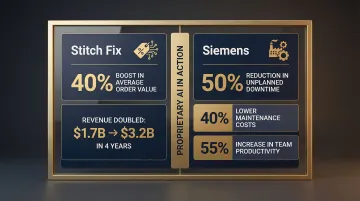
As the custom AI system ingests more data and refines its models over time, the competitive gap widens. The AI gets sharper predictions improve, automation handles more, and the system grows more tightly calibrated to how the business actually operates. Stitch Fix used AI customer personalization to boost average order value by 40% and doubled revenue from $1.7 billion to $3.2 billion in just four years.
When this matters most:
Industries where speed, precision, or customer personalization is a differentiator retail, manufacturing, healthcare where the first mover with operational AI gains lasting advantages that grow over time.
What Happens When Businesses Skip Custom AI
Relying on generic AI tools or avoiding custom development creates predictable consequences:
- Misaligned outputs : Generic tools produce insights that don't reflect how your business actually operates, forcing manual workarounds that negate automation gains entirely.
- Compliance exposure : Off-the-shelf data handling rarely meets industry-specific regulatory requirements, leaving organizations liable when audits surface gaps.
- Scaling failure : Generic tools may hold up at low volume but break down at enterprise scale, producing inconsistent results and rising per-unit costs with no path to adapt.
- Abandoned investment : Gartner predicts at least 30% of generative AI projects will be abandoned after proof of concept by end of 2025, citing poor data quality, inadequate risk controls, and unclear business value.
Each failed generic deployment is time competitors spend training proprietary models on your market's data, a gap that widens every quarter.
How to Get the Most Value from Custom AI Development
Custom AI delivers the highest ROI when it starts with a clearly scoped use case and not an attempt to automate everything at once. Before any build begins, address three fundamentals:
- Define success metrics tied to specific operational outcomes
- Assess data readiness and identify gaps that could limit model performance
- Map integration requirements against existing systems and workflows
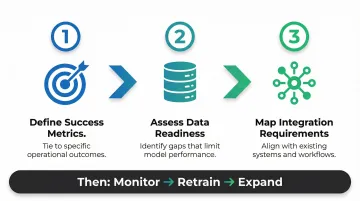
Ongoing performance monitoring matters as much as deployment. Custom AI models should be continuously evaluated against real operational outcomes, retrained as data evolves, and expanded to new use cases once initial deployment proves value. McKinsey's 2025 State of AI report states that the intentional redesigning of workflows has one of the strongest contributions to achieving meaningful business impact.
That continuous improvement cycle depends heavily on who builds and maintains the system. Working with an engineering-led AI partner that builds and integrates directly, rather than handing off a prototype, reduces the gap between design and operational reality. Cybic, for instance, builds directly into existing infrastructure from the initial engagement rather than delivering isolated prototypes.
Conclusion
The value of custom AI development lies in control, operational fit, and compounding intelligence. Systems built around your data and processes outperform generic tools across every dimension enterprises measure like accuracy, throughput, and cost-per-outcome.
The advantages grow over time. As custom AI ingests more data, refines its models, and expands across functions, its value compounds across three dimensions no off-the-shelf subscription can match:
- Control : your architecture, your data, your governance rules
- Operational fit : logic built around your workflows, not around a vendor's assumptions
- Compounding intelligence : models that improve with your data, not a shared user base's
That shift in mindset is what separates a technology project from an operational capability. Enterprises that build custom AI as infrastructure and not a one-time initiative are the ones that close the gap between AI potential and measurable business outcomes.
Frequently Asked Questions
What is custom AI development?
Custom AI development is the process of designing and building AI systems models, automations, and applications specifically architected around a company's unique data, workflows, and business objectives, as opposed to deploying generic, off-the-shelf AI tools.
How does custom AI work?
Custom AI works by training machine learning or large language models on an organization's proprietary data and configuring the system's logic to match existing business rules. The resulting system integrates with your current infrastructure so it can act on real-time operational data and not hypothetical inputs.
How much does custom AI development cost?
Cost depends on scope, data readiness, integration complexity, and the number of use cases being addressed. Projects scoped around specific, measurable business outcomes tend to be more cost-effective than broad platform builds with undefined deliverables.
What are the key benefits of AI for business?
Custom AI delivers more targeted versions of these benefits than generic tools: it automates tasks within your actual workflows, improves decisions using your proprietary data, reduces operational costs at the process level, and enables scaling without proportional headcount growth.
What are the benefits of AI in software development?
AI in software development accelerates testing, automates code review, improves documentation, and enables smarter debugging. When built custom, it also embeds business-specific logic directly into the software optimizing the workflows your team actually runs, not generic defaults.
What are the benefits of AI development?
Custom AI development produces systems that improve as they ingest more of your operational data, deliver higher ROI than off-the-shelf tools configured for general use, and create proprietary capabilities tied to your data and processes that competitors cannot simply purchase or copy.