Introduction
Enterprise data volumes reached 175 zettabytes in 2025, and the pressure on decision-makers has grown with it. According to recent surveys, 74% of IT and business leaders say GenAI accelerates decision speed, while 65% report it improves outcomes. Choosing the right AI-powered BI tool now shapes how enterprise teams operate and not just how they report.
Today's leading BI platforms go well beyond static dashboards. They offer natural language querying (NLQ), autonomous agents, and predictive recommendations that surface insights without requiring a data team to run every query.
That capability expansion raises the stakes for selection. The wrong tool can introduce governance gaps, integration debt, or analysis bottlenecks friction your organization can't afford when speed determines competitive position.
This article evaluates the top AI tools for business intelligence and data analysis in 2026, covering capabilities, ideal use cases, and key selection criteria for enterprise teams.
Key Takeaways
- AI BI tools in 2026 combine NLQ, predictive analytics, and agentic automation to move decisions from insight to action faster than traditional dashboards allow
- Top tools include Microsoft Power BI, Tableau, Domo, Google Looker, Databricks, and Amazon QuickSight, each built for different enterprise needs and data environments
- Key selection criteria: data source connectivity, governance features (SOC 2, HIPAA, RBAC), NLQ accuracy, and automation depth
- Evaluate tools against your existing infrastructure, data warehouses, and compliance requirements that fit matters more than feature lists
- Cybic's Drava platform connects enterprise data, ML, AI reasoning, and workflow automation into a single governed system going further than any standalone BI tool
What Are AI Tools for Business Intelligence & Data Analysis?
AI-powered BI tools combine traditional business intelligence like dashboards, reporting, data visualization with AI capabilities such as natural language querying (NLQ), machine learning-driven forecasting, anomaly detection, and increasingly, autonomous AI agents. This differs fundamentally from legacy BI software, which required manual query writing and offered limited predictive capabilities.
Three Tiers of AI BI Capability
Enterprises in 2026 encounter three distinct tiers of AI BI capability, each with different governance implications:
| Tier | What It Does | Governance Requirement |
|---|---|---|
| BI Assistants | Responds to on-demand questions within dashboards based on existing data models | Basic access controls and audit logging |
| AI Copilots | Proactively suggests queries, drafts reports, and guides users through analysis workflows | Approval workflows for automated actions; stricter access policies |
| Agentic Analytics Platforms | Autonomously monitors data conditions and triggers workflows without human prompts | Role-based access, comprehensive audit trails, and human oversight mechanisms |
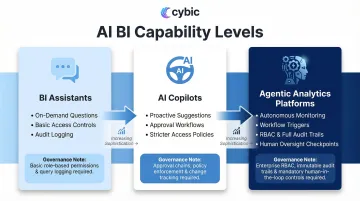
Gartner predicts that by 2027, augmented analytics will evolve to autonomous analytics executing 20% of business processes making the governance requirements at the agentic tier increasingly non-negotiable for enterprise deployments.
That investment is substantial. The global AI market is projected to reach $3,497.26 billion by 2033 at a CAGR of 30.6%, with AI spending in IT markets totaling $1.5 trillion in 2025 and exceeding $2 trillion by 2026. For enterprises choosing between tiers, these numbers signal that agentic platforms and not just assistants that will define competitive advantage within the next two to three years.
Top AI Tools for Business Intelligence & Data Analysis in 2026
These tools were selected based on enterprise readiness, AI feature depth, governance capabilities, data source connectivity, and demonstrated market presence in 2026.
Microsoft Power BI (with Copilot)
Microsoft Power BI is Microsoft's flagship BI platform, deeply integrated with the Microsoft 365 and Azure ecosystem. Its widespread enterprise adoption stems from seamless connectivity across the Microsoft stack, and the Copilot integration brings NLQ, automated report generation, and AI-driven narrative summaries directly into BI workflows.
Key capabilities include:
- Native integration with Azure OpenAI for AI-driven analysis
- Seamless connectivity with Microsoft data sources (Teams, SharePoint, SQL Server, Fabric)
- Copilot-driven DAX query generation for faster report development
- Enterprise-grade security via Microsoft's compliance framework
Critical licensing note: Copilot requires paid Fabric capacity (F2+) or Premium capacity (P1+), a Premium Per User (PPU) license alone isn't sufficient. Microsoft explicitly states that customer data isn't used to train models.
| Feature Category | Details |
|---|---|
| Key Features | AI Copilot for NLQ and report generation, Azure integration, Power Automate workflows, semantic model layer, row-level security |
| Best For | Enterprises standardized on Microsoft Azure and M365 ecosystem; teams needing governed self-service analytics |
| Pricing Model | Pro: $14/user/month; Premium Per User (PPU): $24/user/month; Copilot requires F2+ or P1+ capacity |
Tableau (Salesforce AI)
Tableau is one of the most established data visualization platforms, now enhanced with Salesforce AI (Einstein) capabilities. It maintains a strong presence in enterprise analytics teams across healthcare, retail, and financial services.
Its strengths include drag-and-drop visual analytics, Tableau Pulse for proactively delivered AI-generated metric insights, and deep Salesforce CRM integration. It's particularly well suited for business users who need to build and share complex visualizations without writing code.
Important update: Tableau retired its legacy Ask Data feature in February 2024, replacing it with Tableau Pulse and Tableau Agent. AI features are governed by the Einstein Trust Layer, which enforces zero data retention and no LLM model training on customer data.
| Feature Category | Details |
|---|---|
| Key Features | Tableau Pulse (AI-driven metric monitoring), Tableau Agent (agentic analytics), Einstein integration, Prep Builder for data transformation, broad connector library |
| Best For | Data-driven enterprises with Salesforce CRM; teams needing rich, shareable visual analytics and self-service reporting |
| Pricing Model | Cloud: Viewer $15/user/month, Explorer $42/user/month, Creator $75/user/month; Tableau+ Bundle required for premium Pulse and Agent features |

Domo AI
Domo is a cloud-native BI and data platform built for real-time operational intelligence. Its 2026 positioning centers on agentic AI with Agent Catalyst and an AI agent marketplace, moving beyond passive BI into autonomous workflow automation.
Standout capabilities include:
- End-to-end data integration via 1,000+ connectors
- Agent Catalyst (launched March 2025) for building autonomous AI agents using DomoGPT and RAG
- Low-code App Studio for custom application development
- SOC 1, SOC 2, ISO 27001, HIPAA, and GDPR compliance with a confirmed no-model-training policy on customer data
The platform was named a Challenger in the 2024 Gartner Magic Quadrant for Analytics and BI Platforms.
| Feature Category | Details |
|---|---|
| Key Features | Agentic AI (Agent Catalyst), 1,000+ data connectors, low-code App Studio, automated alerts, embedded analytics, no-code workflows |
| Best For | Organizations needing real-time operational dashboards combined with automated workflow triggers; enterprises embedding analytics in customer-facing applications |
| Pricing Model | Credit-based consumption model; AI features split between standard Domo AI (included) and Domo AI Pro (consumption-based) |
Google Looker
Looker is Google Cloud's enterprise BI platform, differentiated by its LookML semantic modeling layer that ensures consistent metric definitions across the organization. This is a critical governance advantage for large teams managing complex data environments.
Core strengths include Gemini AI for NLQ and conversational analytics, native BigQuery connectivity, a semantic layer that enforces single definitions of business metrics, and embedded analytics capabilities purpose-built for SaaS product teams.
Conversational Analytics became Generally Available (GA) for Looker 25.18+ in November 2025. LookML defines governed metrics for consistent answers, and Google's service terms state they will not use customer data to train models without permission.
| Feature Category | Details |
|---|---|
| Key Features | LookML semantic layer, Gemini AI for conversational analytics, BigQuery-native integration, embedded analytics API, Looker Studio (free self-service reporting) |
| Best For | Google Cloud-native enterprises; organizations prioritizing metric consistency and governed self-service analytics at scale |
| Pricing Model | Quote-based enterprise licensing (contact sales); Standard, Enterprise, and Embed editions available; Looker Studio free tier for basic reporting |
Databricks (Mosaic AI + Genie)
Databricks is a unified data and AI platform built on the open lakehouse architecture. Its 2026 positioning centers on the Genie feature, a conversational AI interface for querying data using natural language and its dominance among data engineering and ML teams working with large-scale data.
Key capabilities include:
- Unity Catalog for enterprise-grade data governance and lineage tracking
- Mosaic AI for custom ML model development and deployment
- Delta Lake for reliable large-scale data management
- Deep integrations with Snowflake, Azure, AWS, and GCP
Genie is Generally Available, delivering conversational SQL and visuals, while Unity Catalog governs data access and lineage. Genie is designed with read-only access to customer data to generate SQL queries, ensuring data security.
| Feature Category | Details |
|---|---|
| Key Features | Genie (NLQ for data), Unity Catalog (governance + lineage), Delta Lake, Mosaic AI for ML, multi-cloud support, notebook-based collaboration |
| Best For | Data engineering and ML-heavy enterprises; organizations needing both analytics and ML model deployment in a governed lakehouse environment |
| Pricing Model | Consumption-based DBU (Databricks Unit) pricing; Genie and Mosaic AI features included in standard plans with DBU consumption charges |

Amazon QuickSight (with Q and GenAI)
Amazon QuickSight is AWS's cloud-native BI service, particularly well-suited for organizations operating within the AWS ecosystem. The QuickSight Q feature enables NLQ, and recent generative BI capabilities allow users to generate visuals and narratives from natural language prompts.
Differentiating features include:
- Serverless architecture with per-session pricing, cost-effective for variable or seasonal usage
- Deep native integration with AWS data services (S3, Redshift, Athena, RDS)
- Embedded analytics for SaaS applications
- QuickSight Generative BI for auto-generating dashboards from natural language
QuickSight pricing is transparent: Reader ($3/user/month) and Author ($24/user/month) in standard Enterprise edition, with Reader Pro ($20/user/month) and Author Pro ($40/user/month) for advanced Generative BI capabilities. AWS explicitly states they don't use customer data to improve underlying models.
| Feature Category | Details |
|---|---|
| Key Features | QuickSight Q (NLQ), Generative BI (auto-visualization), serverless scaling, 50+ AWS data connectors, embedded analytics, SPICE in-memory engine |
| Best For | AWS-native organizations; enterprises needing cost-effective BI at scale with variable user loads and strong cloud integration |
| Pricing Model | Reader: $3/user/month; Author: $24/user/month; Pro roles (Reader Pro $20, Author Pro $40) unlock advanced Generative BI; capacity pricing available for sessions |
How We Chose the Best AI BI & Data Analysis Tools
Tools were assessed on five criteria:
- AI capability depth : NLQ accuracy, predictive analytics, agentic automation
- Data connectivity : breadth of native connectors to warehouses, SaaS apps, and cloud storage
- Governance and security : SOC 2 / HIPAA / GDPR compliance, RBAC, audit logs, SSO/SAML support
- Integration flexibility : cloud-agnostic vs. ecosystem-locked
- Total cost of ownership : enterprise-scale pricing models
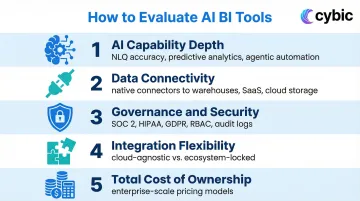
Criteria #3 and #4 are where most evaluations fall short buyers focus on UI and features, then discover governance gaps and integration costs only after deployment.
The Most Common Evaluation Mistake
Enterprise teams often select BI tools based on demo aesthetics or feature lists without testing NLQ accuracy on their own data, validating AI-generated outputs against known source-of-truth figures, or stress-testing how the tool handles ambiguous or multi-step queries.
Forrester's BI Wave evaluation criteria require proof of NLQ and NLG depth, LLM options, RAG grounding, and GenAI guardrails (access control, content moderation). Every AI-generated insight needs a defined validation workflow and clear accountability before it reaches a decision-maker.
When BI Tools Aren't Enough
For enterprises in regulated industries (healthcare, energy, public sector) or those requiring AI automation beyond passive analytics, a standalone BI tool may not be sufficient. Organizations at this level often work with AI engineering partners to build governed, workflow-integrated intelligence systems.
Cybic's Drava platform is designed for this gap. It connects enterprise data, machine learning, and AI reasoning into a single operational layer, with governed automation, workflow orchestration, and intelligent agents integrated directly into business processes like security controls and compliance frameworks included at the architecture level.
Conclusion
The right AI BI tool in 2026 isn't just about visualization quality, it's about how well a platform integrates with your data infrastructure, enforces governance, and enables decision-making at the speed your business requires.
Run structured evaluations before committing. Specifically:
- Test NLQ against real business questions your analysts actually ask
- Validate AI-generated outputs against source data to catch drift or hallucination
- Assess governance controls against your compliance requirements
The best tool is the one that fits your stack, your regulatory environment, and your team's skill set.
When no off-the-shelf BI platform fits because your data infrastructure is complex, governance requirements are strict, or the use case extends beyond dashboards into operational workflows, a custom-engineered solution may be the more practical path. Cybic designs and deploys enterprise AI platforms that embed intelligence directly into business operations, with governance, auditability, and infrastructure fit built in from the start. Talk to our team to identify where AI can have the most immediate impact in your organization.
Frequently Asked Questions
What are the best AI-powered analytics tools for business intelligence in 2026?
The leading platforms are Microsoft Power BI, Tableau, Google Looker, Domo, Databricks, and Amazon QuickSight. The best choice depends on your cloud ecosystem, governance requirements, and whether your team needs passive BI or agentic automation capabilities.
What is the best AI tool for small businesses in 2026?
Small businesses get the most value from lower-cost, easier-to-deploy tools like Microsoft Power BI (Pro tier at $14/user/month) or Amazon QuickSight (per-session pricing starting at $3/user/month). Both offer NLQ and AI features without requiring dedicated data engineering teams or enterprise licensing costs.
What is a GPT assistant?
A GPT assistant is a conversational AI model that interprets natural language questions and generates text, code, or analysis in response. In BI platforms like Power BI Copilot and Tableau, this architecture powers the NLQ and AI copilot features that let users query data without writing SQL.
What's the difference between AI agents, copilots, and BI assistants?
BI assistants respond to on-demand questions within dashboards. Copilots proactively suggest queries and actions during active work sessions. AI agents autonomously monitor data conditions and trigger workflows without human prompts. Agents require stricter governance controls including approval workflows and comprehensive audit logging.
How do I evaluate AI BI tools for enterprise data governance and security?
Start with these non-negotiables during vendor evaluation:
- SOC 2 / HIPAA / GDPR compliance certifications
- Row-level security and RBAC support
- SSO/SAML authentication
- Audit logging of AI-generated actions
- Data lineage visibility and model training transparency
All six platforms reviewed commit to not training foundation models on customer data by default.