Introduction
Most enterprises are not struggling to start AI initiatives, they are struggling to scale them. 88% of large enterprises actively use AI, yet fewer than 30% move beyond pilot projects into production deployment at scale. The gap points to a consistent challenge: transformation requires more than technology adoption. It demands systematic integration of data architecture, governance frameworks, and intelligent automation directly into core business operations.
This guide provides a practical framework for building an enterprise digital transformation roadmap in 2026. It covers the five critical pillars, a phased implementation approach, the role of AI and automation as accelerators, and governance requirements including data access controls, AI auditability, and compliance alignment that shape every stage of execution.
Key Takeaways
- Enterprise transformation in 2026 means embedding AI, automation, and data intelligence directly into operations, cloud migration is table stakes, not the goal
- Effective roadmaps move through five phases from current-state assessment through AI deployment each building on a governed data foundation
- Five pillars underpin every successful transformation: strategy alignment, data architecture, technology modernization, workforce enablement, and embedded governance
- 60% of AI projects fail due to poor data foundations governance and security must be architectural, not retrofitted
- AI and intelligent automation are 2026's primary accelerators, enabling faster execution and compounding efficiency gains at scale
What Is Enterprise Digital Transformation and Why It Matters in 2026
Enterprise digital transformation is the systematic integration of digital technologies including cloud infrastructure, data platforms, AI, and intelligent automation into an organization's full operating model to fundamentally change how it creates and delivers value. This goes beyond upgrading systems; it requires rewiring business processes, decision-making frameworks, and organizational culture around digital capabilities.
2026 represents an inflection point driven by three converging forces:
- Mature LLM capabilities now accessible through enterprise platforms at production scale
- Readily available AI infrastructure across AWS, Azure, and GCP, lowering the barrier to deployment
- Rising competitive pressure across manufacturing, healthcare, oil and gas, and retail
34% of surveyed organizations use AI to deeply transform by creating new products or reinventing core processes. Organizations that treat AI as an operational upgrade rather than a strategic capability risk falling behind competitors who are rebuilding core processes around it.
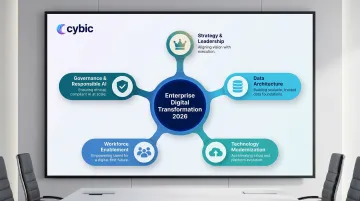
Enterprise transformation differs categorically from IT modernization. While IT projects focus on upgrading existing systems, enterprise transformation restructures how organizations operate changing decision logic, process ownership, and technology deployment at scale.
The scope, governance complexity, integration requirements, and change management demands are in a different category entirely. That distinction shapes every decision in building an effective roadmap.
The Key Pillars of Enterprise Digital Transformation
Pillar 1: Strategy and Leadership Alignment
Transformation fails when treated as an IT project rather than a business strategy initiative. Transformations lacking alignment between the CFO, CSO, and CTO fail 75% of the time, while close partnership from day one increases success rates by nearly 70%.
Leadership must:
- Define a unified vision with clear business outcomes
- Assign executive ownership across business and technology functions
- Embed transformation priorities into budget cycles and performance metrics
- Maintain active sponsorship throughout implementation phases
Cybic works directly with leadership teams to identify high-value automation opportunities, assess operational challenges, and define clear enterprise AI and automation roadmaps that align technical execution with strategic objectives.
Pillar 2: Data Architecture and Analytics Foundation
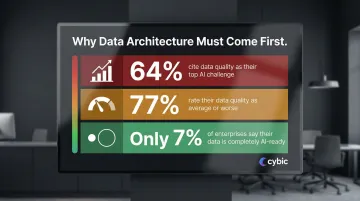
Without a governed, accessible data foundation, AI and automation efforts stall before they deliver value. 64% of organizations cite data quality as their top challenge, with 77% rating their data quality as average or worse. More critically, only 7% of enterprises report their data is completely ready for AI adoption.
Organizations must:
- Conduct comprehensive audits of data silos and integration gaps
- Establish data governance policies with clear ownership structures
- Invest in unified data platforms (data lakehouses, real-time pipelines) that enable AI-ready data flow
- Implement data quality management processes before deploying AI models
Through enterprise data platform modernization, Cybic designs high-performance ETL/ELT pipelines for real-time data ingestion, transformation, and loading across data lakes, warehouses, and enterprise systems creating the low-latency, AI-ready data flow necessary for intelligent automation.
Pillar 3: Technology Modernization
Technology modernization encompasses cloud adoption (public, hybrid, or on-premises based on compliance requirements), legacy system integration, API-first architecture, and infrastructure-agnostic platforms that enable AI capabilities without vendor lock-in.
Key components include:
- Migrating workloads to cloud or hybrid environments
- Re-engineering workflows around modern APIs
- Connecting legacy systems to modern platforms through integration layers
- Establishing infrastructure that supports AI deployment across environments
Cybic's approach prioritizes evolutionary modernization over disruptive replacement, using custom API development to bridge legacy systems with modern AI and automation platforms. This enables organizations to extend existing investments while gaining contemporary capabilities.
Pillar 4: Workforce Enablement and Change Management
Technology deployment alone doesn't produce transformation. 70% of digital transformation initiatives fail to meet objectives, and the human element drives the majority of those failures. Nearly two-thirds of employees resist organizational change, and 64% of U.S. employees feel overwhelmed by workplace change. The upside is equally clear: projects with excellent change management succeed 88% of the time, compared to only 13% where change management is weak.
Organizations must:
- Invest in upskilling employees for new tools and workflows
- Redesign processes around digital capabilities
- Communicate transformation benefits clearly and consistently
- Engage stakeholders throughout all roadmap phases
- Address cultural resistance through structured change programs
Pillar 5: Governance, Compliance, and Responsible AI
In 2026, governance demands architectural priority from day one. With the EU AI Act taking full effect in August 2026 and HHS OCR proposing strengthened HIPAA cybersecurity rules, waiting until deployment to address compliance carries severe financial and operational consequences.
Critical governance components include:
- Role-based access controls (RBAC) for secure system access
- Encrypted data protection in transit and at rest
- Auditability and traceability of AI-driven decisions
- Data governance policies preventing model training on proprietary enterprise data
- Regulatory alignment with industry-specific requirements (HIPAA, GDPR, SOC 2)
Cybic embeds governance at the architectural level rather than bolting it on post-deployment. The company's Drava platform provides a governed AI automation platform with built-in security controls, audit trails, and compliance frameworks, enabling organizations to deploy AI with visibility, control, and regulatory confidence.
Building Your Roadmap: The Stages of Enterprise Digital Transformation
Most enterprise transformations that stall do so not because the technology failed, but because the roadmap was built on incomplete information or misaligned priorities. The five phases below provide a structured path from current-state assessment through scaled AI deployment, with governance embedded at every step.
Phase 1: Discovery and Current-State Assessment
Conduct a comprehensive audit of existing processes, systems, data infrastructure, and organizational capabilities. Use a capability maturity model to identify which capabilities are lagging, performing at market standard, or leading.
Key activities:
- Document current workflows and system dependencies
- Assess data quality, accessibility, and governance maturity
- Evaluate technology infrastructure and integration capabilities
- Identify skill gaps and change readiness across teams
- Involve stakeholders from operations, IT, compliance, and business units
Incomplete assessments that exclude key stakeholders consistently produce roadmaps that fail during execution which is why Phase 2 must be built on what Phase 1 actually surfaces, not what leadership assumes.
Phase 2: Strategy Definition and Prioritization
Translate business strategy into a prioritized set of transformation initiatives using SMART goals (Specific, Measurable, Achievable, Relevant, Time-bound). Only 48% of digital initiatives meet or exceed business outcome targets, with misalignment between IT priorities and business strategy cited as a primary cause.
Prioritization framework:
- Assess capability gaps against strategic objectives
- Estimate business impact (revenue, cost reduction, efficiency)
- Evaluate implementation feasibility (technical complexity, resource requirements)
- Consider dependencies between initiatives
- Secure executive sponsorship for top-priority projects
Avoid prioritizing based solely on technical readiness business value and strategic alignment must drive the roadmap. Once priorities are locked, the next step is building the infrastructure those initiatives will depend on.
Phase 3: Foundation Building : Data and Infrastructure
Before deploying AI or advanced automation, establish foundational infrastructure: cloud or hybrid architecture, integrated data pipelines, identity and access management, and security frameworks. Gartner predicts organizations will abandon 60% of AI projects unsupported by AI-ready data.
Foundation components:
- Cloud infrastructure (AWS, Azure, GCP) or hybrid architecture
- Unified data pipelines connecting disparate sources
- Data governance frameworks with clear ownership
- Identity and access management systems
- Security controls and encryption standards
- Regulatory compliance mapped to architecture decisions (HIPAA, SOC 2, GDPR, or sector-specific requirements)
Organizations that skip this step routinely see AI projects fail before they scale. With the foundation in place, targeted AI deployment becomes a manageable, measurable process rather than a gamble.
Phase 4: AI and Automation Deployment
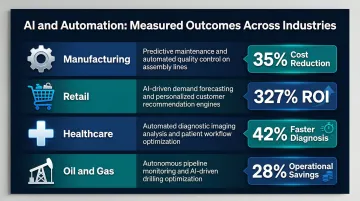
With foundations in place, deploy targeted AI solutions and intelligent automation workflows starting with high-value, well-defined use cases. Results across industries illustrate what's achievable:
| Industry | AI/Automation Use Case | Measured Outcome |
|---|---|---|
| Manufacturing | AI-powered scheduling and equipment monitoring | Up to 10% scrap reduction per ton; 5% OEE improvement; 35% cost reduction via robotic automation |
| Retail | Reverse logistics optimization | Converts $200B in annual returns costs into recoverable business value via real-time item routing |
| Healthcare | Clinical workflow automation on HIPAA-compliant platforms | Reduced administrative burden; improved operational throughput without compromising data governance |
| Oil & Gas | Predictive asset monitoring and safety compliance automation | Reduced unplanned downtime; continuous compliance visibility across distributed infrastructure |
A phased deployment approach rather than a big-bang rollout reduces risk, creates space to learn from early results, and builds the organizational confidence needed to scale.
Phase 5: Scale, Optimize, and Govern
With pilots validated, the focus shifts to enterprise-wide extension measuring business value, managing model performance, and keeping the roadmap current as organizational maturity grows.
Scaling requirements:
- Establish KPIs and measurement frameworks
- Monitor AI model accuracy and performance drift
- Expand governance frameworks to cover new use cases
- Document lessons learned and best practices
- Maintain ongoing auditability and traceability of AI-driven actions
- Iterate roadmap based on results and changing business needs
The organizations that scale AI successfully treat governance not as a compliance checkbox but as an operational capability built into architecture from Phase 3 and stress-tested at every stage that follows.
AI and Intelligent Automation: The 2026 Transformation Accelerator
In 2026, AI shifts from standalone tool to operational layer. Leading enterprises deploy generative AI copilots, LLM-powered workflows, and intelligent automation agents integrated directly into business operations and not as experiments but as production systems embedded in core processes.
Worldwide spending on AI will total $2.52 trillion in 2026, a 44% year-over-year increase, driven heavily by AI-optimized infrastructure. Yet 95% of enterprise AI deployments fail to deliver value, largely because generic tools don't integrate with enterprise workflows.
The Integration Imperative
Fragmented, point-solution AI deployments create complexity rather than value. Enterprise AI success depends on integration connecting enterprise data, machine learning models, and automated workflows into unified systems. Organizations using integrated platforms achieved 327% ROI over three years, driven by $15.7 million in developer productivity gains and $4.3 million in avoided infrastructure costs.
That integration model is what Cybic's Drava platform is built around connecting enterprise data intelligence, machine learning, AI reasoning, and intelligent agents into a single governed automation layer. The result is unified systems that automate complex workflows while preserving visibility, control, and traceable business outcomes.
Infrastructure Compatibility
AI deployment must be compatible with existing enterprise environments like cloud-native, hybrid, or on-premises. 88% of enterprises operate hybrid IT environments, which means orchestration platforms need to coordinate automation tools across diverse infrastructure without introducing new vendor lock-in.
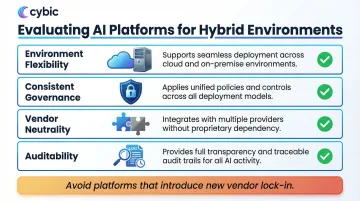
When evaluating AI platforms for hybrid environments, prioritize:
- Environment flexibility : operates across cloud, on-premises, and hybrid without architecture rewrites
- Consistent governance : applies the same security controls and compliance standards regardless of deployment location
- Vendor neutrality : integrates with existing tooling rather than forcing migration to a proprietary stack
- Auditability : provides traceable logs of AI-driven actions for regulatory and operational accountability
Embedding Governance, Security, and Responsible AI from Day One
Organizations that treat governance as an afterthought pay for it twice, once in remediation costs and again in regulatory exposure. Embedding security controls, access management, and compliance requirements into system design from day one eliminates both problems before they start.
Core Governance Architecture
Essential governance components enterprises must build into transformation architecture:
- Role-based access controls (RBAC): Granular permission management enforced at the system level
- Encrypted data protection: Automatic encryption in transit and at rest as architectural requirement
- Auditability and traceability: Immutable logs of AI-driven decisions and workflow executions
- Data governance policies: Clear frameworks preventing model training on proprietary enterprise data
- Regulatory alignment: Built-in compliance with HIPAA, GDPR, SOC 2, and industry-specific requirements
For healthcare, energy, and public sector organizations, this isn't abstract, HIPAA violations carry penalties up to $1.9M per category annually, and GDPR fines have reached €1.2B for a single infraction. Getting governance architecture right at the start is measurably cheaper than fixing it after deployment.
Responsible AI in 2026
As enterprises deploy generative AI and autonomous agents at scale, accountability frameworks, bias monitoring, and explainability standards have moved from best practices to hard requirements backed by regulation and enforced through liability.
Two frameworks are now defining enterprise AI governance obligations:
- NIST AI Risk Management Framework: Outlines required actions including transparency policies for training data provenance, pre-deployment risk evaluation, and continuous bias monitoring processes.
- EU AI Act: Mandates disclosure obligations for AI-generated content and enforces strict governance rules for high-risk AI systems with direct penalties for non-compliance.
Organizations that wire these requirements into their architecture rather than layering them on after launch scale AI systems faster, with fewer compliance interruptions and lower remediation overhead.
Common Pitfalls and How to Avoid Them
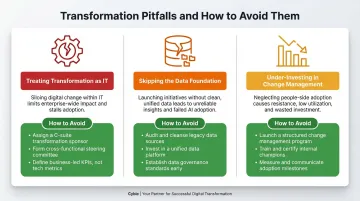
Most transformation programs don't fail because of bad technology. They fail because of how the initiative is governed, funded, and adopted. These three pitfalls show up repeatedly and each one is preventable.
Pitfall 1: Treating Transformation as a Technology Project
The most common failure mode is delegating transformation to IT without executive business ownership. Transformation must be driven by business outcomes and governed at the leadership level, with technology as the enabler and not the driver.
How to avoid:
- Secure executive sponsorship from CFO, CSO, and CTO from day one
- Define business outcomes before selecting technologies
- Embed transformation priorities into budget cycles and performance metrics
- Maintain active leadership engagement throughout all phases
Pitfall 2: Skipping the Data Foundation
Organizations that rush to deploy AI without solid data governance, integration pipelines, and quality standards rarely get usable results. Gartner projects that 60% of AI projects will be abandoned by 2026 due to lack of AI-ready data and poor infrastructure is the root cause in most cases.
How to avoid:
- Conduct comprehensive data quality audits before AI deployment
- Establish data governance frameworks with clear ownership
- Invest in unified data pipelines and integration layers
- Build data infrastructure before deploying AI and don't treat it as a parallel workstream
Pitfall 3: Under-Investing in Change Management and Adoption
Deploying new systems without training, clear communication, and workflow redesign leads to low adoption and low adoption kills ROI regardless of technical quality. Projects with excellent change management succeed 88% of the time, compared to just 13% where change management is weak.
How to avoid:
- Budget realistically for training and change programs typically 15-20% of total program cost
- Engage stakeholders continuously throughout all roadmap phases
- Redesign workflows around new capabilities rather than layering tools onto old processes and communicate the "why" behind every change
Frequently Asked Questions
What is an enterprise digital transformation roadmap?
An enterprise digital transformation roadmap is a structured, phased plan that moves large organizations from their current state to a defined future state. It does this by integrating digital technologies, AI, and process changes in alignment with business strategy.
What is enterprise digital transformation?
Enterprise digital transformation is the comprehensive integration of digital capabilities like cloud, data, AI, and automation into an organization's processes, culture, and business model to reshape how it operates and delivers value.
What are the typical stages of enterprise digital transformation?
Most enterprise transformations follow five stages:
- Current-state assessment : auditing existing capabilities and systems
- Strategy and prioritization : defining goals and sequencing initiatives
- Foundation building : establishing data pipelines and infrastructure
- AI and automation deployment : implementing targeted solutions
- Scaling with governance : expanding enterprise-wide with continuous monitoring
What are the key pillars of enterprise digital transformation?
Five pillars support a durable transformation:
- Strategy and leadership alignment : executive ownership tied to business outcomes
- Data architecture : governed, AI-ready data foundations
- Technology modernization : cloud, APIs, and systems integration
- Workforce enablement : change management and skills development
- Governance and responsible AI : embedded security and compliance controls
What are the biggest challenges in enterprise digital transformation?
Three obstacles derail most transformations:
- Executive misalignment : unclear business ownership creates friction between IT and business priorities
- Inadequate data infrastructure : fragmented or ungoverned data blocks AI-ready workflows
- Change resistance : without structured change management, adoption rates stay low