The problem isn't the technology. It's the absence of strategy.
Organizations that extract real, scalable value from AI don't treat it as a collection of tools. They treat it as a governed operational capability - one that connects data, decision-making, and workflow orchestration across the entire enterprise. This guide covers exactly how to build that capability: what enterprise AI automation actually is, why it matters, how to structure a strategy, and where the most significant challenges and opportunities lie.
Key Takeaways
- Enterprise AI automation integrates AI models, workflow orchestration, and governance to automate complete end-to-end processes and decisions across the organization.
- Effective strategy requires assessing automation maturity, prioritizing high-impact use cases, and establishing data foundations before scaling.
- Surveyed organizations report average 15.2% cost savings and 22.6% productivity improvements from AI programs, per Gartner.
- Data silos, governance gaps, and organizational resistance are the top blockers - all require proactive planning before deployment begins.
- Platform selection should prioritize governance-first architecture, infrastructure flexibility, and deep integration with existing systems.
What Is Enterprise AI Automation (and How It Differs from Traditional Automation)
Enterprise AI automation is the use of AI-driven technologies - machine learning, natural language processing, intelligent agents - to automate workflows, decisions, and actions across an organization at scale. The distinction from traditional automation is worth understanding clearly before scoping any implementation.
Traditional RPA follows fixed scripts - executing repetitive, structured tasks by emulating human clicks and keystrokes. When inputs change, it breaks. Enterprise AI automation handles unstructured inputs, adapts to context, and makes judgment-based decisions that previously required a person in the loop.
There are three functional layers worth distinguishing:
- Task automation - executing repeatable steps like data entry, document extraction, or invoice processing
- Decision automation - AI-driven approvals, risk scoring, anomaly detection, and exception routing
- Workflow orchestration - coordinating multi-step processes across systems, teams, and data sources in real time
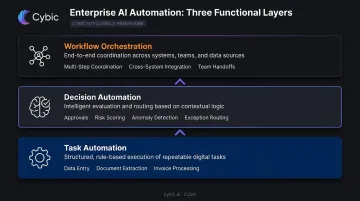
Most organizations start with task automation. The compounding value arrives when decision automation and orchestration are layered on top.
Agentic AI: The Emerging Layer
Agentic AI is the next layer above standard automation. These are AI agents that plan, retrieve information, take multi-step actions, and self-correct based on changing conditions - without requiring human instruction at every step.
The adoption trajectory is significant. Gartner predicts that 33% of enterprise software applications will include agentic AI by 2028, up from less than 1% in 2024 - and that at least 15% of day-to-day work decisions will be made autonomously by agentic AI by that same year. For most enterprises, that means a large portion of operational decisions will no longer route through human approval queues at all.
Cybic's agentic AI practice designs and deploys autonomous agents across use cases like intelligent claim processing, automated loan approvals, and dynamic supply chain management - with multi-agent coordination and workflow orchestration built in from the start.
Key Benefits of Enterprise AI Automation
Operational Efficiency and Cost Reduction
High-volume, repetitive, and judgment-based tasks consume significant labor costs and create cycle-time drag. Automating them reduces manual processing, shortens handoff delays, and eliminates rework caused by human error.
The numbers from Gartner's surveyed adopters are directional but meaningful:
| Metric | Average Reported Gain |
|---|---|
| Cost savings | 15.2% |
| Productivity improvement | 22.6% |
| Revenue increase | 15.8% |
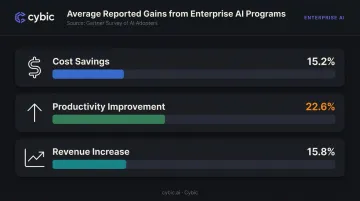
These aren't guarantees - they reflect what well-structured programs achieve, which is precisely why strategy matters.
Faster, More Consistent Decision-Making
Manual review processes introduce two problems: delay and variability. Two reviewers applying the same policy don't always reach the same conclusion. AI automation removes both issues by applying consistent logic to high-volume decisions at machine speed - approvals, compliance checks, exception routing.
In healthcare revenue cycle management, for example, AI systems handle claim scrubbing, billing code assignment, and denial prediction before submission. That upstream consistency reduces the volume of rework that occurs downstream.
Scalability Without Proportional Headcount Growth
Traditional scaling requires proportional increases in people, training, and coordination overhead. AI automation breaks that relationship. Enterprises can expand output, enter new markets, and absorb higher transaction volumes without a corresponding increase in operational staff or infrastructure complexity.
The pattern shows up consistently across:
- Multi-site manufacturing operations managing distributed workflows
- Multi-region financial services firms processing high transaction volumes
- Government agencies absorbing case volume growth without equivalent hiring
Scale, however, creates its own demands - particularly around governance.
Governance, Compliance, and Auditability
Well-architected enterprise AI systems create automatic audit trails, enforce access controls, and monitor for policy violations in real time. In regulated industries - healthcare, energy, financial services, public sector - this isn't a nice-to-have. It's a compliance requirement.
The failure mode is building automation first and adding governance later. By then, autonomous actions have already occurred without adequate traceability, creating liability exposure that's difficult to retroactively address.
Freeing Workers for Higher-Value Work
The goal of enterprise AI automation isn't workforce replacement. McKinsey estimates that current AI and related technologies could automate work activities that absorb 60-70% of employees' time - but the appropriate response is task reallocation, not headcount reduction. When AI handles volume and repetition, employees redirect effort toward customer relationships, complex judgment calls, and innovation.
How to Build an Enterprise AI Automation Strategy
Step 1 - Assess Current Automation Maturity
Before selecting tools or use cases, audit what exists: which workflows are already automated, where manual bottlenecks persist, what data is available and in what condition, and what governance frameworks are in place.
Cybic's engagement process begins with exactly this - a structured data landscape audit, gap analysis, and governance assessment that establishes a realistic starting point. Skipping this step is how organizations end up deploying AI onto processes that aren't ready for it.
Step 2 - Identify and Prioritize High-Impact Use Cases
Not all processes worth automating are worth automating first. Strong early candidates share these characteristics:
- High transaction volume
- Repetitive, well-defined steps
- Measurable business impact
- Available and reasonably clean data
- Clear process owner accountable for outcomes
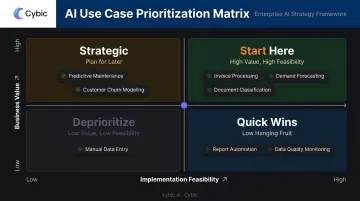
The common trap is automating "easy" processes that are low-value - digitizing a process no one cares about doesn't generate ROI. Gartner recommends a standardized prioritization framework using clear criteria based on business value and feasibility to identify which opportunities to scale.
A simple value-vs-feasibility matrix works well: score each use case on potential business impact (cost reduction, cycle time, risk mitigation) against implementation feasibility (data readiness, complexity, integration requirements). Start in the high-value, high-feasibility quadrant.
Step 3 - Build the Data and Infrastructure Foundation
AI automation depends on consistent, accessible, well-governed data. Fragmented inputs, data silos, and legacy integration gaps are the most common technical barriers to scaling AI programs.
The consequences are measurable: Gartner ties poor data quality directly to the 30% GenAI proof-of-concept abandonment rate.
Organizations don't need perfect data to start, but they need:
- A clear inventory of data sources and their quality status
- Integration architecture that connects key systems (CRMs, ERPs, data lakes)
- A data governance plan that scales alongside automation expansion
Cybic addresses this through ETL/ELT pipeline modernization, legacy system integration, and governance framework design - ensuring data infrastructure is AI-ready before automation is deployed.
Step 4 - Define Governance, Ownership, and a Rollout Roadmap
A phased roadmap typically looks like this:
| Phase | Focus | Timeframe |
|---|---|---|
| Pilot | Single use case, one department, measurable outcome | Months 1–3 |
| Expansion | Cross-department replication, refined governance | Months 4–9 |
| Scale | Autonomous workflows, broader orchestration | Months 10+ |
Each phase in this structure requires upfront answers to the same set of questions: Who approves AI-driven actions? What triggers a human review? How are errors logged and corrected? Defining ownership, success metrics, and review checkpoints before each phase launches prevents governance gaps from compounding as the program grows.
Governance built into the architecture from day one is structurally different from governance added after a system is already operating. The former scales; the latter generates risk.
Step 5 - Scale, Measure, and Continuously Optimize
Scaling AI automation requires standardized governance, cross-team training, and regular performance reviews - not a one-time deployment and move-on approach. The enterprises that extract the most value run AI automation as a continuously managed capability.
Key KPIs to track:
- Automation rate - percentage of process steps handled without human intervention
- Process cycle time reduction - time from trigger to completion, before vs. after
- Cost per transaction - operational cost per unit of work processed
- Decision accuracy - error rates and exception volumes
- Human-in-the-loop intervention rates - how often AI-driven actions require manual override
High-Impact Use Cases Across Industries
Operations and Supply Chain
AI automation in manufacturing, oil and gas, and retail addresses production monitoring, demand forecasting, procurement workflows, and logistics coordination.
AI automation in manufacturing, oil and gas, and retail addresses production monitoring, demand forecasting, procurement workflows, and logistics coordination. According to a McKinsey distribution operations report, AI can reduce inventory levels by 20–30% through improved demand forecasting, and AI-enabled supply chain control towers can improve fill rates by 5–8%. Supply chain and inventory management was also the area where McKinsey survey respondents most commonly reported revenue increases above 5%.
Cybic serves manufacturing and oil and gas clients with predictive maintenance, asset monitoring, and production workflow coordination - reducing manual handoffs across complex, multi-site environments.
Clinical and Administrative Workflows (Healthcare)
Around 46% of hospitals and health systems now use AI in revenue-cycle management, according to the American Hospital Association. On the clinical side, ambient AI scribes save clinicians an average of 10.8 minutes per workday, while the same study reported clinician burnout decreasing from 51.9% to 38.8% after 30 days of use.
The automation opportunity in healthcare isn't clinical decision-making - it's the administrative burden surrounding it: documentation, prior authorization, triage routing, and compliance reporting.
Decision Automation and Risk Management (Financial Services and Public Sector)
Around 70% of financial services firms are already using AI in areas like cash-flow prediction and fraud detection, per the Bank for International Settlements. The value case in this sector centers on applying consistent decision logic to high-volume requests - approvals, compliance checks, case routing - with full auditability.
Governance is central to any deployment in this space. The Financial Stability Board has flagged that AI adoption in finance raises vulnerabilities tied to model risk, data quality, and governance gaps - which means compliance-embedded architecture isn't optional; it's the entry point for any viable solution.
Common Challenges and How to Address Them
Data Silos and Legacy System Integration
Most enterprise environments have fragmented data spread across incompatible systems built at different times for different purposes. AI automation cannot produce reliable outputs from inconsistent inputs.
The solution is to prioritize integration architecture early: APIs, middleware, data governance frameworks. Select platforms designed to operate across cloud, on-premise, and hybrid environments without requiring full system replacement. Partial modernization is a viable path; complete legacy replacement is rarely required.
Governance Gaps and Compliance Risk
Without clear ownership, approval workflows, and monitoring, automated systems can produce errors, violate policies, or expose sensitive data at scale. Gartner's prediction that over 40% of agentic AI projects will be canceled by the end of 2027 cites inadequate risk controls as a primary cause.
Organizations must establish governance frameworks before scaling, defining access controls, audit requirements, and human review triggers. Cybic's "Governance Embedded by Design" approach addresses this directly. RBAC, encrypted data handling, full audit trails, and a strict policy of no model training on proprietary enterprise data are built into the architecture of every deployment.
Organizational Resistance and Change Management
BCG research found that 74% of companies struggle to achieve and scale value from AI - and BCG's analysis suggests the reason is largely organizational: 70% of AI scaling effort should focus on people and processes, with only 20% on technology and data.
Employees need clear communication about how AI affects their roles, what new skills are required, and how the rollout will be managed. Leaders who build change management into the project plan from day one, rather than addressing it after deployment, see measurably better adoption rates and faster time to value.
What to Look for in an Enterprise AI Automation Platform
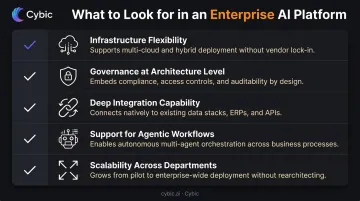
When evaluating platforms, apply these criteria:
- Infrastructure flexibility - deployable across cloud, on-premise, and hybrid environments without vendor lock-in
- Governance at the architecture level - RBAC, encrypted data handling, audit trails, and a firm commitment to no training on proprietary data
- Deep integration capability - native connectivity to existing enterprise systems (CRMs, ERPs, data lakes, legacy platforms)
- Support for agentic workflows - multi-step, multi-agent orchestration with human override mechanisms
- Scalability across departments and geographies - without requiring system rebuilds at each expansion
Platforms built for controlled demos struggle in operational environments with legacy systems, compliance constraints, and inconsistent data. The right platform is engineered for that reality - not an idealized architecture.
Cybic's Drava platform is built for exactly this kind of environment. It connects enterprise data, ML models, AI reasoning, and intelligent agents into a single governed system - moving organizations from isolated pilots to automation that runs at scale. Governance, security controls, and auditability are architectural features, not add-ons. That makes Drava particularly well-suited for regulated sectors like healthcare, energy, and manufacturing, where audit trails and access controls are operational requirements.
Frequently Asked Questions
What is the difference between enterprise AI automation and traditional RPA?
Traditional RPA handles fixed, rule-based tasks by following scripts that emulate human actions. Enterprise AI automation extends into unstructured data, adaptive decision-making, and multi-step orchestration across the organization. It handles scenarios where inputs vary, context matters, and outcomes require judgment rather than rule-following alone.
How do you build an enterprise AI automation strategy from scratch?
Start with an honest assessment of current automation maturity and data readiness. Identify use cases by business value and feasibility, not just ease of automation. Establish data foundations and governance frameworks before scaling, and run a focused pilot with measurable success criteria before expanding across departments.
What are the biggest benefits of enterprise AI automation?
The primary benefits are: cost reduction, faster and more consistent decision-making, scalability without proportional headcount growth, and improved compliance auditability. Gartner survey respondents report average 15.2% cost savings and 22.6% productivity improvements, though outcomes depend heavily on how well the strategy is structured.
What are the most common challenges in enterprise AI automation?
Data silos and legacy system integration, governance and compliance gaps, and organizational resistance are the top barriers. Each must be planned for before deployment because retrofitting governance or forcing adoption after systems are live is more expensive and harder to fix.
How do you measure ROI from enterprise AI automation?
Track automation rate, process cycle time reduction, cost per transaction, decision accuracy, and human-in-the-loop intervention rates - each measured against pre-automation baselines. These metrics tell you whether the program is delivering value or just generating activity.
What role does governance play in enterprise AI automation?
Governance ensures AI-driven actions are auditable, compliant, and trustworthy. It covers access controls, approval workflows, drift monitoring, and alignment with regulatory requirements such as HIPAA, SOC 2, and GDPR. Design it into the architecture from day one: adding governance post-deployment creates gaps that are difficult to close once autonomous systems are live.