That burden compounds at scale. With an estimated 560 billion invoices processed globally each year - and at least 80% still handled manually - the throughput gap between what manual teams can manage and what business volume demands is widening.
This article explains how AI agents close that gap in practice. Not through theoretical capability claims, but through the specific operational advantages that show up in day-to-day document workflows: processing speed at volume, accuracy with embedded governance, and end-to-end orchestration that eliminates the coordination overhead currently consuming skilled employee time.
Key Takeaways
- AI agents automate the repetitive core of enterprise document work - extraction, classification, validation, and routing - without requiring human input at each step.
- The measurable advantages are processing speed at volume, accuracy with built-in governance, and workflow orchestration that eliminates manual handoffs.
- Regulated and document-intensive industries - healthcare, manufacturing, O&G, public sector - see the sharpest immediate impact due to volume and compliance requirements.
- Gains compound over time: each workflow automated removes friction and frees skilled staff for higher-value work.
What Are AI Agents in the Context of Enterprise Document Work?
AI agents are software systems that can read, interpret, and act on documents autonomously - going beyond rules-based OCR or legacy RPA by understanding document context, handling format variation, and executing actions against defined business rules without human intervention.
They apply across the full document lifecycle:
- Sort incoming invoices, contracts, forms, and reports by type and priority
- Pull structured fields and check them against business rules or reference datasets
- Route documents and exceptions to the right approver with context pre-populated
- Update records, produce summaries, and archive with full action logs
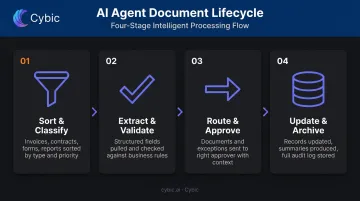
The contrast with older automation tools is worth understanding clearly. Legacy RPA breaks when document formats change; static OCR requires fixed templates. AI agents adapt to format variation and handle ambiguity by flagging it for human review rather than passing errors downstream.
They also integrate with existing ERP, CRM, and document management systems - no system replacement required.
Cybic's Drava platform builds orchestration and governance directly into the system architecture from the start, rather than layering them on after deployment. In regulated industries - healthcare, financial services, government - that architectural decision has direct consequences for how reliably agents perform under real operational conditions.
Key Advantages of AI Agents for Enterprise Document Tasks
Manual document workflows create friction in three specific places: how long processing takes, how often errors compound, and how much employee time disappears into coordination. Each advantage below addresses one of those directly.
Advantage 1: Processing Speed at Scale
AI agents process documents continuously, in parallel, at a rate no manual team can sustain. They operate around the clock without business-hours constraints - a structural advantage that compounds across high-volume workflows.
The intake-to-output pipeline runs autonomously: ingest from multiple sources (email attachments, portals, scanned uploads), classify by document type, extract data, validate against business rules, and push outputs to target systems - all in near-real time.
The throughput gap is significant. Ardent Partners' 2024 AP research found that average organizations take 10.1 days to process an invoice at a cost of $9.87 per invoice. Best-in-Class AP teams - those with higher automation rates - process the same invoice in 3.4 days at $2.81. That's a 3x speed difference and a 71% cost reduction per document, and it compounds across thousands of invoices monthly.
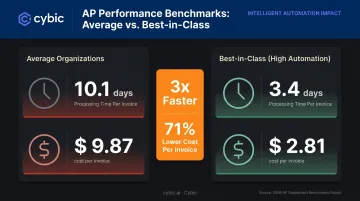
Published customer results reinforce this: Sumitomo Warehouse reported a 90% reduction in invoice processing time after deploying intelligent document processing, and PennyMac reduced processing time from several hours to minutes using automated document extraction tools.
In practice, that translates to:
- Finance teams eliminate backlog buildup and shorten payment cycle times across thousands of monthly invoices
- Procurement handles contract volumes that would otherwise require additional headcount
- 24/7 autonomous processing removes delays tied to shift schedules and peak-period bottlenecks
KPIs impacted: Processing time per document, daily throughput volume, backlog size, time-to-close on invoices and approval cycles.
Advantage 2: Accuracy and Built-In Governance
Manual data entry carries real error risk. A 2023 peer-reviewed study published in PubMed Central found single-entry error rates ranging from 4 to 650 errors per 10,000 fields - a wide range, but even the low end represents meaningful noise at enterprise document volumes.
AI agents reduce extraction errors by validating data against predefined business rules and reference datasets before anything moves downstream. When confidence is low, they flag for human review rather than passing incorrect data into ERP or financial systems. This keeps errors contained rather than propagated.
The downstream cost of document errors is not abstract:
- Ardent Partners found an average invoice exception rate of 20.7% - every exception requires manual investigation and correction
- HHS OCR reported 148 HIPAA settlements totaling over $143 million as of September 2024 - many tied to documentation and recordkeeping failures
- The SEC issued $88.2 million in penalties across 11 firms in 2024 for failures to maintain and preserve electronic records
In regulated industries, auditability is not optional. Every document action needs to be traceable - who accessed it, what was extracted, what decision was made, and when.
Cybic's Drava platform embeds these controls at the architectural level: role-based access, encrypted data handling in transit and at rest, and full audit trail generation are built into the system design from day one. Drava also enforces a strict no-training policy on proprietary client document data - a critical governance baseline for organizations handling sensitive records.
KPIs impacted: Data extraction accuracy rate, exception rate per document volume, audit pass rate, rework cycles per period.
Advantage 3: End-to-End Workflow Orchestration Without Manual Handoffs
AI agents don't handle a single step in isolation. They orchestrate the full document workflow - from intake through validation, routing, approval, system update, and archiving - without requiring a human to coordinate each handoff.
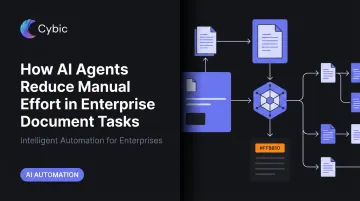
Consider a concrete example: an agent receives a vendor invoice, extracts line items, matches them against the corresponding purchase order in the ERP, routes exceptions to the correct approver with supporting context already populated, updates the financial system on approval, and archives the document with a complete action log. No human acts as the coordinator between those steps.
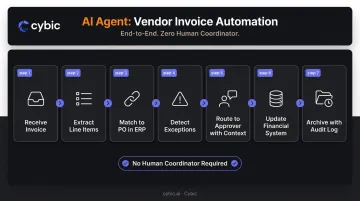
The coordination overhead removed here is measurable. Ardent Partners found that 49% of AP leaders cite slow invoice and payment approvals as their biggest operational hurdle, with AP staff spending 19.3% of their time responding to supplier status inquiries - work generated entirely by the information gaps and delays that manual handoffs create.
Orchestrated workflows also enforce consistency. Every document follows the same process steps regardless of which team member initiated it. That eliminates the process variation that silently creates errors, compliance gaps, and reporting inconsistencies across teams.
End result: End-to-end process cycle time, approval turnaround time, manual touchpoints per document, and employee hours redirected from coordination to substantive work - all move in the right direction.
What Happens When Document Tasks Stay Manual
Organizations that continue relying on manual document workflows don't absorb a fixed inefficiency - the cost compounds as document volume and complexity grows. The consequences that consistently emerge:
- Inconsistent output - extraction, classification, and routing varies by employee, creating data quality gaps that distort downstream reporting
- Error and rework costs - manual extraction errors propagate into ERP and financial systems; reworking a single Medicare Advantage denial averages $47.77, a figure that multiplies fast in high-volume environments
- Capacity bottlenecks - backlogs build when document volume outpaces headcount; SLAs slip and approval delays create cascading operational problems
- Compliance exposure - without consistent process and audit trails, regulated industries carry elevated risk during document audits, contract disputes, or regulatory reviews
- Talent misuse - skilled employees spend hours on low-value extraction tasks instead of the analysis and judgment work they were hired for
Incorrect document information caused payment delays in 25.7% of invoices in the Americas and 26.3% in Asia-Pacific, per Billentis 2024 data. At high document volumes, that failure rate isn't an anomaly - it's the predictable result of workflows that depend on manual consistency.
How to Get the Most Value from AI Agents in Document Workflows
The organizations that see the sharpest results from AI agents share a common starting approach: they pick one clearly defined, high-volume document workflow and deploy there first, rather than rolling out broadly across all document types simultaneously.
A practical deployment sequence:
- Start with one high-volume, consistent document type - vendor invoices, intake forms, and compliance filings work well because their structure is predictable and performance baselines are easy to measure
- Capture baseline metrics before launch - processing time per document, exception rate, error rate, and manual touchpoints; these numbers make the before-and-after comparison credible
- Configure governance guardrails before go-live - access controls, audit trails, and exception routing thresholds should be set before the agent touches live documents
- Track performance on a defined cadence - extraction accuracy, exception rates, and cycle times need regular review; workflow refinement only compounds if performance is measured against specific KPIs
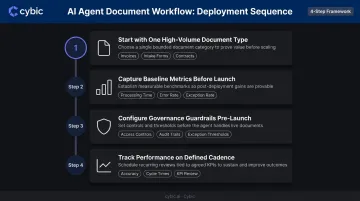
Exception thresholds deserve particular attention. Overly conservative thresholds - where the agent flags a large percentage of documents for human review - recreate the manual bottleneck the agent was meant to eliminate. Getting that threshold right, based on observed performance data, is where the compounding efficiency gain actually comes from.
Cybic's Drava platform provides the orchestration and governance layer for deploying AI agents reliably across enterprise document environments. Security controls, audit trails, and regulatory controls are built into the architecture from the start - not retrofitted once the system is live. That design approach matters directly for healthcare, O&G, manufacturing, and public sector organizations, where those controls are requirements, not preferences.
Frequently Asked Questions
What types of enterprise documents can AI agents process automatically?
Modern AI agents handle structured documents (invoices, intake forms with fixed fields), semi-structured documents (contracts, purchase orders), and unstructured content (emails, narrative reports). This breadth distinguishes them from earlier OCR tools, which only worked with fixed-format templates.
Which AI agent platform is best for enterprises?
The right platform depends on your organization's requirements. Prioritize governance and security controls, integration depth with existing ERP and CRM systems, infrastructure flexibility (cloud, hybrid, on-prem), and production-readiness over prototyping capability. For regulated industries, compliance alignment built into the architecture - not bolted on afterward - is non-negotiable.
How accurate are AI agents at extracting data from unstructured documents?
Accuracy depends on model quality, training data, and validation logic. A 2026 benchmark study (ExtractBench) found that frontier models achieved 72.9% accuracy when conditioned on valid JSON output across structured PDF extraction tasks , a meaningful result with room for error. Well-governed agents are designed to flag low-confidence extractions for human review rather than silently passing errors downstream.
Do AI agents for document processing integrate with existing ERP, CRM, or document management systems?
Enterprise-grade AI agents integrate with existing systems via APIs or custom connectors. Integration scope should be a primary evaluation criterion - organizations should prioritize platforms that work within current infrastructure rather than requiring system replacement. Cybic builds document automation around custom API development and ecosystem integration, designed to operate within your existing infrastructure from day one.
Which AI application helps reduce manual effort in email sorting?
AI agents with email triage capabilities classify incoming messages, extract document attachments, and route them into the appropriate workflow automatically. This is particularly valuable in accounts payable, procurement, and customer support contexts where email is the primary document intake channel.
How do enterprises maintain compliance when using AI agents for document tasks?
Compliance depends on governance features embedded in the platform architecture: role-based access controls, full audit trails, encrypted data handling, and traceable records of every agent action. These controls must be designed in from the start - platforms that layer compliance on after deployment create gaps that surface during audits.