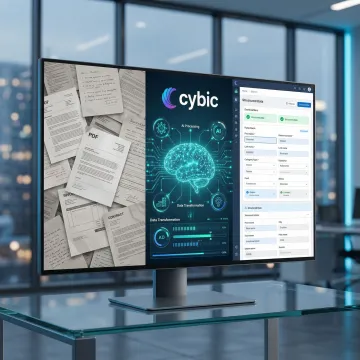
OCR (Optical Character Recognition) converts scanned images into machine-readable text but has no understanding of context or document structure. IDP (Intelligent Document Processing) goes further combining OCR with AI, NLP, and machine learning to classify documents, extract specific fields, validate data, and route it into downstream systems. IDP handles variability in document formats, making it far more effective for enterprise-scale automation than OCR alone.
What is the best document automation software?
The best document automation solution depends on your document types, volume, compliance requirements, and existing tech stack. Enterprise organizations benefit most from platforms that combine IDP, RPA, and LLM-based extraction in governed, integrated pipelines rather than point solutions. Cybic builds custom document automation systems tailored to your specific workflows, integrating with your CRM, ERP, or data lake rather than requiring you to adapt to a rigid off-the-shelf product.
What types of documents can be automated with Cybic's IDP solution?
Cybic's IDP handles a broad range of document types including invoices, purchase orders, contracts, insurance claims, loan applications, compliance filings, medical records, and HR documents. The system is trained to manage both structured and unstructured formats including PDFs, scanned images, emails, and handwritten forms across industries such as healthcare, finance, manufacturing, and the public sector.
How does Cybic's document automation integrate with existing enterprise systems?
Cybic connects document automation pipelines to your existing CRMs, ERPs, data warehouses, and cloud platforms via custom API development. Extracted and validated document data flows directly into systems like Salesforce, SAP, or your proprietary platforms eliminating manual re-entry and ensuring data consistency. Integration is designed to work within your current infrastructure without requiring a full system replacement.
Is my enterprise data kept private and secure during document processing?
Yes. Cybic enforces strict data governance policies, including encrypted data protection in transit and at rest, role-based access controls (RBAC), and a firm policy against training AI models on proprietary enterprise data. All deployments are aligned with regulatory frameworks including GDPR, HIPAA, SOC 2, and CCPA, with full audit trails and traceability of every AI-driven action within the document workflow.
Can Cybic's document automation scale to handle high-volume enterprise workloads?
Cybic designs infrastructure-agnostic, cloud-native architectures built to scale across AWS, Azure, and Google Cloud as well as hybrid and on-prem environments. Document processing pipelines are optimized for low-latency, high-throughput workloads, ensuring performance does not degrade as document volumes increase. The architecture is engineered from the outset to support enterprise-scale operations without manual intervention.
How long does it take to implement a document automation solution?
Implementation timelines vary based on document complexity, integration requirements, and the number of workflows being automated. A focused pilot targeting a single document type such as invoice processing can typically be deployed within 6 to 10 weeks. Broader enterprise rollouts involving multiple document categories, system integrations, and governance frameworks are scoped individually during the discovery phase.
Does Cybic provide ongoing support and monitoring after deployment?
Yes. Cybic's engagement model includes post-deployment monitoring, model performance tracking, and ongoing maintenance to ensure document automation systems continue to operate accurately as document formats or business rules evolve. AI lifecycle management and KPI tracking are built into every deployment, with mechanisms for continuous improvement and accountability as volumes and requirements scale.