Introduction
Enterprises are drowning in documents. Invoices, contracts, patient records, loan applications, compliance filings - the volume keeps climbing, and manual processing simply cannot keep pace. Industry estimates consistently place unstructured data at roughly 80% of everything enterprises generate, and the overwhelming share of it lives in documents that require human eyes to interpret.
That's changing fast. The global IDP market is projected to reach USD 12.35 billion by 2030, growing at a 33.1% CAGR from 2025. Automated document intelligence has moved from experimental to essential.
The clearest confirmation came in September 2025, when Gartner published its inaugural Magic Quadrant for Intelligent Document Processing Solutions - formally recognizing IDP as a mainstream enterprise software category.
That market recognition also means more vendors, more feature claims, and harder buying decisions. This guide evaluates seven platforms on AI architecture, extraction accuracy, deployment flexibility, governance controls, and real-world enterprise traction - criteria that matter in production, not in pitch decks.
Key Takeaways
- IDP goes well beyond OCR - it classifies, extracts, validates, and routes document data into business workflows automatically
- In 2026, differentiation has shifted from extraction accuracy to orchestration, governance, and workflow integration
- The 7 solutions span governance-first platforms, RPA-integrated tools, cloud-native systems, and transactional specialists
- Key selection criteria: AI architecture (VLM vs. legacy OCR), deployment flexibility, security certifications, and integration depth
- No single platform fits every organization; match the tool to your document types, compliance needs, and existing workflows
What Is Intelligent Document Processing?
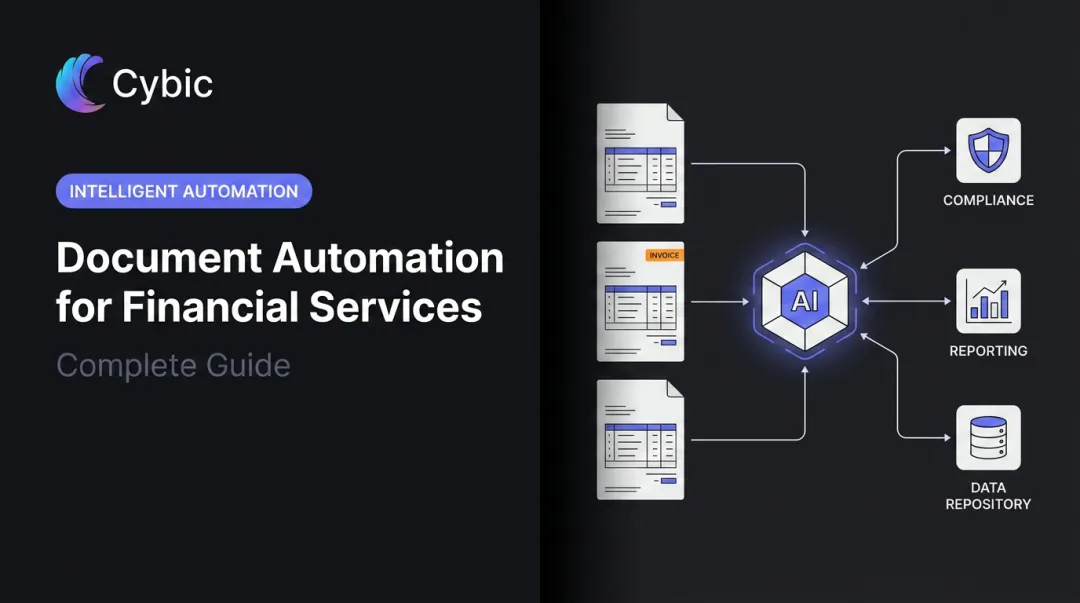
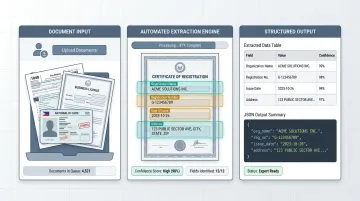
IDP is AI-driven software that captures, classifies, extracts, validates, and routes data from structured, semi-structured, and unstructured documents - PDFs, scanned forms, emails, contracts, handwritten records - without manual intervention. As AWS and ABBYY describe it, IDP combines machine learning, NLP, classification logic, and workflow integration - capabilities OCR can't provide. OCR converts pixels to text; IDP understands what that text means, where it belongs, and what action to take.
Three Generations of Document Automation
The technology has evolved through three distinct phases:
- Template-based OCR (pre-2015): rigid, rules-driven, breaks on any layout variation
- ML-enhanced extraction (2015–2023): added classification and training, but still required significant configuration
- AI-native IDP on vision-language models (2026 standard): understands document context, handles novel layouts, and integrates into orchestrated workflows
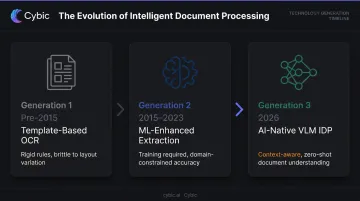
Enterprises still running second-generation tools face compounding problems: configuration overhead, brittle templates, scaling failures across document types, and the constant maintenance burden that comes with all three.
Primary Use Cases Driving Adoption
- BFSI: Invoice and AP automation, KYC, loan origination
- Healthcare: Patient records, prior authorizations, billing
- Legal: Contract lifecycle management, clause extraction
- Public Sector: Case files, licensing, benefits processing
- Manufacturing/Logistics: Compliance records, shipping documentation
Top 7 Intelligent Document Processing Solutions for 2026
Solutions were evaluated on AI architecture, extraction accuracy, deployment flexibility, enterprise integration depth, governance and compliance controls, and verified market presence.
1. Cybic - Drava Enterprise Data Intelligence Platform
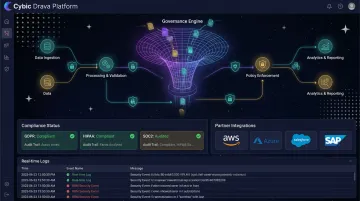
Cybic is an AI engineering company that designs and deploys enterprise AI solutions. Its Drava platform functions as a governed data intelligence-to-automation system, connecting enterprise data, machine learning, AI reasoning, and intelligent agents into unified operational workflows. Drava serves clients across Healthcare, Oil & Gas, Manufacturing, Retail, and Public Sector.
What separates Cybic from standalone IDP vendors is design philosophy. Governance is embedded from day one - not layered on afterward. The platform is infrastructure-agnostic, running across cloud, hybrid, or on-premises environments without forcing organizations to rebuild workflows around it.
RBAC, encrypted data protection, full auditability, and a strict no-model-training-on-proprietary-data policy are built into the architecture at the core.
For regulated industries where data sovereignty, compliance alignment, and operational integration matter as much as extraction accuracy, this is a meaningful distinction.
| Category | Details |
|---|---|
| Key Features | AI workflow orchestration, governed LLM applications, RBAC security controls, encrypted data handling, auditability and traceability, infrastructure-agnostic deployment, enterprise data integration |
| Best For | Enterprises in regulated industries (Healthcare, Oil & Gas, Manufacturing, Public Sector) requiring governance-first IDP with strict data controls across cloud, hybrid, or on-prem environments |
| Deployment & Pricing | Cloud, hybrid, and on-premises; custom enterprise pricing based on deployment scope - contact Cybic for a tailored engagement |
2. ABBYY Vantage
ABBYY brings over 35 years of document intelligence experience to its Vantage platform, which uses a skills-based architecture - deploying pre-trained AI models for specific document types or training custom models with continuous learning. ABBYY was named a Leader in the inaugural 2025 Gartner Magic Quadrant for IDP Solutions.
Key differentiators include a large pre-trained document model library available through the Vantage Marketplace, Generative AI integration via Azure OpenAI added in Vantage 3.0 (launched January 20, 2026), SOC 2 Type II certification, and data center options in the USA, Western Europe, and Australia to address data residency requirements.
| Category | Details |
|---|---|
| Key Features | Pre-trained and custom AI document skills, OCR + NLP extraction, low-code configuration, workflow integration, Generative AI (Azure OpenAI) integration, document classification and validation |
| Best For | Compliance-heavy enterprises needing flexible, high-accuracy extraction across diverse document types including contracts, claims, onboarding forms, and mortgage applications |
| Deployment & Pricing | Cloud and on-premises; REST API-first architecture; pricing available on demand |
3. Hyperscience
Hyperscience stands out for its proprietary ORCA (Optical Reasoning and Cognition Agent) model - a vision-language model purpose-built for structured, semi-structured, unstructured, and handwritten documents, with human-in-the-loop validation built into the platform architecture. It was named a Gartner MQ Leader with the highest completeness-of-vision placement among 18 vendors and achieved FedRAMP High authorization in December 2024.
Government sector traction is substantial: the US Social Security Administration adopted Hyperscience in 2024, a federal veterans agency uses it to serve nearly 9 million beneficiaries, and HMRC cut tax form processing from 45 days to one after implementation. For federal agencies and regulated government organizations, Hyperscience is the most proven option on this list.
| Category | Details |
|---|---|
| Key Features | Proprietary ORCA vision-language model, handwriting recognition, human-in-the-loop validation, structured and unstructured document handling, FedRAMP High authorization |
| Best For | Large regulated enterprises and federal agencies where handwriting support, FedRAMP compliance, and high automation rates are non-negotiable |
| Deployment & Pricing | Cloud and on-premises; FedRAMP High authorized; pricing available on request |
4. Tungsten Automation (TotalAgility)
Tungsten Automation - formerly Kofax, with roughly 40 years of market presence - is one of the largest dedicated IDP vendors globally. TotalAgility combines IDP with full workflow orchestration, RPA integration, AI copilots, and 140+ pre-built connectors. The company serves 25,000+ enterprise customers, including 8 of the top 10 global banks, and achieved FedRAMP High ATO for TotalAgility Cloud in March 2026.
The platform's strength is breadth: it orchestrates complex multi-department document workflows end-to-end rather than stopping at extraction. Generative AI Copilots in TotalAgility 8 accelerate model creation and reduce configuration time. For large BFSI, insurance, and supply chain organizations running cross-departmental document processes, TotalAgility is the most feature-complete option available.
| Category | Details |
|---|---|
| Key Features | AI-powered document capture, RPA integration, BPM workflow orchestration, Generative AI Copilots, pre-built document models, 140+ connectors, multi-channel ingestion |
| Best For | Large enterprises with complex cross-departmental document workflows - loan processing, insurance claims, KYC checks, supply chain documentation |
| Deployment & Pricing | Cloud, on-premises, and hybrid; SOC 2 Type II, HIPAA, GDPR, FedRAMP High compliant; custom pricing |
5. UiPath Document Understanding
UiPath Document Understanding is the document processing layer within UiPath's broader RPA platform. It uses AI and ML to extract data from structured, semi-structured, and unstructured documents, integrating directly into UiPath automation workflows. Pre-trained models for common document types are available as public endpoints requiring no model training, and the platform's One-Click Extraction capability allows custom extractors to be created without deep ML expertise.
The case for UiPath Document Understanding is tight integration. If your organization already runs UiPath for RPA, adding Document Understanding means you're extending existing infrastructure rather than introducing a separate vendor, contract, and integration layer. For organizations not already on UiPath, the case weakens considerably.
| Category | Details |
|---|---|
| Key Features | AI/ML data extraction, pre-trained document models, One-Click Extraction for custom models, RPA workflow integration, cloud and on-premises deployment |
| Best For | Organizations already using UiPath RPA that want intelligent document processing without introducing a separate platform |
| Deployment & Pricing | Cloud and on-premises; pricing tied to UiPath RPA licensing - contact UiPath for combined platform pricing |
6. Microsoft Azure AI Document Intelligence
Azure AI Document Intelligence (formerly Azure Form Recognizer) is Microsoft's enterprise document processing service. It offers prebuilt extraction models for invoices, receipts, ID documents, tax forms, and health insurance cards, alongside custom neural models for organization-specific layouts. Integration across Microsoft 365, Dynamics, and Power Automate is native.
The cost story improved significantly with a 40% reduction on custom extraction pricing in June 2024 - from USD $50 to USD $30 per 1,000 pages, with a free tier offering 500 pages/month for testing. For Microsoft-heavy organizations, this is the path of least resistance - document intelligence embedded directly into the tools teams already use.
| Category | Details |
|---|---|
| Key Features | Prebuilt and custom extraction models, Power Automate integration, multi-language support, REST API access, role-based access controls, free tier available |
| Best For | Organizations running on Microsoft infrastructure (SharePoint, Dynamics, Teams) that want document intelligence embedded in existing workflows |
| Deployment & Pricing | Azure cloud; free tier (500 pages/month); custom extraction from USD $30/1,000 pages - check Azure pricing page for current rates |
7. Rossum
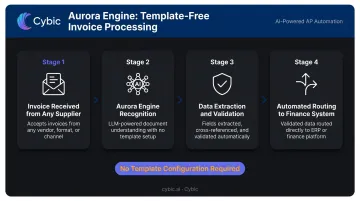
Rossum (founded 2017) is purpose-built for transactional document automation - invoices and purchase orders specifically. Its Aurora engine handles template-free recognition, meaning it processes documents from new vendors without requiring template configuration.
Aurora is a proprietary transactional LLM trained on millions of annotated financial documents. Rossum was also among the first IDP vendors to achieve ISO/IEC 42001:2023 certification for AI management systems.
The template-free approach is the core differentiator. Organizations processing invoices from hundreds of suppliers typically spend significant time maintaining templates as supplier formats change. Rossum eliminates that overhead entirely. With 450+ enterprise deployments and Gartner MQ recognition as a Challenger in 2025, it's a credible choice for finance and procurement teams where invoice volume is high and template maintenance has become a bottleneck.
| Category | Details |
|---|---|
| Key Features | Template-free Aurora engine, purpose-built transactional LLM, automated communications triggering, real-time analytics, continuous learning, ISO 42001 AI management certification |
| Best For | Finance and procurement teams processing high volumes of invoices and purchase orders from many different suppliers |
| Deployment & Pricing | Cloud-native; Starter tier begins at USD $18,000/year; higher tiers are quote-based |
How We Chose the Best IDP Solutions
The Evaluation Framework
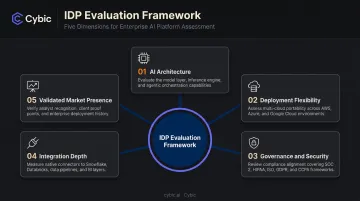
These solutions were assessed across five dimensions:
- AI architecture - VLM-native vs. legacy OCR with an AI wrapper; this gap in capability compounds at scale
- Deployment flexibility - cloud, hybrid, and on-premises options for data sovereignty requirements
- Governance and security - RBAC, encryption, audit trails, and compliance certifications (SOC 2, HIPAA, FedRAMP) relevant to the vendor's target markets
- Integration depth - connectivity with ERP, CRM, RPA, and data warehouse systems
- Validated market presence - analyst recognition (Gartner, Everest Group) and verifiable customer references, not feature lists
The Mistake Most Buyers Make
These five criteria narrow the field - but they don't replace real-world validation. Evaluating IDP solutions on vendor-supplied demo documents is a reliable path to a failed deployment. Production performance on your worst-case documents - handwritten annotations, mixed layouts, blurry scans, multi-language forms - is almost always lower than demo accuracy. Proof-of-value testing with your own document sets is non-negotiable.
The right platform depends entirely on use case fit, not brand recognition. A solution that excels at invoice automation in a Microsoft-heavy enterprise may be the wrong choice entirely for a regulated federal agency requiring on-premises FedRAMP deployment. The seven solutions below reflect both dimensions: capability and fit.
Conclusion
The IDP landscape in 2026 has matured. Differentiation has moved up the stack - from raw OCR accuracy to orchestration, governance, and the ability to turn document data into business action. Vendors that look identical in demos often diverge sharply when documents get complex, compliance obligations apply, or integration reaches your actual infrastructure.
Before finalizing a decision, assess your requirements across four dimensions:
- Document types and complexity - handwritten, multi-language, mixed layouts, volume
- Regulatory and compliance obligations - HIPAA, FedRAMP, SOC 2, GDPR as applicable
- Existing technology ecosystem - what you're already running on matters enormously
- Long-term scalability - will this solution grow with your document volumes and workflow complexity?
Then run a proof-of-value test with real documents before committing. How a solution handles your edge cases matters more than how it performs on clean samples.
For enterprises in Healthcare, Oil & Gas, Manufacturing, or the Public Sector, that evaluation often surfaces a harder requirement: governance embedded at the architecture level, not added on, with deployment flexibility across cloud, hybrid, or on-premises environments. Cybic engineers IDP solutions built around exactly those constraints - integrating data, automation logic, and compliance controls into systems that work in your actual environment from day one. Reach out to the Cybic team to scope your document automation requirements.
Frequently Asked Questions
What is the difference between IDP and traditional OCR?
OCR converts image text to machine-readable characters and stops there. IDP classifies documents, extracts structured fields with contextual understanding, validates data against business rules, and routes it into downstream systems - combining OCR with NLP, ML, and workflow logic to deliver end-to-end automation rather than just digitization.
Which industries benefit most from intelligent document processing?
The highest-impact verticals are BFSI (loan origination, KYC, claims), Healthcare (patient records, prior authorizations, billing), Public Sector (licensing, case files), Legal (contract review, clause extraction), and Manufacturing and Logistics (shipping documents, compliance records). If your team handles high volumes of repetitive documents, IDP is worth evaluating.
What should enterprises prioritize when evaluating IDP solutions in 2026?
Prioritize five criteria: AI architecture (VLM-native vs. legacy OCR wrapper), deployment flexibility for data sovereignty, security certifications (SOC 2, HIPAA, FedRAMP), integration depth with ERP and CRM systems, and field-level confidence scoring that enables threshold-based automation without reviewing every output manually.
Is intelligent document processing only suitable for large enterprises?
Early adoption was dominated by large enterprises, but cloud deployment and usage-based pricing have made IDP accessible to mid-market organizations. Platforms like Azure AI Document Intelligence offer free tiers, and Rossum's Starter plan begins at $18,000/year - making entry-level IDP viable at smaller scale.
How long does IDP implementation typically take?
Timelines vary by solution and complexity. Third-generation VLM-native platforms can reach production in two to four weeks for standard use cases. Legacy template-based systems often require three to six months of configuration. Regardless of vendor claims, proof-of-value testing before full deployment is strongly recommended.
How does AI governance factor into choosing an IDP platform?
Governance - covering data privacy controls, audit trails, RBAC, model transparency, and compliance with GDPR, HIPAA, and CCPA - is now a core evaluation criterion, not a checkbox. Verify that controls are embedded at the architecture level, and confirm that certifications apply to your specific deployment configuration, not just the vendor's hosted environment.