Introduction
Financial apps have become the default interface between people and money. According to the World Bank's Global Findex 2025, 79% of adults globally now have a financial account, with 3 billion people owning smartphones - creating massive demand for mobile banking, digital wallets, and neobank platforms.
That demand puts real pressure on enterprises to choose the right development partner. Fintech isn't standard software development. Security vulnerabilities, compliance failures, and poorly architected backends don't just create technical debt - they trigger regulatory action, customer loss, and sometimes company-ending breaches.
This guide covers the top 10 FinTech app development companies in 2026, evaluated on technical depth, AI capability, security architecture, and verifiable delivery - plus what to look for when making your own selection.
Key Takeaways
- The fintech software market is projected to grow by $25.56B from 2024 to 2029 at 8.2% CAGR
- Top partners are defined by domain depth, compliance-ready architecture, and proven AI delivery
- Cybic leads this list for its governance-embedded, engineering-led approach to AI-native fintech systems
- Key selection criteria: fintech domain expertise, security architecture, AI integration, and production outcomes
- Right-fit partner choice reduces risk first; cost savings follow
FinTech App Development in 2026: What the Market Demands
A fintech app development company builds digital financial products (payment apps, digital wallets, neobanks, lending platforms, investment tools) that must balance user experience, regulatory compliance, and security simultaneously. That's a different challenge than building a SaaS product or consumer app.
The market reflects this complexity. The broader financial services software market sits at $180.96B in 2026, projected to reach $276.28B by 2030. Embedded finance alone is expected to more than double from $92B in 2024 to $228B in 2028, driven by API-first banking and embedded wallet demand.
Three forces are reshaping what clients expect from development partners right now:
- AI integration - Deloitte projects AI tools could save banks 20–40% in software investments by 2028; the demand is for partners who build AI into the architecture from the ground up, not bolt it on after
- Embedded finance - open banking, BaaS, and payment integrations have become table stakes; clients expect them built in from day one
- Agentic automation - intelligent agents handling compliance workflows, transaction monitoring, and document processing have moved from roadmap to production
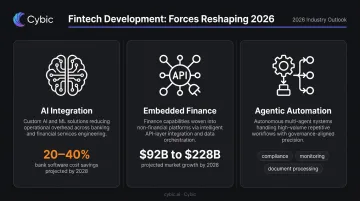
These are the 10 fintech app development companies delivering against all three of those demands in 2026.
Top 10 FinTech App Development Companies in 2026
Companies were evaluated on fintech domain expertise, AI and governance capabilities, security architecture, client portfolio breadth, and ability to deliver production-grade systems.
1. Cybic
Cybic is an AI engineering company that designs and deploys enterprise AI solutions, custom LLM applications, and intelligent automation systems. Its client ecosystem includes Google, NVIDIA, Microsoft Azure, AWS, Databricks, and Snowflake. In fintech contexts, Cybic's strength is building AI-native architectures that integrate data pipelines, machine learning, and workflow orchestration into core financial operations.
What separates Cybic from most development firms is its governance-embedded-by-design approach. Security controls, RBAC, encrypted data protection, auditability of AI-driven actions, and regulatory alignment (SOC 2, GDPR, ISO, HIPAA) are built at the architecture level - not added post-deployment. The Drava platform connects enterprise data, ML pipelines, AI reasoning, and autonomous agents to automate complex workflows with full visibility and governance. In practice, this means compliance workflows, transaction monitoring pipelines, and LLM-powered document intelligence are production-ready from day one - not retrofitted after launch.
| Core Fintech Services | Enterprise AI platform development, custom LLM applications, intelligent automation, AI workflow orchestration, real-time data pipelines (Drava platform) |
| Technology Specializations | Generative AI, LLMs, ML/data science, agentic automation, cloud/hybrid/on-prem deployment, governed AI architecture |
| Best For | Enterprises building AI-native fintech systems requiring strict data governance and compliance-ready AI infrastructure |
2. Intellectsoft
Founded in 2007, Intellectsoft delivers fintech solutions for banks, investment firms, and large financial institutions. Services span mobile banking, payment processing, financial analytics, and crypto wallets. Named clients include the London Stock Exchange and Experian.
Security implementation includes 3-factor authentication, biometrics, and DevSecOps practices. Clutch reviews reflect consistent delivery across financial services engagements.
| Core Fintech Services | Mobile banking apps, financial analytics platforms, payment processing, crypto wallet development |
| Technology Specializations | AI/ML, cloud infrastructure, blockchain, cybersecurity |
| Best For | Mid-market and enterprise financial institutions seeking secure, compliance-ready fintech software |
3. Innowise
Founded in 2007 with 3,500+ IT specialists and 1,600+ completed projects, Innowise has nearly two decades of experience delivering custom solutions for banks, fintech startups, and large financial institutions. The fintech practice covers core banking, payment systems, digital wallets, lending, wealth management, blockchain, and crypto.
Compliance claims include PCI DSS, PSD2, GDPR, CCPA, ISO 27001, and SOC 2 Type II - with over 100 fintech-specific projects on record.
| Core Fintech Services | Core banking platforms, payment processing, fintech consulting, custom software engineering |
| Technology Specializations | AI, blockchain, big data, cybersecurity, IoT |
| Best For | Enterprises and financial institutions needing large-scale custom fintech engineering with compliance depth |
4. Itexus
Founded in 2013, Itexus focuses specifically on fintech - digital banking, wealth management, AI-driven robo-advisors, and blockchain/crypto solutions. The company serves clients across 23+ countries with 250+ fintech projects completed (one official source cites 300+; treat the lower figure as verified).
Strong startup track record alongside enterprise delivery, with an agile model that extends from ideation through post-launch support.
| Core Fintech Services | Digital banking, wealth management systems, blockchain/crypto, fintech consulting, UI/UX design |
| Technology Specializations | AI/ML, blockchain, cloud, smart contracts |
| Best For | Startups and mid-sized financial businesses building new fintech products or modernizing existing systems |
5. Netguru
Founded in 2007, Netguru has built fintech products for clients including UBS, Klarna, Solaris, Skrill, and Nedbank. The finance practice covers digital banking, regtech, wealthtech, Banking-as-a-Service, open banking, AI/ML, and blockchain across 2,500+ projects.
Open banking capabilities are particularly strong - account aggregation, payment initiation, fund transfers, and secure data sharing. The client list - UBS, Klarna, Solaris - reflects a track record in high-UX financial products.
| Core Fintech Services | Banking platforms, investment tools, digital wealth management, Banking-as-a-Service |
| Technology Specializations | Product design, open banking, AI-driven features, mobile and web engineering |
| Best For | Companies prioritizing user experience and design quality alongside technical delivery |
6. DataArt
Founded in 1997 in New York, DataArt brings 6,000+ experts across 20+ countries and 1,200 finance specialists serving 400+ finance clients. Named clients include Nasdaq, Monex Europe, Invesco, Legal & General, and CIFC. One documented case study involved a 30 petabyte data migration completed in four weeks; another achieved 80% faster document reviews.
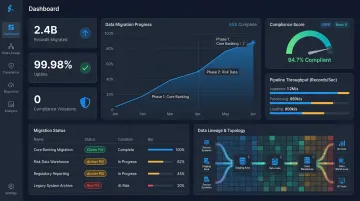
The strongest firm on this list for enterprise-scale legacy modernization and financial data infrastructure.
| Core Fintech Services | Legacy modernization, data management, insurance software, digital transformation consulting |
| Technology Specializations | Cloud migration, analytics, cybersecurity, enterprise architecture |
| Best For | Large financial institutions modernizing legacy systems or managing complex regulatory data requirements |
7. Cleveroad
Cleveroad positions itself as a full-cycle fintech software company with recognized presence on Clutch's Top 1000 lists. Services cover native mobile, web, AI/data science, and cross-platform development across fintech, logistics, and healthcare.
Known for close collaboration and tailored builds rather than template-based delivery - a good fit for businesses that need solutions shaped around specific operational requirements.
| Core Fintech Services | Custom fintech apps, mobile banking, payment systems, software modernization |
| Technology Specializations | AI/data science, ML, cross-platform development, cloud |
| Best For | Startups and SMBs needing custom fintech builds with close collaboration and flexible engagement models |
8. ScienceSoft
In operation since 1989, ScienceSoft delivers full-cycle fintech solutions including P2P platforms, digital wallets, payment processing systems, and AI/blockchain integrations. With 35+ years in operation, ScienceSoft spans both legacy and modern financial technology stacks - a practical choice for institutions that need a single partner across multiple technology generations.
| Core Fintech Services | P2P platforms, digital wallets, payment processing, client-facing financial apps |
| Technology Specializations | AI, blockchain, cloud, data engineering |
| Best For | Banks and financial service providers seeking a veteran partner with broad fintech technology coverage |
9. Nimble AppGenie
Founded in 2017, Nimble AppGenie focuses on consumer-facing fintech - eWallet, BNPL, loan lending, and mobile-first financial applications. The company reports 350+ completed projects and a 97% client satisfaction rate (vendor-claimed figures; not independently verified at time of writing).
Strong mobile development coverage across Android and iOS with fast delivery timelines. Purpose-built for early-stage fintech companies shipping their first consumer product.
| Core Fintech Services | eWallet apps, BNPL, loan/lending platforms, mobile banking, custom fintech apps |
| Technology Specializations | iOS/Android development, React Native, payment integrations |
| Best For | Startups and SMBs launching consumer-facing fintech apps with tight timelines and mobile-first requirements |
10. Yalantis
Founded in 2008, Yalantis builds secure, scalable financial applications including eBanking platforms, lending systems, investment tools, and payment apps. The payment practice specifically covers core banking integrations, cybersecurity best practices, fraud prevention, BI, and ML-enabled risk tools.
Particularly effective for fintech companies that need complex third-party API integrations delivered alongside solid UX.
| Core Fintech Services | eBanking platforms, lending apps, investment tools, payment systems |
| Technology Specializations | Third-party API integrations, cloud, mobile, UX design |
| Best For | Companies needing feature-rich fintech apps with complex integration requirements and strong UX focus |
How We Chose the Best FinTech App Development Companies
The most common selection mistake is optimizing for cost or brand recognition instead of domain fit and technical depth. The result: security gaps, compliance failures, or products that can't scale beyond their initial launch.
The evaluation criteria used for this list:
- Fintech domain expertise - not general software delivery, but demonstrated experience in banking, payments, wallets, lending, trading, or wealth workflows
- Security and governance architecture - how controls are built in, not bolted on; PCI DSS, GDPR, SOC 2, and ISO 27001 familiarity
- AI integration readiness - McKinsey projects agentic AI could cut banking operating costs by 20% or more; partners who can deliver this at the architecture level are better positioned to reduce compliance risk and cut time-to-market
- Compliance track record - verifiable evidence of regulatory alignment, not just claims
- Production delivery proof - named clients, case studies with measurable outcomes, review-platform verification
- Working systems vs. advisory decks - engagement models that end in deployed software, not recommendations
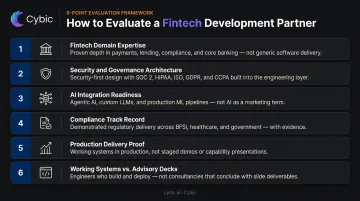
Each company below was evaluated against these criteria - not vendor claims. What follows is the shortlist that held up under that scrutiny.
Conclusion
Choosing a fintech development partner in 2026 is as much about regulatory depth and operational discipline as it is about technical capability. The right firm builds security and governance in from day one and delivers systems that run in production - not just look good in a demo.
When evaluating candidates, go beyond the pitch deck:
- Request case studies with measurable outcomes, not just client logos
- Ask how compliance and AI governance are handled at the architecture level
- Confirm the team can integrate into your existing infrastructure without disrupting operations
For organizations building AI-native fintech systems, Cybic designs and deploys custom AI solutions with governance, auditability, and compliance embedded at the architecture level - not bolted on after the fact. Their Drava platform connects enterprise data, ML models, and AI agents into a unified, governed system purpose-built for regulated industries. Contact Cybic to discuss your fintech AI requirements.
Frequently Asked Questions
What does a fintech developer do?
A fintech developer builds digital financial software - payment apps, digital wallets, banking platforms, lending systems - and handles backend logic, API integrations, security implementation, and regulatory compliance. It's substantially more complex than standard app development due to financial data sensitivity and regulatory requirements.
How much does it cost to develop a fintech app?
Costs vary based on complexity, team geography, tech stack, and compliance scope. A basic MVP typically starts in the $50,000–$150,000 range, while a full enterprise fintech platform can exceed $500,000+. Security and compliance requirements add meaningful cost compared to standard app builds.
What should I look for when choosing a fintech app development company?
Prioritize verified fintech domain experience, a demonstrable security and compliance track record, AI and integration capability relevant to your project, and case studies showing real production outcomes. Vendor claims about project counts or satisfaction scores carry less weight than named clients and documented results.
How long does it take to build a fintech app?
A basic MVP typically takes 3–6 months. A full-featured enterprise fintech platform runs 12–18+ months. Regulatory review processes, third-party banking integrations, penetration testing, and AI model governance all extend timelines beyond standard software projects.
What technologies are most commonly used in fintech app development?
Core infrastructure runs on cloud platforms (AWS, Azure, GCP), with mobile built on React Native, Flutter, Swift, or Kotlin. Backend systems use Python, Node.js, or Java. Specialized fintech components include AI/ML frameworks, blockchain, payment gateway APIs, and encryption-based security protocols.