Introduction
Most businesses don't outgrow their software overnight. It happens gradually - a workaround here, a manual export there, until your team is spending real hours bridging gaps that a $200/month SaaS tool was never designed to close.
The problem is structural. Off-the-shelf software is built for the broadest possible audience, which means it fits no one perfectly. You pay for features you'll never touch, bend your workflows to match the tool's logic, and then hit a wall the moment your operations get complex enough to need something different.
That's why more enterprises in 2026 are investing in bespoke web application development - software built from scratch around how their business actually works, not how a vendor assumes it should.
This guide gives technical and business leaders a clear framework for that decision. It covers:
- What bespoke development is and when it makes sense
- How it compares to off-the-shelf alternatives
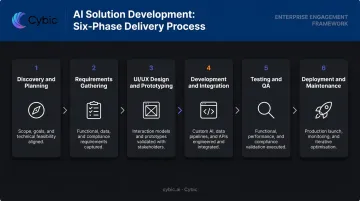
- What the build process looks like across six structured phases
- How to evaluate a development partner worth trusting with the work
Key Takeaways
- Bespoke web applications are built from scratch to match your exact workflows, not the other way around
- Key advantages: full IP ownership, no vendor lock-in, purpose-built scalability, compliance by design, and stronger long-term ROI
- Development follows six phases: discovery, requirements, UI/UX design, development, QA, and post-launch support
- Best suited for enterprises with specialized workflows, regulated operations, or complex integration needs
- In 2026, AI and intelligent automation are standard components of enterprise bespoke applications, built in from the start
What Is Bespoke Web Application Development?
Bespoke web application development is the process of designing and building a web application from scratch, tailored to a specific organization's workflows, goals, and technical environment. Nothing is recycled from a generic template. No feature is included because it shipped with the platform.
The word "bespoke" comes from tailoring - a garment cut to one person's exact measurements. Applied to software, it means every feature, interface, and integration is deliberately chosen for the client.
That translates to no unused modules cluttering the interface, no forced workarounds because the platform wasn't built for your process, and no vendor controlling your roadmap.
This stands in direct contrast to commercial off-the-shelf (COTS) solutions, which serve the widest possible audience by design. That breadth is their strength for simple use cases. For complex or specialized operations, it becomes their ceiling.
The market reflects growing recognition of this distinction. According to Gartner's 2024 custom software development services analysis, the custom software development market is growing at an 8.9% CAGR and will exceed $283 billion by 2028. That growth isn't driven by novelty - it's driven by enterprises hitting the limits of off-the-shelf tools and needing something built for their specific reality.
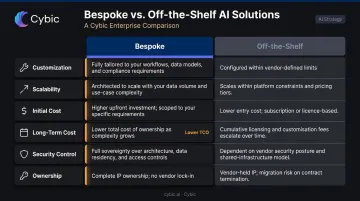
Bespoke vs. Off-the-Shelf Software: Key Differences
Neither approach is universally superior. The right choice depends entirely on your business complexity and growth trajectory.
| Dimension | Bespoke | Off-the-Shelf |
|---|---|---|
| Customization | Fully tailored to your workflows | Configured within vendor limits |
| Scalability | Designed for your growth path | Constrained by vendor architecture |
| Initial cost | Higher upfront investment | Lower entry cost |
| Long-term cost | No recurring per-seat fees | License costs scale with headcount |
| Security control | Built into architecture | Dependent on vendor |
| Ownership | You own the IP and source code | Vendor retains all rights |
Off-the-shelf makes sense when:
- You're an early-stage startup with standard workflows
- Your use case matches the tool's core design
- Budget constraints require minimizing upfront spend
Bespoke is the right call when:
- Your processes are specialized or regulated
- You need deep integration with existing enterprise systems
- The application itself is a competitive differentiator
- You're hitting scalability ceilings with your current stack
Benefits of Bespoke Web Application Development
Exact Fit to Business Processes
Generic software extracts a hidden cost: the productivity lost when your team bends real workflows to fit software limitations. Gartner calls this "digital friction," noting that fragmented technology and inconsistent workflows directly erode workforce productivity.
Research from Productiv puts a number on this - the average engaged user rate across enterprise SaaS apps sits at just 45%, meaning more than half of what companies pay for goes largely unused.
Bespoke applications eliminate that gap. Every screen, workflow, and data field is designed around how your team actually operates.
Full Ownership and No Vendor Lock-In
With bespoke development, the client owns the intellectual property, source code, and roadmap outright. That ownership has real operational consequences:
- No per-seat licensing fees that inflate as headcount grows
- No risk of a vendor sunsetting a feature your operations depend on
- No exposure to a third party's product decisions or pricing pivots
When a vendor restructures their model or discontinues a core feature, bespoke owners simply aren't in that conversation.
Superior Scalability
Bespoke architectures - modular or microservices-based - can be designed from day one to handle growth in users, data volume, and geographic reach. McKinsey projects that companies going beyond basic cloud adoption could unlock more than $3 trillion in EBITDA by 2030 - a figure tied directly to building scalable, modern architectures rather than working around legacy constraints.
Enhanced Security and Compliance by Design
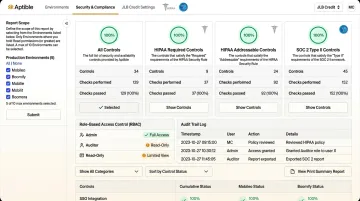
Custom applications allow security controls to be built into the architecture from the start:
- Role-based access control (RBAC) scoped to your org structure
- Encrypted data in transit and at rest
- Full audit trails on user and system actions
- Compliance frameworks (HIPAA, SOC 2, ISO, GDPR) embedded architecturally - not bolted on after launch
In regulated industries, the stakes are concrete. IBM's 2025 Cost of a Data Breach Report puts the global average breach cost at USD $4.44 million. Security designed in from day one carries a fundamentally different risk profile than security added as an afterthought.
Stronger Long-Term ROI
Upfront investment is higher than off-the-shelf - that's honest. But the ROI case builds over time through:
- Elimination of recurring per-seat license fees
- Productivity gains from automation of manual processes
- Competitive advantage from software your competitors can't replicate by subscribing to the same tool
Core Features of a Bespoke Web Application
Custom Dashboards and Role-Based UI
Bespoke applications serve different users differently. An executive sees strategic KPIs. An operations manager sees task-level controls. A field technician sees only the inputs relevant to their current job.
This goes beyond aesthetics - it reduces cognitive load and accelerates decision-making. Generic tools force every user through the same interface regardless of relevance.
Deep System Integrations
Enterprise operations don't run on one tool. BetterCloud's 2025 State of SaaS Report shows organizations use an average of 106 different SaaS tools. A bespoke application can connect your CRM, ERP, data pipelines, and third-party APIs into a single operational interface - eliminating the manual data movement and context-switching that kills productivity at scale.
For enterprise firms, this integration layer is often where the most immediate value is created - custom API development ensures data flows where it's needed, automatically, without manual handoffs between teams.
Custom Analytics and Reporting
Off-the-shelf reporting gives you the metrics the vendor thought were important. Bespoke applications surface the metrics that matter to your specific business. That includes:
- Real-time operational visibility tied to your workflows
- Anomaly detection calibrated to your data patterns
- Custom KPI tracking aligned to business-specific goals
- Predictive analytics built on your actual data model
A generic dashboard describes what happened. A purpose-built one shapes what happens next - and that distinction compounds over time as your data grows.
The Bespoke Web Application Development Process
Discovery and Planning
Discovery is where business stakeholders and the development team align on objectives, user groups, constraints, and success criteria. In practice, it's where most project failures are seeded - not during development, but in the weeks before it starts.
Misalignment at discovery produces the wrong system, regardless of how well it's built. Identifying conflicting assumptions early and establishing measurable success criteria prevents costly course corrections in every phase that follows.
That's why Cybic puts experienced engineers in discovery conversations from day one, not account managers. Engineers who will architect and build the system should be the ones asking the questions - that's how translation gaps between discussion and implementation get eliminated before they form.
Requirements Gathering and Analysis
Requirements fall into two categories:
- Functional requirements - what the application must do (features, integrations, workflows, user roles)
- Non-functional requirements - how it must perform (response time, uptime targets, security standards, compliance obligations)
Both matter. A system that does the right things but crashes under load, or handles data without HIPAA alignment, is not a finished product - it's a liability.
Tools like Business Process Model and Notation (BPMN) are particularly useful here, allowing development teams to visually map workflows so non-technical stakeholders can validate them without needing to read code or technical specifications.
UI/UX Design and Prototyping
Wireframes, mockups, and interactive prototypes exist for one reason: to find and fix design problems before a line of production code is written.
The cost math is significant. Research from UXPA indicates that correcting a usability problem once a system is in development costs 10 times as much as fixing it during design - and 100 times as much after release. Prototyping isn't optional; it's the cheapest insurance available on a complex software project.
Development and Integration
Development splits into two parallel workstreams:
- Front-end - the user-facing interfaces, interaction logic, and rendering
- Back-end - server logic, databases, business rules, and APIs
Integration work - connecting the new application to existing enterprise systems - is frequently where bespoke projects deliver their most immediate business value. When a manufacturer can finally see their ERP inventory data, CRM pipeline, and production floor status in one place without a manual export, that's the integration layer doing its job.
Testing and Quality Assurance
A complete QA process covers four categories:
- Functional testing - does it do what it's supposed to do?
- Performance/load testing - does it hold up under real traffic?
- Security testing - can it be exploited?
- User acceptance testing (UAT) - does it actually work for the people using it?
NIST's foundational software testing research estimated that a requirements-stage defect with a relative repair cost of 1x can cost 470x to 880x more to fix once a system is in production. Pre-launch QA is where that cost curve gets broken. The teams who skip it don't save time - they spend it later, at a much higher rate.
Deployment and Post-Launch Maintenance
Modern deployment practices include CI/CD pipelines, staged rollouts, and environment configuration management that reduce the risk of launch-day failures. But deployment isn't the finish line.
Post-launch maintenance covers security patches, performance optimization, feature additions, and infrastructure monitoring. A bespoke application without a defined maintenance model is a depreciating asset. The support structure - who owns patches, what SLAs apply, how feature requests get scoped - should be agreed upon before development begins, not negotiated under pressure when something fails in production.
AI and Intelligent Automation: The 2026 Bespoke Advantage
AI is no longer a feature you add to enterprise software. In 2026, it's becoming a structural component - embedded in how applications reason, automate, and deliver actionable insight from day one.
McKinsey's 2025 State of AI survey found that 78% of organizations now use AI in at least one business function, up from 55% just two years prior. The question is no longer whether to embed AI - it's how to do it so the system is governed, auditable, and genuinely wired into your operations.
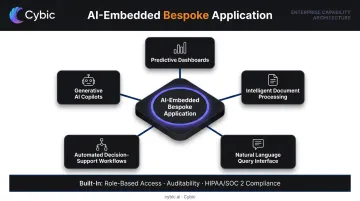
Bespoke web applications built in 2026 can include:
- Predictive dashboards that surface anomalies and forecasts alongside live operational data
- Intelligent document processing (IDP) to automate data entry and unstructured document handling
- Natural language query interfaces so non-technical users can interrogate complex datasets directly
- Automated decision-support workflows that flag exceptions and route approvals without manual steps
- Generative AI copilots embedded inside operational workflows - not layered on top of them
The risk in this environment isn't adopting AI - it's deploying it without governance. IBM's 2025 breach data shows that 63% of organizations had no AI governance policies, and organizations with high shadow AI exposure saw an average breach cost increase of $670,000. Standalone AI tools that create data silos compound that exposure.
For enterprise environments in Oil & Gas, Manufacturing, and Healthcare, AI integration requires governance controls built into the architecture: role-based access, auditability of AI-driven actions, and data privacy protections that satisfy HIPAA, SOC 2, or ISO requirements.
Cybic embeds these governance frameworks at design time - treating them as structural requirements rather than compliance checkboxes appended at the end of a project.
Who Should Consider Bespoke Web Application Development?
Not every organization needs bespoke software. The investment is justified when the alternative - adapting your operations to fit a generic tool - carries a higher long-term cost.
Three types of organizations consistently reach that threshold:
- Regulated-industry enterprises - Healthcare, financial services, manufacturing, oil & gas, and the public sector face compliance obligations that off-the-shelf products can rarely satisfy at the architectural level. HIPAA, SOC 2, and FINRA requirements demand systems designed for those constraints from day one.
- Businesses at a growth inflection point - When data silos, manual workarounds, and integration failures start appearing regularly, the organization has outgrown its current toolset. A unified platform built for scale resolves those symptoms structurally rather than managing them indefinitely.
- Organizations where the application is the product - Startups and enterprises building a unique digital product or service can't afford to hand the same capability to every competitor through an off-the-shelf subscription.
The compliance stakes are significant. SEC enforcement alone resulted in $8.2 billion in financial remedies in FY2024 - a figure that reflects what happens when systems aren't built to regulatory specification from the start.
How to Choose the Right Bespoke Development Partner
Evaluate Process Transparency and Engineering Depth
The difference between an engineering-led firm and an account-manager-led firm shows up quickly in discovery conversations. The right partner can articulate their requirements-gathering process, explain architecture decisions in plain terms, and show you relevant work in your industry - not just a portfolio of aesthetically pleasing screenshots.
Ask for case studies that describe the problem, the approach, and the measurable outcome. Presentation decks aren't evidence. Working systems are.
Assess Integration and Security Capabilities
Your bespoke application doesn't exist in isolation. It needs to connect to the systems already running your business. A partner without demonstrated experience in your specific stack creates risk that compounds throughout the engagement - not just at launch, but at every future integration point.
Key systems your partner should have hands-on experience connecting to:
- ERP and CRM platforms (SAP, Salesforce, Microsoft Dynamics)
- Cloud infrastructure across AWS, Azure, or Google Cloud
- Data warehouses and real-time pipelines
- Legacy on-prem systems requiring API bridging
Security should be treated as an architectural requirement, not a post-build checklist. Given an average enterprise breach cost of $4.44 million, the question to ask any prospective partner is specific: how do you embed security controls and compliance alignment into the architecture, and at what phase?
Clarify Ownership, Contracts, and Post-Launch Support
Before signing anything, three things need to be explicitly documented:
- IP and source code ownership assigned to the client in the development agreement
- Third-party or reused components - which assets, if any, are licensed rather than built fresh for your engagement
- Post-launch support model - who handles maintenance, on what terms, and at what cost
Without a clear post-launch plan, a bespoke application becomes a support liability the moment it ships. Cybic structures every engagement to include explicit post-launch ownership - defining who handles maintenance, how incidents are escalated, and what the ongoing support model looks like before a single line of code is written.
Frequently Asked Questions
What is bespoke web development?
Bespoke web development is the process of building a website or web application entirely from scratch, tailored to a specific organization's unique requirements. Unlike pre-built templates or off-the-shelf platforms, every feature, integration, and interface is purpose-built for a single client.
How much does bespoke software cost?
Costs vary widely - simpler applications can start around $25,000–$50,000, while complex enterprise systems often run $200,000 or more. The higher upfront investment is typically offset by full ownership, scalability, and the elimination of ongoing licensing fees over a 3-5 year horizon.
How long does bespoke web application development take?
Timelines range from a few weeks for simple applications to 6-12+ months for complex enterprise systems. Scope, number of integrations, compliance requirements, and team size are the primary variables.
What is the difference between bespoke and custom web development?
The terms refer to the same thing. "Bespoke" stresses that the solution is uniquely crafted for one client with no reuse of generic components; "custom development" is simply the more common industry term for the same concept.
Who owns the source code in a bespoke web application project?
This should always be explicitly stated in the development contract before work begins - not assumed. Standard practice is for the commissioning client to own the intellectual property and source code outright.
Can bespoke web applications integrate with existing enterprise systems?
Yes - integration with existing CRMs, ERPs, data warehouses, and third-party APIs is one of the primary reasons enterprises choose bespoke development, and it's designed into the application architecture from the start.