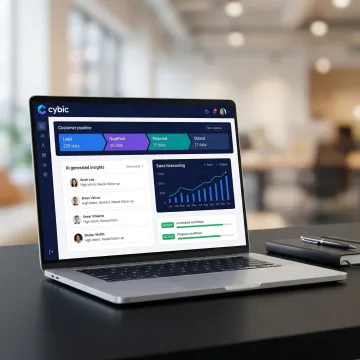
What is bespoke CRM development and how is it different from configuring an existing platform?
Bespoke CRM development means building a customer relationship management system from the ground up, engineered specifically around your workflows, data models, and business logic. Unlike configuring Salesforce or HubSpot where you adapt your processes to the platform's constraints, a custom CRM is architected to reflect exactly how your teams operate, with no feature bloat, licensing limitations, or structural compromises.
Which industries does Cybic build custom CRM solutions for?
Cybic builds custom CRM platforms for enterprises across healthcare, financial services (BFSI), manufacturing, retail, oil and gas, and the public sector. Each industry has distinct compliance requirements, data structures, and workflow patterns. Our engineering teams design CRM systems that address these domain-specific realities from the architecture level, ensuring the platform fits the operational environment it's deployed in.
Can Cybic integrate a custom CRM with our existing ERP, data warehouse, or third-party systems?
Yes. Cybic specializes in connecting custom CRM platforms to ERPs, data lakes, marketing automation tools, cloud data warehouses, and AI systems via custom API development and platform integration. We design integration layers that enable real-time, bidirectional data exchange across your entire enterprise ecosystem, using existing infrastructure without requiring disruptive replacements or extended downtime.
How does Cybic embed AI capabilities into a custom CRM platform?
Cybic integrates AI at the functional level, including predictive lead scoring, Generative AI copilots for sales reps, NLP-driven contact intelligence, automated workflow triggers, and real-time pipeline forecasting. AI models are connected to your CRM's data pipelines and deployed through governed, enterprise-grade infrastructure on AWS, Azure, or Google Cloud, ensuring models operate with auditability and access controls in place.
What does the custom CRM development process look like from discovery to deployment?
Our process begins with requirements discovery and workflow mapping, followed by architecture design, iterative prototyping, and QA validation. We then handle deployment, integration, and user acceptance testing before go-live. Post-launch, Cybic provides ongoing maintenance and iterative enhancement support. Every phase is driven by engineers who build and integrate directly, reducing translation gaps between business requirements and the final working system.
How does Cybic handle data security and compliance in a custom CRM?
Security and compliance are embedded at the architectural level, not added as afterthoughts. Cybic's CRM systems include role-based access controls (RBAC), encrypted data protection in transit and at rest, full audit trails of user and AI-driven actions, and alignment with GDPR, HIPAA, CCPA, and SOC 2 standards where applicable. Critically, Cybic enforces strict data governance. Your proprietary data is never used to train external AI models.
Can Cybic modernize or replace our existing legacy CRM system?
Yes. Cybic's legacy modernization practice handles full CRM migration and re-engineering, moving your existing data, workflows, and user configurations into a new, cloud-ready architecture. We assess the existing system, design a migration path that minimizes operational disruption, and rebuild functionality with modern APIs and scalable infrastructure. The result is a CRM that performs at enterprise scale without carrying forward technical debt.
How long does it typically take to build a custom CRM, and what factors affect the timeline?
Timelines vary based on scope, integration complexity, the number of custom modules required, and AI feature depth. A focused CRM with core pipeline management and key integrations can be delivered in 10–16 weeks. Enterprise-scale platforms with multi-system integrations, AI capabilities, and complex compliance requirements typically run 4–9 months. Cybic provides a detailed project roadmap and milestone schedule during the discovery phase so expectations are clear before development begins.