What is AI document classification and how does it work?
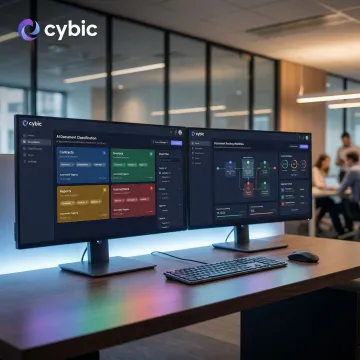
AI document classification uses natural language processing (NLP) models and large language models (LLMs) to automatically read, understand, and categorize documents based on their content, context, and semantics. The system is trained on domain-specific document types, enabling it to assign accurate categories such as contracts, invoices, or medical records without manual human review, at enterprise scale.
Which document types and formats can Cybic's AI classification system handle?
Cybic's classification systems are built to handle a wide range of document types including PDFs, Word documents, scanned images (via OCR), emails, structured forms, and unstructured text. Industries supported include legal contracts, healthcare records, financial instruments, manufacturing reports, and government documents with custom taxonomy built for each use case.
How accurate is AI document classification compared to manual sorting?
Well-trained domain-specific NLP and LLM models consistently achieve classification accuracy exceeding 95% on structured and semi-structured documents, significantly outperforming manual processes that are prone to human error, inconsistency, and fatigue. Cybic's models are continuously monitored for drift and retrained to maintain and improve accuracy as document volumes and types evolve.
How does Cybic ensure data security and regulatory compliance in document classification?
Cybic embeds security and compliance at the architectural level incorporating role-based access controls (RBAC), encrypted data protection in transit and at rest, full audit trails, and alignment with GDPR, HIPAA, and CCPA requirements. Critically, Cybic never trains models on proprietary enterprise data, ensuring your documents remain strictly confidential throughout the classification process.
Can the AI document classification system integrate with our existing enterprise platforms?
Yes. Cybic builds custom API integrations to connect classification outputs directly to your existing CRMs, ERPs, data lakes, document management systems, and enterprise workflows. Whether you operate on AWS, Azure, Google Cloud, hybrid, or on-prem environments, Cybic's infrastructure-agnostic architecture ensures seamless, low-disruption integration into your current operational ecosystem.
How long does it take to deploy an AI document classification system?
Deployment timelines vary based on document complexity, taxonomy size, integration requirements, and data availability. A focused classification project for a defined document set typically progresses from discovery through deployment in 8-16 weeks. Cybic uses CI/CD-based model deployment and phased rollout strategies to minimize disruption and deliver production-ready systems efficiently.
Does AI document classification require a large volume of training data to get started?
Not necessarily. Cybic's approach includes fine-tuning pre-trained foundation models and LLMs on your domain-specific documents, which significantly reduces the volume of labeled training data required compared to training models from scratch. For specialized domains with limited data, Cybic employs few-shot learning and synthetic data augmentation techniques to achieve strong classification performance.
What industries does Cybic serve with AI document classification solutions?
Cybic delivers AI document classification solutions across Oil & Gas, Healthcare, Manufacturing, Public Sector, and Retail with domain-specific model tuning for each industry's unique document types and compliance requirements. Enterprise customers including NVIDIA, Google, Microsoft Azure, AWS, Snowflake, and Databricks have trusted Cybic's AI engineering capabilities for complex, regulated document environments.