The problem is structural. A contract review tool that flags a risk clause does nothing about routing that finding, drafting a revision, updating the matter file, or notifying the attorney. Those handoffs still happen manually. That is not an AI problem - it is an architecture problem.
Multi-agent AI systems solve it by coordinating specialized agents across entire workflows, not just individual tasks.
Key Takeaways
- Multi-agent AI connects specialized agents across research, drafting, review, and compliance - coordinating work that isolated tools handle separately
- Automate full workflow chains - contract lifecycle, eDiscovery triage, research-to-memo pipelines, and compliance monitoring - for the largest efficiency gains
- Build governance in from day one: privilege protection, RBAC, audit logs, and data residency belong in the architecture, not bolted on later
- Start with one high-volume, low-risk workflow, define success metrics before launch, then scale in phases
From Single AI Tools to Multi-Agent Systems: What's Actually Different
A multi-agent AI system is a coordinated network of specialized agents - each with a defined role - managed by an orchestration layer that routes tasks, maintains context across steps, and handles handoffs without requiring a human to manually move work between tools.
Why Individual Tools Fall Short
A standalone contract review tool can flag a non-standard indemnification clause. What it cannot do:
- Route that finding to a research agent to surface relevant precedents
- Pass the result to a drafting agent to propose revised language
- Update the matter file in your document management system
- Notify the responsible attorney with a summary
Each of those steps still requires manual effort. Multiply that across hundreds of matters and the inefficiency compounds fast. Thomson Reuters found that 75% of legal departments prioritized using technology to simplify workflows and manual processes - yet the tools most firms have deployed are not connected enough to deliver that.
How Orchestration Actually Works
The orchestrator (sometimes called a supervisor agent) interprets the goal, breaks it into subtasks, assigns each to the appropriate specialist agent, and synthesizes outputs into a coherent result. A research-to-memo request, for example, becomes: query databases → surface precedents → reconcile conflicts → draft memo with citations, all in one connected pipeline.
Legal work maps naturally onto this design. Matters are inherently multi-step, span multiple document types and systems, require cross-referenced authority, and demand documented decision trails - the same structural demands that multi-agent architecture was built to satisfy.
Gartner projects that by 2027, one-third of agentic AI deployments will combine agents with complementary specializations to handle multi-step tasks. Separately, the firm forecasts that 40% of enterprise applications will feature task-specific AI agents by end-2026, up from less than 5% in 2025.
The Legal Workflows Where Multi-Agent AI Delivers the Most Value
Contract Lifecycle Automation
Most firms run contract review across four separate tools. A connected pipeline collapses that into one workflow:
- Intake agent - captures and classifies the agreement type
- Review agent - flags non-standard clauses against the firm's playbook
- Redlining agent - proposes edits with reasoning
- Routing agent - escalates high-risk items to the supervising attorney
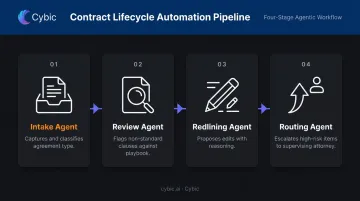
The attorney receives a structured summary with flagged clauses, proposed redlines, and a clear escalation rationale - not a raw document with highlights.
Legal Research and Memo Production
Research that used to take days can move in hours when agents handle the heavy lifting:
- A research agent queries legal databases using semantic search to surface relevant precedents
- A synthesis agent cross-references and reconciles conflicting authorities
- A drafting agent produces a structured memo with inline citations
Attorneys receive a memo ready for review rather than a stack of raw search results to sort through. Thomson Reuters projects AI could free legal professionals nearly 240 hours per year, with an average annual value of $19,000 per professional - though actual results vary by firm and practice area.
eDiscovery and Document Triage
Document review accounts for the majority of electronic discovery costs, and AI-assisted review has changed the cost structure. Agents can process large document sets in parallel:
- Classification agent - ranks documents by relevance against review criteria
- Privilege-screening agent - flags potentially privileged material for attorney review
- Summary agent - generates structured review notes, reducing the volume reaching human reviewers
According to the EDRM's Winter 2026 pricing survey, GenAI-assisted review is increasingly priced at $0.11–$0.50 per document, compared with $0.50–$1.00 per document for traditional human review. The throughput difference is substantial.
Compliance Monitoring and Regulatory Change Management
Thomson Reuters Regulatory Intelligence tracked 61,228 regulatory events in 2022 - roughly 234 daily alerts across 1,374 regulators in 190 countries. That volume is not manageable manually.
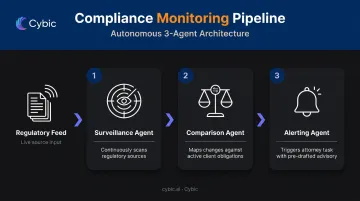
A monitoring pipeline handles it systematically:
- A surveillance agent continuously scans regulatory sources (GDPR updates, FINRA notices, state bar rule changes)
- A comparison agent maps changes against the firm's active client obligations
- An alerting agent triggers a task for the responsible attorney with a pre-drafted client advisory
The same orchestration logic that works for contracts and research applies here - the difference is the input is regulatory feeds rather than documents.
Client Intake and Matter Initialization
Intake checks every box for AI automation: it's repetitive, rule-based, and costly when done incorrectly. Agents handle it end-to-end:
- Conversational intake agent collects matter details
- Conflict-check agent cross-references the firm's matter database
- Setup agent creates the matter file, assigns the team, and populates deadlines in the practice management system
Designing a Multi-Agent Architecture for Your Law Firm
Two Layers, Clearly Separated
Effective multi-agent systems use two distinct layers:
| Layer | Role |
|---|---|
| Supervisory orchestrator | Interprets goals, plans tasks, manages agent sequencing |
| Specialist agents | Each handles a defined scope: research, review, drafting, compliance, or operations |
Firms that conflate these layers tend to build brittle systems. When the orchestrator also performs specialist functions, it becomes difficult to isolate failures, update individual agents, or audit specific outputs.
Connecting to Existing Legal Tech
The right architecture works with your existing legal tech stack, not around it. Document management systems (iManage, NetDocuments), practice management platforms (Clio, Aderant), billing systems, and communication tools become data sources and action targets for the agent pipeline.
Cybic's ecosystem integration approach connects AI platforms, data pipelines, and enterprise applications into unified operational systems - including custom API development for platforms without native AI connectors. The infrastructure supports AWS, Azure, Google Cloud, on-premises, and hybrid deployments to accommodate firms with strict data residency requirements.
Defining Handoff Protocols
Poorly defined handoffs are the leading cause of multi-agent system breakdowns. Every agent handoff needs four things specified:
- What data the agent receives as input
- What it returns as output
- When it escalates to a human versus proceeding autonomously
- What constitutes task completion versus task failure
Human-in-the-Loop Checkpoints
Those handoff definitions feed directly into your review checkpoints. Attorney oversight should be built into the pipeline at specific stages - not treated as an afterthought. Define review gates for:
- Final redlines before client delivery
- Research memos before filing or advice
- Compliance advisories before client distribution
For firms without in-house AI engineering capacity, working with an engineering-led partner like Cybic removes the translation gap between architectural design and working deployment. Cybic's approach embeds governance and compliance controls at the architecture level from day one.
Governance, Security, and Ethics Compliance by Design
Baseline Data Governance Requirements
ABA Formal Opinion 512 establishes clear requirements under Model Rules 1.1, 1.4, and 1.6: attorneys must understand the technology they use, protect client confidentiality, verify AI outputs, and maintain supervision over AI-generated work. State bars - including California, Florida, New York, and Texas - have issued additional guidance with specific requirements that vary by jurisdiction.
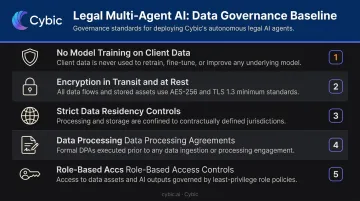
The baseline data governance requirements for any legal multi-agent deployment:
- No model training on client data - client information must never be used to train or fine-tune AI models
- Encryption in transit and at rest - across every agent and every data store
- Strict data residency controls - particularly relevant for cross-border matters
- Data processing agreements with every vendor in the agent stack
- Role-based access controls (RBAC) that mirror the firm's existing permission structure
Audit Logging as an Architectural Requirement
Every agent action, data access event, and output must be traceable. Audit trails are foundational infrastructure - they support privilege logs, billing records, and regulatory review. The audit trail needs to capture:
- Which agent performed each action
- What data was accessed and when
- What output was produced
- Whether a human reviewed and approved the output
Cybic embeds RBAC, encrypted data protection, and auditability of AI-driven actions directly into system architecture - aligned with SOC 2, HIPAA, ISO, and GDPR requirements where applicable - rather than applying these controls after the system is deployed.
Audit logging captures what happened - but the supervisory framework determines who was responsible for it.
The Supervisory Framework Bar Associations Expect
Every workflow should have a defined attorney review gate. Attorneys must be able to:
- Explain what each agent does and what data it accesses
- Review outputs before they reach clients or courts
- Demonstrate that oversight was exercised
Without a documented review gate in place before deployment, demonstrating oversight after a complaint or audit becomes nearly impossible.
A Phased Deployment Roadmap
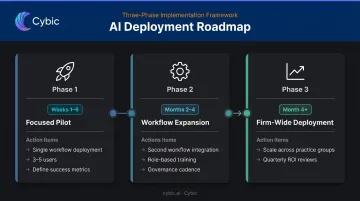
Phase 1: Focused Pilot (Weeks 1–6)
Start with one high-volume, low-risk workflow. NDA review and internal research memos are ideal candidates - they are repetitive, well-defined, and easy to measure.
Before launch, define success metrics explicitly:
- Turnaround time reduction (target percentage)
- Attorney hours recovered per week
- Accuracy rate on flagged clauses or cited authorities
Keep the pilot to 3–5 users with a structured weekly feedback loop. The goal is a measured result, not a broad rollout.
Phase 2: Workflow Expansion and Team Enablement (Months 2–4)
Expand to a second workflow: eDiscovery triage and client intake are the most common next steps. Run role-based training in parallel so attorneys, paralegals, and legal ops staff understand how to work with agents, not around them.
Then establish a governance review cadence:
- Audit agent outputs on a regular schedule
- Document errors by type and frequency
- Refine handoff rules based on what actually fails in production
Real-world errors are more informative than any pre-launch test.
Phase 3: Firm-Wide Deployment and ROI Measurement (Month 4 Onward)
Scale across practice groups, connect additional data sources, and add agents as the system matures. Run quarterly ROI reviews measuring:
- Billable hours recovered
- Cost per matter reduction
- Client delivery speed
Tracking these figures over time reveals where the system is creating real leverage - and where the next phase of expansion will have the highest return.
Frequently Asked Questions
What is a multi-agent AI system, and how is it different from a standard legal AI tool?
A single legal AI tool handles one task in isolation. A multi-agent system coordinates multiple specialized agents that pass work to each other, completing entire workflows like research-to-memo or contract intake-to-redline without a human manually moving work between steps. The distinction is orchestration across the full workflow, not just automation of one step.
How do multi-agent AI systems protect attorney-client privilege and client confidentiality?
The key requirements are no model training on client data, end-to-end encryption in transit and at rest, role-based access controls that mirror existing firm permissions, and full audit logs of every agent action. These controls must be built into the architecture, not applied after deployment.
Which legal workflows are best suited for a first multi-agent deployment?
Start with high-volume, structured workflows that have clear success metrics: NDA review, legal research memos, eDiscovery triage, and client intake are the most reliably successful early deployments. They are repetitive, well-defined, and straightforward to measure.
Do bar association ethics rules permit law firms to use AI agents?
Yes. ABA Formal Opinion 512 permits AI use but requires attorneys to understand the technology, protect client data, verify outputs, and maintain supervision. State bars - including California, Florida, New York, and Texas - have issued additional guidance, and requirements vary by jurisdiction.
How long does it typically take to deploy a multi-agent AI system at a law firm?
A focused pilot on a single workflow can be operational in four to six weeks. Firm-wide deployment across multiple practice areas typically takes three to six months, depending on the complexity of existing infrastructure and the number of integrations required.
Can a law firm build a multi-agent AI system without in-house AI engineering expertise?
Most firms cannot, and should not attempt to build from scratch internally. An AI engineering firm that specializes in enterprise deployment will integrate the system with existing legal tech, meet governance requirements, and build for production conditions rather than prototype use.