Introduction
Most enterprises aren't short on ambition when it comes to agentic AI. They're short on foundations.
AI agents have moved from conference keynotes into active pilots across industries - but the data tells a more sobering story. According to Deloitte's 2025 research, 38% of organizations are piloting agentic AI, yet only 11% have systems actively running in production. That gap isn't a technology problem. It's an infrastructure, governance, and design problem.
The blockers showing up most consistently: over-permissioned agents creating security exposure, fragmented pilots that collapse under production conditions, and governance gaps that stall deployments in regulated industries.
This article covers what enterprises actually need to close that gap:
- A working definition of agentic AI
- The five factors that determine adoption success or failure
- A 3-stage maturity framework
- A practical implementation guide built for engineering reality
Key Takeaways
- Agentic AI plans, reasons, calls tools, and takes autonomous action - not just generate outputs on demand
- 38% of organizations are piloting; only 11% are in production - the gap is governance and infrastructure, not budget
- Five factors decide adoption outcomes: security, governance readiness, data quality, cost-benefit clarity, and workforce alignment
- A 3-stage path - Process AI → Single-Agent → Multi-Agent - provides structure without skipping foundations
- Governance embedded at the architecture level is what separates enterprises that scale from those that stall
What Makes AI "Agentic"?
The word gets used loosely. Here's a precise definition: agentic AI refers to systems that can plan, use tools, adapt, and retain memory - not just respond to a prompt.
The Four Core Capabilities
- Planning - breaking a goal into executable steps and sequencing them
- Tool-calling - querying APIs, databases, and external systems to gather information or trigger actions
- Adaptability - adjusting behavior based on changing inputs or failed steps
- Memory - retaining context across a multi-step task so earlier decisions inform later ones
Traditional RPA and rule-based automation do none of this. They execute predefined logic on fixed inputs - when the input changes, they break. Agentic AI handles that variability instead. Understanding where agentic systems fit relative to other automation types helps clarify where they belong in an enterprise stack.
Four Categories of AI Systems
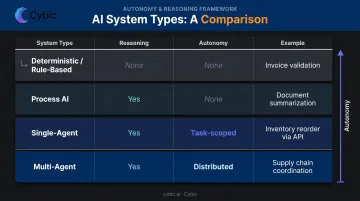
Enterprises typically encounter these four system types:
| System Type | Reasoning | Autonomy | Example |
|---|---|---|---|
| Deterministic / rule-based | None | None | Invoice validation rules |
| Process AI (LLM-powered) | Yes | None | Document summarization, internal Q&A |
| Single-agent systems | Yes | Task-scoped | Inventory monitoring + reorder via API |
| Multi-agent systems | Yes | Distributed | Supply chain coordination across teams |
The Generative AI Distinction
Generative AI responds when prompted. Agentic AI decides when and how to act. That distinction reshapes risk profiles, governance requirements, and integration scope. A chatbot that gives wrong information is a UX problem. An agent that takes the wrong action in a production system is an operational incident - which is why oversight and control architecture need to be designed in from the start, not added later.
Why Enterprise Adoption Is Accelerating Now
The numbers make the urgency concrete. Gartner predicts that 40% of enterprise applications will include task-specific AI agents by end of 2026 - up from less than 5% in 2025. That's an 8x shift in under two years - effectively a near-term architecture deadline.
McKinsey's 2025 global survey found **62% of organizations are experimenting with or scaling AI agents**, including 39% in active experimentation. Budget is following intent: a 2025 Gartner poll found that 61% of organizations have already committed capital to agentic AI - 19% at significant investment levels, another 42% in conservative early spend.
The Competitive Case for Moving Now
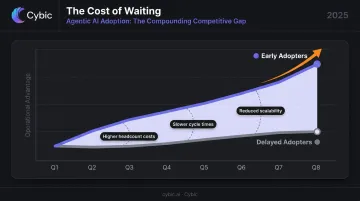
The operational value is measurable. Deloitte found 74% of organizations met or exceeded ROI expectations from their most advanced generative AI initiatives - with 20% reporting ROI above 30%. As agentic systems absorb more of the execution layer, organizations that delay will face compounding disadvantages:
- Slower process cycle times relative to competitors who have automated the same workflows
- Higher headcount costs for tasks that are automatable at scale
- Reduced ability to grow without proportional hiring
The compounding effect matters: each quarter of delay widens the operational gap against competitors who have already automated the same workflows.
Key Factors Shaping Successful Agentic AI Adoption
Security as the Primary Blocker
Autonomous agents don't just use systems - they act within them. That changes the risk profile fundamentally.
Gartner predicts over 40% of agentic AI projects will be canceled by end of 2027 due to escalating costs, unclear business value, or inadequate risk controls. OWASP's 2025 LLM Top 10 specifically identifies Excessive Agency - where agents have too much permission or autonomy - as a primary risk category. CrowdStrike's 2025 threat research confirms attackers already exploit AI software as both a tool and a target.
The practical answer is least-privilege by design: agents receive only the access required for their specific task. Think of onboarding a contractor - you give them a key card for the floors they need, not a master key. For agents, this means:
- Risk-tier classification for each agent type
- Spending or action caps that trigger human approval above a threshold
- Assigning each agent a governed, auditable identity - Palo Alto Networks identifies this as the emerging foundation for agentic defense
Governance and Compliance Readiness
For any agent running in production, three questions must have documented answers: Who approved its access? What actions did it take? Why did it make a specific decision?
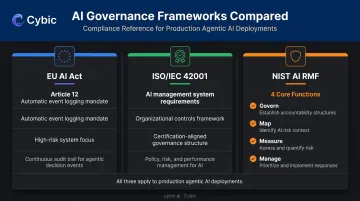
Without those answers, AI-driven outcomes can't be defended to regulators, auditors, or the board. Three frameworks shape what "documented" must look like: the EU AI Act (Article 12) mandates automatic event recording logs for high-risk systems; ISO/IEC 42001 defines requirements for an AI management system; and NIST's AI RMF organizes risk management around Govern, Map, Measure, and Manage.
For regulated industries - healthcare, financial services, energy, public sector - governance maturity is the deciding factor between staying in pilot mode and reaching production. Platforms with governance built into the architecture (role-based access controls, encrypted data handling, audit trails, AI action traceability) remove this bottleneck.
Cybic embeds RBAC, encrypted data protection, and action traceability at the architectural level, addressing the compliance requirements that block deployment in HIPAA, SOC 2, and GDPR environments.
Data Infrastructure and Integration Readiness
Agentic AI is only as reliable as the data it acts on. IBM's 2024 enterprise AI adoption index found 25% of organizations cite data complexity as a deployment barrier - and that figure was measured before agents became mainstream.
Fragmented, siloed data doesn't just slow agents down; it causes them to fail silently or produce incorrect outputs that trigger real-world actions. Before deploying agents that will act autonomously, organizations must address:
- Data integration across source systems
- Data quality and consistency standards
- Governance frameworks that define what data agents can access and how
Cybic's data engineering practice typically begins with a data landscape audit and gap analysis before any agent deployment work begins - building the pipelines, governance frameworks, and master data management foundations that make agents reliable.
Cost and ROI Assessment
The cost equation for agentic AI has two sides. On the investment side: model inference costs, orchestration tooling, engineering overhead, security controls, and ongoing human review. On the return side: reduced back-office labor, faster process cycle times, and scalability without proportional headcount growth.
The failure mode Gartner identifies - projects canceled due to escalating costs and unclear value - happens when organizations build autonomously without first proving value in a bounded scope. The safest framing: prove value before expanding autonomy. Start with one well-scoped use case, measure it rigorously, then scale.
Workforce Adoption and Change Management
Agents don't replace teams - they change what those teams do. Resistance escalates when employees don't understand which decisions remain with humans or how oversight works.
Effective change management means being specific: which tasks are agents handling, what triggers human review, and where does the human retain final authority. Cybic's AI adoption frameworks embed change management alongside technical deployment, with KPI tracking and lifecycle management built into the engagement - not added as an afterthought when friction surfaces.
The 3-Stage Path to Agentic AI Maturity
Skipping stages doesn't accelerate progress: it compounds risk. Each stage introduces new autonomy, new failure modes, and new governance requirements that depend on the prior stage's infrastructure being solid.
Stage 1: Process AI (Foundation)
At this stage, LLMs assist but don't act. Use cases include document summarization, internal Q&A, and AI-powered copilots that surface recommendations. Humans decide and execute; the AI informs.
Common obstacles here include data integration gaps, poor stakeholder alignment, and governance that hasn't been formalized. Before advancing, organizations must establish:
- A secure AI registry cataloguing all deployed models and tools
- Baseline governance: RBAC, audit logging, access controls
- Repeatable, standardized workflows that can be handed off to agents in Stage 2
Stage 2: Single-Agent Systems (Autonomous Execution)
With Stage 1 foundations in place, Stage 2 marks a qualitative shift: a single agent can now plan, reason, and call external tools to complete a task without human input, within a defined scope.
A concrete example: an agent monitors inventory levels across warehouse systems, identifies restock thresholds, and places purchase orders autonomously via an ERP API. No human reviews each order. Gartner predicts 15% of day-to-day work decisions will be made autonomously through agentic AI by 2028, up from 0% in 2024.
Configuration errors at this stage don't surface as chat responses. They surface as real-world actions with real costs. Governance, observability, and granular traceability become non-negotiable.
Stage 3: Multi-Agent Systems (Distributed Intelligence)
Multiple specialized agents coordinate in real time, each with its own tools, logic, and scope - handling supplier communication, monitoring logistics, flagging compliance exceptions, and delegating to each other dynamically.
The power is scale and speed. The risk is emergent behavior: interconnected agents can produce outcomes no single agent would generate alone, a challenge well-documented in multi-agent systems research. Gartner predicts one-third of agentic AI implementations will combine agents with different skills by 2027.
Infrastructure requirements at this stage:
- Elastic compute that scales with agent workload
- An orchestration layer managing inter-agent coordination
- End-to-end dynamic observability across all agent activity
- Adaptive security protocols that handle identity and permission management at scale
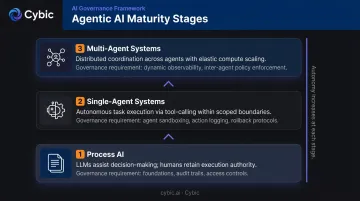
Each stage builds the controls the next one depends on. Without that foundation, Stage 3's speed and scale work against you.
Building Your Implementation Framework: From Pilot to Production
Most enterprises don't fail at agentic AI because the technology doesn't work. They fail because they deploy without structured design, build, and operate disciplines.
Design Phase: Scope and Ownership Before Code
Every agent deployed must have four things defined before development starts:
- Task boundary: Define precisely what the agent does - and what it doesn't. Scope creep at runtime is harder to contain than scope limits set at design.
- Assigned owner: One person accountable for the agent's behavior in production, not a committee.
- Autonomy threshold: The point above which human approval is required before the agent acts.
- Ethical constraints: Hard limits baked into requirements, not added as post-launch patches.
Guardrails that aren't defined at the design stage cannot be enforced reliably in production.
Build Phase: Engineering Guardrails In, Not On
The build phase must treat safety as a first-class engineering requirement:
- Kill switches - the ability to halt an agent immediately without code changes
- Schema validation - wrapping every tool call to block malformed or high-risk inputs before they reach external systems
- Sandbox testing - isolated environments that replicate production conditions without production consequences
- Red-team exercises - a dedicated group actively trying to cause the agent to operate outside its intended scope
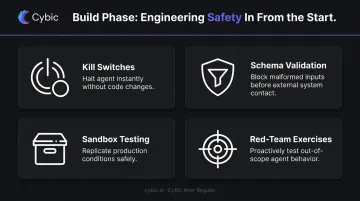
Cybic's engineering-led delivery model architects these controls into the system from the build phase. Governance, security controls, and workflow orchestration are part of the initial design - not retrofitted after the fact. For enterprise teams without deep AI security expertise in-house, that means fewer rework cycles and less reliance on specialist hires to close gaps post-launch.
Operate Phase: Human Oversight as a Permanent Feature
Deployment isn't the finish line. The operate phase requires:
- Real-time monitoring of agent behavior with anomaly detection
- Detailed logging of every decision and action, with rationale captured
- Structured change management for any update to prompts, models, or data sources - each change is a new deployment, not an edit
- Empowered human operators with clear authority and defined escalation paths
Shadow rollouts reduce cutover risk considerably. Run the new agent version in parallel to the current one, validate behavior against real traffic, then switch - no service interruption, no blind deployments.
Start Narrow, Prove Value, Then Scale
Large-scope "AI for everything" programs stall. The pattern that works consistently: identify one high-value, well-scoped use case (automating vendor onboarding, triaging support tickets, managing maintenance scheduling), deliver a measurable outcome within a defined timeline, and use that success to build the cross-functional confidence and budget for broader deployment.
Cybic's engagement model starts by identifying high-value automation opportunities alongside leadership teams. That discovery shapes a roadmap with concrete milestones - so each phase delivers a working system, not just a plan for the next one.
Frequently Asked Questions
What is agentic AI adoption?
Agentic AI adoption is the process of integrating AI systems capable of autonomous planning, decision-making, and action execution into core business workflows - systems that complete multi-step tasks independently, without a human initiating each step.
What is the adoption rate for agentic AI?
McKinsey's 2025 global survey found 62% of organizations are experimenting with or scaling AI agents. However, Deloitte's research puts production deployment at just 11% - meaning broad experimentation is happening, but production-grade deployment remains limited.
What are the 4 levels of AI adoption?
The four levels follow a maturity progression: deterministic rule-based automation (no reasoning), Process AI powered by LLMs (insight generation, no action), single-agent systems (autonomous task execution within defined scope), and multi-agent systems (coordinated distributed intelligence across specialized agents).
What are the 4 types of agentic AI?
The four types span a spectrum of autonomy and complexity: deterministic systems (fixed rules, fully predictable outputs), rule-based systems (if/then logic with conditional variability), single-agent AI (autonomous, tool-using, independently goal-directed), and multi-agent AI (multiple coordinated agents working toward shared goals with dynamic delegation).
What is the biggest challenge in enterprise agentic AI adoption?
Security and governance consistently block production deployment. The core friction points: managing agent permissions to prevent excessive access, maintaining auditability of autonomous actions, and meeting compliance requirements in regulated industries without sacrificing deployment speed.
How do you govern agentic AI in the enterprise?
Three pillars: embed governance at the architecture level before deployment (not after problems appear), implement role-based access controls and audit logging for every agent action, and maintain human-in-the-loop oversight with clear escalation paths and unambiguous intervention authority.