Introduction
GitHub Copilot autocompletes a function. An agentic AI system reads a ticket, decomposes it into subtasks, generates code across multiple files, writes the tests, opens a pull request, and flags a dependency conflict it found along the way - without being prompted at each step.
That's a different category of tool entirely - one that operates at the feature or repository level, not the line level.
For engineering and technology leaders, the strategic question has already shifted. It's no longer whether to adopt agentic AI in software delivery - 97% of organizations are already using or planning to use AI in the SDLC, according to GitLab's 2025 Global DevSecOps Report. The challenge now is moving from ungoverned experimentation to production-grade systems that don't accumulate technical debt or drift outside human oversight.
This guide covers what agentic AI in software development actually means, how each SDLC phase changes, the architecture required, governance requirements, and how to get from pilot to production without repeating the failure patterns that are currently ending a significant share of enterprise projects.
Key Takeaways
- Agentic AI owns work at the feature and repository level, not just the line level - a fundamental expansion of what AI can deliver
- The SDLC shifts from deterministic control to intent-based design: teams set goals, constraints, and guardrails
- Governance cannot be retrofitted after deployment - it must live inside the architecture
- Most agentic AI projects fail not during prototyping but during the move to production, due to architecture gaps and absent governance
- Adopting agentic AI creates demand for new roles: intent designers, behavioral testers, and observability engineers
What Makes Agentic AI Different From Traditional AI Tools
Traditional coding assistants like GitHub Copilot operate at the line or function level. They respond to immediate context, have no memory of prior sessions, and take no independent action - keeping the developer in the loop for every decision.
Agentic AI systems work differently. As Anthropic describes, the key distinction is that agents dynamically direct their own processes and tool use - rather than following predefined code paths. They decompose a high-level goal, select appropriate tools, execute actions across a codebase, evaluate the results, and iterate, all without continuous human prompting.
The Empirical Trajectory
The performance gap between these two paradigms has widened That's a 50x jump in two years. Enterprise teams adopting these tools now are largely doing so without established governance structures built for this level of autonomous execution.
Why This Changes the Responsibility Model
With a coding assistant, the developer reviews every suggestion. With an agentic system, the developer delegates execution. That shift moves the center of gravity from the AI model itself to the architecture around it: the guardrails, oversight mechanisms, and behavioral boundaries that determine what the agent can and cannot do on its own.
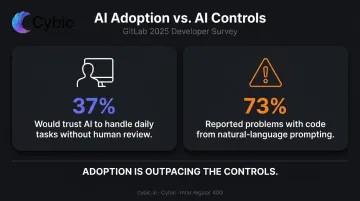
GitLab's 2025 survey found that only 37% of respondents would trust AI to handle daily work tasks without human review. Separately, 73% reported problems with code produced by natural-language prompting - specifically, in cases where users couldn't read or verify the output themselves. Both figures point to the same gap: adoption is outpacing the controls needed to make it safe.
The Agentic SDLC: How Each Phase Changes
The traditional SDLC was designed for deterministic, human-controlled systems. Every stage - requirements, design, development, testing, deployment - assumed a human was making each significant decision. Agentic AI doesn't just automate tasks within that structure. It requires the structure itself to change.
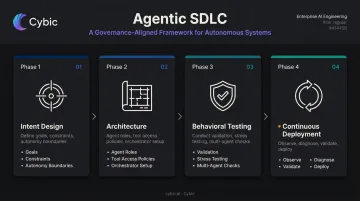
Planning and Intent Design
Traditional requirements gathering produces specifications. In an agentic SDLC, this phase becomes intent design - and the output is different in kind.
Teams must answer questions that never appeared in a waterfall document:
- What outcomes should this agent pursue, and how is success measured?
- Which decisions is the agent authorized to make autonomously?
- Which decisions require human approval before execution?
- What are the acceptable failure modes?
- What does "out of scope" look like, and how does the agent recognize it?
Forrester characterizes agentic software development as delegating meaningful development work to agents while humans remain accountable for intent. That accountability requires explicit design, not assumption.
Architecture and AI-Assisted Development
Architecture in an agentic context means defining the scaffold the agents operate within, not scripting every code path. Key design decisions at this phase include:
- Agent roles - which specialized agents handle requirements extraction, code generation, design review, and testing
- Interfaces between agents - how handoffs occur and what information transfers
- Tool access policies - which agents can access which systems, and under what conditions
- Fallback mechanisms - what happens when an agent exceeds its confidence threshold or encounters an unexpected state
A central orchestrator agent coordinates across these specialized agents, maintains project context, tracks cross-phase consistency, and escalates to human reviewers when needed. According to GitLab's 2025 survey, 85% of respondents agreed that agentic AI is most successful when implemented through a platform engineering approach - a finding that reflects this architectural reality directly.
Behavioral Testing and QA
Once the architecture is defined, the next challenge is validating that agents behave correctly within it. Traditional QA asks whether the code does what it's supposed to do. Behavioral testing for agentic systems asks a different question: does the agent stay within its defined boundaries across varied and adversarial inputs?
That requires:
- Behavioral test suites that test agent conduct, not just output correctness
- Stress testing at scale, including edge cases that won't appear in normal workflows
- Multi-agent coordination checks - do handoffs between agents preserve context without introducing leakage or inconsistency?
Pass/fail unit tests are insufficient for probabilistic, context-sensitive systems. An agent that produces correct output 95% of the time and takes unauthorized action 5% of the time is not production-ready.
Deployment and Continuous Adaptation
Production deployment for agentic systems is not a one-time release. It's the beginning of continuous orchestration, with real-time controls and monitoring replacing the traditional periodic release cycle.
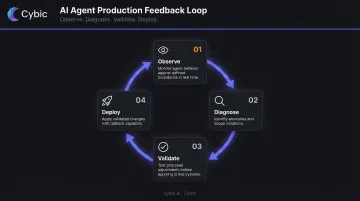
The feedback loop that separates agents that improve from agents that drift follows four stages:
- Observe - monitor agent behavior against defined boundaries in real time
- Diagnose - identify anomalies, scope violations, or performance degradation
- Validate - test proposed adjustments before applying them to live systems
- Deploy - apply validated changes with rollback capability
Production will surface scenarios no test suite anticipated. Anomaly detection and clear human escalation paths are architectural requirements, not optional features.
The Architecture of an Agentic AI Development System
A reference architecture for agentic software engineering spans four interdependent layers:
| Layer | Function |
|---|---|
| Reasoning and Planning | Interprets goals, selects actions, manages iteration |
| Memory | Short-term context (active session) + long-term retrieval (knowledge base) |
| Tool Use | APIs, code execution, version control, CI/CD integrations |
| Orchestration | Coordinates specialized agents, tracks cross-phase consistency, escalates to humans |
All four layers must be observable and auditable. An architecture that functions but can't be inspected is not an enterprise architecture.
Interoperability Standards
Vendor lock-in is a genuine risk as agent portfolios grow. Two open standards address this directly:
- MCP (Model Context Protocol) - an open standard for connecting AI applications to external data sources, tools, and workflows in a standardized way
- A2A (Agent-to-Agent Protocol) - an open protocol, maintained under the Linux Foundation after Google's initial contribution, that enables agents to discover each other, exchange messages, and collaborate across different frameworks and runtimes
Building to these standards keeps architectures modular and extensible as requirements evolve.
API-First, Event-Driven Design
That modularity only holds if agents are also programmatically controllable - not locked into proprietary interfaces. Equally important, they need to respond to business events in real time rather than waiting for manual triggers. Event-driven design keeps agent behavior aligned with what's actually happening in the operational environment, rather than what a schedule or polling interval happens to catch.
This is where orchestration and governance become the distinguishing factor. Cybic's Drava platform connects enterprise data, ML reasoning, and intelligent agents into a single governed system - integrating into existing infrastructure, CI/CD pipelines, and compliance frameworks from day one. Most organizations that start with point solutions eventually need to retrofit this layer; building it in upfront avoids that rework.
Governance, Security, and Human Oversight
Governance added after deployment isn't governance - it's documentation after the fact.
When security controls, audit logging, and oversight mechanisms are retrofitted onto a live system, every new use case triggers a compliance review that slows delivery and creates gaps. The goal is compliant by design, not compliant by documentation.
Gartner predicts that 40% of enterprises will demote or decommission autonomous AI agents by 2027 - specifically because governance failures are only identified after production incidents. That's an avoidable outcome.
Autonomy Boundaries
Not all agent actions should be treated the same. A practical classification framework:
- Fully autonomous - the agent executes without approval (example: generating a pull request, running unit tests)
- Human-approved - the agent prepares the action and waits for explicit sign-off (example: merging to main, modifying production configurations)
- Always human-led - the agent provides information and analysis, but a human makes and executes the decision (example: architecture decisions with security implications)
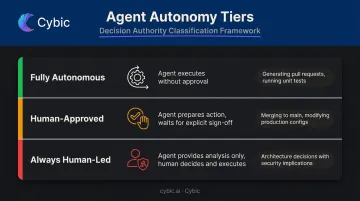
These boundaries must be defined before agents are deployed, not discovered when something goes wrong.
The Security Stack
Agentic systems require security controls that go beyond standard application security:
- Zero-trust access - no agent is implicitly trusted; all actions are verified against defined permissions
- RBAC - separate roles for development, deployment, and oversight teams
- Encrypted data handling - in transit and at rest
- Audit logging - every agent action and decision captured for traceability, not just the final output
The OWASP GenAI Security Project identifies tool misuse, prompt injection, and data leakage as the primary failure modes for agentic systems. Each requires targeted architectural controls, not just application-level security scanning.
Cybic embeds these controls - RBAC, audit trails, encrypted data protection, and regulatory alignment to SOC 2, HIPAA, ISO, and GDPR - at the architectural level across every engagement. When governance is built into the architecture rather than bolted on at the perimeter, systems can scale without creating compliance exposure at every growth stage.
Challenges, Pitfalls, and How to Get Started Right
The Pilot-to-Production Failure Pattern
Gartner predicted that over 40% of agentic AI projects will be canceled by end-2027 due to escalating costs, unclear business value, or inadequate risk controls. The failure pattern is consistent: the prototype worked, the production deployment didn't, and the root causes were architectural.
Specifically:
- Architecture designed for demo conditions, not enterprise scale
- Behavioral testing skipped in favor of functional testing
- Governance treated as a post-deployment concern rather than a design input
The fix isn't a better AI model. It's a better implementation approach.
The Shadow Agent Problem
Many enterprises already have ungoverned agents operating - marketing automation, sales bots, SaaS-embedded AI workflows - that run outside centralized visibility. An analysis of 22 million enterprise AI prompts found that employees at over 90% of organizations actively use AI tools, but only 40% of companies have purchased official AI subscriptions.
The first governance step is discovery and inventory - understanding what's already running before building new systems on top of an ungoverned foundation. Knowing what exists and establishing oversight is the starting point.
New Roles, New Skills
The shift to agentic AI creates genuine role gaps that most engineering organizations haven't addressed:
- Intent designers - define agent goals, constraints, and acceptable failure modes; this is closer to product and systems thinking than traditional engineering
- Behavioral testers - validate agent conduct across varied inputs, not just functional correctness
- Observability engineers - monitor agent health in production, detect drift, and maintain the feedback loop
The cultural adjustment is as important as the technical one. Teams accustomed to deterministic systems need frameworks for managing systems that adapt - and judgment about when adaptation is working as intended versus drifting from it.
Closing those role gaps takes time, which is why the first use case matters. Start with something well-scoped - automated requirements extraction, PR generation, or test creation from specifications. These provide a fast feedback loop and a low cost of failure while your team builds operational experience.
When choosing that first use case, look for three things:
- Clear success metrics that make evaluation unambiguous
- Limited blast radius if the agent fails or behaves unexpectedly
- A human review checkpoint built in from the start
Frequently Asked Questions
What is the difference between agentic AI and traditional AI coding assistants like GitHub Copilot?
Coding assistants like Copilot operate at the line or function level - responding to immediate context without memory, planning, or tool access. Agentic systems plan across a full codebase, use external tools autonomously, maintain context across sessions, and execute multi-step tasks without continuous human prompting at each stage.
Which SDLC phases are most ready for agentic AI automation today?
Requirements extraction, code generation from specifications, unit test creation, and deployment monitoring are the most mature areas with proven tooling. Architecture review and production deployment decisions still require meaningful human oversight: the judgment calls at those stages involve risk profiles that current agents aren't equipped to handle.
How do you keep humans in control when AI agents operate autonomously?
Three mechanisms: explicitly defined autonomy boundaries (which actions are autonomous vs. approval-required), approval workflows for high-stakes actions before execution, and real-time observability that surfaces anomalies before they escalate. Control is maintained through architecture, not just policy.
What are the biggest risks of deploying agentic AI in software development?
The most common failure points are:
- Ungoverned agent proliferation across teams
- Behavioral drift as production data and edge cases accumulate
- Integration failures with legacy systems
- Compounding technical debt when governance is absent from the architecture
Most of these risks surface after go-live, not during prototyping.
What skills do engineering teams need to work effectively with agentic AI systems?
The shift moves from writing functions to designing intent and guardrails. New roles such as behavioral tester and observability engineer matter as much as prompt engineering. Culturally, adapting to systems that don't behave deterministically is often harder than the technical learning curve.