Introduction
Most AI tools in a developer's workflow do exactly what they're told - generate a snippet, answer a question, suggest a refactor. They wait. They respond. They stop.
Agentic AI works differently. Given a goal like "build a user authentication module with OAuth," an agentic system doesn't hand back code and wait for your next message. It scaffolds the feature, runs tests, reads the failures, and iterates - surfacing only the decisions that genuinely need a human. No hand-holding required.
Gartner forecasts that 40% of enterprise applications will include task-specific AI agents by 2026, up from less than 5% in 2025. That's not a gradual shift - it's a step change in how software gets built and operated.
This guide breaks down what agentic AI is, how it operates in web development, and what enterprise teams need to know before deploying it in production.
Key Takeaways
- Agentic AI systems plan, execute, and adapt across multi-step tasks, acting on defined goals rather than responding to individual prompts
- In web development, agents handle code generation, testing, CI/CD, and live monitoring with minimal human input
- Production systems combine orchestration layers, shared memory, and specialized sub-agents - no single model handles everything end-to-end
- Enterprise deployment requires governance, RBAC, and auditability built into the architecture from day one - not added after the fact
- Enterprise contexts require platforms with native data integration, compliance controls, and audit trails - not lightweight tools built for prototyping
What Is Agentic AI in Web Development?
Agentic AI refers to autonomous software systems that can perceive a goal, reason about the steps required, use tools to act, and adapt when something doesn't go to plan. Unlike generative AI - which produces an output and stops - an agentic system keeps running until the goal is reached or it determines it needs human input.
Anthropic draws a clear distinction between workflows (where LLMs follow predefined code paths) and agents (where LLMs dynamically direct their own processes and tool use). That difference matters operationally: one is a sophisticated script, the other is a system that can navigate ambiguity.
The Three Types of AI Systems
| System Type | What It Does | Stops When |
|---|---|---|
| Chatbot | Answers questions | After each response |
| Generative AI tool | Produces content on request | After generating output |
| Agentic AI | Completes goal-oriented tasks across multiple systems | Goal is achieved or escalated |
What Makes a System "Agentic"
Three components must be present:
- An LLM capable of planning and decision-making (the reasoning engine)
- Access to APIs, code execution environments, databases, and external services
- The ability to act across multiple steps without waiting for instruction after each one
For web development, this distinction is operational. An agent can scaffold a full feature, run a test suite, identify failures, and iterate - work that otherwise requires multiple developer handoffs and hours of context-switching between tools.
How Agentic AI Works: The Think–Act–Adapt Loop
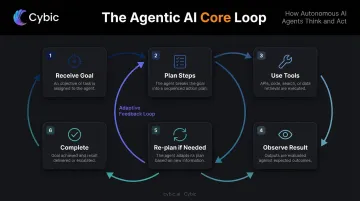
Every agentic system operates on the same core loop: Receive Goal → Plan Steps → Use Tools → Observe Result → Re-plan if needed → Complete. This is entirely different from a single prompt-response exchange, where the model contributes once and exits.
Receiving and Decomposing Goals
When an agent receives a high-level instruction - say, "build a user authentication module with OAuth" - it doesn't execute that as a single command. It breaks the goal into executable sub-tasks:
- Research existing codebase structure and identify relevant dependencies
- Scaffold the module and write initial tests
- Run tests, observe failures, and apply fixes
The quality of this decomposition directly affects output quality. Vague goals produce meandering plans; precise goals with clear constraints produce tighter, more reliable execution paths.
The Role of Tools and Memory
Agents don't work in isolation. They access tools - code repositories, terminal access, APIs, external databases, browser interfaces - and use shared memory to track state across the entire workflow.
Memory in agentic systems functions similarly to state management in web apps:
- Short-term memory - the current session context, what's been tried, what failed
- Long-term memory - searchable knowledge persisted across sessions
- Episodic memory - records of past agent actions that can inform future decisions
Without this context layer, agents lose coherence across long tasks. With it, they can pick up where they left off, avoid repeating failed attempts, and adjust based on earlier results.
Orchestration: The System's Project Manager
In multi-agent systems, the orchestration layer coordinates everything. Microsoft Research's Magentic-One uses a dedicated Orchestrator agent specifically for this, handling:
- Assigning tasks to specialized sub-agents based on capability
- Monitoring progress and surfacing blockers early
- Rerouting or retrying when failures occur
- Keeping the overall goal coherent across parallel workstreams
This layer is usually the most complex design element in a production agentic system. Poorly designed orchestration creates cascading failures across sub-agents - and because model-swapping is relatively straightforward once architecture is solid, getting orchestration right matters more than which underlying model you choose.
Architectural Patterns for Agentic Web Systems
How you wire agents together matters as much as the agents themselves. Web developers already have the instincts to recognize these patterns - they mirror patterns in distributed systems and microservices architecture.
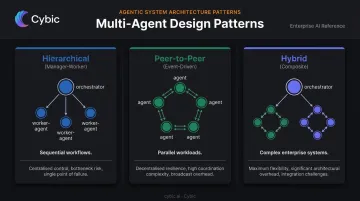
Hierarchical (Manager-Worker) Pattern
A central orchestrator decomposes goals and delegates to specialist worker agents. Amazon Bedrock's multi-agent collaboration follows this model: a supervisor agent creates and executes plans by routing tasks to specialized collaborators.
Best for: Sequential, well-defined workflows - staged deployments, structured form processing, report generation Trade-off: Strong control, but the orchestrator becomes a potential bottleneck
Peer-to-Peer (Event-Driven) Pattern
Agents subscribe to shared topics and collaborate without a central manager. Microsoft AutoGen's SelectorGroupChat implements this: participants broadcast messages to all other agents, and a model selects the next actor from shared context.
Best for: Parallel workloads - concurrent research gathering, multi-source data aggregation, real-time monitoring Trade-off: High throughput, but harder to audit and coordinate
Hybrid Pattern
Most production systems combine both. Top-level orchestration provides strategic control while sub-teams of agents operate collaboratively on specific components. This mirrors how real engineering organizations actually work - leadership coordinates direction while specialized teams execute in parallel.
For complex enterprise web systems, start here - then layer in communication protocols that keep agents interoperable as the system grows.
Communication Protocols
Model Context Protocol (MCP), an open protocol specification launched by Anthropic, functions as the "API contracts" of agentic systems. It gives AI applications a consistent way to access tools and data across vendors and models - making architectures modular rather than locked to a single provider. Early adopters included Replit, Zed, Codeium, and Sourcegraph.
Real-World Applications of Agentic AI in Web Development
Agentic AI delivers the most value where workflows are multi-step, involve ambiguity, and currently require significant manual handoffs.
High-impact web development applications:
- Automated code generation and refactoring - GitHub Copilot's cloud agent researches a repository, creates an implementation plan, makes code changes on a branch, and opens work for review
- Application modernization - Amazon Q Developer Transform handles Java upgrades, SDK migrations, and embedded SQL conversion; AWS reported an 85% higher success rate versus prior approaches
- Intelligent bug detection and patching - agents can fix bugs, improve test coverage, and resolve merge conflicts within CI/CD environments
- Dynamic content personalization - Adobe Experience Platform's Agent Orchestrator automates audience segmentation and site optimization tasks across CX workflows
- Automated API integration testing - Postman AI Agent Builder supports API discovery, testing, and integration with agent-ready tool generation
Vertical-Specific Examples
In manufacturing web portals, agents monitor real-time dashboards and flag anomalies in production data, compressing the gap between detection and response. Healthcare platforms use agents to automate compliance-driven documentation workflows, reducing manual burden while maintaining audit trails.
In retail supply chain interfaces, agents dynamically re-route fulfillment logic based on live inventory feeds - responding to conditions that would otherwise require a human decision at every step.
Cybic builds agentic systems across all three of these verticals, connecting enterprise data, ML pipelines, and AI reasoning into workflows where governance controls are embedded at the architectural level, not added as an afterthought.
That architecture distinction reflects a broader principle for applying agentic AI well: use deterministic code for predictable, rules-based logic. Reserve agents for tasks that require interpretation, ambiguity handling, or coordination across multiple systems. Agents aren't universally superior - they're specifically suited to work that exceeds what traditional automation can handle.

Risks, Challenges & Governance in Enterprise Deployment
Deploying agentic AI in production enterprise systems introduces risks that don't exist with simpler automation. Treat each of the following as a design constraint, not a post-deployment checklist item.
Core Security Risks
- Prompt injection - OWASP lists this as the top risk for LLM applications; malicious content in inputs can redirect agent behavior. OpenAI's security research found that prompt injection via email content extracted employee data in 50% of test cases before mitigations were applied
- Sensitive data leakage - agents connected to multiple enterprise systems can inadvertently expose data across boundaries if permissions aren't scoped correctly
- Misalignment with business intent - an agent that technically completes a task but misinterprets the intent can cause real operational damage at scale
- Supply chain vulnerabilities - multi-API architectures introduce risk at every integration point
The Governance Imperative
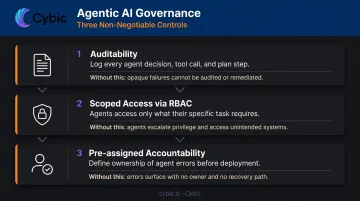
Agentic systems that act autonomously require three non-negotiable governance elements:
- Log every agent decision, tool call, and plan step - auditability is the foundation of incident response
- Scope access tightly using RBAC - agents should reach only the systems and data their specific task requires
- Assign accountability before deployment - define who owns an agent error before it happens, not after
Cybic embeds these governance requirements at the architecture level - including RBAC, encrypted data protection, and compliance alignment across SOC 2, HIPAA, ISO, and GDPR - rather than retrofitting controls onto a running system. That's the standard enterprise teams should hold to, regardless of vendor.
Human-in-the-Loop Design
Effective human-in-the-loop design is about control points, not constant review. Define which decisions require human approval before execution - not everything, but the right things. In practice, this means:
- Setting escalation thresholds by decision type, risk level, or confidence score
- Treating monitoring as a permanent operational function, not a launch task
- Ensuring agents can recognize when a task exceeds their authority or confidence level before acting
Best Agentic AI Tools for Web Development
Tool Overview by Use Case
| Tool | Best For |
|---|---|
| Replit Agent | Full-stack development in one workspace; handles planning through deployment from natural language |
| Bolt.new | Browser-based prototyping with Figma import, GitHub sync, and cloud backend services |
| v0 by Vercel | UI-first builds with agentic capabilities; web search, screenshot inspection, and Vercel deployment |
| Lovable | Full-stack apps with Supabase integration for auth, database, and edge functions |
| Hostinger Horizons | No-code app creation with built-in hosting, testing, and launch flow |
Stack Overflow's 2025 Developer Survey found that 84% of developers use or plan to use AI tools, yet 46% distrust AI tool output accuracy and 66% cite frustration with solutions that are "almost right." Tool selection matters, but so does how you evaluate outputs.
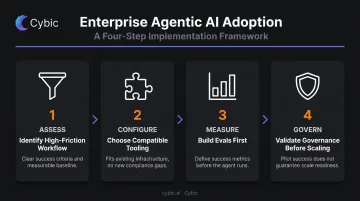
Starting Framework for Enterprise Teams
- Start with one high-friction workflow - not the most ambitious use case, but the one with the clearest success criteria and a measurable baseline you can track.
- Choose tooling that fits your existing infrastructure, so you don't open new compliance gaps or data governance risks in the process.
- Build evaluation ("evals") before the agent runs, not after. Define what "good" looks like upfront and measure task success, tool-use trajectories, safety failures, and human-review outcomes from day one.
- Expand scope only after validating the governance layer. A pilot that works in isolation doesn't automatically scale.
Enterprise-Grade Requirements
Individual tools like Bolt.new and v0 are effective for prototyping and smaller teams. Enterprise teams in manufacturing, healthcare, or financial services need more: platforms that connect agents to governed data sources, maintain traceability of every AI-driven action, and operate across cloud, hybrid, or on-prem environments.
Cybic's Drava platform is built for exactly this context. It connects enterprise data, ML, AI reasoning, and intelligent agents into a governed automation layer with built-in orchestration, security controls, and compliance alignment across AWS, Azure, and Google Cloud.
Frequently Asked Questions
What is agentic AI in web development?
Agentic AI in web development refers to autonomous AI systems that can plan and execute multi-step tasks - code generation, testing, deployment, and more - without continuous human input. Unlike generative AI tools that respond to individual prompts, agentic systems pursue goals across multiple steps and connected systems.
How do you use agentic AI in web development?
Teams give agents goal-based prompts such as "build this feature" or "fix this class of bugs," and the agent plans and executes the required steps using code repositories, APIs, and test runners. For complex workflows, orchestration layers coordinate multiple agents working in parallel.
Which AI tools are best for agentic AI web development?
Replit Agent suits full-stack development, Bolt.new works well for browser-based prototyping, v0 is strong for UI-first builds on Vercel, and Lovable handles full-stack apps with backend integration. Enterprise contexts typically require platforms with built-in governance and data connectivity rather than standalone tools.
How does agentic AI differ from traditional AI automation?
Traditional automation follows fixed scripts with predefined rules. Agentic AI can adapt to new conditions, make decisions between steps, and handle ambiguous or multi-system tasks that no predefined rule covers. The key difference is adaptability in the face of unexpected states.
What are the risks of using agentic AI in enterprise web development?
Key risks include prompt injection attacks, sensitive data leakage, misalignment between agent behavior and business intent, and supply chain vulnerabilities in multi-API architectures. Governance frameworks, RBAC, and auditability need to be embedded at the design level - not added after deployment.
Can agentic AI replace web developers?
No. Agentic AI handles repetitive execution, multi-step workflows, and ambiguous tasks well - but engineers are needed to design, orchestrate, monitor, and maintain these systems. The developer role shifts toward systems thinking and architectural oversight rather than disappearing.