Agentic AI is not a feature added to existing platforms. It is a different operating paradigm - one where software perceives conditions, reasons through options, executes tasks, and adapts without waiting for a human to initiate each step. For enterprise leaders, this shift creates both urgency and genuine uncertainty.
The momentum to adopt is accelerating. Gartner predicts 33% of enterprise software applications will include agentic AI by 2028, up from less than 1% in 2024. But alongside that growth, over 40% of agentic AI projects are forecast to be canceled by end of 2027 due to poor governance, unclear ROI, and integration failures.
This article explains how agentic AI creates actual growth - not just operational savings - and what enterprise leaders across manufacturing, healthcare, retail, energy, and financial services need to understand before committing capital and organizational focus.
Key Takeaways
- Agentic AI moves software from passive tools to autonomous systems that act across workflows without constant human direction.
- The strategic value is growth acceleration - faster product cycles, hyper-personalized experiences, and self-reinforcing data advantages that widen over time.
- Enterprise software pricing is shifting from seat-based access to consumption- and outcome-based models.
- Governance cannot be retrofitted - it must be embedded into the architecture from the start.
- Enterprises that run focused pilots with clear ROI criteria now will set the standard others scramble to match.
What Sets Agentic AI Apart from Traditional Automation
Traditional automation - including RPA - executes predefined rules on structured inputs. Give it a clean data set and a clear trigger, and it runs reliably. Shift the input format or introduce an exception, and it fails.
Agentic AI operates differently. It uses reasoning and planning to break complex, open-ended goals into subtasks, execute them in sequence or in parallel, evaluate results, and adjust when conditions change. No human needs to manage each step.
Multi-Agent Systems: Where the Real Power Sits
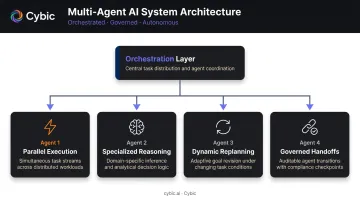
The more consequential architecture is multi-agent systems. Instead of a single model handling everything, specialized agents collaborate under an orchestrating layer that assigns tasks, monitors outputs, and routes decisions. Each agent handles a distinct domain: financial analysis, workflow coordination, data processing, compliance checking.
This structure enables capabilities no single model or automation script can replicate:
- Parallel execution across multiple enterprise systems simultaneously
- Specialized reasoning per domain - financial logic handled differently from supply chain logic
- Dynamic replanning when an upstream agent hits an unexpected condition
- Governed handoffs between agents with audit trails at each step
IDC estimated that roughly 20% of the enterprise application market was already supplementing applications with complete AI agents in 2025. MarketsandMarkets projects the enterprise agentic AI market will grow from $6.76 billion in 2025 to $46.04 billion by 2030 - a 47% CAGR. Separately, Gartner predicts 40% of enterprise applications will feature task-specific AI agents by end of 2026, up from less than 5% in 2025.
At a 47% CAGR, enterprises that defer adoption by two years will be competing against organizations that have already embedded agentic workflows into core operations - with compounding productivity and data advantages built in.
How Agentic AI Creates New Growth Levers
The efficiency story is real. Fewer manual steps, faster cycle times, lower operational costs. But treating agentic AI purely as a cost-reduction tool misses the more durable value: growth acceleration.
Hyper-Personalization at Scale
Current enterprise platforms struggle to deliver individualized experiences at volume. Agentic systems close that gap by autonomously tailoring product experiences, pricing, content, and recommendations per user or account in real time - without manual configuration for each variation.
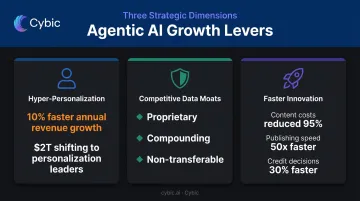
BCG research found that personalization leaders grow revenue 10 percentage points faster annually than laggards, with an estimated $2 trillion in revenue shifting over five years toward companies that operationalize personalized experiences. Agentic AI is what makes that operationalization possible at enterprise scale.
Competitive Moats Through Data Intelligence
Enterprises that embed agentic AI into core systems accumulate a compounding learning advantage. Agents continuously optimize based on proprietary operational data - your customers, your supply chain, your pricing dynamics. That advantage has three characteristics competitors can't replicate:
- Proprietary: built on your data, not generic training sets
- Compounding: accuracy and relevance improve with every interaction
- Non-transferable: tied to your specific operational environment, not available off the shelf
Faster Innovation Without IT Release Cycles
BCG documented a consumer goods company using intelligent agents to reduce content production costs by 95% and accelerate publishing speed by 50x - from four weeks to one day. The same principle applies to workflow iteration: business teams can test, adjust, and deploy process changes without waiting for IT release schedules.
McKinsey found that a bank using agentic workflows for credit processing reduced turnaround time by 30%. In credit markets, a 30% faster decision cycle is also a 30% faster path to booked revenue - the efficiency and the growth outcome are the same event.
Real-World Impact: Where Enterprises Are Seeing the Biggest Gains
Agentic AI is already producing measurable results across four core enterprise functions.
ERP and Supply Chain Operations
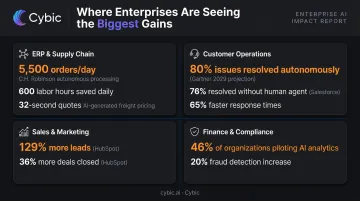
C.H. Robinson provides one of the clearest documented cases. Their fleet of over 30 AI agents now processes 5,500 truckload orders per day, saves 600 labor hours daily, and delivers customer-specific freight quotes in 32 seconds. Their LTL Classifier Agent increased order automation from 50% to over 75%. These are not pilot metrics - this is production-scale autonomous operation across a global logistics network.
Customer Operations and Case Management
The scale of impact here is well-documented. Key benchmarks include:
- Gartner projects agentic AI will autonomously resolve 80% of common customer service issues without human intervention by 2029, with a 30% reduction in operational costs
- Salesforce's Agentforce deployment reports 76% of customer inquiries resolved without a human agent
- Response times dropped by 65% for 90% of users in that same deployment
For healthcare claims, insurance, and retail returns - where end-to-end case handling involves document validation, triage, routing, and resolution - these numbers translate directly to cost and throughput gains.
Sales, Marketing, and Revenue Operations
Agentic campaign managers can autonomously test touchpoints, route leads, and adjust messaging based on live performance data - without waiting for a weekly review cycle. The underlying data supports the direction: HubSpot reports customers using its AI-enhanced platform acquire 129% more leads and close 36% more deals over a one-year period compared to pre-adoption baselines.
The compounding advantage is speed, not just scale. Autonomous agents compress the feedback loop between experiment and optimization from weeks to hours - a structural edge that compounds over time.
Finance, Risk, and Compliance Monitoring
In regulated industries, explainability has historically blocked AI adoption. Agentic systems with audit logging and traceability built into the architecture remove that barrier directly. The compliance data reflects this shift:
- Deloitte estimates generative AI increases fraud detection rates by an average of 20%, with peaks significantly higher in certain deployment scenarios
- PwC's 2025 Global Compliance Survey found 46% of organizations already piloting AI for predictive analytics
- 36% are piloting AI specifically for fraud detection - and that share is growing quarter over quarter
The Business Model Shift Agentic AI Is Forcing
The traditional SaaS pricing model - charge per seat, expand by adding users - is under direct pressure. When AI agents perform tasks that previously justified per-seat licenses, the value metric shifts from "who has access" to "what outcomes are delivered."
IDC argues that as AI agents increasingly become users of business applications, the user-based SaaS revenue model collapses, and licensing must evolve toward business-outcome alignment.
The shift is already happening at the vendor level:
- Salesforce introduced Flex Credits for Agentforce - consumption-based pricing where customers pay for the exact actions their agents perform
- Intercom prices its Fin AI Agent at $0.99 per resolved outcome
- SAP, Microsoft, and ServiceNow are all building unified data and orchestration layers designed to sit across traditional application boundaries
The platform consolidation race has direct consequences for enterprise buyers. As AI agents pull data regardless of where it lives, the traditional boundaries between CRM, ERP, and ITSM are eroding. SAP's Joule Studio, Microsoft's Copilot Studio, and ServiceNow's AI Agent Orchestrator are each competing to become the orchestration layer across the enterprise stack.
For CIOs, the timing matters. Contracts negotiated now - before this shift fully lands - will look expensive in 18 months. Organizations that map these pricing dynamics early can renegotiate vendor relationships, consolidate platforms, and avoid lock-in to models built for a pre-agentic world.
Governance and Controls: Scaling Agentic AI Without Creating New Risk
Gartner predicts 25% of all enterprise GenAI applications will experience at least five minor security incidents per year by 2028. The risk landscape for agentic AI is distinct from traditional software: expanded attack surfaces, potential bias in autonomous decisions, and accountability gaps when no single human is clearly responsible for an agent's actions.
In regulated industries (healthcare, energy, financial services), these risks carry legal and reputational weight, not just technical ones.
The Three-Phase Control Model
Responsible enterprises apply governance across three phases:
Design:
- Least-privilege access to data and systems
- Defined autonomy thresholds per workflow type
- Clear agent ownership and accountability mapping
- Ethical hard limits built into agent behavior
Build:
- Guardrails and sandboxed testing environments
- Kill-switch and rollback capability built into the orchestration layer
- Rigorous red-team testing before production
Operate:
- Human override authority at defined decision points
- Explainability logging for every autonomous action
- Structured change management and incident response protocols
Governance as Architecture, Not a Dashboard
The most costly failure mode is treating governance as a monitoring layer added after deployment. Organizations that embed security controls, role-based access, and auditability at the system design level avoid the bulk of these failures.
Every agentic AI system Cybic architects includes RBAC for secure system access, encrypted data protection in transit and at rest, and full auditability of AI-driven actions - built into the foundational architecture, not configured post-deployment.
This applies across cloud, hybrid, and on-premises environments, with alignment to SOC 2, HIPAA, ISO, and GDPR where applicable.
Defining Autonomy Thresholds by Risk Tier
Not every workflow carries the same stakes. The practical approach is tiered autonomy:
- Low-stakes workflows (data formatting, report generation, routine alerts): fully autonomous execution
- Medium-stakes workflows (procurement triggers, customer routing, anomaly flagging): autonomous with logging and exception escalation
- High-stakes decisions (loan approvals, clinical recommendations, regulatory filings): human review or dual-control approval required
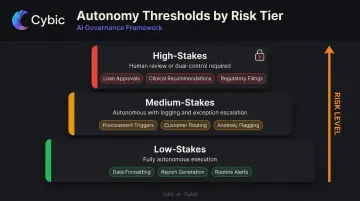
Configuring these thresholds at the architecture level - rather than leaving them to individual users - is what makes agentic AI safe to deploy at scale.
From Pilots to Production: Getting Your Enterprise Ready
According to McKinsey's 2025 State of AI survey, 62% of enterprises are experimenting with AI agents - yet nearly two-thirds have not begun scaling. The gap between experimentation and production is where most value is currently stranded.
Start Narrow, Not Broad
Enterprises that attempt enterprise-wide deployment from the start stall. The pattern that works: identify a single high-visibility use case with a clear, measurable outcome, demonstrate ROI within a defined window, then use that proof point to secure broader organizational commitment.
Work backwards from a specific business problem - a claims processing bottleneck, a procurement exception rate, a customer escalation volume - not forward from what the technology can theoretically do.
The Three Common Implementation Blockers
1. Data readiness: Agents need clean, well-governed data across systems. Roughly 80% of enterprise data is unstructured, siloed, or underutilized. Before agents can operate reliably, the data layer must be addressable - typically the longest lead-time item in any agentic AI project.
2. Talent gaps: Agentic AI requires AI engineers, prompt engineers, and business translators who can map use cases to workflows and governance requirements. Most enterprises do not have this team in-house at the start.
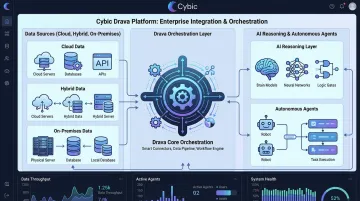
3. Legacy infrastructure: Most enterprise systems were not designed to support autonomous agents. The practical options are middleware strategies, phased re-platforming, or an intelligence layer that abstracts the complexity without requiring full legacy replacement. Cybic's Drava platform is built for this scenario, connecting enterprise data, ML models, AI reasoning, and autonomous agents across cloud, hybrid, or on-premises environments.
What "Production-Ready" Actually Means
Before committing to scaled deployment, enterprises should be able to answer yes to these questions:
- Are agents operating across shared, governed data layers rather than isolated data silos?
- Is governance embedded in the architecture, with audit trails and override controls in place?
- Are success metrics tied to business outcomes - revenue, cycle time, error rate - not just automation volume?
- Is there a tested incident response and rollback capability?
- Has the human oversight model been defined by risk tier, not left to individual judgment?
Deloitte's research found that over two-thirds of organizations expect 30% or fewer of their AI experiments to fully scale within three to six months - and many need at least a year to resolve governance, talent, and data challenges.
The enterprises that scale successfully are not the ones with the most aggressive timelines. They are the ones that answered these questions before they tried to expand.
Frequently Asked Questions
What is agentic AI, and how is it different from traditional AI automation?
Traditional automation executes predefined rules on structured inputs - it does exactly what it was scripted to do. Agentic AI reasons through goals, breaks them into subtasks, executes autonomously, and adapts when conditions change. The difference matters because enterprise workflows are rarely clean or predictable.
How does agentic AI actually drive enterprise software growth, not just cost reduction?
Growth levers include faster product and workflow iteration (compressing months to days), hyper-personalized customer experiences that increase conversion and retention, and a compounding data intelligence advantage that builds competitive differentiation over time. Traditional automation cannot deliver any of these at scale.
Which enterprise functions see the fastest ROI from agentic AI?
ERP and supply chain operations, customer case management, and sales and marketing automation consistently show early measurable returns. C.H. Robinson's documented 600 daily labor hours saved and Salesforce's 76% autonomous resolution rate are production-scale examples, not projections.
Will agentic AI replace traditional SaaS platforms like CRM and ERP?
Core platforms are unlikely to disappear near-term, but the user interface and workflow layer will become increasingly agentic. AI orchestration will sit above existing systems rather than replacing them. The vendor race is to control that orchestration layer, not eliminate the underlying platforms.
What governance controls does an enterprise need before deploying agentic AI?
Essential controls include:
- Clear agent ownership and accountability
- Least-privilege access configured at the architecture level
- Defined autonomy thresholds by risk tier
- Explainability and audit logging for every autonomous action
- A tested kill-switch and rollback capability before go-live
How long does it typically take to move from a pilot to full enterprise deployment?
Timeline depends on data maturity, integration complexity, and governance infrastructure. Enterprises with a clear use case and resolved data foundations can demonstrate pilot ROI within 60-90 days. Scaled deployment typically takes 6-18 months - the longest delays come from governance gaps and legacy integration, not the AI itself.