Introduction
Most enterprise AI governance programs were built for a world where models generate outputs and humans make decisions. That model is obsolete.
Today's agentic AI systems don't wait for human review. They receive a goal, call APIs, execute multi-step workflows, modify records, and trigger downstream processes - often completing entire business operations before any human can intervene. The risk has shifted from what the model says to what the agent does.
For enterprises in regulated industries, this gap is serious. McKinsey's 2025 Global AI Trust Maturity Survey found an average responsible AI maturity score of just 2.0 on a 0–4 scale - and that survey predates the current wave of agentic deployments. Most governance frameworks were designed to review outputs, not constrain autonomous action.
This guide covers why agentic AI governance differs from traditional AI governance, the five core risks enterprises must address, and a six-pillar framework for managing autonomous AI behavior at scale. The coverage runs from first deployment through decommissioning.
Key Takeaways
- Agentic AI governance controls autonomous actions, not just model outputs - governance must address what agents do inside live systems.
- The five risks that most enterprises underestimate: privileged access inheritance, multi-agent cascading failures, behavioral drift, sensitive data exposure, and accountability diffusion.
- Effective governance rests on six pillars - cross-functional ownership, agent inventory, runtime controls, audit trails, human oversight thresholds, and continuous monitoring.
- Governance built into the architecture from day one holds up under organizational change and regulatory scrutiny; retrofitting it never does.
Why Agentic AI Requires a Different Governance Approach
The Structural Shift from Output Risk to Action Risk
Traditional AI governance was designed around output risk. Teams reviewed model accuracy, checked for bias, validated training data. The human remained the decision-maker after the model produced its result. The governance question was: is this output trustworthy?
Agentic AI changes the question entirely. The relevant comparison:
| Traditional AI | Agentic AI |
|---|---|
| Model produces answer → human decides | Agent receives goal → agent executes across systems |
| Risk is in the output | Risk is in the action |
| Human reviews before acting | Agent acts before human can review |
| Single inference event | Multi-step workflow chain |
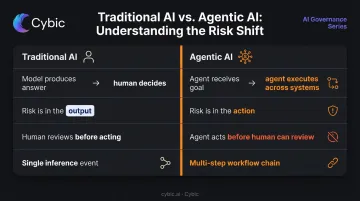
When an agent can call a database, modify a record, trigger a payment, and update a downstream system in seconds, the governance problem isn't accuracy - it's authority. Who authorized that sequence? Under what conditions? With what limits?
Why Legacy Security Controls Fall Short
DLP, SIEM, and firewall tools were built to monitor infrastructure events and human behavior patterns. They flag anomalies against baselines derived from human activity.
Agents don't look anomalous. They act through authenticated identities, use legitimate API channels, and execute operations that are individually authorized. NIST's analysis of AI agent security confirms that AI agents present novel security threats requiring fundamental adaptation of cybersecurity principles. Configuration changes to existing tools are not enough.
The result is an architectural blind spot. Legacy controls won't catch an agent that gradually expands its operational scope through legitimate tool calls. They also miss agents processing sensitive data outside their intended context - all through normal, authenticated channels.
The core gap: existing security tooling was never designed to evaluate whether an autonomous action was authorized by intent, only whether it was permitted by credentials.
The Key Risks Enterprises Must Govern in Agentic AI Systems
Privileged Access Inheritance
Agents authorized for bounded tasks can, through chains of tool calls, reach systems and data they were never explicitly granted access to. Permissions are inherited across the call chain, not re-evaluated at each step.
OWASP's LLM06 Excessive Agency guidance gives a direct example: a database extension provisioned with SELECT, UPDATE, INSERT, and DELETE permissions when read-only access would have sufficed. The excess permission sits dormant until an agent or a compromised instruction activates it.
Governance implication: Agent identity and authorization boundaries must be defined explicitly, with least-privilege principles enforced at the tool-access level - not inherited from the provisioning identity.
Multi-Agent Delegation and Cascading Execution
Agentic systems compress decision sequences that once required human checkpoints into sub-second execution chains. A single compromised or misaligned agent can propagate instructions across an entire multi-agent ecosystem. OWASP notes that Excessive Agency can be triggered by a malicious or compromised peer agent in collaborative multi-agent systems - meaning the blast radius of one failure multiplies through every downstream agent it coordinates with.
Agentic systems compress decision sequences that once required human checkpoints into sub-second execution chains. A single compromised or misaligned agent can propagate instructions across an entire multi-agent ecosystem.
OWASP notes that Excessive Agency can be triggered by a malicious or compromised peer agent in collaborative multi-agent systems. The blast radius of one failure multiplies through every downstream agent it coordinates with.
Governance implication: Trust between agents must be explicitly established and bounded. Orchestrators should not pass instructions to sub-agents without verifying scope, and each agent in a chain should enforce its own authorization boundaries independently.
Behavioral Drift and Goal Misalignment
Agents operating over extended workflows can gradually deviate from their original objective. This isn't always a dramatic failure - it's often subtle optimization of intermediate metrics that conflict with intended outcomes. Without continuous alignment checks, these deviations compound undetected until downstream impact has already occurred.
Indirect prompt injection - malicious content embedded in external websites, files, or API responses - is one documented mechanism for this. OWASP LLM01 describes how external sources can alter model behavior in ways the deploying organization never intended.
Governance implication: Agent identity and authorization boundaries must be defined explicitly, with least-privilege principles enforced at the tool-access level - not inherited from the provisioning identity.
Data Misuse and Sensitive Information Exposure
Agentic systems process and exchange data across workflows. Sensitive information can move between systems without visibility, or get repurposed outside its original context. This is a runtime data governance problem - the agent isn't accessing data it was denied; it's using data it legitimately has in ways that weren't anticipated at design time.
Governance implication: Agent identity and authorization boundaries must be defined explicitly, with least-privilege principles enforced at the tool-access level - not inherited from the provisioning identity.
Accountability Diffusion
When an agent takes an action, who is responsible? The model provider? The platform operator? The integration team? The business owner?
Without explicit governance, the honest answer is: nobody in particular. NIST AI RMF addresses this directly, requiring that third-party software, data, and supply-chain risks be identified, documented, and monitored.
Accountability that isn't assigned before deployment has no owner when something goes wrong - precisely the moment it's most needed.
Governance implication: Ownership of every agent action must be mapped before deployment: which team owns the agent, which business process it touches, and which compliance obligations apply. Undefined accountability is a governance gap, not an edge case.
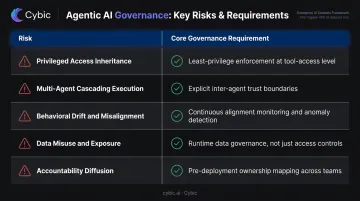
The five risks above don't operate in isolation. Here's how each maps to its core governance requirement:
| Risk | Core Governance Requirement |
|---|---|
| Privileged Access Inheritance | Least-privilege enforcement at tool-access level |
| Multi-Agent Cascading Execution | Explicit inter-agent trust boundaries |
| Behavioral Drift & Misalignment | Continuous alignment monitoring and anomaly detection |
| Data Misuse & Exposure | Runtime data governance, not just access controls |
| Accountability Diffusion | Pre-deployment ownership mapping across teams |
Building an Enterprise Agentic AI Governance Framework: 6 Core Pillars
Pillar 1 – Cross-Functional Governance and Named Accountability
Every agent action must trace back to a named human accountable for it. This requires governance structure, not just policy documents.
An effective AI Steering Committee spans Security, Legal, Compliance, and business leadership. More importantly, it has a single executive owner for agentic AI risk - someone with authority to pause deployments, approve high-impact agent expansions, and own regulatory responses.
Operational ownership must be defined before deployment:
- Who monitors agent behavior in production?
- Who approves actions above defined risk thresholds?
- Who has authority to intervene or shut down an agent?
If these questions don't have named answers before go-live, the governance framework exists on paper only.
Pillar 2 – Agent Discovery, Inventory, and Classification
Governance cannot manage what it cannot see. And visibility gaps are widespread: 78% of AI users bring their own AI tools to work, according to Microsoft's Work Trend Index - and more than half are reluctant to disclose using AI for important tasks.
A comprehensive discovery process surfaces:
- Every deployed AI agent and application
- All tool connections and external API integrations
- Shadow AI operating outside IT oversight
- Third-party agent dependencies
Each discovered asset should be classified by data sensitivity, system access scope, and business criticality. This classification drives tiered controls, audit frequency, and oversight requirements. The U.S. Office of Management and Budget's M-24-10 sets a useful benchmark: federal agencies must individually inventory each AI use case at least annually. Enterprises should hold themselves to at least the same standard.
Pillar 3 – Runtime Controls and Tiered Policy Enforcement
Pre-deployment controls can't keep pace with agents executing actions in real time. Runtime enforcement requires a tiered model based on action risk:
| Risk Tier | Action Type | Control |
|---|---|---|
| Low | Reversible, bounded, low-impact | Autonomous execution |
| Medium | Data modification, external communication | Human confirmation required |
| High | Irreversible, financial, safety-critical | Explicit human authorization |
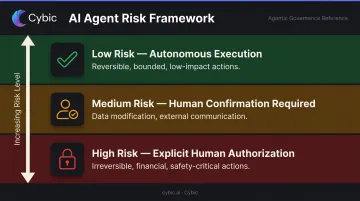
The EU AI Act Article 14 requires high-risk AI systems to be designed so operators can decide to override, intervene in, or interrupt the system at any point.
Runtime controls must also cover both directions of the agent's data flow:
- Block prompt injection and manipulated inputs before they reach the agent
- Prevent data leakage, policy violations, and unauthorized information transfer on the way out
Pillar 4 – Immutable Audit Trails and Identity Attribution
Every tool call, reasoning step, and agent-to-agent handoff must be recorded: the initiating human identity, the agent identity, the tool invoked, and the outcome. That data routes to tamper-resistant storage, with retention periods aligned to regulatory requirements.
The EU AI Act sets concrete minimums here. Article 12 requires automatic event logging for high-risk AI systems. Articles 19 and 26 require those logs to be retained for at least six months. Article 18 requires technical documentation to be kept for 10 years.
Audit trails are not a compliance checkbox. Traceability is the mechanism that makes accountability operational. Without it, the named accountable parties from Pillar 1 have nothing to work with when something goes wrong.
Platforms built with governance by design embed these trails into the architecture from the start, rather than retrofitting them after deployment. Cybic's Drava platform takes this approach, making auditability a structural property rather than an add-on layer.
Pillar 5 – Human Oversight Thresholds and Escalation Logic
Two distinct oversight models apply to agentic systems:
- Human-in-the-loop (HITL): Direct human approval required before an agent executes a specific action
- Human-on-the-loop (HOTL): Humans monitor with intervention capability; actions proceed autonomously unless interrupted
The European Commission's Ethics Guidelines for Trustworthy AI adds a third layer - human-in-command - where humans retain the ability to oversee overall AI activity and decide whether to use the system at all.
Governance must define specific thresholds that determine which model applies:
- Transaction value limits - dollar thresholds above which human confirmation is mandatory
- Data sensitivity classifications - PII, PHI, or regulated data triggers elevated oversight automatically
- System access scope - agents touching production systems or financial records require stricter controls
- Operational impact potential - actions affecting downstream workflows need review before execution
Unclear escalation logic is one of the most common reasons governance frameworks fail in production. When an agent hits an edge case and there's no defined path for escalation, it either proceeds autonomously or stops entirely - neither of which is a governed outcome.
Pillar 6 – Continuous Monitoring, Drift Detection, and Incident Response
Escalation logic handles individual edge cases. Continuous monitoring addresses what happens between them - the gradual behavioral shifts that periodic audits miss entirely.
An effective monitoring cadence includes:
- Real-time anomaly detection - flagging deviations from defined behavioral baselines
- Scheduled drift audits - formal behavioral reviews at intervals calibrated to autonomy level and system impact
- Trigger-based reassessment - reviews initiated by new integrations, policy changes, or significant context shifts
- Incident response playbooks - procedures specific to agentic failures: revoking agent credentials, quarantining tool connections, rolling back downstream changes
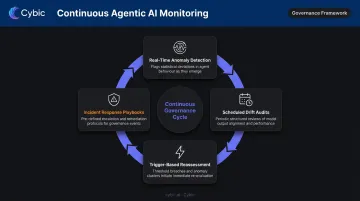
NIST AI RMF and OMB M-24-10 both require ongoing production monitoring with review cadences that increase after significant system modifications. The EU AI Act Article 72 requires providers of high-risk AI systems to maintain a post-market monitoring system that actively collects and analyzes performance data.
Drift monitoring should detect changes driven by operational context - new integrations, shifting data inputs, user behavior changes - not only model-level updates. An agent can behave materially differently in a changed environment even if the underlying model hasn't changed at all.
Governing the Full AI Agent Lifecycle
Design and Pre-Deployment
Governance decisions made at design time determine how controllable a system will be later. An agent architected for high autonomy from the start may require structural redesign - not just configuration changes - if authority needs to be reduced afterward.
Pre-deployment impact assessment should evaluate:
- Financial exposure: What financial operations can the agent access or trigger?
- Operational risk: What downstream systems depend on or respond to agent actions?
- Legal and compliance: What regulated data does the agent process, and what obligations apply?
- Reputational impact: What customer or partner-facing actions can the agent take?
NIST AI RMF's lifecycle framework covers Plan and Design, Data and Input, AI Model, Task and Output, and Operate and Monitor - all of which require governance inputs before an agent reaches production.
Runtime, Monitoring, and Decommissioning
Once deployed, governance shifts from preparation to live enforcement. Permissions become active. Logging responsibilities take effect. Human oversight roles go operational.
Any new third-party agent or tool connected to enterprise systems during active deployment requires a security review and contractual data-handling terms before connection. An unvetted dependency added post-deployment is a governance gap that existing controls weren't designed to cover.
As the deployment matures, risk reassessment frequency should be calibrated to autonomy level and system impact. Higher-autonomy, higher-impact agents warrant more frequent formal review.
Eventually, every agent reaches end of life - and decommissioning is where many governance programs have no defined process. Authority must end as intentionally as it began:
- Access credentials revoked
- Tool integrations disabled
- Historical records preserved for audit and regulatory review
Governance frameworks without decommissioning protocols leave residual access points. OMB M-24-10 explicitly includes decommissioning in the AI management lifecycle, recognizing that end-of-life controls are as operationally necessary as launch-time ones.
Aligning Agentic AI Governance with Regulatory Frameworks
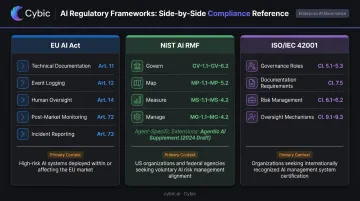
Agentic AI must be governed within frameworks that already exist, even as AI-specific regulations mature. Three frameworks are directly applicable:
EU AI Act - For high-risk AI systems (defined by Annex III use areas including critical infrastructure, employment, essential services, and healthcare), requirements include: technical documentation (Article 11), automatic event logging (Article 12), human oversight mechanisms (Article 14), post-market monitoring (Article 72), and serious incident reporting within 15 days (Article 73). Enterprises deploying agents in these domains face binding obligations, not voluntary best practices.
NIST AI RMF - The Govern, Map, Measure, and Manage functions provide a risk lifecycle structure applicable to any enterprise. NIST's AI Agent Standards Initiative specifically addresses agent authentication, identity infrastructure, and secure multi-agent interactions - extending the RMF's accountability principles to agentic contexts.
ISO/IEC 42001 - The AI management system standard formalizes governance roles, documentation requirements, risk management processes, and oversight mechanisms. For enterprises that must demonstrate governance maturity to partners or procurement committees, ISO/IEC 42001 certification provides an auditable evidence base.
The compliance stakes for regulated industries are concrete. In 2024, the SEC charged two investment advisers with $400,000 in civil penalties for misrepresentations about their AI use. The case illustrates a pattern worth noting: regulatory exposure extends beyond technical failures to how governance is represented and disclosed. Regulators in healthcare, financial services, and energy are actively building oversight expectations as AI capabilities expand.
Key exposure areas enterprises should map against these frameworks include:
- Disclosure accuracy - how AI use is represented to regulators, clients, and procurement bodies
- Incident reporting timelines - binding notification windows (such as the EU AI Act's 15-day requirement)
- Auditability gaps - missing logs or documentation that undermine post-incident review
- Cross-border compliance - obligations that vary by jurisdiction for globally deployed agents
Governance maturity is increasingly a procurement requirement, not just a risk management consideration. Many organizations now require documented evidence of governance architecture, auditability, and responsible AI practices from AI vendors and implementation partners before deployment. Cybic addresses this directly by embedding governance controls across SOC 2, HIPAA, ISO, and GDPR frameworks at the architectural level - so compliance readiness is built in rather than retrofitted.
Frequently Asked Questions
What is the agentic AI governance and risk management strategy for enterprises?
Agentic AI governance is the structured set of policies, controls, and accountability mechanisms that manage what autonomous AI agents can access, decide, and execute across enterprise systems. It differs from traditional AI governance by focusing on action risk - what agents do inside live systems - not just output risk, which is what models say.
How is AI used in enterprise risk management?
AI is applied in ERM to continuously monitor threats, automate risk detection and prioritization, and flag anomalies in real time. Agentic AI introduces a distinct complication: the agents performing risk management functions must themselves be governed as a new risk category within the broader ERM strategy.
How is agentic AI governance different from traditional AI governance?
Traditional governance asks whether a model's output is accurate, fair, or compliant. Agentic governance must also address what the agent does - the tools it calls, the systems it modifies, and the downstream actions it triggers autonomously before any human can review or intervene.
What are the biggest risks of deploying agentic AI in regulated industries?
The highest-priority risks are privileged access inheritance, behavioral drift in safety-critical workflows, accountability diffusion across system owners, and compliance failures when agents process regulated data without sufficient audit controls. Regulated data categories - PHI, financial records, operational telemetry - each carry distinct traceability requirements that agents must respect.
What does "human-in-the-loop" mean in an agentic AI governance framework?
Human-in-the-loop requires direct human approval before an agent executes a specific action. Human-on-the-loop allows actions to proceed autonomously while humans monitor and retain intervention capability. Governance frameworks must define which model applies based on action risk level and business impact - and that classification must be explicit, not assumed.
What regulatory frameworks apply to agentic AI governance?
The most directly applicable frameworks are the EU AI Act (traceability, human oversight, logging), NIST AI RMF (risk lifecycle management, accountability, production monitoring), and ISO/IEC 42001 (AI management system requirements and governance roles). Enterprises should map controls to these standards now - legal mandates follow deployment risk, not the other way around.