Introduction: Data Governance in Manufacturing Has Become Non-Negotiable
Manufacturing generates data at a scale that's difficult to overstate. A single semiconductor fab can produce petabytes daily, and according to Intel, some operations now hold 600 PB of data across their systems. Yet the Manufacturing Leadership Council found that while 61% of manufacturers have a corporate-wide governance plan, only 15% say their data strategy is fully aligned with business objectives.
That gap is where problems compound:
- Data silos block operational visibility across plants and systems
- Compliance failures trigger regulatory penalties
- AI initiatives stall when underlying data is inconsistent or untraceable
- Cybersecurity vulnerabilities multiply at every ungoverned access point
This guide covers what data governance actually means for manufacturers in 2026: the core challenges, the five pillars of an effective program, high-impact use cases, and a practical framework for building one that lasts.
Key Takeaways
- 61% of manufacturers have a governance plan, but only 15% align it to business strategy - leaving a gap where financial and operational risk accumulates
- Regulatory pressure (ISO, FDA, GDPR, ESG) and rising cybersecurity threats turn ungoverned data into a direct financial liability
- Effective manufacturing data governance rests on five pillars: data quality, ownership, security, compliance, and lineage
- Governance is the prerequisite for reliable AI; without it, predictive models can't be trusted
- Start with a single production line pilot, prove ROI, then scale systematically across plants and partners
What Is Data Governance in Manufacturing?
Data governance in manufacturing is the system of policies, roles, standards, and processes that ensure data is accurate, secure, accessible, and used appropriately - from raw material sourcing through quality control, supply chain, and customer delivery.
That definition covers a lot of ground. To apply it practically, it helps to break down what's actually being governed.
What Data Needs to Be Governed
Manufacturing environments generate several distinct categories of data, each with its own governance requirements:
- Product lifecycle data - bills of materials, engineering specs, design revisions
- Operational data - machine performance metrics, sensor output, production logs
- Supply chain data - supplier records, inventory levels, lead times
- Quality data - defect rates, inspection results, non-conformance reports
- Compliance data - audit trails, certification records, regulatory submissions
- ESG/environmental data - emissions, energy consumption, waste output
Governance vs. Data Management: The Distinction That Matters
These two terms get conflated constantly - and the confusion typically results in teams over-investing in tooling while neglecting accountability structures.
Data governance is the strategic layer - the rules, roles, and accountability structures that define who is responsible for data, what standards it must meet, and how it can be used.
Data management is the operational layer - the technical execution of storing, processing, and moving data. Both are necessary. Without governance, even well-built data infrastructure has no accountability structure behind it. Without management, governance policies have nothing to act on.
Why Manufacturing Can't Afford to Skip Data Governance in 2026
Regulatory Pressure Is Intensifying
ISO 9001, FDA quality guidelines, GDPR, CCPA, and expanding ESG mandates now require manufacturers to maintain accurate, traceable, auditable records - and enforcement has teeth.
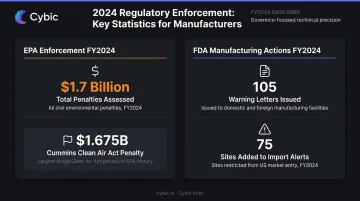
The financial stakes are real. The EPA assessed $1.7 billion in administrative and judicial penalties in FY2024 - the highest level since 2017 - including a $1.675 billion civil penalty against Cummins Inc. for vehicle emission control violations, the largest ever under the Clean Air Act. On the pharmaceutical side, the FDA issued 105 warning letters to drug manufacturing sites in FY2024 alone, with 75 sites added to import alerts for poor quality.
Poor Data Quality Has a Measurable Cost
Gartner estimates that poor data quality costs organizations an average of $12.9 million per year. In manufacturing, that figure materializes as:
- Overproduction and excess inventory from inaccurate demand forecasts
- Defective products that reach quality control too late
- Delayed shipments due to supply chain blind spots
- Missed maintenance windows that cause unplanned downtime
AI Readiness Depends on Governed Data
As manufacturers deploy AI for predictive maintenance, demand forecasting, and quality inspection, the value of those systems is entirely contingent on the quality of the data feeding them. When data is ungoverned, AI amplifies the problem - at scale, with automated decisions attached.
Ungoverned data produces unreliable model outputs and introduces compliance risk when AI-driven decisions can't be audited. Predictions drift when the underlying data has no quality enforcement, and that exposure compounds fast.
The Cybersecurity Dimension
Manufacturing is now the most targeted sector for cyberattacks. IBM X-Force reported that manufacturing accounted for 27.7% of cybersecurity incidents in 2025 - the top industry for the fifth consecutive year. The scale of exposure is significant:
- Dragos tracked 1,211 ransomware incidents affecting industrial entities in Q4 2025 alone
- Manufacturing accounted for nearly 70% of those incidents
Ungoverned data streams, unmonitored access points, and systems without defined ownership all widen the attack surface.
The 4 Key Challenges of Data Governance in Manufacturing
Legacy Systems and Data Silos
Most manufacturers operate a mixed estate: legacy PLCs and MES platforms alongside modern IoT devices and cloud infrastructure. These systems weren't designed to share data. They use incompatible protocols, inconsistent data formats, and different quality standards.
The result is isolated silos - production data that never reaches the supply chain team, quality data that doesn't feed back into demand forecasting, maintenance logs that exist only within the MES and never inform enterprise analytics.
The MLC found that 70% of manufacturers still collect data manually and 68% rely on Excel for data analysis. Those numbers define the starting point most governance programs inherit.
High Data Volumes and Real-Time Requirements
Industrial IoT generates data at a pace traditional governance frameworks weren't designed for. One CPG manufacturer's sensor platform ingests 1 million data points per second in real-time monitoring. MLC reported that 44% of manufacturers say their data volumes at least doubled in the two years prior to 2024.
Traditional enterprise data governance was built for structured, slower-moving data environments. Manufacturing governance has to work at machine speed - which means automated enforcement, not human review.
Unclear Data Ownership and Accountability
Technical infrastructure challenges are only part of the picture. In manufacturing, data flows across production, procurement, logistics, quality, IT, and finance - and without formally assigned owners and stewards, the question "who is responsible for this data?" produces only ambiguity.
The MLC found that while 58% of manufacturers place primary responsibility for data governance with senior leadership, only 22% link those responsibilities to annual incentives or KPIs. When ownership carries no measurable consequence, governance frameworks exist on paper but rarely shape behavior.
Scalability Across Plants and Partners
Governance frameworks that work in a single plant frequently fail when extended to a second site with different equipment generations, a different regulatory environment, or third-party suppliers running different systems entirely.
McKinsey found that only 30% of manufacturers successfully rolled out digital solutions company-wide - most stall after initial pilots. Data governance faces the same scaling problem: what works for one production line rarely transfers without deliberate architectural planning.
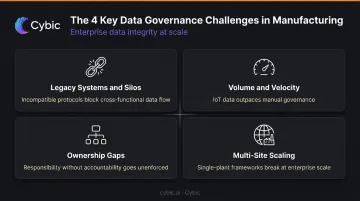
At a glance - the four challenges and where they bite hardest:
- Legacy systems and silos: Incompatible protocols block cross-functional data flow
- Volume and velocity: IoT data at machine speed outpaces manual governance controls
- Ownership gaps: Assigned responsibility without accountability metrics goes unenforced
- Multi-site scaling: Single-plant frameworks break down across sites, suppliers, and regulatory boundaries
The 5 Pillars of Effective Data Governance in Manufacturing
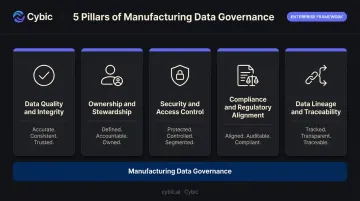
A durable manufacturing data governance program isn't built on technology alone. The five pillars below - spanning data quality, ownership, security, compliance, and lineage - form the interconnected foundation that holds the whole framework together.
Pillar 1: Data Quality and Integrity
Data quality governance means setting rules for accuracy, completeness, consistency, and timeliness - then enforcing them continuously through automated monitoring, anomaly detection, and validation workflows.
In manufacturing, data quality failures have direct operational consequences:
- Inaccurate sensor readings corrupt predictive maintenance models
- Incomplete inventory records produce bad demand forecasts
- Inconsistent quality metrics make root-cause analysis unreliable
Periodic audits don't cut it here. Continuous, automated quality enforcement is the only approach that keeps pace with manufacturing data volumes.
Pillar 2: Data Ownership and Stewardship
Every critical data domain - product data, supply chain data, quality data, compliance data - needs a named owner responsible for its accuracy and governance compliance. Data stewards serve as the operational enforcers: monitoring adherence, resolving data quality issues, and escalating violations.
No platform assigns accountability by itself. This pillar is fundamentally an organizational design challenge - and it's often where governance programs stall without intentional structure.
Pillar 3: Data Security and Access Control
Manufacturing data includes intellectual property, supplier contracts, regulated compliance records, and process trade secrets. Protecting it requires controls at every layer:
- Role-based access control (RBAC) - restricts data access to authorized users and roles
- Encryption at rest and in transit - protects sensitive records from interception or unauthorized access
- Comprehensive audit trails - log every data access and modification for accountability
Access policies must cover both human users and automated systems - APIs, connected machines, and orchestrated workflows all need governance controls applied consistently.
Pillar 4: Compliance and Regulatory Alignment
This pillar involves mapping governance policies directly to applicable standards - ISO 9001, FDA requirements, GDPR, CCPA, and ESG frameworks - and maintaining audit-ready documentation at all times.
Automated compliance tracking significantly reduces the manual burden of regulatory reporting. When an FDA inspector arrives or an ISO certification audit begins, the documentation should already exist and be retrievable in minutes, not days.
Pillar 5: Data Lineage and Traceability
Data lineage tracks where data originates, how it's transformed, and where it flows across systems. In manufacturing, this capability is critical for:
- Product recalls - tracing a quality defect back to its source lot, supplier, or production run
- Root-cause analysis - identifying where a process deviation first appeared in the data chain
- Compliance audits - demonstrating to regulators that data hasn't been altered and records are complete
Without lineage, manufacturers can't reliably answer the question regulators always ask: "Show me the chain of evidence."
4 High-Impact Use Cases for Data Governance in Manufacturing
Data governance delivers measurable operational value - and the returns show up across specific, high-stakes functions.
Use Case 1: Regulatory Compliance and Audit Readiness
A governance program ensures manufacturers maintain traceable, audit-ready records across all production and supply chain touchpoints. When an FDA inspection or ISO certification audit arrives, automated policy enforcement means the documentation is already there: accurate, complete, and organized.
The alternative - scrambling to reconstruct records manually under audit pressure - is both operationally disruptive and reputationally risky.
Use Case 2: Supply Chain Visibility and Risk Management
Governed, standardized data shared across suppliers, logistics partners, and internal teams provides real-time visibility into inventory levels, lead times, and demand signals. Manufacturers without this visibility can't identify disruptions until they've already become production delays.
The Manufacturing Leadership Council (MLC) found that 42% of manufacturers were actively working to extend supply chain visibility beyond Tier 1 suppliers - which requires governed data-sharing frameworks with partners operating under different systems.
Use Case 3: Predictive Maintenance and OEE Improvement
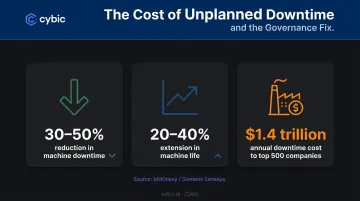
Governed IoT sensor data - cleaned, validated, consistently formatted - feeds predictive maintenance models that detect equipment anomalies before they cause unplanned downtime. McKinsey found that advanced predictive maintenance can reduce machine downtime by 30–50% and extend machine life by 20–40%.
The context: Siemens/Senseye reports that unplanned downtime costs the world's 500 largest companies $1.4 trillion annually, with automotive manufacturers absorbing $2.3 million per idle hour at a major plant. The data quality feeding the predictive models determines how reliable those models actually are.
Use Case 4: ESG Reporting and Sustainability Compliance
ESG compliance requires accurate, auditable data on emissions, energy consumption, waste output, and labor practices. The EU's CSRD framework - now narrowed to companies with more than 1,000 employees and €450 million net turnover after the Council of the EU's February 2026 simplification - demands structured, verifiable sustainability data.
Governance ensures environmental data is consistently captured, classified, and reportable. Without it, ESG reporting becomes a manual reconciliation exercise - one prone to exactly the errors auditors are trained to find.
Building a Manufacturing Data Governance Framework: A Step-by-Step Approach
Start With a Pilot, Prove ROI, Then Scale
The most common failure mode in manufacturing governance is trying to govern everything at once. Start with a single production line or a single data domain - quality data, for example, or supplier records - and build governance that demonstrably improves a measurable outcome.
Reduced defect rates. Faster audit response times. Fewer unplanned maintenance events. These are the metrics that justify expanding governance architecture across additional plants and systems. McKinsey's finding that only 30% of manufacturers successfully scale digital programs company-wide reflects what happens when organizations skip this step and try to deploy enterprise-wide governance without proving the model first.
The Three-Tier Architecture for Scalable Governance
Scalable manufacturing data governance typically follows a layered architecture that addresses both real-time operational needs and enterprise-level compliance management:
| Layer | Components | Governance Role |
|---|---|---|
| Edge | Smart sensors, PLCs | Immediate data capture, protocol translation, initial quality filtering |
| Fog | MES, historians | Real-time validation, anomaly detection, data quality enforcement |
| Cloud | Enterprise analytics, ERP, compliance platforms | Centralized governance policies, audit trails, regulatory reporting |
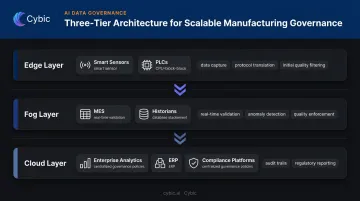
This architecture addresses the legacy-modern integration challenge by giving each layer defined responsibilities - rather than routing raw PLC data directly to cloud analytics platforms where legacy format inconsistencies compound into larger problems.
Where AI-Powered Governance Changes the Equation
Manual governance at IoT scale isn't viable. A production environment generating millions of data points per shift cannot be governed through spreadsheets and periodic audits.
AI-powered governance platforms automate the tasks that would otherwise demand extensive manual effort across multiple teams:
- Monitor data quality continuously across sensor and machine feeds
- Detect anomalies before they propagate downstream into ERP or analytics layers
- Enforce access and policy controls without manual intervention
- Generate audit trails automatically for regulatory reporting
Governance needs to be embedded at the architecture level. That's the principle behind Cybic's Drava platform, which connects enterprise data, machine learning, and intelligent agents into a single governed automation layer built for manufacturing environments.
Drava incorporates role-based access controls, encrypted data protection in transit and at rest, and full auditability of AI-driven actions - built into the platform architecture from the ground up. For manufacturers deploying AI automation at scale, that approach is what lets operational speed and compliance requirements coexist rather than compete.
Frequently Asked Questions
What are the 5 pillars of data governance?
The five pillars are data quality and integrity, data ownership and stewardship, data security and access control, compliance and regulatory alignment, and data lineage and traceability. Effective governance requires all five working in concert. A weakness in any single pillar undermines the others.
What is a data governance service?
A data governance service is a managed offering or platform capability that helps organizations define, implement, and enforce policies for how data is collected, stored, accessed, and used. It covers role assignment, quality standards, compliance monitoring, and regulatory reporting across data domains.
Is MDG part of SAP?
SAP Master Data Governance (MDG) is a module within the SAP ecosystem that centralizes master data across domains like materials, suppliers, and customers. It handles master data management well, but it is one component of a broader governance strategy, not a complete framework.
How does data governance support regulatory compliance in manufacturing?
Governance ensures that regulatory-relevant data - audit trails, certification records, inspection results - is captured accurately, kept consistent, and retrievable on demand. When FDA, ISO, or environmental audits occur, manufacturers with strong governance can produce documentation quickly and cleanly rather than reconstructing it under pressure.
What types of data need to be governed in manufacturing?
Key categories include product lifecycle data (BOMs, engineering specs), operational and machine data, supply chain and inventory records, quality control data, compliance documentation, customer data, and ESG/environmental metrics. Each category carries distinct accuracy, access, and retention requirements.
How is AI changing data governance in manufacturing?
AI automates previously manual governance tasks - data quality monitoring, anomaly detection, policy enforcement, and lineage tracking - enabling real-time governance at the speed and scale that IoT-driven manufacturing demands. That said, AI is only as reliable as the data feeding it - governed, consistent inputs are what make AI outputs trustworthy.