Introduction
An AI model trained on duplicate, outdated, or conflicting records doesn't just produce bad outputs - it erodes trust in every decision downstream. Gartner reports that poor data quality costs organizations an average of $12.9 million annually, yet 59% of organizations still don't measure data quality at all.
Compliance exposure compounds the problem. CCPA administrative fines now reach up to $7,988 per intentional violation, and enforcement actions across US state regulators hit record highs in 2024.
Data governance is no longer a back-office compliance exercise. It's the operational foundation that determines whether your organization can actually use its data - or just store it.
This guide covers the distinction between a governance strategy and a roadmap, what each must contain, how to construct them step by step, and how to measure whether they're delivering results.
Key Takeaways
- A data governance strategy defines what you're governing and why; a roadmap sequences how you'll get there
- Poor data governance costs organizations millions annually and directly undermines AI and analytics initiatives
- Effective governance spans people, process, and technology - ownership stops at IT's door only when governance fails
- Roles, policies, and business goal alignment must be explicit before any initiative launches
- Governance is a continuous program, not a project - build in review cycles from the start
Data Governance Strategy vs. Roadmap: Key Distinctions
These two terms get used interchangeably, but they serve different functions. Confusing them is one of the more common reasons governance programs stall.
What a Strategy Does
A data governance strategy is the operating model. It defines decision rights, accountability structures, and the policies that govern how data assets are valued, created, consumed, and controlled. Gartner frames modern data governance as increasingly business-led and decision-centric - not a technical checkbox exercise.
The strategy answers:
- What data needs to be governed, and to what standard
- Why governance matters to this specific organization right now
- Who holds accountability at each level
What a Roadmap Does
A data governance roadmap is the tactical complement. It takes the strategy's direction and sequences the work into prioritized initiatives, milestones, and timeframes. It is not a rigid project plan - it's a living guide designed to flex as organizational priorities and data maturity evolve.
The roadmap answers:
- How the strategy gets implemented
- When specific capabilities or outcomes will be in place
- What dependencies exist between initiatives
Each artifact fails without the other. Strategy without a roadmap leaves teams committed to principles but unable to execute. A roadmap without a strategy produces a flurry of activity pointed in no particular direction.
What a Data Governance Strategy Should Include
A governance strategy that doesn't connect to business outcomes loses executive sponsorship within months. Gartner predicted in 2024 that 80% of data and analytics governance initiatives will fail by 2027 - specifically because they lack a real or manufactured business crisis to anchor them. The root cause is structural, not technical.
Here's what a strategy must include to avoid that failure mode:
Business Goal Alignment
Every governance strategy needs an explicit anchor to a business priority. Not "improve data quality" as an abstract goal, but something like: "Reduce compliance audit remediation time by 60%" or "Enable AI deployment across three production use cases by year-end." Without this anchor, governance becomes a cost center rather than a value driver.
Framework Selection
The strategy must specify which governance framework the organization will use as its structural backbone. Two well-established options:
- DAMA-DMBOK - A globally recognized framework that helps organizations structure, govern, and optimize data assets aligned with business strategy and regulatory compliance
- DCAM (Data Management Capability Assessment Model) - The EDM Council's standard for managing data to drive strategic value, used by 430+ organizations in cross-industry benchmarking
Organizations can also build a hybrid model - just document the rationale before execution begins.
Roles and Accountability
Ungoverned ownership is one of the primary ways governance programs collapse. Clear role assignments are what keep a governance program from becoming a governance wish list.
A practical role framework (RACI or DACI) assigns:
- Data Owners - Business-side accountability for a data domain
- Data Stewards - Day-to-day quality and policy enforcement within their data domain
- Governance Committee - Cross-functional oversight and escalation
- Executive Sponsor - Organizational authority and budget accountability
Policies and Standards
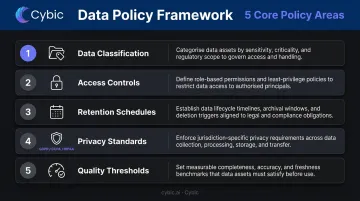
Data policies must cover five core areas:
- Data classification - What categories of data exist, and what sensitivity level applies to each
- Access controls - Who can access what, under which conditions
- Retention schedules - How long data is kept and when it must be deleted
- Privacy standards - GDPR, CCPA, HIPAA requirements built into data handling processes
- Quality thresholds - Minimum standards for accuracy, completeness, and timeliness
Every policy needs a designated owner, a review schedule, and a clear escalation path when violations occur. Without those, even well-written policies go unenforced.
Communication and Buy-In Plan
Resistance to governance usually has nothing to do with data. People push back on change. The strategy must include a communications plan that explains - for each stakeholder group - why governance is happening, how it affects their work, and who owns accountability. Teams that don't understand the rationale will route around governance processes rather than through them.
How to Build a Data Governance Roadmap Step by Step
Step 1 - Assess Current State
Before sequencing any initiative, organizations need an honest picture of where they are. This means auditing existing data management practices, identifying capability gaps, and documenting the current state of data quality, ownership, and tooling.
Skipping this step produces a roadmap built on assumptions rather than facts. Cybic's governance engagements begin with exactly this work - data landscape audits and gap analysis across data quality, sources, and existing governance structures - before any strategic sequencing begins.
Step 2 - Define and Prioritize Initiatives
Not all governance work is equal in impact or feasibility. Package actions into discrete initiatives, then prioritize based on:
- Business impact - Which initiative unblocks the highest-value use case?
- Feasibility - What can realistically be executed given current resources?
- Dependencies - What must be true before this can happen?
Apply the "bowling-pin" principle: choose a first initiative that creates momentum and opens the path for subsequent ones. Defining data ownership for your highest-priority business domain, for example, makes every downstream initiative easier to execute.
Step 3 - Map Timelines and Milestones
Roadmap stages should use outcome-based timeframes, not granular task lists. A milestone like "Data ownership formally assigned for five core business domains by Q2" communicates direction and accountability without over-prescribing execution. That flexibility matters - organizational readiness and priorities will shift as the program progresses.
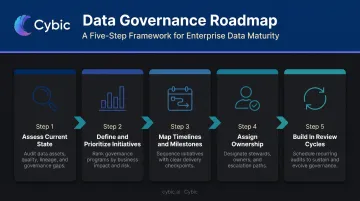
Step 4 - Assign Ownership Per Initiative
Each roadmap initiative needs two named people: a driver (the person accountable for execution) and an executive approver (the person who can remove barriers and commit resources). Without both roles named, a roadmap has no accountability structure - and accountability is what separates execution from planning.
Step 5 - Build In Review Cycles
A data governance roadmap is a living document. Business priorities shift, data environments evolve, and stakeholder readiness changes. Build in structured review cycles to reassess priorities, retire completed initiatives, and add new ones.
As programs mature, teams need visibility into initiative progress and audit trails across roadmap activities. Cybic's Drava platform supports this directly, with built-in workflow orchestration and governance tracking designed for enterprise data programs.
People, Process, and Technology: The Three Pillars
People
Data governance cannot succeed as an IT-only effort. It requires cross-functional participation where business leaders, process owners, data stewards, and end users all have defined roles and shared accountability.
Beyond role assignments, governance programs need to build genuine data literacy. Forrester research shows organizations need 1.3x more data-literate people to achieve strategic objectives, yet the average data literacy rate across organizations sits at just 41%. Employees who understand why data quality matters are more likely to act as active stewards, not passive data consumers.
Process
Four core governance processes form the operational backbone:
| Process | What It Covers |
|---|---|
| Discover | Identify and profile data assets across the organization |
| Define | Document definitions, policies, ownership, and business glossaries |
| Apply | Operationalize rules, stewardship workflows, and access controls |
| Measure & Monitor | Track compliance, quality metrics, and program value over time |
Make these processes repeatable, documented, and auditable - not ad hoc.
Technology
Governance technology should do more than store policy documents. Look for platforms that offer:
- Starts with core capabilities and scales without requiring a rebuild (modularity)
- Metadata management and data lineage to track where data originates, how it transforms, and where it lands
- Reduces manual cataloging, tagging, and classification through automation
- Provides role-relevant interfaces so business users and IT teams each see governance data in a format that works for them
The underlying principle matters more than any single feature: governance should be embedded by design. Security controls, role-based access, and auditability belong in the architecture from day one, not bolted on after deployment. Cybic applies this directly when engineering enterprise AI and data platforms, incorporating RBAC, encrypted data protection, and audit trails at the architectural level across cloud, hybrid, and on-premises environments - with alignment to SOC 2, HIPAA, GDPR, and CCPA built in from the start.
How to Measure Data Governance Success
Agree on metrics before the first initiative launches. Retroactively defining success almost always leads to measuring what was easy to achieve rather than what actually mattered.
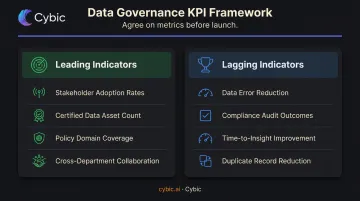
Leading Indicators (Early-Stage Signals)
- Stakeholder adoption rates and stewardship forum participation
- Number of data assets with certified ownership
- Policy coverage across business domains
- Cross-department collaboration on data issues
Lagging Indicators (Outcome Measures)
- Reduction in data errors and rework
- Compliance audit outcomes and remediation time
- Time-to-insight improvements for analytics teams
- Reduction in duplicate or conflicting data records
A governance scorecard or dashboard that gives both executives and practitioners visibility into program health keeps governance funded and credible. The Data Management Capability Assessment Model (DCAM) measures capability progress through engagement, process repeatability, and auditable evidence - a practical framework for organizing metrics at both early-stage and mature governance programs.
Not every program will have quantitative KPIs in the first six months. Early-stage programs often rely on qualitative signals: are stewards showing up to reviews? Are business teams flagging data issues instead of working around them? These are valid indicators of cultural traction.
Frequently Asked Questions
What is the roadmap for data governance?
A data governance roadmap is a high-level, prioritized plan of initiatives and milestones that guides implementation of the governance strategy over time. It stays flexible as organizational priorities, data complexity, and stakeholder readiness evolve - not a rigid project schedule.
What should a data governance strategy include?
A governance strategy should cover:
- Alignment to specific business goals
- A chosen framework such as DAMA-DMBOK or DCAM
- Formally assigned roles and responsibilities
- Data policies addressing classification, access, retention, and quality
- A stakeholder communication plan
How is a data governance roadmap different from a project plan?
A roadmap is high-level and flexible, focused on direction and broad outcome-based milestones. A project plan is detailed and task-specific. Data governance is an ongoing program, not a one-time project, which makes rigid project plans a poor fit for governance work.
Who is responsible for data governance in an organization?
Responsibility is distributed across several roles: an executive sponsor (organizational accountability), a governance committee (cross-functional oversight), data owners (domain-level accountability), data stewards (day-to-day quality and policy enforcement), and data consumers (adherence to standards in daily use).
How long does it take to implement a data governance strategy?
Timelines vary by organizational size, data complexity, and current maturity. Most programs show measurable progress within 6–12 months. Enterprise-wide governance maturity - where governance is embedded in culture and operations - is typically a multi-year journey.
How do you measure the success of a data governance program?
Success is measured through adoption metrics (stewardship participation, policy coverage), data quality improvements (error rates, certified assets), and business outcomes (compliance results, faster analytics). Early-stage programs should also track qualitative signals like cross-functional collaboration while quantitative KPIs are still being established.