Introduction
Many organizations have invested heavily on data infrastructure - cloud migrations, modern warehouses, BI tools - and still make major decisions based on gut instinct or siloed spreadsheets. The investment happened. The outcomes didn't follow.
The reason is almost always the same: capabilities get built without a structured plan connecting them to business results. New platforms get purchased before anyone defines what problem they're solving. Data teams get pulled in every direction.
Governance is assumed, not designed. And AI initiatives get layered on top of a foundation that was never ready for them.
A data strategy roadmap closes that gap. It's the sequenced, outcome-driven execution plan that turns a data strategy from a document into operational reality: what gets built, in what order, who owns it, and how success gets measured.
This article covers the five key phases of building a roadmap that actually works, how to operationalize it across the organization, and the execution failures that derail even well-designed plans.
Key Takeaways
- A data strategy roadmap is a sequenced, living execution plan - built to evolve as business priorities and data maturity shift.
- Start with an honest assessment of your current data landscape before touching technology or governance decisions.
- Business outcomes - not platform choices - should drive initiative prioritization and sequencing.
- Roadmaps stall when staffing, governance, and AI readiness aren't addressed upfront.
- Quarterly reviews keep roadmaps on track - without them, infrastructure spend outpaces actual use.
What Is a Data Strategy Roadmap?
A data strategy roadmap is a sequenced, time-bound plan that specifies how an organization will execute its data strategy - what initiatives will be built, in what order, who is responsible, and how success will be measured.
Two terms that often get conflated:
- Data strategy = the why and what - the principles, goals, and priorities that guide how the organization uses data
- Data strategy roadmap = the how and when - the phased execution plan that turns those priorities into actual deliverables
Without a roadmap, even a well-written strategy stays on a slide deck. The roadmap is what makes it operational.
What an Effective Roadmap Makes Explicit
An effective roadmap answers three questions for every initiative on it:
- What will the business get? Specific outputs: a real-time dashboard, an integrated data pipeline, an ML model that flags equipment anomalies. Not vague capabilities.
- When will it arrive? Deliverables tied to business quarters, not open-ended timelines.
- Why does it matter? A direct link to a measurable outcome - cost reduction, revenue growth, risk mitigation, or faster decisions.
That third question is where most roadmaps fall short. If an initiative can't be traced to a business outcome, it belongs in a backlog - not on the shortlist you're taking to leadership for budget approval.
Why a Data Strategy Roadmap Is Critical for Enterprise AI Readiness
Across manufacturing, healthcare, energy, retail, and financial services, the pressure to deploy AI is accelerating. The problem is that AI systems are only as reliable as the data beneath them, and the data beneath most organizations isn't ready.
According to a 2025 Gartner survey of 1,203 data management leaders, 63% of organizations either do not have, or are unsure they have, the right data management practices for AI - and Gartner predicts that 60% of AI projects unsupported by AI-ready data will be abandoned by 2026.
The Cisco 2024 AI Readiness Index reinforces this: only 13% of organizations are fully prepared for AI adoption, with 80% reporting data preprocessing and cleaning shortcomings and 82% reporting fragmented data.
What Happens Without a Roadmap
When there's no structured roadmap to sequence data foundation work before AI deployment, a predictable set of problems emerges:
- Data teams pursue conflicting department-level priorities with no shared framework
- Governance ownership stays undefined, so quality disputes go unresolved
- The same data gets duplicated across systems, creating inconsistency at scale
- Every new AI initiative requires rebuilding integration and cleanup from scratch
The cost isn't just wasted money - it's organizational distrust in data. Teams stop relying on systems that have produced unreliable outputs.
What a Roadmap Actually Enables
A well-designed roadmap creates alignment across three different audiences:
- Executives get a funding-justified view tied to board-level outcomes
- Departments get visibility into when their specific needs will be addressed
- Data teams get a prioritization framework that lets them stop operating reactively
That alignment is the prerequisite for moving from data infrastructure investment to measurable AI outcomes - which is exactly what the roadmap phases below are designed to deliver.
Key Phases of a Data Strategy Roadmap
These five phases follow a logical progression - each builds the capability the next phase requires. Governance, doesn't sit in one phase; it starts in Phase 3 and runs continuously. The sequencing logic matters most: don't build advanced capabilities on an unstable foundation.
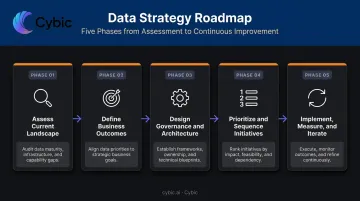
Phase 1: Assess Your Current Data Landscape
Before any technology decisions or initiative definitions, you need an honest picture of where things actually stand.
The assessment should document:
- Where data lives across all business systems and applications
- How accurate and complete key datasets are, by domain
- Which processes depend on manual data handling
- Where data ownership is unclear, contested, or simply absent
The challenge here is organizational honesty. Most companies overestimate their data maturity. Teams describe what the system is supposed to do, not what it actually does. Getting accurate findings - even uncomfortable ones - is essential because this assessment directly determines what gets prioritized in subsequent phases.
Cybic's data strategy engagements begin with exactly this: a data landscape audit and gap analysis that evaluates data quality, sources, and governance structures before any roadmap or architecture decisions are made.
Phase 2: Define Business Outcomes First
The most common roadmap mistake is starting with technology selection. An organization decides it needs a data lake, procures it, and then works backwards trying to justify the investment.
The outcome-first approach works differently. Instead of "we need a data lake," the starting question becomes: "We need to reduce operational downtime by identifying equipment failure patterns before they cause shutdowns."
That outcome definition then determines what data is needed, where it sits, what quality issues must be resolved, and what architecture decisions follow.
Working backwards from outcomes looks like this:
- Identify the decision or operation to be improved
- Determine what data makes that improvement possible
- Assess what's currently missing, unreliable, or inaccessible
- Define the data initiative required to close that gap
- Map the initiative directly to a measurable KPI or OKR
Each initiative on the roadmap should have a clear business owner, a defined metric, and a baseline to measure against. This is also what makes initiatives fundable - an executive can approve investment in something that moves a number they care about.
Phase 3: Design the Governance and Architecture Framework
This phase establishes the structural backbone: governance, architecture, and operating model.
Three components need explicit design decisions here:
Governance defines which teams own which data domains, how access is controlled and audit trails are maintained, how quality disputes get escalated, and which compliance standards apply (SOC 2, HIPAA, GDPR, CCPA).
Architecture determines whether to centralize in a warehouse, distribute through a mesh, or use a hybrid model - and which platforms (Snowflake, Databricks, or others) fit the workload.
Operating model settles centralized vs. embedded vs. federated team structures, and where accountability sits when data quality breaks down.
One point that often gets missed: governance must be designed to enable, not block. Overly rigid governance frameworks slow adoption and push teams toward shadow processes. Gartner predicts that 80% of data and analytics governance initiatives will fail by 2027 - largely because governance gets designed as a control mechanism rather than a business enabler.
AI readiness should also be a design criterion at this phase. This means building architecture that supports data lineage and auditability from the start, and selecting platforms that can integrate ML pipelines without requiring a full rebuild later.
Infrastructure-agnostic design - operating across cloud, hybrid, and on-premises environments - preserves flexibility as requirements evolve. Cybic builds across AWS, Azure, and Google Cloud with that principle in mind: avoiding architectures clients will need to undo.
Phase 4: Prioritize and Sequence Initiatives
Not all initiatives can run in parallel, and attempting to run too many simultaneously fragments team capacity and delays outcomes across all of them.
Evaluate and rank initiatives on two dimensions:
| Dimension | What It Measures |
|---|---|
| Business impact | How much value is delivered, and to which stakeholders |
| Implementation feasibility | Dependencies, required skills, infrastructure prerequisites |
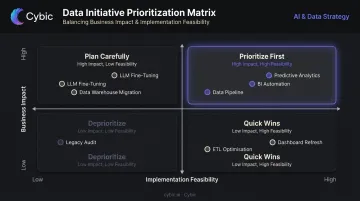
High-impact, high-feasibility initiatives go first. They build momentum, prove value to stakeholders, and generate the organizational confidence that funds subsequent phases.
Sequencing discipline is what separates a roadmap from a wish list. A phased MVP approach - delivering the minimum work required to create meaningful value at each stage - reduces risk and keeps the roadmap credible across quarters. If Phase 1 delivers a working outcome that measurably moves a metric, Phase 2 gets funded. That chain of proof is how roadmaps survive budget cycles.
Phase 5: Implement, Measure, and Iterate
Implementation should follow 90-day cycles. Each cycle delivers a measurable capability and generates learning that informs the next.
The critical distinction: measuring project completion is not the same as measuring business outcome. A dashboard was delivered on time - that's a milestone. Did it reduce the decision cycle the team needed it for? That's the question that determines whether the investment was worth it.
Only 38% of organizations have clearly defined metrics to measure AI impact and gains, according to Cisco's 2024 AI Readiness Index. That gap is where roadmaps silently fail - projects complete, but no one can demonstrate that anything changed.
If a metric isn't moving after a completed cycle, the strategy needs adjustment, not just the timeline. This phase is also where the roadmap proves it's a living document. Business conditions shift. AI mandates accelerate. Mergers happen. Organizations that treat the roadmap as fixed will find it obsolete within a year.
How to Operationalize Your Data Strategy Roadmap
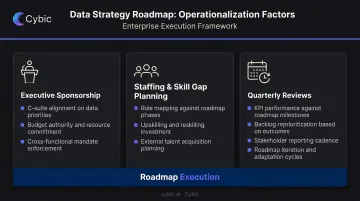
Having a well-designed roadmap isn't enough. Execution depends on a set of non-technical factors that most roadmap documents don't address.
Executive Sponsorship
Without a C-suite champion - CDO, CIO, or CTO - data initiatives get deprioritized when competing with short-term operational demands. Effective sponsorship means:
- The roadmap is used as the actual decision tool in budget discussions
- Priorities are tied to board-level OKRs, not just departmental requests
- New ad-hoc requests get evaluated against the roadmap before bypassing it
CDO/CDAO average tenure is under 2.5 years, according to Wavestone's 2024 Data and AI Leadership Survey. That continuity risk means the roadmap itself needs to be institutionalized, not dependent on a single person.
Staffing and Skill Gap Planning
Many roadmaps collapse not because the strategy was wrong, but because teams assumed existing staff could absorb new responsibilities. The roadmap should explicitly specify:
- Which roles are required at each phase
- Where skill gaps currently exist
- Whether gaps will be closed through new hires, reskilling, or external partners
Only 50.5% of organizations believe they have the talent in place to implement GenAI responsibly, per Wavestone. That figure needs to be confronted in the roadmap, not discovered during execution.
Quarterly Reviews
A quarterly review cadence should cover:
- What value was delivered in measurable business terms (not just project completions)
- Which initiatives need re-prioritization based on changed conditions
- What capacity or skill issues are emerging before they stall delivery
- How completed milestones connect to the overall strategic picture
As quarterly reviews confirm that the data foundation is stable, the natural next step is activating it for AI-driven use cases. Cybic's Drava platform is designed for this transition - connecting enterprise data, machine learning, AI reasoning, and intelligent agents within a single governed architecture, so organizations don't need a separate transformation effort to move from data readiness into AI deployment.
Common Pitfalls in Data Strategy Roadmap Execution
Even well-designed roadmaps fail in predictable ways.
Treating the roadmap as a one-time deliverable. Organizations produce a roadmap, present it to leadership, and then continue making ad-hoc data decisions that bypass it entirely. Within months, the roadmap is disconnected from actual execution and the organization is back to reactive, fragmented data work.
Starting with technology before defining outcomes. Organizations purchase modern data platforms and then struggle to justify their value because no one defined the business problem they were solving. Platform selection should follow outcome definition and architecture design - not precede it.
Underestimating governance complexity. Teams assume data ownership will resolve informally. It won't. Without explicit roles, standards, and escalation paths embedded in the roadmap, ownership disputes become the friction that slows every subsequent initiative - and governance demands sustained attention across every phase, not just initial setup.
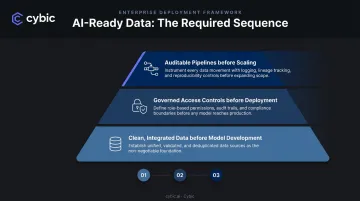
Building AI capabilities before the data foundation is ready. Organizations that skip data quality and integration phases find their AI models produce unreliable outputs - because the underlying data is incomplete, inconsistent, or ungoverned. The correct sequence is non-negotiable:
- Clean, integrated data before model development
- Governed access controls before deployment
- Auditable pipelines before scaling
Frequently Asked Questions
What is the difference between a data strategy and a data strategy roadmap?
A data strategy defines why data is critical to the business - the principles, goals, and priorities. The roadmap is the sequenced execution plan that specifies what will be built, in what order, when, and by whom. One is the vision; the other is the operational plan for achieving it.
How long does it typically take to build a data strategy roadmap?
An initial draft covering the first 3–5 major initiatives can typically be produced within 4–8 weeks. The roadmap itself is a living document that evolves continuously - the goal is a functional first version in stakeholders' hands quickly, not a perfect plan that takes months and arrives outdated.
Who should own the data strategy roadmap within an organization?
Ownership sits with the CDO or senior data leader, but effective roadmaps require cross-functional sponsorship. Finance, operations, and business unit leaders co-own the business case portions; IT or data engineering owns technical sequencing. Executive oversight ensures the roadmap actually drives funding and prioritization decisions.
How often should a data strategy roadmap be reviewed and updated?
Quarterly is the right default cadence. Trigger an immediate review whenever a major business change occurs: a merger, a new AI mandate, a significant budget shift, or a leadership change. These check-ins are what keep the roadmap connected to real priorities rather than collecting dust.
What is the role of data governance in a data strategy roadmap?
Governance is not a phase to complete and check off. It's a structural element established early and embedded across every subsequent phase, defining who owns data domains, how access is controlled, and how quality standards are enforced as usage scales.
How do you measure whether a data strategy roadmap is actually delivering value?
Measurement should happen at two levels: operational metrics (data quality scores, time-to-insight, tool adoption rates) and business outcome KPIs (cost reductions, decisions accelerated, AI model accuracy improvements). Progress against business outcomes - not just project milestones - is what validates the roadmap is working.