Introduction
Worldwide AI spending is forecast to hit $1.5 trillion in 2025 and exceed $2 trillion in 2026, according to Gartner. Yet McKinsey's 2025 State of AI survey reports that while 88% of organizations use AI in at least one function, only 39% report measurable EBIT impact - and just one-third are scaling it across the business.
The cause isn't inferior tools or insufficient budgets. Organizations launch AI without a structured plan, clear priorities, or governance guardrails. Pilots accumulate. Models sit idle. Business and technical teams pull in different directions.
An enterprise AI roadmap is the infrastructure that closes this gap - a structured plan that connects AI investments to business outcomes, establishes governance from day one, and gives every team a shared path from pilot to production.
This guide covers what a roadmap is, where most enterprises stand today, the five core components, a phase-by-phase build process, and the failure patterns that most commonly stall progress.
Key Takeaways
- Enterprise AI investment is surging, but fewer than 1 in 3 organizations are scaling AI beyond pilots
- A structured roadmap ties AI investments to measurable business outcomes, not isolated experiments
- Five components drive a successful roadmap: use-case prioritization, data readiness, architecture, operating model, and governance
- A realistic execution timeline runs 12–18 months across five sequential phases
- The most common failure points are weak use-case selection, under-prepared data foundations, and governance added too late
What Is an Enterprise AI Roadmap?
An enterprise AI roadmap is a structured, organization-wide strategic plan that maps AI investments to specific business outcomes across a defined timeline. A traditional IT roadmap tracks software upgrades, license renewals, and infrastructure refreshes - focused on keeping systems current. An AI roadmap is different: it's about what changes in the business as a result of AI, and how to get there reliably.
Four Hallmarks of a True AI Roadmap
| Hallmark | What It Means |
|---|---|
| Business-outcome focus | Use cases selected for ROI potential, not technical novelty |
| Data and infrastructure readiness | Assessed before any model development begins |
| Embedded governance | Risk, compliance, and auditability built in from day one |
| Phased execution plan | Clear milestones from discovery through production |
What a Roadmap Is Not
This distinction matters early, because misreading the roadmap's purpose is one of the most common sources of misalignment at the start of an AI program:
- Not a list of AI tools or vendors to evaluate
- Not a one-time strategy document filed after a workshop
- Not a technology architecture diagram
It's a living execution framework. As AI matures inside the organization, the roadmap evolves with it - new use cases get added, governance models get updated, and infrastructure decisions get revisited.
Where Most Enterprises Stand on AI in 2026
The headline adoption numbers are misleading. Among organizations with over 1,000 employees, 42% have actively deployed AI and another 40% are exploring or experimenting. That sounds like near-universal engagement. The problem shows up in the results.
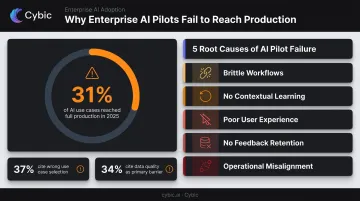
ISG analyzed 1,200 AI use cases from 400 senior decision-makers and found that only 31% reached full production in 2025 - and only one in four of those met expectations for revenue impact. The average spend per use case: $1.3 million.
Why Pilots Stall Before Production
The dominant failure pattern is structural, not technical. MIT's research on GenAI implementations identified five recurring causes:
- Brittle workflows that don't survive contact with real operational conditions
- No contextual learning - models that can't adapt to how teams actually work
- Poor user experience leading to low adoption
- Failure to retain feedback and improve over time
- Fundamental misalignment with day-to-day operations
Gartner adds another dimension: 37% of low-maturity organizations cite finding the right use case as a top challenge, and 34% identify data availability and quality as a primary constraint. Neither is a technology problem. Both come down to planning and prioritization - the gap between organizations that scale AI and those stuck in pilot cycles.
Core Components of an Enterprise AI Roadmap
Business Objectives and Use-Case Prioritization
Every roadmap starts with business-first questions. Which P&L outcomes should AI move - cost reduction, forecast accuracy, cycle time, customer churn? Which use cases have both high ROI potential and realistic technical feasibility given your current data and systems?
The most common early failure is selecting use cases for what they demonstrate technically rather than what they deliver financially. A demand forecasting model that reduces inventory carrying costs by 15% is far more valuable than a computer vision system that doesn't connect to any measurable outcome.
Use-case scoring dimensions:
- Is required data available, accessible, and clean enough to train and run models? (data readiness)
- How many systems must this touch, and how stable are those integrations? (integration complexity)
- Can this realistically reach production within 6–12 months? (time-to-value)
- What is the quantifiable business outcome, and which P&L line does it move? (financial impact)
Focus the first 12 months on no more than 2–3 high-ROI, feasible use cases. Teams that concentrate on fewer, better-scoped projects consistently reach production faster than those chasing a broad portfolio.
Data Readiness and Infrastructure Assessment
Data maturity is the most constrained variable in any AI roadmap. Gartner predicts that through 2026, organizations will abandon 60% of AI projects unsupported by AI-ready data. That's not a technology failure - it's a planning failure.
AI-ready data is not the same as BI-ready data. Reporting systems need accurate, aggregated data for dashboards. AI systems need data that is representative of the specific use case - including patterns, errors, outliers, and edge cases that inform how models behave in production.
Before any model development begins, a data readiness assessment should confirm:
- Availability and completeness of required datasets
- Data quality, lineage, and provenance
- Integration across ERP, CRM, and operational systems
- Access controls and permission structures
- Real-time versus batch accessibility requirements
Building models on unvalidated data foundations produces pilots that can't survive production conditions.
Technology and Architecture Blueprint
Enterprises consistently underinvest in architecture relative to model development. The result: systems that work in demos but collapse under production load, fail compliance reviews, or can't support a second use case without rebuilding from scratch.
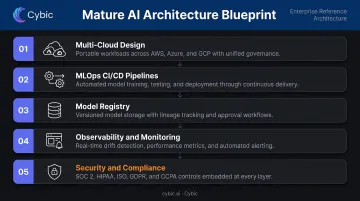
A mature architecture blueprint covers:
- Multi-cloud and hybrid environment design across AWS, Azure, and Google Cloud
- MLOps pipelines with CI/CD for model deployment, versioning, and automated retraining
- Model registries tracking versions, performance history, and deployment state
- Real-time performance monitoring and alerting (observability)
- Encryption in transit and at rest, RBAC, and full audit trails (security)
Organizations locked into a single cloud vendor face real constraints as AI expands across business units with different infrastructure requirements. Cybic builds across AWS, Azure, and Google Cloud because production enterprise AI rarely lives in one environment - and architecture decisions made early tend to either enable or block that expansion.
Governance, Risk, and Compliance
Only 14% of organizations currently enforce AI assurance at the enterprise level, according to ModelOp's 2025 benchmark of 100 senior AI and data leaders. That number should alarm any enterprise operating in a regulated industry.
A mature governance framework must address:
- Model explainability and decision auditability
- Bias monitoring and fairness controls
- Data access controls and lineage tracking
- Drift detection and model performance degradation alerts
- Compliance alignment with GDPR, HIPAA, SOC 2, and emerging regulations including the EU AI Act
Cybic's approach treats governance as a design principle, not a compliance checkpoint. Every solution embeds RBAC for secure system access, encrypted data protection in transit and at rest, full auditability and traceability of AI-driven actions, and a strict policy of no model training on proprietary enterprise data. These controls are architectural - built in from day one, not layered on after deployment.
For enterprises in healthcare, financial services, or government, that architectural difference is often what determines whether a solution clears a compliance review or stalls indefinitely in security assessment.
People, Skills, and Operating Model
AI transformation fails without a defined operating model. 66% of enterprises cite lack of talent as a top AI hurdle, and only 33% feel confident they have the right talent mix to execute their AI strategy, per the ServiceNow/Oxford Economics Enterprise AI Maturity Index.
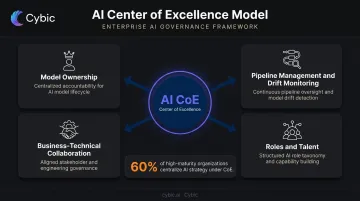
The operating model needs to resolve four questions before the first model goes to production:
- Who owns each model once it's live?
- Who manages pipelines and monitors for drift or degradation?
- How do business and technical teams collaborate on use-case definition and iteration?
- Which roles need to be added - ML engineers, data stewards, prompt engineers, model monitors?
High-maturity organizations establish an AI Center of Excellence (CoE) as the governance and coordination body. Nearly 60% of high-maturity organizations centralize AI strategy, governance, data, and infrastructure under this structure. The CoE is where roadmap priorities get resolved, model refresh cycles get tracked, and enterprise-wide standards get enforced.
How to Build Your Enterprise AI Roadmap: A Phase-by-Phase Guide
Phase 1: Discovery and Strategic Alignment (Weeks 1–8)
This phase establishes the foundation everything else depends on. Stakeholder interviews across business, data, product, and IT teams surface priorities, constraints, and pain points that don't appear in documentation. Structured workshops translate these inputs into AI opportunities mapped to business outcomes.
Key outputs:
- 3–5 enterprise-level AI objectives tied to measurable KPIs (cost savings, revenue uplift, risk reduction)
- Executive sponsorship model with named owners
- Clear scope definition for the first 12 months
The alignment built here prevents duplicated investments and competing priorities from fragmenting execution later.
Phase 2: Use-Case Selection and Business Case Modeling (Weeks 6–12)
With objectives defined, potential use cases get scored across four dimensions: technical feasibility, data readiness, business value, and deployment risk. A value-to-effort matrix quickly filters out initiatives that are technically premature or lack a defined ROI path.
Key outputs:
- Prioritized use-case portfolio (2–3 initiatives for Year 1)
- Business case documentation with expected ROI model for each
- Sequencing logic distinguishing early-phase from later-phase initiatives
This portfolio becomes the investment justification for executive buy-in. Without it, AI spending is difficult to defend when results don't materialize on an arbitrary timeline.
Phase 3: Data and Infrastructure Foundations (Months 3–6)
This phase is the most frequently rushed - and the most consequential when shortchanged. Teams tackle four parallel workstreams:
- Modernize or build data pipelines with unified access across ERP, CRM, and operational systems
- Design secure cloud, hybrid, or on-prem infrastructure aligned to compliance requirements
- Implement MLOps pipelines with CI/CD for model deployment and version control
- Establish monitoring and observability infrastructure before the first model goes near production
Technical prerequisites locked in here:
- Data lineage and source tracking
- Access governance and identity controls
- Feature stores for reusable model inputs
Skipping this phase is the primary cause of pilot-to-production failure. When models are built on incomplete data or deployed into fragile pipelines, retraining loops break, accuracy degrades silently, and the cost of fixing it mid-deployment far exceeds the cost of getting it right first.
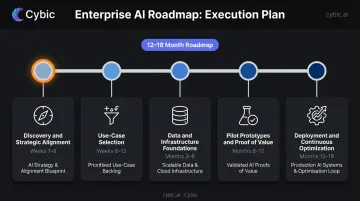
Phase 4: Pilot Prototypes and Proof of Value (Months 6–12)
Rapid prototyping produces working models in 4–8 weeks, injected into real workflows to test accuracy, performance, and user adoption against defined KPIs. Scope discipline is everything: one use case, one workflow segment, with explicit go/no-go criteria set before expansion begins.
Beyond model accuracy, this phase tests the full stack:
- Data pipeline performance under realistic load
- Integration stability with production systems
- Governance controls functioning as designed
- User acceptance and workflow fit
The output is a production readiness assessment that drives the scaling decision going into Phase 5.
Phase 5: Deployment, Scale, and Continuous Optimization (Months 12–18)
Models move from validated pilots into live workflows with monitoring, drift detection, and automated retraining schedules in place. This is where the MLOps foundation built in Phase 3 pays for itself.
Ongoing model management - not one-time deployment - is what makes production AI sustainable:
- Drift detection identifies when model performance degrades relative to baseline
- Automated retraining triggers refresh cycles before degradation affects business outcomes
- Cost observability tracks compute and data costs per model against delivered value
- Model refresh cycles keep outputs aligned with evolving business conditions
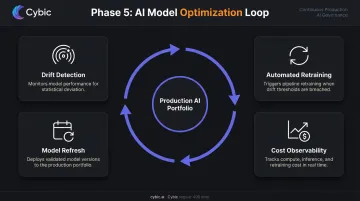
From the initial 2–3 use cases, the organization expands into a multi-use-case AI portfolio governed by the CoE, with a continuous improvement process aligned to changing business priorities.
Common Mistakes That Derail Enterprise AI Roadmaps
The technology-first trap. Most failed roadmaps begin with tools, vendor evaluations, or model experimentation before defining the business problems AI must solve. Without P&L-linked KPIs from the start, the result is a collection of disconnected pilots with no path to measurable ROI.
Over-scoping. 80% of enterprises have 50+ GenAI use cases in the pipeline, but most have only a handful in production, according to ModelOp. Deploying across multiple business units simultaneously inflates timelines, creates integration complexity, and prevents any single initiative from reaching production. Teams that sequence and focus consistently see faster time-to-ROI on their first two or three use cases - and that proof is what unlocks budget for expansion.
The MLOps gap. Organizations invest heavily in model development and almost nothing in post-deployment management. Without monitoring, drift detection, and retraining pipelines, models degrade within months.
In healthcare and financial services, that degradation isn't just a performance problem - it's a compliance exposure that can halt regulated workflows entirely.
Governance as an afterthought. Teams that treat compliance and auditability as a final sign-off before deployment consistently find themselves blocked from deploying in regulated workflows.
Retrofitting governance into a production system typically costs more than the original build. It must be embedded from Phase 1 - as a design constraint, not a review step.
Frequently Asked Questions
What is an enterprise AI roadmap and how is it different from a traditional IT roadmap?
An enterprise AI roadmap ties AI investments to measurable business outcomes, embeds governance, and charts a phased path from pilot to production. A traditional IT roadmap focuses on software upgrades and infrastructure currency - not value creation or business outcome delivery.
How long does it typically take to execute an enterprise AI roadmap?
Most enterprises require 12–18 months to define, validate, and operationalize a full roadmap. Timeline is heavily influenced by data maturity, integration complexity, and the number of use cases selected for early deployment.
What is the most common reason enterprise AI roadmaps fail?
The leading cause is misalignment between business owners and technical teams. Use cases get selected based on technical interest rather than measurable P&L impact, with no defined KPIs or named executive sponsors to hold the program accountable.
How do you prioritize AI use cases when building an enterprise roadmap?
Score use cases across four dimensions: technical feasibility, data readiness, expected business value, and deployment risk. Prioritize those that can realistically reach production within 6–12 months with a clear, quantifiable ROI.
What role does data readiness play in an enterprise AI roadmap?
Data readiness is the most underestimated factor. According to Gartner, 60% of AI projects will be abandoned due to lack of AI-ready data. A data readiness assessment must occur before any model development begins.
How should enterprises approach AI governance in regulated industries?
In healthcare, financial services, and energy, governance must be embedded into the architecture from day one - not retrofitted after deployment. That means building in audit trails, RBAC, model explainability, and bias monitoring aligned with GDPR, HIPAA, and applicable AI regulations from the start.