Introduction
Most enterprises have adopted AI in some form. According to McKinsey's 2025 Global Survey, 78% of organizations now use AI in at least one business function. Yet only 17% attribute 5% or more of enterprise EBIT to generative AI.
The bottleneck is no longer access to AI. It's integration.
The gap between "we have AI tools" and "AI runs our operations" comes down to one thing: whether AI is embedded into the systems, data flows, and workflows that drive actual business outcomes, or sitting alongside them as a disconnected experiment.
This guide covers what enterprise leaders evaluating or implementing AI at scale need to know - what integration actually means, why pilots stall, what production-grade architecture requires, how to build a practical roadmap, and what governance demands at scale.
Key Takeaways
- 78% of enterprises use AI, yet most are still running disconnected pilots with no path to production
- Enterprise AI integration means AI embedded in systems and workflows, not running in parallel to them
- Gartner predicts 30% of gen AI projects will be abandoned after proof of concept by end of 2025
- Root causes include fragmented data, weak governance, and operating models that weren't built for AI
- Governance and security need to be built into the architecture from day one, not added after deployment
What Is Enterprise AI Integration?
Enterprise AI integration is the strategic embedding of AI into core enterprise systems, data flows, and workflows. It's not deploying a model or adding an AI feature to a product. Integrated AI consumes enterprise data, triggers actions, orchestrates processes, and operates within existing infrastructure.
The Pilot vs. Integration Distinction
Consider a churn prediction model that outputs a weekly dashboard. Someone reviews it, maybe acts on it, maybe doesn't. That's a pilot.
Now take the same model embedded directly in a CRM. When it predicts churn above a threshold, it automatically triggers a retention workflow, assigns a customer success rep, logs the interaction, and tracks the outcome against cost and conversion. That's enterprise AI integration.
The model is the same in both cases. What changes is everything built around it - the data connections, the triggered actions, the accountability structures, and the feedback loops that tie outputs to outcomes.
At the enterprise level, AI integration touches:
- Data architecture - how data is aggregated, governed, and made accessible across systems
- Security and access controls - who and what can query or trigger AI models
- Compliance frameworks - how AI behavior is audited and regulated
- Operating models - who owns AI outputs and who is accountable for acting on them
- Financial accountability - how AI-driven decisions connect to measurable business outcomes
Cybic calls this "integrated intelligence": data, automation logic, and AI models combined into a unified operational system. The model is one component. The system is what creates business value.
Why Most AI Pilots Never Scale: The Integration Gap
Gartner predicts at least 30% of generative AI projects will be abandoned after proof of concept by end of 2025 - citing poor data quality, inadequate risk controls, escalating costs, and unclear business value as the primary causes. The model is rarely the problem. What's missing is the enterprise operating environment needed for secure, reliable, production-grade deployment.
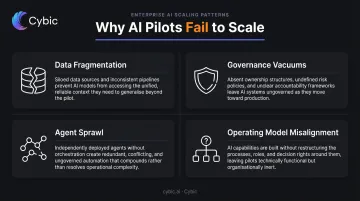
These failures tend to follow four recognizable patterns.
Four Recurring Failure Patterns
Data fragmentation starts undermining AI before the model is even built. In most enterprises, data sits siloed across disconnected systems - marketing in one platform, finance in another, operations in a third. IBM reports that 83% of organizations believe data silos block cross-departmental sharing and undermine innovation. Models trained on partial, inconsistent data produce unreliable outputs.
Cybic's own client data puts 80% of enterprise data as unstructured or siloed - which is why data modernization typically precedes any AI deployment.
Governance vacuums turn small pilots into large liabilities. McKinsey's 2024 survey found only 18% of organizations had an enterprise-wide council with authority over responsible AI. Without standardized security controls, access management, or model performance oversight, scaling the same AI across departments creates inconsistent outputs, accountability gaps, and mounting compliance risk.
Agent sprawl emerges when individual teams deploy disconnected models without architectural standards. Each tool requires separate monitoring, retraining, access management, and integration maintenance - raising total overhead while producing no unified view of AI performance or risk.
Operating model misalignment is the quietest failure. Organizations deploy AI while leaving existing processes unchanged. Without clear ownership over AI outputs, recommendations get ignored - not because they're wrong, but because no one knows who is responsible for acting on them.
The Architecture of Enterprise AI Integration
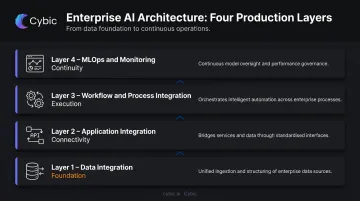
Production-grade enterprise AI is built across four interconnected layers. Each one must be designed before deployment begins - because skipping any layer is where integration projects stall.
Data Integration Layer
This is the foundation. Before any model can work reliably at scale, enterprise data must be aggregated, cleansed, and synchronized. Three patterns apply depending on use case:
| Pattern | Best For |
|---|---|
| Real-time integration | Fraud detection, live personalization, operational alerts |
| Batch integration | Forecasting, financial planning, reporting |
| Hybrid | Environments with both latency-sensitive and high-volume needs |
Gartner warns that 60% of AI projects unsupported by AI-ready data will be abandoned through 2026. Data readiness is a scale gate, not a background task. Cybic builds ETL/ELT pipelines for both real-time and batch processing across AWS, Azure, Google Cloud, Snowflake, and Databricks - treating data architecture as a prerequisite to any model work.
Application Integration Layer
AI delivers value when it connects to the systems employees and customers already use. That means embedding AI outputs into CRM platforms, ERP systems, supply chain tools, contact centers, and case management platforms - not building a new AI interface that requires behavioral change.
Cybic's AI & Data Ecosystem Integration service handles this through custom API development and platform integration - connecting AI platforms, data pipelines, and enterprise applications into the systems teams already operate within.
Workflow and Process Integration Layer
AI should not just inform decisions - it should participate in executing them. This means:
- Triggering actions based on predictions or detected intent
- Guiding employees within existing workflows (not parallel interfaces)
- Escalating exceptions to human teams based on defined thresholds
- Coordinating actions across multiple systems simultaneously
Cybic's Drava platform addresses this layer directly. Drava is Cybic's enterprise Data Intelligence to Automation platform - connecting enterprise data, ML, AI reasoning, and intelligent agents into a governed automation framework with built-in workflow orchestration, security controls, and visibility.
MLOps and Monitoring Layer
Integration is not a one-time activity. Enterprise AI requires:
- Continuous model versioning and lifecycle management
- Drift detection and automated retraining workflows
- Performance monitoring dashboards tied to business outcomes
- CI/CD-based deployment with rollback capability
Google Cloud and Microsoft Azure both define MLOps as applying continuous delivery and automation principles to ML systems. Cybic applies this across every production deployment - automated retraining triggers when drift is detected, versioning runs through CI/CD, and performance dashboards are tied to business metrics rather than model metrics alone.
A Step-by-Step Enterprise AI Integration Roadmap
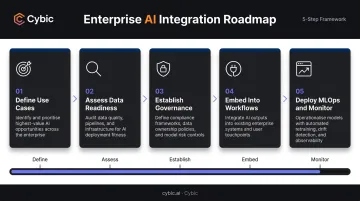
Step 1 - Define Business-Critical Use Cases First
Integration should start with a specific operational problem - not a technology agenda. Before any architecture decisions are made, evaluate candidate use cases against three criteria:
- Feasibility: Is the data available, accessible, and accurate enough?
- Business impact: Does this reduce cost, grow revenue, or mitigate material risk?
- Operational readiness: Is there an owner for the AI output who can act on it?
Cybic's Digital Transformation Strategy practice delivers AI opportunity discovery and prioritization frameworks as the first step in enterprise engagements, specifically to avoid the common failure of building before the business case is validated.
Step 2 - Assess Data Readiness and Architecture Gaps
Before writing a line of integration code, audit the current data landscape:
- Where does data live, and can it be accessed programmatically?
- Is it accurate, consistent, and governed?
- What are the latency and compliance requirements for each use case?
- Which systems need to be connected, and what are the integration dependencies?
Skipping this audit is where most integration failures originate. Cybic's data assessment process covers gap analysis, data quality evaluation, lineage tracking, and roadmap development - all before any model work begins.
Step 3 - Establish Governance, Security, and Access Controls Early
Governance retrofitted after deployment is far more expensive and risky. At the architecture stage, define:
- Role-based access controls (RBAC) - restricting which users and systems can query or trigger AI models
- Encryption - enforced at both the transport layer and storage level
- Auditability - full audit trails covering every AI-driven action and recommendation
- Data lineage requirements - how data flows through the system and who can see what
- Compliance alignment - SOC 2, HIPAA, ISO, GDPR, or sector-specific requirements
Cybic builds these controls at the architectural level - as structural requirements, not optional add-ons. In regulated environments like healthcare and energy, this is the difference between a system that can be deployed and one that stalls in legal review.
Step 4 - Embed AI Into Existing Workflows, Not Alongside Them
AI integration succeeds when outputs appear inside tools employees already use - not in a separate platform that requires a context switch. Connect AI outputs to CRM, ERP, or operational dashboards through APIs and system connectors.
The technical work of building a good model is wasted if the output surfaces in a dashboard nobody opens. Embedding AI directly into existing infrastructure from day one is how Cybic approaches every deployment.
Step 5 - Deploy MLOps Foundations and Monitor From Day One
Treating deployment as the finish line is a common mistake. Build in:
- Model versioning and deployment via CI/CD pipelines
- Automated retraining workflows triggered by drift detection
- Performance monitoring dashboards accessible to business stakeholders
- Business outcome metrics - not just accuracy scores
Define what "performing correctly" means in production before go-live: cycle time, error rate, cost per decision, throughput, conversion impact. Cybic's AI Adoption & Governance Frameworks embed KPI tracking and AI lifecycle management as deployment requirements, not post-launch additions.
Governance, Security, and Compliance by Design
Why Governance Added After Deployment Fails
Without architectural controls, AI systems can access unauthorized data, make unauditable decisions, and drift from their original performance baseline without detection. McKinsey found only 18% of enterprises have governance authority structures in place. The other 82% are scaling AI without the mechanisms to oversee it.
Core Governance Requirements
For production-grade enterprise AI, these controls are non-negotiable:
- Role-based access controls (RBAC) restrict which users and systems can query or trigger AI models
- Encryption covers data in transit and at rest across all pipeline stages
- Full auditability traces every AI-driven action, recommendation, and output
- Proprietary enterprise data is never used to train models - a hard requirement in regulated industries
- Compliance alignment with SOC 2, HIPAA, ISO, and GDPR is built into the architecture, not bolted on later
Cybic embeds these controls at the architectural level from day one. In healthcare and energy environments, a governance gap doesn't produce a compliance ticket - it produces a breach, a regulatory action, or an operational failure.
Compliance by Industry
| Sector | Key Requirement | Architectural Implication |
|---|---|---|
| Healthcare | HIPAA Privacy and Security Rules | PHI/ePHI protection across pipelines, model inputs, logs, APIs, and outputs |
| Financial Services | Federal Reserve SR 11-7 model risk management | Validation, monitoring, approval workflows, explainability |
| Energy / Manufacturing | EU AI Act safety-critical classification | Full audit trails on operational control system integrations |
| Public Sector | EU AI Act, sector-specific data sovereignty | Governance documentation, oversight mechanisms, controlled access |
The NIST AI Risk Management Framework (Govern, Map, Measure, Manage) provides a cross-functional model for assigning risk ownership and defining controls. ISO/IEC 42001 is the management system standard for organizations building or deploying AI at enterprise scale. Together, they give compliance programs a concrete structure - risk ownership mapped to specific controls, not left as a policy document that sits untouched until an audit.
How to Choose the Right Enterprise AI Integration Approach
Choosing how to approach enterprise AI integration - internal build, platform-based, or partner-led - comes down to one question: does this approach have production depth, or does it excel at proof of concept?
Evaluate capability across the full stack:
- Data engineering and pipeline architecture (not just model development)
- Cloud infrastructure across AWS, Azure, and GCP without ecosystem lock-in
- MLOps maturity - model registry, CI/CD, drift detection, rollback, monitoring
- Application integration into existing enterprise platforms
- Security and governance built at the architecture level
Look for infrastructure-agnostic design. Enterprise AI must operate across cloud, hybrid, and on-premises environments. Evaluate support for multi-cloud deployments and integration with existing platforms like Snowflake, Databricks, and SAP.
Red flags to screen out:
- Overemphasis on pilots, demos, and proofs of concept with no production track record
- Vague or deferred answers on governance and compliance controls
- No post-deployment monitoring, versioning, or retraining capability
- One-size-fits-all architectures that ignore enterprise constraints
Signals of genuine execution depth:
- Deployed production systems with measurable business outcomes
- MLOps infrastructure as a standard deliverable, not an optional add-on
- Clear post-deployment support and monitoring commitments
- Compliance alignment demonstrated at the architecture level, not just in a policy document
Applying these criteria narrows the field quickly. Cybic structures every engagement around deploying working systems - data engineering, custom AI/ML development, MLOps, and governance embedded at the architecture level - rather than delivering strategy documents that defer the hard work.
Frequently Asked Questions
How do you integrate AI into an enterprise?
Enterprise AI integration means connecting AI models to existing systems (CRM, ERP, data warehouses) through APIs and data pipelines, then embedding outputs directly into the workflows employees already use. It requires data readiness, security controls, governance, and MLOps foundations from day one - not as afterthoughts.
What is the difference between an AI pilot and enterprise AI integration?
An AI pilot is an isolated test in a controlled environment with manual oversight. Enterprise AI integration embeds AI across business systems with standardized security, governance, and workflow automation - enabling it to scale, operate reliably, and deliver sustained, measurable ROI rather than a one-time demonstration.
What are the biggest challenges in enterprise AI integration?
The top challenges are data fragmentation across disconnected systems, weak governance and security standards, and difficulty scaling beyond pilots into reliable production. A fourth obstacle - often overlooked - is misalignment between AI outputs and decision structures, leaving no clear owner accountable for acting on recommendations.
How long does enterprise AI integration typically take?
McKinsey's 2024 data shows most organizations put gen AI into production in one to four months for standard deployments. Highly customized or multi-system integrations involving governance frameworks, data pipelines, and enterprise automation typically take four to nine months or more.
What enterprise systems does AI typically integrate with?
Common integration targets include CRM platforms (Salesforce, HubSpot), ERP systems (SAP, Oracle), data warehouses (Snowflake, Databricks), cloud platforms (AWS, Azure, GCP), and industry-specific operational systems such as supply chain tools, contact centers, clinical platforms, and energy management systems.
How do you measure ROI from enterprise AI integration?
ROI is measured through business outcomes: automation-driven cost savings, productivity gains (faster cycle times, lower error rates), and revenue impact from better forecast accuracy or conversion rates. These numbers only materialize once AI is embedded in workflows and triggering real operational actions - a separate analytics dashboard won't move the needle.