According to Deloitte's 2025 Smart Manufacturing Survey of 600 manufacturing executives, only 29% had implemented AI or ML at the facility or network level. Meanwhile, 92% believe smart manufacturing will be the primary competitiveness driver over the next three years. That gap between belief and execution is where most organizations are stuck.
The problem isn't access to AI tools. It's sequencing. Manufacturers that succeed treat AI integration as an operational redesign - starting with a specific workflow problem, building data foundations first, piloting in a constrained environment, then scaling with governance embedded. Those that treat it as a technology installation keep restarting from zero.
This guide walks through the exact steps to integrate AI into manufacturing processes, what needs to be in place before you start, the variables that separate successful deployments from stalled pilots, and the most common mistakes to avoid.
Key Takeaways
- Start with a specific, high-friction operational problem - not a broad mandate to "adopt AI"
- Most pilots fail to scale due to fragmented data, poor system integration, and absent governance
- Work through a defined sequence: use case identification, data readiness, live workflow piloting, governance embedding, then scale
- Four variables drive outcomes: data quality, infrastructure compatibility, human oversight design, and governance
- Treat AI integration as a continuous operational capability - one that evolves with your processes and data
How to Integrate AI in Manufacturing Processes: Step-by-Step
Step 1: Identify High-Value Use Cases and Operational Pain Points
AI integration should start with a specific, recurring problem - not a technology category. The most proven starting points in manufacturing are:
- Predictive maintenance - Poor maintenance strategies can reduce asset productive capacity by 5%–20%; AI shifts maintenance from scheduled guesswork to condition-based action
- Quality inspection - Computer vision can achieve defect detection rates approaching 100% in high-volume production environments
- Production scheduling - AI optimizes sequencing and capacity allocation based on real-time demand and constraint data
- Demand forecasting - ML models reduce forecast error by analyzing patterns across more variables than manual methods can track
To rank your candidates, evaluate each use case against three criteria:
- Frequency: Does this problem occur daily, or only quarterly? High-frequency issues generate more training data and faster ROI validation.
- Measurability: Can you track improvement with existing data? No baseline means no proof of ROI - and no organizational buy-in for scaling.
- Data availability: Does sufficient historical operational data already exist? Models trained on thin or inconsistent data underperform, regardless of algorithm quality.
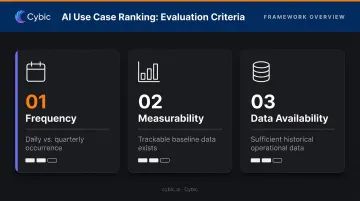
A use case that scores well on all three is your first deployment candidate.
Step 2: Assess Your Data Infrastructure and Readiness
AI models require clean, accessible, and consistently structured data. Before selecting any technology, audit what you currently have.
Map your data sources:
- Sensors and IIoT devices
- ERP systems
- MES (Manufacturing Execution Systems)
- SCADA systems
- Quality management records
Then ask three questions about each source:
- Is the data structured in a consistent format across shifts, lines, and facilities?
- Is there sufficient historical volume to train or validate a model?
- Can that data reach the execution layer where AI decisions need to happen?
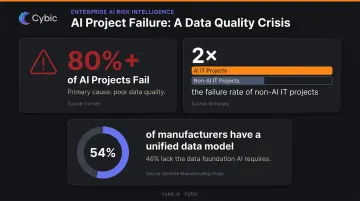
Fragmented or siloed data is the leading cause of manufacturing AI project failure. The Manufacturing Leadership Council's 2024 Data Mastery report found that only 54% of manufacturers had adopted a unified data model - meaning nearly half are running data architectures that will block AI deployment before it starts. If your audit reveals gaps, address them first. Data harmonization is consistently the longest phase of any integration and needs to be planned for, not discovered mid-project.
Step 3: Select AI Technologies and Validate Fit
Match the technology to the use case, not the other way around. The four primary categories relevant to manufacturing:
| AI Category | Best-fit Manufacturing Use Cases |
|---|---|
| Machine learning | Predictive maintenance, demand forecasting, anomaly detection |
| Computer vision | Automated quality inspection, defect classification |
| Generative AI | Troubleshooting assistance, maintenance documentation, operator support |
| AI agents | Workflow automation, production scheduling, cross-system coordination |
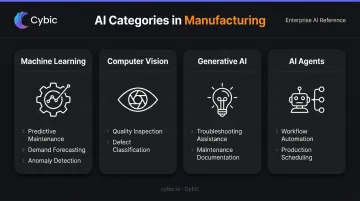
Once you've matched the category to the use case, evaluate integration fit. The critical question: does this solution connect to your existing ERP, MES, and SCADA systems, or does it require replacing them?
Full system replacement is rarely necessary and almost always disruptive. Platforms that operate as an integration and orchestration layer - connecting AI capabilities to existing systems via APIs - significantly reduce deployment risk.
Infrastructure flexibility matters here too. Manufacturing environments often run legacy on-premises SCADA systems that cannot go offline. Solutions designed to operate across cloud, hybrid, or on-premises environments avoid forcing a choice between AI adoption and operational continuity.
Step 4: Run a Constrained Pilot in a Live Environment
A well-scoped pilot has four boundaries:
- Single workflow - not a department, not a line, one workflow
- Defined success metric - reduction in repair time, defect escape rate, manual escalations - something measurable from day one
- Small operator group - enough to generate signal, not so large that change management becomes the project
- Fixed time window - typically 4–8 weeks for a focused use case
The goal is to prove the workflow performs better, not to prove the technology works in theory.
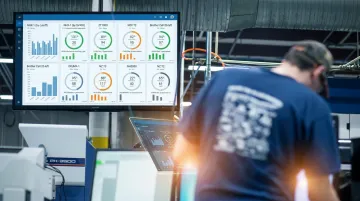
The most important design decision: place AI at the exact point where the decision happens. An alert that surfaces in a separate dashboard is not an embedded workflow - it's a tool operators have to remember to check. Insights must appear inside the steps operators already follow, or they won't translate to action.
McKinsey's research on digital manufacturing found that leading manufacturers spend proportionally more on process and adoption than on technology - roughly $5 on scale and adoption for every $2 on technology itself. That ratio reflects where pilots actually succeed or stall.
Step 5: Embed AI Into Workflows and Design Human Oversight
Scaling from pilot to operations requires a shift: from AI that analyzes to AI that executes within a governed process.
This means embedding AI recommendations, inspection results, and alerts directly into the workflow steps operators already follow. It also means defining clear rules before deployment:
- Auto-execute: Identify which outputs can automatically advance a process step - low-stakes, high-confidence decisions with well-defined conditions.
- Escalate: Define which outputs trigger supervisor review or dual sign-off - especially in regulated processes where traceability is required.
These rules serve two purposes. First, they build operator trust - people adopt AI faster when they understand exactly what it will do on its own versus what it will ask them to decide. Second, they create the audit trail required in regulated manufacturing environments where AI-assisted decisions must be traceable and reviewable.
Building that audit trail after the fact is expensive and often incomplete. Cybic addresses this by embedding role-based access controls (RBAC), encrypted data handling, and full auditability of AI-driven actions at the architectural level - so governance is structural, not an afterthought.
Step 6: Scale Use Case by Use Case and Establish Continuous Improvement
The first successful deployment is your template. Its governance model, integration pattern, and change management approach reduce the risk and time for every subsequent deployment.
Expansion logic:
- Apply the same architectural template to adjacent workflows before moving to new lines or facilities
- Use each deployment to refine the model - new operational data improves accuracy over time
- Assign ownership to process engineers and operations teams, not IT - the people closest to the process are best positioned to spot when models drift or need updating
The World Economic Forum's Global Lighthouse Network reports that leading manufacturers achieve 2–3x ROI over three years and 4–5x over five years from scaled digital manufacturing operations. That compounding return reflects what happens when AI is maintained and expanded continuously - each new deployment built on a proven foundation, not started from scratch.
What You Need Before Integrating AI in Manufacturing
Preparation quality determines integration outcomes. Organizations that skip readiness assessment tend to either fail during pilots or build solutions that cannot scale beyond a single site.
Infrastructure and System Requirements
Minimum technical foundation required:
- Collect operational data consistently - via sensors, IIoT devices, or MES systems that generate reliable machine and process signals
- Establish connectivity from that data to wherever AI will run and decisions need to happen
- Provision compute capacity (cloud, on-prem, or hybrid) sufficient to support model inference at the speed your use case demands
If any of these three are absent, address them before building. An AI model that cannot access live operational data in time to affect a decision has no operational value.
Data Quality and Availability Requirements
AI in manufacturing needs data that is:
- Sufficiently historical - enough volume to train or validate a model for the target use case
- Consistently structured - same formats and labels across shifts, lines, and facilities
- Accessible at the point of action - not locked in a system the AI deployment layer cannot reach
- Complete enough to act on - missing values or irregular sampling intervals degrade model reliability before training even begins
Before committing to a use case, identify which data gaps would block it - data harmonization surprises mid-project are one of the most common reasons AI rollouts stall.
Team Readiness, Change Management, and Governance
The human-side prerequisites matter as much as the technical ones:
- Develop AI literacy across operations teams - enough to interpret outputs, spot anomalies, and avoid over-relying on incorrect recommendations
- Define accountability before deployment - leadership needs to assign ownership of AI-driven decisions before errors happen, not after
- Build governance into the architecture from day one - access controls, auditability of AI actions, and data handling policies are harder to retrofit than to design in
For manufacturers in regulated industries, these requirements carry real compliance weight. Cybic structures governance controls - RBAC, audit trails, and data handling policies - directly into the system architecture rather than adding them as post-deployment layers, which reduces the compliance burden on the manufacturer's own team.
Key Variables That Determine AI Integration Success
Even with the right steps in place, outcomes vary. These four variables account for most of the difference between pilots that scale and those that stall.
Data Quality and Consistency
Inconsistent sensor readings, incomplete maintenance logs, or mislabeled defect images produce unreliable model outputs. Unreliable outputs erode operator trust fast. Once operators stop trusting the system, adoption collapses.
The World Manufacturing Foundation states directly: flawed data can create a false sense of security and produce disastrous operational results. RAND's 2024 analysis found that by some estimates more than 80% of AI projects fail - roughly twice the failure rate of non-AI IT projects - with poor data cited as a primary root cause.
Infrastructure Compatibility
AI deployed on infrastructure that doesn't connect to existing ERP, SCADA, or MES systems creates isolated insights that never reach the people or processes that need them. That architectural gap is why most pilots stall at the facility level rather than scaling across sites.
Infrastructure-agnostic deployment (capable of running across cloud, hybrid, or on-premises environments) determines whether AI can expand across lines and facilities or remains a single-site experiment.
Human Oversight Design
Manufacturers that deploy AI without clear human approval protocols see lower adoption, higher error rates, and meaningful compliance exposure. Early definition of what AI can auto-execute versus what requires confirmation correlates directly with frontline adoption rates and audit readiness.
In regulated environments, AI decisions that lack traceable human oversight can fail compliance reviews and block regulatory approval of AI-assisted processes.
Governance and Compliance Integration
Governance is no longer optional. The EU AI Act (Regulation EU 2024/1689) classifies AI used as a safety component in covered machinery as high-risk, with general requirements applying from August 2026. FDA's Computer Software Assurance guidance covers software used in medical device production and quality systems.
Embedding governance from day one avoids costly compliance retrofits and accelerates regulatory review. That means building in:
- Access controls and role-based permissions
- Encrypted data handling in transit and at rest
- Traceable, auditable records of AI-driven actions
Common Mistakes When Integrating AI in Manufacturing
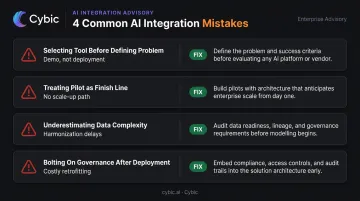
Most AI integration failures come down to the same four patterns:
- Selecting a tool before defining the problem. Evaluating AI in isolation - before connecting it to a real operational pain point - almost always produces a demo, not a deployment. The project stalls before it reaches production.
- Treating the pilot as the finish line. Declaring a proof-of-concept successful without a defined scale-up path is just an expensive experiment. The actual value lives in production, not the pilot environment.
- Underestimating data complexity. Manufacturers consistently discover how fragmented their operational data is only after they try to connect it to an AI system. Data harmonization across ERP, MES, and sensor systems is frequently the longest phase of any integration - plan for it from the start.
- Bolting on governance after deployment. Adding security controls, access management, auditability, and compliance documentation after a system is live is more expensive and disruptive than building them in from the start. For regulated manufacturers, retrofitting governance can mean taking systems offline entirely.
Conclusion
AI integration in manufacturing delivers real operational value - reduced downtime, better quality control, faster decisions, stronger supply chain resilience. That value only materializes when implementation follows a disciplined sequence:
- Use case first: Identify the highest-impact, data-rich problem before selecting any technology
- Data readiness second: Confirm clean, accessible, labeled data exists to support the model
- Pilot in real workflows: Test under actual operating conditions, not isolated lab settings
- Governed scaling: Expand only with monitoring, access controls, and audit trails in place
The most common failure point is not the AI technology itself. It's the gap between a successful pilot and production deployment. Closing that gap requires treating AI integration as an operational redesign, not a technology installation.
Manufacturers that treat AI as an ongoing operational capability - with governance embedded, infrastructure-agnostic architecture, and models that improve as production data accumulates - compound their advantage with each deployment cycle. The ones that treat it as a one-time project find themselves rebuilding from scratch each time priorities shift.
Frequently Asked Questions
How do you incorporate AI in manufacturing?
Start by identifying a specific, high-friction operational problem - unplanned downtime, defect escape rates, manual scheduling overhead. Assess whether you have sufficient data for that use case, then select an AI capability that embeds into the existing workflow rather than adding a separate tool operators have to remember to check.
What are the biggest barriers to AI integration in manufacturing?
The four most cited barriers are poor or fragmented data quality, lack of integration between AI tools and frontline systems (ERP, MES, SCADA), absent governance frameworks, and organizational resistance to change. Each is significantly harder to fix after deployment than before it.
How long does it take to integrate AI into manufacturing operations?
A constrained pilot on a single workflow can show results in days to weeks when scope is tightly defined (McKinsey research on generative AI pilots supports this). Scaling across multiple lines and sites typically takes 6–18 months, depending on data readiness, infrastructure complexity, and governance requirements.
What AI technologies are most commonly used in manufacturing?
The primary categories are machine learning for predictive maintenance and demand forecasting, computer vision for automated quality inspection, generative AI for troubleshooting assistance and documentation, and AI agents for workflow automation and production scheduling.
How do you measure ROI from AI integration in manufacturing?
Define ROI in operational terms from day one: reduction in unplanned downtime, defect escape rate, repair cycle time, manual escalations, or throughput improvement. Projects anchored to specific baselines before launch sustain budget support far better than those that try to quantify value retroactively.
Do manufacturers need to replace existing systems to integrate AI?
No. AI can be layered onto existing ERP, MES, SCADA, and quality systems via standard APIs. The AI platform acts as an execution and orchestration layer - connecting enterprise data to frontline decisions without replacing the core systems of record that manufacturing operations depend on.