Introduction
Manufacturing operations are drowning in data. Sensors, ERP systems, MES platforms, and supply chain feeds generate more information every hour than most teams can process in a week-and the majority of it goes unanalyzed until something breaks.
That's the core problem AI agents solve. Where traditional automation executes fixed scripts, AI agents perceive operational data, reason over it, and act - continuously, across multiple systems simultaneously - without waiting for human intervention at every step.
The market reflects this shift. According to MarketsandMarkets, the global AI in manufacturing market was valued at $23.40 billion in 2024 and is projected to reach $155.04 billion by 2030-a 35.3% CAGR. Manufacturers aren't experimenting anymore. They're deploying.
This guide covers:
- What AI agents actually are in a manufacturing context
- The five highest-impact use cases
- How they work technically
- What governance and data infrastructure they require
- How to build a practical implementation roadmap
Key Takeaways
- AI agents learn from data and adapt to changing conditions-unlike traditional automation, which only executes fixed rules
- Predictive maintenance, quality inspection, and supply chain optimization deliver the clearest early ROI
- Agents require certified data products, not raw sensor feeds, to produce trustworthy outputs
- Over 80% of AI projects fail-most because data and governance foundations are skipped
- Start with Tier 1 monitoring agents and a solid data foundation before advancing to higher-autonomy tiers
What Are AI Agents in Manufacturing?
AI agents in manufacturing are autonomous software systems that perceive operational data, reason over it, and take action-without requiring constant human direction at each step.
That's a meaningful distinction from traditional automation. A rule-based system executes the same script every time: if vibration exceeds threshold X, trigger alert Y. It works well for predictable, repeatable conditions.
The moment conditions shift outside those programmed boundaries, it either fails silently or generates false positives until someone manually reconfigures it.
AI agents operate differently:
- They learn from data patterns, not just rules-detecting anomalies that don't fit a predefined threshold
- They adapt to new conditions without requiring manual reprogramming
- They coordinate across systems simultaneously-connecting equipment sensor data with maintenance scheduling, parts inventory, and shift planning in a single decision loop
- They improve over time as they accumulate operational history specific to your environment
The practical effect is that an AI agent can detect a bearing failure pattern developing over weeks, cross-reference parts availability, check technician schedules, and propose a maintenance window-all before the equipment fails. A rule-based system alerts when the bearing is already failing.
This capability gap is driving adoption. Manufacturers who have deployed AI agents report measurable reductions in unplanned downtime-often in the 20–30% range-within the first year of production use. The data infrastructure required to support these systems is now widely available, and the engineering patterns for deployment are well-established.
Top Use Cases for Manufacturing AI Agents
AI agents are already running in production across manufacturing functions. Here are the five areas delivering the most measurable operational impact.
Predictive Maintenance
Predictive maintenance agents continuously monitor equipment sensor data-vibration, temperature, pressure, current draw-to detect anomaly patterns that precede failures. The goal is scheduled intervention before a breakdown, not emergency response after one.
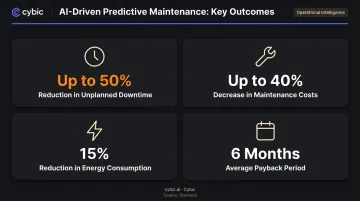
Siemens reports that AI-driven predictive maintenance delivers:
- Up to 50% reduction in unplanned downtime
- Up to 40% decrease in maintenance costs
- 15% reduction in energy consumption
- Payback within 6 months in documented deployments
The BlueScope Steel case is instructive. Using Siemens Senseye Predictive Maintenance, BlueScope prevented 1,950 hours of downtime and avoided 53 process stops globally-including 1,200 unplanned downtime hours in Australia alone. Those are production-environment results, not controlled pilot outcomes.
Predictive maintenance is typically the recommended starting point for manufacturers new to AI agents because sensor data is usually already being collected, the ROI calculation is straightforward, and the failure modes are well understood.
Quality Control and Inspection
Vision-based AI agents inspect 100% of products at production speed, detecting surface defects, dimensional errors, and assembly issues at accuracy rates that exceed manual inspection. They also correlate defect patterns back to upstream process variables-identifying root causes, not just symptoms.
BMW Group's production deployment illustrates what's achievable. After training and adjustment, BMW reports AI inspection reliability reaching 100% at facilities including Dingolfing and Steyr. At Plant Regensburg, BMW's GenAI4Q system now supports quality recommendations for approximately 1,400 vehicles manufactured each day.
For high-volume manufacturers, the inspection speed advantage alone justifies deployment. AI-based systems cover every unit; manual inspection, by contrast, can only ever work from samples.
Supply Chain and Inventory Optimization
Supply chain AI agents analyze demand signals, inventory positions, supplier performance data, and logistics feeds simultaneously-handling a complexity level that manual processes cannot manage at scale.
McKinsey research indicates AI-driven supply chain management can:
- Reduce inventory levels by 20–30% through improved demand forecasting
- Reduce logistics costs by 5–20%
- Reduce procurement spend by 5–15%
The more immediate value is responsiveness. When a supplier misses a shipment or a demand signal shifts unexpectedly, a supply chain agent can reroute and replan in minutes rather than waiting for a planner to manually recalculate across spreadsheets.
Cybic's multi-agent architecture supports this directly-multiple agents collaborating to handle dynamic supply chain management and multi-location logistics optimization as interconnected problems rather than isolated tasks.
Production Scheduling and Planning
Production planning agents balance in real time order priorities, machine availability, material readiness, and workforce capacity to generate optimized schedules. The critical capability is real-time adjustment.
When a machine goes down mid-shift or a priority customer order changes, a planning agent recalculates the full schedule immediately-factoring in all constraints simultaneously. A human planner working from a spreadsheet might take hours to reach the same output, by which time conditions have changed again.
This closes the loop between what's planned and what's actually happening on the floor.
Energy Management and Sustainability
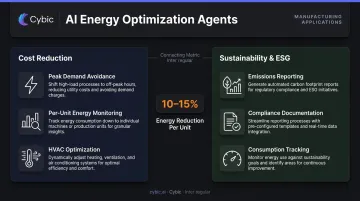
Energy optimization agents monitor per-unit energy consumption across production lines, adjust HVAC and equipment settings based on real-time workload, and coordinate energy-intensive processes to avoid peak demand charges.
The dual benefit-cost reduction and sustainability reporting-makes this use case increasingly attractive as manufacturers face both energy cost pressure and ESG reporting requirements. An agent that reduces energy consumption per unit by even 10–15% compounds significantly across full production volumes.
How Manufacturing AI Agents Work
The Operational Loop
A manufacturing AI agent runs a continuous operational cycle:
- Ingest - Pull data from IoT sensors, MES, ERP, QMS, and historian systems
- Analyze - Apply machine learning models to detect patterns, anomalies, and deviations
- Decide - Generate an alert, recommendation, or autonomous action depending on the tier of autonomy
- Log - Record the action with full reasoning for auditability
The logging step is what makes agent behavior auditable - and auditability is what builds operator trust over time.
The Three Tiers of Agent Autonomy
Not all manufacturing AI agents operate at the same level of autonomy. The appropriate tier depends on the use case, data maturity, and governance infrastructure in place.
| Tier | Function | Autonomy Level | Governance Required |
|---|---|---|---|
| Tier 1 | Monitoring and alerting | Low | Basic access controls, data logging |
| Tier 2 | Analysis and recommendation | Medium | Explainable reasoning, decision traceability |
| Tier 3 | Scheduling and action | High | Full decision traces, human-in-the-loop checkpoints |
Each tier demands correspondingly deeper governance infrastructure. Organizations that skip Tier 1 and attempt to deploy Tier 3 agents on raw, unvalidated data tend to generate the failure statistics cited later in this guide.
The OT/IT Integration Reality
That governance depth is only achievable when the underlying data is reliable - which is where most implementations run into trouble. Manufacturing AI agents must connect across fragmented OT/IT environments built at different times, with different data definitions and no shared semantic layer.
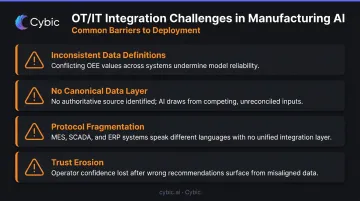
Common integration challenges include:
- Inconsistent data definitions - "OEE for Line 3" may return three different values from three different systems
- No canonical data layer - without one, the agent cannot determine which source is authoritative
- Protocol fragmentation - MES, SCADA historians, ERP, QMS, PLM, and IoT platforms rarely speak the same language natively
- Trust erosion - a confidently wrong recommendation can take months to recover from with operators
Getting this layer right before deploying agents isn't a preliminary step. It's what determines whether the agent produces reliable decisions or expensive noise.
Benefits and ROI: What Manufacturers Are Achieving
Documented Outcomes
Across use cases, manufacturers running AI agents report meaningful operational improvements:
- 10–20% improvement in production output and 7–20% improvement in employee productivity, per Deloitte's 2025 Smart Manufacturing Survey of 600 executives
- Up to 50% reduction in unplanned downtime and up to 40% decrease in maintenance costs from AI-driven predictive maintenance (Siemens)
- 20–30% inventory reduction from AI-enabled supply chain optimization (McKinsey)
The ROI Reality Check
These outcomes are real - but they don't happen automatically. RAND Corporation research found that by some estimates more than 80% of AI projects fail - roughly twice the failure rate of conventional IT projects. Gartner predicts over 40% of agentic AI projects will be canceled by end of 2027 due to escalating costs, unclear business value, or inadequate risk controls.
The failure pattern is consistent: deployments are treated as technology projects rather than business transformation initiatives, and data quality and governance prerequisites are skipped in the rush to deploy models.
The outcomes above are achievable. What separates them from failed deployments is almost always the foundation built before the first model goes live.
The Indirect Value That Compounds
Direct savings are measurable within months. But the value that often exceeds them over a 2–3 year horizon includes:
- Faster decision cycles across operations, procurement, and quality
- Knowledge capture from experienced workers before they retire-encoding expertise into agent behavior
- Improved regulatory compliance posture through systematic audit trails
- Demand volatility response at a speed and precision manual processes can't replicate
The Governance and Data Foundation AI Agents Actually Need
Why Manufacturing Data Is Uniquely Difficult
Production data is fragmented across systems built at different times with different definitions. OEE might be calculated differently in the MES, ERP, and historian-each defensible by its own logic but producing different numbers. An AI agent querying this raw, unvalidated data will produce inconsistent outputs operators cannot trust.
One wrong confident-sounding recommendation breaks operator trust in ways that persist long after the error is corrected. This isn't a technology problem-it's a data architecture problem that must be solved before agents are deployed.
Certified Data Products
In a manufacturing context, a certified data product is a pre-computed, owner-assigned, versioned view of a key metric-OEE, scrap rate, MTBF, MTTR, energy per unit-with:
- Defined freshness SLAs (how current the data is guaranteed to be)
- Full lineage from raw source to the value the agent queries
- Clear ownership so discrepancies have a responsible party
- Version control so changes to calculation logic are tracked
AI agents must query certified data products, not raw sensor streams. Without this layer, agents surface numbers operators can't verify-and stop using the system.
Decision Trace Requirements for Regulated Manufacturing
In pharma (FDA 21 CFR Part 11), aerospace (AS9100), and automotive (IATF 16949) environments, every AI-driven process change must generate a documented record of:
- What signal triggered the action
- What policy version authorized it
- Who approved it (where human approval is required)
These are compliance artifacts, not optional logs. Under IATF 16949 Clause 8.5.6.1.1, temporary changes to process controls must be documented and retained as quality records. FDA Part 11 requires validated audit trails for electronic records affecting product quality. These requirements don't bend because the decision was made by an AI.
Governance-Embedded Architecture in Practice
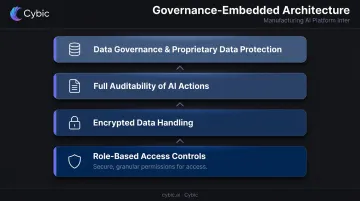
Meeting these compliance requirements demands that governance is wired into the architecture from the start, not added on after deployment. Cybic builds these controls in at the structural level, which in practice means:
- Role-based access controls defining which agents can query which systems and recommend which actions
- Encrypted data handling in transit and at rest
- Full auditability of every AI-driven action and recommendation
- Strict data governance ensuring proprietary production data is never used to train third-party models
The human-in-the-loop requirement also demands direct attention. High-autonomy agents executing process parameter changes, line shutdowns, or supplier escalations above defined thresholds should require human approval before execution.
Any platform claiming to "fully automate" these decisions without oversight in regulated environments should be scrutinized carefully. Requiring human sign-off isn't a product limitation-it's what the regulations actually mandate.
How to Get Started with AI Agents in Manufacturing
Step 1: Start with Use Cases, Not Technology
Identify the 2–3 operational problems that cause the most business pain, have available data, and have a clear way to measure success.
Predictive maintenance is the recommended starting point for most manufacturers:
- Sensor data is usually already being collected
- The ROI calculation is straightforward (avoided downtime cost vs. implementation cost)
- Failure modes are well understood
- Success builds operator confidence for subsequent deployments
Step 2: Conduct a Data Readiness Assessment
Before building anything, determine:
- Does the data needed for the target use case exist?
- Is it accurate and consistently defined across systems?
- Can it be accessed programmatically?
If the answer to any of these is no, invest in data infrastructure first. AI agents built on poor data will fail regardless of model sophistication. Skipping this step is the most common reason manufacturing AI projects fail to deliver.
Cybic structures manufacturing engagements around a data assessment and audit phase before any agent architecture is finalized, evaluating data landscape quality, sources, and gaps against the target use case.
Step 3: Follow the Phased Deployment Sequence
Match your deployment phase to the appropriate tier of agent autonomy:
- Deploy Tier 1 monitoring and alerting agents first - Establish operator trust, validate data quality, build the certified data foundation
- Move to Tier 2 analysis and recommendation agents - Once data products are stable and lineage is traceable, add agents that recommend actions with explainable reasoning
- Progress to Tier 3 scheduling and action agents - Only with the full governance infrastructure in place, human-in-the-loop checkpoints defined, and decision trace architecture operational
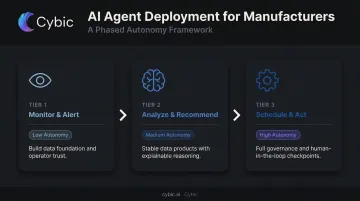
Cybic's manufacturing AI engagements follow this sequence precisely - governance and integration architecture come first, so agents function in real operational environments with existing systems from initial deployment.
Step 4: Set Realistic Timeline and Cost Expectations
Getting the deployment sequence right shapes your cost and timeline picture. Most implementations underestimate effort in three areas:
- Data preparation: Often represents 60–80% of total implementation work.
- System integration: Legacy OT/IT infrastructure rarely has clean APIs. Budget accordingly.
- Organizational change management: Operators need to trust the agents, understand their reasoning, and know when to override them.
Plan for 12–18 months to realize full operational value, with a phased milestone structure that demonstrates ROI at each stage to maintain organizational support. Focused use cases like predictive maintenance can show measurable returns within 6–12 months-use these early wins to fund and justify the broader program.
Frequently Asked Questions
How are AI agents different from traditional factory automation?
Traditional automation follows fixed, pre-programmed rules and requires manual reconfiguration when conditions change. AI agents learn from operational data, adapt to new conditions autonomously, and coordinate decisions across multiple systems simultaneously. They detect anomalies outside predefined thresholds and improve as operational history accumulates.
What manufacturing processes benefit most from AI agents?
Predictive maintenance, quality inspection, production scheduling, and supply chain optimization deliver the highest and most measurable impact. The best starting point depends on where sensor data is already available, where operational pain is greatest, and where success can be clearly measured.
What data infrastructure is needed before deploying manufacturing AI agents?
Agents require clean, consistently defined data with clear ownership and lineage. Certified data products for key metrics like OEE and scrap rate are the standard - not raw feeds from disconnected OT/IT systems. Deploying agents before this foundation exists is the most common cause of failed implementations.
Can AI agents integrate with existing ERP and MES systems?
Modern AI deployments are designed to work alongside existing ERP and MES infrastructure, not replace it. The integration layer requires careful engineering to maintain data consistency - and that work typically represents the bulk of implementation effort.
How do manufacturers ensure AI agent decisions are auditable and compliant?
Compliance requires decision traces - complete records linking each agent action to the data signal, policy version, and human approval that authorized it. In regulated environments like pharma, aerospace, and automotive, these are formal compliance artifacts governed by FDA 21 CFR Part 11, AS9100, and IATF 16949, and must be built into the architecture from day one.
How long does it typically take to see ROI from manufacturing AI agents?
Focused use cases like predictive maintenance can show measurable ROI within 6–12 months. Full operational benefits from a multi-use-case deployment typically take 12–18 months as agents learn specific operational patterns and become embedded in daily workflows across the organization.