Introduction
Most manufacturers today aren't short on data. Sensors stream readings from every machine, MES platforms log every production event, and ERP systems track every order and inventory movement. The problem isn't data volume - it's the gap between data and action.
A vibration sensor detects early bearing wear. An operator reviews the alert two hours later, checks the maintenance schedule, and decides to defer. By the time a technician arrives, the bearing has degraded and the line has lost four hours of production. The data was right. The timing wasn't.
This is the gap traditional automation can't close. Rule-based systems execute pre-programmed responses. Conventional AI flags anomalies for human review. Neither perceives context, weighs competing priorities, nor acts without a human in the loop. Agentic AI changes all of that - it reasons about the situation and initiates a response before the window closes.
What follows is a practical look at what makes agentic AI different, where it's already producing results on the factory floor, what implementation actually requires, and how manufacturers can begin building toward it.
Key Takeaways
- Agentic AI goes beyond alerts and rules - it perceives conditions, reasons through them, takes action, and learns from outcomes without waiting for human intervention.
- High-impact manufacturing applications include predictive maintenance, quality management, dynamic scheduling, and supply chain coordination.
- Proven outcomes include 66% defect reduction (Beko), 50%+ downtime reduction (Jubilant Ingrevia), and 45% fewer unplanned stoppages from AI-enabled maintenance.
- Implementation requires solid data infrastructure, clear governance boundaries, and a phased start with 2–3 high-value use cases.
- Security controls and auditability must be embedded in the architecture before autonomous agents touch live production workflows.
What Sets Agentic AI Apart from Traditional Manufacturing Automation
Three Tiers of Automation Intelligence
Most manufacturers are familiar with the first two tiers:
- Traditional automation - rule-based, deterministic. If temperature exceeds threshold X, trigger alarm Y. It executes what it's been told, nothing more.
- Conventional AI - analyzes data and surfaces recommendations, but stops short of acting. A human still has to read the insight and decide what to do.
- Agentic AI - perceives inputs from sensors, databases, and connected systems; reasons through multi-step problems against defined goals; takes autonomous action; and refines future decisions through feedback loops.
The difference isn't incremental. An alert tells a human there's a problem. An agentic system evaluates that problem, cross-references the production schedule and parts inventory, assigns a technician, and redistributes workload. All of that happens before the alert would have reached a supervisor's inbox.
The Perceive–Reason–Act–Learn Cycle
AWS Prescriptive Guidance defines the agentic operating model as Perceive, Reason, Act - extended to include a Learn loop in more advanced implementations:
- Perceive - Ingests real-time data from IIoT sensors, MES, ERP, and connected systems
- Reason - ML models and LLMs analyze conditions and determine the best response against defined goals
- Act - Executes changes autonomously: adjusting parameters, triggering orders, rescheduling jobs
- Learn - Feedback loops refine future decisions based on outcomes
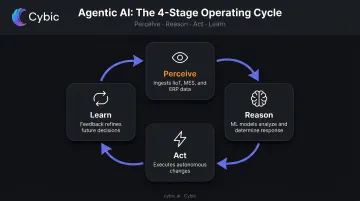
This cycle runs continuously - not on a shift-change schedule, not when someone checks a dashboard.
Single-Agent vs. Multi-Agent Architecture
A single agent handles a contained, well-defined task effectively. But manufacturing environments rarely involve contained problems. A bearing fault affects the production schedule, which affects procurement, which affects delivery commitments.
Gartner predicts that 33% of enterprise software applications will include agentic AI by 2028, up from less than 1% in 2024. By 2027, one-third of those implementations will combine agents with different specializations. That reflects a reality manufacturers are already encountering: complex, cross-functional problems require coordinated agent networks.
In practice, a multi-agent architecture might include:
- A maintenance agent monitoring equipment health and triggering service workflows
- A scheduling agent continuously reoptimizing production sequences
- A procurement agent managing inventory levels and supplier signals
All three share context and coordinate toward unified operational goals. No human is needed to sit in the middle translating between systems.
For workforce roles, the shift is substantive. Employees move from executing repetitive decisions to supervising parameters, reviewing exceptions, and directing agent behavior where judgment matters most.
Key Use Cases: Where Agentic AI Transforms Manufacturing Operations
Agentic AI delivers the most value where processes span multiple systems, require rapid adaptive decisions, and involve coordinating actions across production, maintenance, and supply chain simultaneously. These four areas are where manufacturers are already seeing measurable results.
Predictive Maintenance Orchestration
Traditional predictive maintenance stops at the alert. Agentic maintenance systems take it from there.
When sensor data indicates a developing thermal anomaly or vibration pattern consistent with bearing wear, the agent doesn't stop at flagging it. It evaluates the fault's urgency against the production schedule, checks parts availability, assigns a technician, and temporarily redistributes workload to other machines - all before human review.
The business case is documented. According to PwC, AI-enabled predictive maintenance can reduce maintenance costs by up to 30% and unplanned downtime by 45%. The World Economic Forum reports Jubilant Ingrevia reduced process variability by 63% and equipment downtime by more than 50% using AI and ML-driven process monitoring.
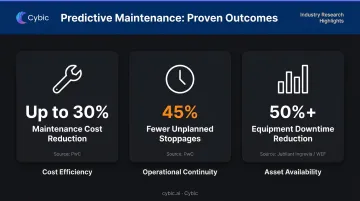
When downtime is prevented, the downstream cascade - delayed schedules, material shortages, missed delivery commitments - never materializes.
Autonomous Quality Management
Quality issues discovered at end-of-line are expensive. Agentic quality systems push that discovery point upstream.
Computer vision identifies defects at the point of production. The system traces them to root causes - material batch inconsistency, machine drift, temperature deviation - and adjusts process parameters automatically, without waiting for a quality manager to review and authorize the change.
The WEF case from Beko is instructive: a smart ML control system that adjusts sheet-metal forming parameters in real time to prevent defects achieved 66% reduction in defect rates and 12.5% material cost savings. Midea's washing machine plants saw a 53% reduction in poor quality through AI and digital process controls.
Closed-loop quality management also improves over time. Each corrective action becomes training data, so the system gets progressively better at catching drift before it produces defects rather than after.
Dynamic Production Scheduling
Static production schedules break the moment reality diverges from the plan. A component arrives late. A machine goes down unexpectedly. Demand spikes overnight.
Agentic scheduling systems don't treat these as exceptions requiring manual intervention - they treat them as inputs for continuous recalculation. The system monitors incoming orders, machine availability, labor status, and material flow in real time, adjusting job sequences as conditions change.
When a delayed component shipment threatens to idle an assembly line, the system automatically resequences jobs to prioritize builds that don't require the missing part, rebalances workloads across stations, and maintains line utilization. What would take a planner several hours to work through manually resolves in seconds.
Supply Chain and Inventory Coordination
Supply chain decisions are only as good as the information behind them, and that information changes constantly. Agentic supply chain systems monitor supplier signals, update demand forecasts, adjust order quantities, and identify alternative sources when disruptions emerge.
Procurement teams no longer need to manually track every input. The system surfaces what matters and acts on what it can resolve directly.
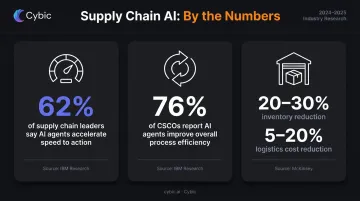
IBM's research found that 62% of supply chain leaders say AI agents embedded in operational workflows accelerate speed to action, and 76% of CSCOs say AI agents performing repetitive tasks faster than humans improve overall process efficiency.
McKinsey data on AI in distribution operations points to inventory reductions of 20–30% and logistics cost reductions of 5–20% - figures that become achievable when procurement and production decisions are synchronized with live supply chain conditions rather than last week's plan.
The Business Benefits of Agentic AI in Manufacturing
The benefits cluster across five areas:
Operational efficiency and cost reduction Agentic systems continuously evaluate trade-offs across energy, labor, materials, and machine usage, acting on inefficiencies in real time rather than waiting for a monthly review. Deloitte's 2025 smart manufacturing survey reports smart manufacturing investments have delivered 20% improvement in production output and unlocked 10–15% additional production capacity.
Supply chain resilience Real-time decision-making means manufacturers respond to disruptions in minutes, not hours. When supply chains remain volatile and lead-time expectations keep shortening, absorbing disruptions without manual coordination becomes a concrete operational edge.
Quality at scale Always-on monitoring and automated correction catches defects earlier than periodic inspection cycles. Results from manufacturers like Beko and Midea - who achieved measurable defect reductions through closed-loop quality control - reflect what's possible when the feedback loop runs continuously rather than on a scheduled check.
Faster product development Agentic AI can automate complex engineering tasks: coordinating simulations, generating design alternatives, and running performance tests through digital twins. AstraZeneca's use of AI-powered process digital twins compressed manufacturing lead times from weeks to hours. McKinsey reports 75% of large enterprises are investing in digital twins to scale AI-driven engineering.
Reduced variability in operational decisions High-frequency, data-heavy decisions made by AI systems are more consistent than those made by operators working across shifts with different experience levels, varying information, and fatigue. That consistency matters operationally. In regulated industries where decision audit trails are required, it matters for compliance too.
Implementation Challenges and How to Address Them
Gartner warns that more than 40% of agentic AI projects will be canceled by end-2027 due to escalating costs, unclear business value, or inadequate risk controls. These aren't abstract risks - they're predictable failure modes with known mitigations.
Data infrastructure and legacy integration
Agentic AI depends on high-quality, real-time data. Many manufacturers operate with fragmented systems that were never designed to share data across functions.
The practical path forward isn't replacing everything at once. Prioritize integration of the highest-value data sources first, use APIs and middleware to bridge legacy infrastructure with modern AI platforms, and treat legacy systems as sources of operational intelligence that need to be made legible to AI agents.
Governance, accountability, and human oversight
Autonomous systems acting across production workflows create accountability gaps that need architectural answers, not just policy updates. CISA's guidance on AI in operational technology is clear: governance must be embedded from the start, not layered on afterward.
That means building in:
- Clear decision boundaries defining what the AI handles independently versus what requires human approval
- Human-in-the-loop controls for high-stakes or irreversible actions
- Audit trails capturing every AI-driven action for review and compliance
Skills gaps and change management
Deloitte's 2025 survey found 48% of manufacturers report moderate to significant challenges filling production and operations management roles, and 46% struggle to fill planning and scheduling positions. Agentic AI changes role requirements rather than eliminating them - operators become system supervisors, subject matter experts become AI collaborators, and new roles like AI stewards and prompt engineers emerge. Clear communication about how roles are changing, paired with targeted reskilling, is what separates successful transitions from resistant ones.
Building a Foundation for Agentic AI in Your Manufacturing Operations
Infrastructure Prerequisites
Before any agent ecosystem can function, the data layer must be in place:
- IIoT sensors generating real-time machine and process data across the production environment
- MES integration capable of feeding and receiving data from AI systems (not just logging events)
- Edge computing and connectivity to support low-latency decisions at the plant level
- A unified data layer that aggregates signals across production, maintenance, and supply chain into a coherent operating picture
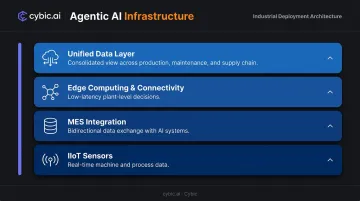
Without this foundation, agents have nothing reliable to perceive. Data quality issues are the single most common reason early pilots underperform.
A Phased Deployment Approach
Start with 2–3 high-impact, high-feasibility use cases rather than attempting broad transformation at once. The right use cases score well on both dimensions: high coordination complexity and real-time responsiveness requirements (relevance), and meaningful efficiency gains, cost savings, or quality improvements (business value).
Pilot carefully, measure outcomes against baselines, and use early wins to build organizational confidence and refine data infrastructure before scaling. Manufacturers who scale successfully don't start with the most ambitious use case. They start with the most well-defined one and build from there.
The Role of Purpose-Built Platforms
Ad hoc AI integrations assembled from disconnected tools create the governance and accountability gaps that get agentic projects canceled. Manufacturers building for production-grade deployment need a platform where governance, security, and auditability are embedded by design, not patched in after the fact.
Cybic's Drava platform is built for exactly this. It's an enterprise Data Intelligence to Automation platform that connects operational data, machine learning, AI reasoning, and intelligent agents into a unified system. Role-based access controls, encrypted data protection, and complete auditability of every AI-driven action are embedded at the architectural level.
For manufacturers with mixed legacy and modern systems, Drava's infrastructure-agnostic architecture supports deployment across cloud, hybrid, or on-premises environments without ecosystem lock-in. Existing infrastructure doesn't need to be replaced. It needs to be connected - a meaningful difference for manufacturers balancing long asset lifecycles with modern digital investments.
Frequently Asked Questions
Frequently Asked Questions
What is the difference between agentic AI and traditional automation in manufacturing?
Traditional automation follows fixed, pre-programmed rules and stalls when conditions fall outside its defined parameters. Agentic AI perceives real-time conditions, reasons through multi-step problems, takes autonomous action, and learns from outcomes - responding to disruptions and novel situations that rule-based systems cannot handle.
Can agentic AI integrate with existing legacy manufacturing systems?
Yes. Agentic AI can be deployed in environments with legacy infrastructure using APIs, middleware, and data integration layers. The key is prioritizing high-value data connections rather than requiring full system replacement. Platforms designed to be infrastructure-agnostic from the outset , like Cybic's Drava, make this process far more straightforward.
What are the biggest risks of deploying agentic AI on the factory floor?
The primary risks are data quality issues that corrupt agent decisions, cybersecurity vulnerabilities from multi-platform interactions, and accountability gaps when autonomous systems take consequential actions. All three are manageable when governance and security are built into the AI architecture from day one.
How does agentic AI handle situations that require human judgment?
Well-designed agentic systems include human-in-the-loop controls that route high-stakes or ambiguous decisions to human operators. The system handles high-frequency, data-intensive decisions autonomously and escalates exceptions requiring contextual judgment or strategic input, keeping humans accountable for consequential calls.
Is agentic AI only suitable for large manufacturing enterprises?
Early deployments have typically been at large enterprises, but cloud-based and infrastructure-agnostic platforms are making agentic AI accessible to mid-sized manufacturers. A phased approach that starts with targeted, high-ROI use cases lowers the entry barrier significantly.
How long does it typically take to see results from an agentic AI implementation?
Targeted pilots - predictive maintenance or dynamic scheduling - often begin delivering measurable results within months. Broader transformation across multiple workflows typically unfolds over 12–24 months as data infrastructure matures and agent ecosystems expand. Data readiness is the most significant variable in determining how quickly results materialize.