Introduction
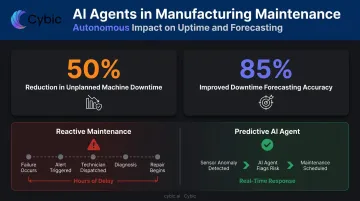
A critical equipment alert fires at 11 PM in a manufacturing plant. Under a traditional workflow, it sits in a queue until morning. A shift supervisor eventually escalates it. Maintenance arrives hours later. The line has been down for six hours.
With an autonomous AI agent, the sequence looks different. The anomaly is detected in real time. Root cause analysis runs automatically, a work order is created and routed, the right technician is notified, and operations leadership gets a status update - before anyone has opened a dashboard.
That gap - between reactive and autonomous - is where enterprises are placing their bets. According to Gartner, agentic AI will appear in 33% of enterprise software applications by 2028, up from less than 1% in 2024, with at least 15% of day-to-day work decisions made autonomously by the same year.
The question is no longer whether to deploy autonomous AI agents. It's how to do it without joining the 40%+ of agentic AI projects Gartner predicts will be cancelled by end of 2027 due to unclear value or inadequate governance.
This guide is built for teams that want to implement - not just evaluate. It covers what autonomous agents are, how to apply them across workflows, and the governance foundations that separate deployments that stick from projects that get cancelled.
Key Takeaways
- Autonomous AI agents reason, plan, and act across multi-step workflows; traditional automation only executes fixed rules
- The biggest enterprise wins are in high-frequency, data-intensive processes: predictive maintenance, prior authorization, demand forecasting
- Multi-agent architecture is essential for cross-functional complexity; single agents hit ceilings fast
- Governance must be built before deployment, not bolted on after
- Start with one bounded, measurable workflow - then expand based on demonstrated performance
What Are Autonomous AI Agents?
AWS defines AI agents as software programs that interact with their environment, collect data, and perform self-directed tasks toward predetermined goals. Humans set the objectives; agents independently determine how to achieve them.
That independence is what separates agentic AI from traditional automation. A rule-based system executes exactly what it was programmed to do. An autonomous agent perceives context, reasons through options, and selects a course of action - even when conditions weren't anticipated at build time.
Three Properties That Make a Workflow Agentic
Not every AI-assisted process qualifies. A workflow is genuinely agentic when it exhibits:
- Autonomy - acts on live data without waiting for human instruction at each step
- Adaptability - adjusts its approach when conditions change mid-execution
- Continuous learning - refines behavior based on outcomes, improving each subsequent run
The contrast is concrete. A rule-based email trigger fires when a form is submitted. An agentic outreach system reads behavioral signals, evaluates context, selects the most relevant message, and times delivery based on engagement patterns - all without a human in the loop.
Understanding those properties also clarifies a common point of confusion: how agentic AI differs from generative AI.
Generative AI vs. Agentic AI
The two are related but not interchangeable. Generative AI creates content from training patterns. Agentic AI takes goal-directed actions in dynamic environments.
Most enterprise deployments combine both: LLMs provide reasoning and language understanding, while the agent architecture provides planning, memory, tool use, and execution. In practice, the LLM handles reasoning while the agent layer handles planning, tool calls, and follow-through.
How Autonomous AI Agents Optimize Workflows
The Core Operational Loop
Every agentic workflow follows the same basic cycle:
- Input/trigger - a sensor reading, API event, user request, or scheduled task
- Goal decomposition - the agent breaks the objective into subtasks
- Planning - selects tools, data sources, and sequence of actions
- Execution - runs the plan, calling APIs, querying databases, or triggering downstream systems
- Evaluation - assesses whether the outcome meets the objective
- Iteration - adjusts and re-runs if needed
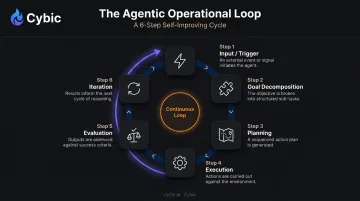
Unlike static automation, each cycle can take a different path based on real-time context. The same trigger on Monday morning and Friday afternoon might produce entirely different action sequences.
Workflow Architecture Components
Enterprise-grade agentic systems require four layers working in concert:
| Component | Role |
|---|---|
| LLM reasoning engine | Interprets context, plans actions, generates decisions |
| Memory systems | Short-term context (within a session) + long-term knowledge (across sessions) |
| Tool integrations | APIs, databases, IoT feeds, enterprise applications |
| Orchestration layer | Coordinates agent activity, manages handoffs, tracks state |
Multi-agent orchestration adds another dimension: an orchestrator agent decomposes complex tasks and delegates them to specialized worker agents, then synthesizes results. Gartner predicts 70% of AI applications will use multi-agent systems by 2028. For cross-functional enterprise workflows, single-agent architectures simply run out of scope.
Cybic's Drava platform follows this same orchestration model, integrating enterprise data, ML pipelines, AI reasoning, and intelligent agents into a single governed layer. Coordination logic and compliance controls are built into the architecture rather than added afterward.
Five Foundational Workflow Patterns
Anthropic identifies five core patterns that cover most enterprise agentic use cases:
- Prompt chaining - sequential LLM steps, each building on the last; suited to multi-stage document processing
- Routing - classifies inputs and directs them to specialized handlers; ideal for customer service triage
- Parallelization - runs independent subtasks simultaneously; good for batch analysis or multi-source data gathering
- Orchestrator-workers - a central agent delegates and synthesizes; best for complex, cross-functional workflows
- Evaluator-optimizer - one model output is judged and improved in a loop; suited to compliance document review or content QA
What makes agentic workflows self-improving is the knowledge log. Each run produces a record of what worked and what didn't. Subsequent runs launch from a more refined baseline, gradually narrowing the gap between initial execution and optimal output - a capability that traditional rule-based automation requires manual reprogramming to replicate.
Enterprise Use Cases by Industry
Autonomous AI agents deliver the most value in high-frequency, data-intensive environments where conditions shift rapidly. That describes every sector Cybic serves.
Manufacturing and Operations
Unplanned downtime costs major manufacturers $1.4 trillion annually (11% of revenue), according to Siemens. Deloitte adds that poor maintenance strategies can reduce asset productive capacity by 5% to 20%.
Autonomous agents attack this directly:
- Monitor production line sensor data continuously, not on shift schedules
- Detect degradation patterns before failure thresholds are crossed
- Trigger maintenance work orders, route them to the right technician, and update production schedules
- Log every action for reliability and compliance review
The shift from reactive to predictive maintenance is measurable. Siemens/Senseye client results show 50% reduction in unplanned machine downtime and 85% improved downtime forecasting accuracy in cited deployments (vendor benchmark; treat as directional).
Cybic builds these systems with governance embedded at the architectural level. Every agent action is traceable, and no proprietary operational data leaves the client environment.
Energy and Infrastructure
Only 7% of energy organizations have scaled AI enterprise-wide, per Accenture - yet Aramco recorded $1.8 billion in AI-driven technology value in 2024 across 442 identified use cases. For Oil & Gas and regulated energy operators, agentic workflows are where that value gets captured:
- Continuous sensor monitoring across distributed infrastructure
- Safety anomaly detection and automatic compliance alert routing
- Coordinated corrective action workflows with full audit trails
- Integration with operational technology (OT) systems under appropriate access controls
Governance is non-negotiable here. NERC's Critical Infrastructure Protection standards apply to AI systems connected to bulk electric systems, and any autonomous agent touching operational energy infrastructure must be assessed against those obligations.
Cybic's platform addresses this directly: role-based access controls, encrypted data handling, and end-to-end auditability are built into the architecture from the start, not retrofitted after deployment.
Healthcare Operations
The administrative burden in healthcare is severe. The AMA's 2024 survey found 93% of physicians say prior authorization delays patient access to care, and physicians and staff spend an average of 12 hours per week on prior authorization alone.
Autonomous agents can absorb much of this load:
- Route patient data and documentation to the appropriate care team members
- Manage prior authorization submissions, status tracking, and appeals
- Surface relevant clinical documentation at the point of care
- Monitor regulatory compliance in real time
Healthcare deployments require strict data governance as a prerequisite, not an afterthought. HIPAA's Security Rule mandates appropriate safeguards for electronic protected health information. ONC rules now require transparency into AI models used in health decisions. Cybic enforces a hard no-training-on-patient-data policy and builds data protection controls directly into the system architecture, so agents operate within HIPAA boundaries from day one.
Retail and Supply Chain
McKinsey reports AI can reduce inventory levels by 20–30%, cut logistics costs by 5–20%, and reduce procurement spend by 5–15% through improved demand forecasting and optimization.
Key agentic applications in retail include:
- Demand forecasting agents that update predictions based on real-time sales signals
- Inventory agents that trigger reorder decisions before stockout thresholds are hit
- Supply chain control tower agents that flag exceptions and coordinate supplier responses
- Dynamic pricing agents informed by inventory status and demand signals
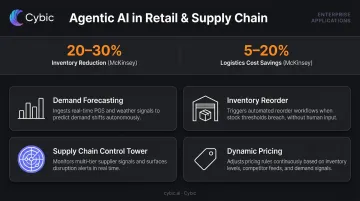
McKinsey documents a major building-products distributor that improved fill rates by 5–8% using an AI-enabled supply chain control tower. One caveat: verified production examples of fully integrated multi-agent pricing and inventory systems remain limited. Start with demand and inventory optimization, where the evidence base is strongest.
Governance, Risks, and Enterprise Deployment
Governance isn't a constraint on agentic AI - it's what makes expansion possible. Organizations that embed it from day one can safely increase agent authority over time. Those that skip it face compounding risk as agent scope grows.
Security, Access Control, and Data Sovereignty
Non-negotiable requirements for enterprise agentic deployments:
- RBAC - each agent gets access only to the data and systems its role requires
- Encrypted data - in transit and at rest, without exception
- Audit logging - every agent action recorded with full traceability
- Data sovereignty - proprietary enterprise data must not be used to train external models; this should be architecturally enforced, not just contractually promised
- Compliance alignment - SOC 2, HIPAA, ISO, GDPR as applicable to the deployment context
Cybic's governance-by-design approach embeds these controls at the architectural level across all deployments, including on AWS, Azure, and Google Cloud, as well as hybrid and on-premises environments.
Hallucinations, Coordination Failures, and Unpredictability
Three technical failure modes demand specific mitigation:
- LLM hallucinations - Stanford HAI found legal AI systems hallucinated in 1 out of 6 benchmark queries. Gartner reports only 19% of IT leaders trust vendor hallucination protections. A confident but wrong output driving an automated decision is a concrete operational risk.
- Coordination failures - in multi-agent systems, conflicting actions, dropped handoffs, and race conditions can produce outcomes no individual agent would have generated alone.
- Unpredictable long-horizon behavior - the further an agent plans ahead, the harder its behavior becomes to predict or audit.
Recommended mitigations:
- Validation layers before any high-stakes action executes
- Human-in-the-loop checkpoints for decisions above defined risk thresholds
- Output logging with anomaly detection on agent behavior patterns
- NIST AI 600-1 hallucination controls as operational standards, not prompt tips
Establishing Decision Boundaries
Tiered authority is the practical answer to the autonomy question:
| Tier | Example | Approval Required |
|---|---|---|
| Autonomous | Auto-approve purchases under $500, reroute a support ticket, trigger a reorder | None |
| Supervised | Flag a compliance exception, recommend a pricing change | Human review |
| Escalation | Modify a regulated process, take action above a financial threshold | Human approval required |
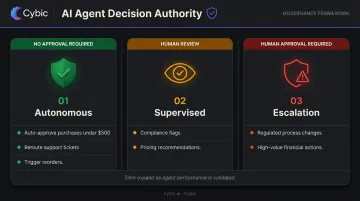
These tiers aren't permanent. As agents demonstrate reliable performance, autonomy can expand - but only where the track record justifies it. Re-evaluate boundaries regularly rather than treating them as a one-time configuration.
Governance frameworks also interact directly with integration complexity. Gartner predicts over 40% of agentic AI projects will be cancelled by 2027, with escalating costs and integration failures among the primary causes. Cybic's infrastructure-agnostic architecture and legacy modernization capabilities address this directly, connecting modern agentic systems to existing ERPs, CRMs, and OT systems via custom API development and middleware layers.
Implementation Roadmap
Step 1: Identify the Right Workflow
Not every process is agent-ready. The best candidates share three characteristics:
- Fast feedback loop - results visible in hours or days, not quarters
- Measurable baseline - a clear metric to improve (processing time, error rate, reorder accuracy)
- API accessibility - the relevant systems can be connected without a major infrastructure project
Start with one bounded, high-impact workflow. Predictive maintenance, prior authorization processing, and inventory reorder management are consistently strong starting points across Cybic's target verticals. Resist the temptation to start enterprise-wide.
Step 2: Build Governance Before Deployment
Before any agent goes live:
- Establish RBAC policies and data access rules
- Configure audit logging and action traceability
- Define decision boundaries (what agents can do autonomously vs. what escalates)
- Set escalation protocols and notification thresholds for leadership visibility
- Confirm data sovereignty commitments with your AI vendor - specifically, that no client data will be used for model training
Governance infrastructure is what allows deployments to scale rather than stall. Skipping this step is the most common reason enterprise AI pilots don't survive their first compliance review.
Step 3: Deploy, Measure, and Expand Iteratively
With governance in place, launch in a controlled environment. Measure decision quality and business outcomes alongside processing speed - then document what worked, what failed, and why before expanding scope.
Use that evidence base to justify expanding agent authority and deploying into additional workflow domains. A Forrester TEI benchmark for LogicMonitor's Edwin AI found 313% ROI and payback in under 6 months (vendor-commissioned benchmark; treat as directional, not a universal average).
Building this infrastructure from scratch adds months of engineering work before a single workflow goes live. Cybic's Drava platform ships with orchestration, compliance frameworks, and audit trails already in place, so engineering effort goes toward workflow logic rather than foundational plumbing.
Frequently Asked Questions
What is the difference between autonomous AI agents and traditional workflow automation?
Traditional automation follows fixed rules and cannot adapt when conditions fall outside what was programmed. Autonomous AI agents reason through context, make decisions dynamically, and improve over time. They handle the exceptions and edge cases that rule-based systems either fail on or escalate to humans.
Which business processes are best suited for autonomous AI agent deployment?
Look for three prerequisites: a fast feedback loop (results visible quickly), objectively measurable outcomes (error rate, cycle time, fill rate), and API accessibility to the relevant systems. Predictive maintenance, inventory management, prior authorization, and customer service routing consistently meet all three criteria.
How do autonomous AI agents handle exceptions and unexpected situations?
Well-designed agents attempt to resolve exceptions through adaptive reasoning before escalating - cross-referencing data sources, investigating root causes, and exploring alternative action paths. When escalation is needed, they provide full context so the human decision-maker isn't starting from scratch.
What governance controls are essential before deploying autonomous AI agents in an enterprise?
At minimum, your architecture should enforce:
- RBAC and audit logging
- A data governance policy (no proprietary data used for external model training)
- Defined decision boundaries for each tier of agent authority
- Documented escalation pathways
Writing these into contracts isn't enough - they need to be built into the system.
Can autonomous AI agents integrate with existing legacy enterprise systems?
Yes, but it requires planning. Infrastructure-agnostic platforms, API middleware layers, and phased integration starting with the most accessible data sources reduce friction. Cybic's approach connects agentic systems to existing ERPs, CRMs, OT infrastructure, and data pipelines without requiring a wholesale infrastructure replacement.
How long does it take to see ROI from AI-driven workflow optimization?
Timeline depends on workflow complexity and scope. A Forrester TEI benchmark found payback in under 6 months for a well-scoped agentic deployment, with 313% ROI (vendor-commissioned; use as directional). Bounded deployments in measurable processes such as maintenance triage, authorization processing, and inventory optimization typically show cycle time and error rate improvements within weeks of go-live.