Introduction
Most US manufacturing IT leaders are caught in the same bind: aging ERP, MES, SCADA, and CMMS platforms consume the bulk of their technology budgets just to stay operational. According to McKinsey research on technical debt, technical debt accounts for roughly 40% of IT balance sheets and adds 10–20% to project costs - and that's before accounting for manufacturing-specific downtime exposure. Siemens Senseye estimates that unplanned downtime costs the world's 500 largest companies $1.4 trillion annually - about 11% of revenue.
The real problem isn't that manufacturers don't want to modernize. It's that traditional modernization methods are too slow, too risky, and too expensive to execute while keeping the line running.
Generative AI changes that calculus. It compresses timelines that were previously impractical and brings modernization within reach of real-world budgets.
This article covers what GenAI actually does in a manufacturing modernization context, which systems benefit most, how to phase the rollout safely, and how governance prevents the program from creating the very risks it's meant to eliminate.
Key Takeaways
- Technical debt consumes a disproportionate share of manufacturing IT budgets, leaving little capacity for innovation or Industry 4.0 integration.
- GenAI compresses modernization's most time-intensive phases - discovery, documentation, code translation, test generation - from months to weeks.
- MES, CMMS, legacy ERP, quality management, and supply chain platforms are the highest-value modernization targets.
- A phased approach (discovery → pilot → core migration → continuous optimization) reduces production risk and avoids single-cutover failure modes.
- Governance, security, and operational continuity must be embedded at the architectural level from day one, not bolted on at the end.
Why Legacy Systems Are Costing US Manufacturers More Than They Realize
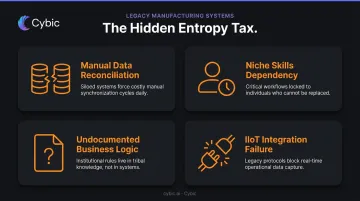
The Hidden Entropy Tax
The direct costs of legacy systems (license fees, maintenance contracts, aging hardware) are visible on the balance sheet. The indirect costs are harder to see - and considerably larger.
Consider what maintaining a legacy manufacturing stack actually requires:
- Manual data reconciliation between disconnected ERP and MES layers that don't share data models
- Niche skills dependency on engineers who understand COBOL, VB6, or PL/SQL - a shrinking talent pool
- Undocumented business logic that exists only in the memory of one or two engineers approaching retirement
- IIoT integration failure because legacy SCADA and MES platforms have no modern API surface
IBM notes that over 250 billion lines of COBOL remain active across industries including manufacturing - and a common risk in modernizing these systems is insufficient documentation combined with a lack of specialized skills to verify what the code actually does.
Why Traditional Modernization Has Failed
Manual dependency mapping is the central bottleneck. Mapping a mid-size manufacturer's application portfolio by hand typically takes three to six months - before any transformation work begins. Then hidden integrations surface mid-project, scope expands, and the program burns through budget without reaching production.
This isn't a failure of intent. It's a structural problem with how modernization has been executed. GenAI addresses it at the root: by automating the discovery and dependency-mapping work that has historically consumed most of the program budget, freeing engineering effort for actual transformation.
What Generative AI Actually Does in Manufacturing Application Modernization
GenAI accelerates modernization by handling the groundwork that has consumed the most time and budget before real transformation can start. It compresses discovery, documentation, and translation phases that engineering teams have historically spent months on.
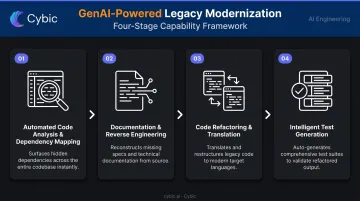
Automated Code Analysis and Dependency Mapping
GenAI-powered static analysis tools can scan entire legacy codebases and produce structured maps of component relationships, integration points, and undocumented dependencies. What previously took weeks of manual investigation compresses into days.
The output isn't just a diagram. It's a risk register: which modules carry the most downstream dependencies, which contain the densest business logic, which are candidates for early modernization versus careful later-stage handling.
AWS's agentic mainframe modernization approach - used in reference contexts including Toyota Motor North America - automates analysis of JCL, BMS, COBOL programs, and copybooks to surface dependencies and missing artifacts that manual review would take months to find.
Documentation and Reverse Engineering
Most legacy manufacturing systems have no reliable documentation. GenAI can analyze undocumented code and generate technical docs, dependency diagrams, and business-rule summaries in hours. This directly addresses the single-point-of-failure risk: the senior engineer who still remembers how the system works and is five years from retirement.
Automated Code Refactoring and Translation
Large language models can generate first-draft translations from legacy languages to modern equivalents - COBOL to Java, VB6 to Python - requiring engineering review and refinement rather than ground-up authorship.
One critical point: AI-generated translations must be treated as drafts, not finished code. Engineers who understand the source system need to validate output before it reaches production. Treating AI output as final is how regressions get introduced into systems that have been running reliably for decades.
Intelligent Test Generation
Legacy manufacturing systems almost never have comprehensive test suites. GenAI can infer expected behavior from production logs and historical data, then generate test cases covering scenarios the legacy system has handled for years.
The result is behavioral parity validation between old and new systems - a hard requirement before any cutover in a production manufacturing environment.
Thoughtworks documents a case where a small team modernized a custom application in six weeks against an initial estimate of six months. Not every project compresses at that rate, but the pattern is consistent: AI-handled discovery, documentation, and test generation phases are where the most calendar time has traditionally disappeared.
The Manufacturing Systems GenAI Can Transform
Manufacturing Execution Systems (MES)
Legacy MES platforms run on static, rule-based scheduling. When a machine fails or a materials shortage hits, operators work around the system rather than with it.
A modernized MES changes that dynamic in two concrete ways:
- Dynamic rescheduling that responds to real-world disruptions - machine failures, material gaps, shift changes - rather than requiring manual override
- Natural language interfaces that let operators query production data in plain English rather than navigating rigid dashboards built in a different decade
IDC notes a meaningful shift toward cloud solutions for MES, driven specifically by the limitations of traditional on-premises platforms. Static scheduling costs production time that dynamic, AI-augmented systems recover.
CMMS and Predictive Maintenance
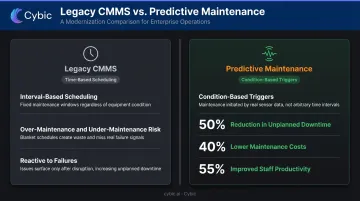
Legacy CMMS platforms schedule maintenance by time intervals, not equipment condition. The result is a combination of over-maintenance (replacing parts that still have service life) and under-maintenance (missing failures that don't follow a calendar).
The modernized alternative connects IIoT sensor data - vibration, temperature, acoustics - to a predictive model that identifies condition-based maintenance needs before failures occur. Siemens Senseye reports that predictive maintenance implementations can reduce unplanned machine downtime by 50%, cut maintenance costs by 40%, and improve maintenance staff productivity by 55% (vendor-reported benchmarks; results depend on implementation quality and baseline conditions).
ERP Modernization
Aging ERP systems - many built on COBOL-era logic or early SAP/Oracle stacks - create bottlenecks in demand forecasting, procurement, and inventory visibility. The deeper problem is that the business logic embedded in these systems is genuinely valuable; it represents decades of operational rules that the organization depends on.
GenAI-assisted refactoring preserves that logic while migrating to cloud-native, API-enabled architectures that connect to modern data layers and IIoT platforms. The goal isn't replacement - it's structural modernization that makes the logic accessible and maintainable.
Supply Chain and Quality Management Platforms
McKinsey research found that 75% of supply-chain functions still rely on spreadsheets for demand forecasting, and more than 50% use SAP APO - a platform McKinsey notes will lose vendor support in 2027. That's not a future risk. It's a countdown.
GenAI-powered modernization enables multi-source data ingestion and dynamic demand signal interpretation, replacing brittle spreadsheet-based planning with responsive, integrated forecasting.
The same modernization logic applies to quality management. Modernized QMS platforms move from retrospective defect logging to real-time anomaly detection - correlating production parameters (temperature, speed, humidity) with defect patterns to surface root causes rather than tracking symptoms after the fact.
How to Execute GenAI-Powered Modernization Without Stopping the Line
Phase 1: AI-Assisted Discovery and Assessment
Start by running GenAI-powered analysis against the full legacy portfolio. The outputs:
- Dependency maps showing integration relationships across systems
- Complexity profiles identifying which modules carry the highest technical debt
- A prioritized risk register distinguishing quick wins from high-risk transformation targets
Quick wins - modules with clear business value, low integration complexity, and manageable risk - go first. They validate the tooling, establish team confidence, and deliver production deployments before the program bets on a big-bang cutover.
Phase 2: Pilot-Led Transformation
Before scaling portfolio-wide, modernize one high-impact, lower-risk system. A specific reporting module or a defined MES workflow is a common starting point.
During the pilot:
- Use AI pair programmers to accelerate code translation
- Run parallel behavioral testing against the legacy version
- Establish the CI/CD pipeline and governance structures the broader program will reuse
The pilot phase proves the methodology works in your specific environment before applying it to business-critical platforms.
Phase 3: Core System Migration
Phase 3 targets business-critical platforms - the systems carrying the highest operational value and the deepest technical debt. The governing principle here is parallel running: keep the legacy system live alongside the modernized version until behavioral parity is confirmed. No cutover event should put production operations at risk.
Key safeguards during core migration:
- Run legacy and modernized systems simultaneously through a defined validation window
- Confirm output parity on high-stakes workflows before decommissioning the old system
- Gate each cutover decision on operational sign-off, not just technical testing
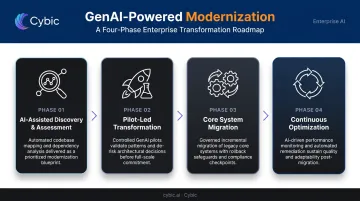
Phase 4: Continuous Optimization
Phase 4 shifts modernization from a project to an ongoing capability. The modernized system is built to learn - operational data from the factory floor feeds back into AI models, continuously improving scheduling recommendations, maintenance predictions, and quality insights.
Cybic's Drava platform supports this continuous intelligence layer post-modernization. It connects enterprise data, machine learning, and intelligent agents into a governed automation platform - giving manufacturers a path from a modernized application architecture to production AI that runs daily operations.
Governance, Security, and Operational Continuity
Speed Creates Pressure on Review Gates
GenAI-assisted modernization moves faster than traditional development. That speed is the point - but it creates pressure to compress review and validation gates. This is precisely where programs introduce the regressions that become expensive to diagnose in environments where downtime is measured in lost revenue per minute.
Governance can't exist only on paper. It must be embedded at the architectural level from day one.
Manufacturing-Specific Security Risks
OT/IT convergence during modernization creates real attack surface exposure. The manufacturing sector is not a peripheral target: Dragos observed 424 manufacturing ransomware incidents in Q4 2024, accounting for 70% of observed industrial ransomware activity. CISA has flagged manufacturing as a primary target for Rhysida ransomware since May 2023.
Proprietary production data, process parameters, and supply chain logic must not be exposed to model training pipelines or uncontrolled API endpoints.
Cybic addresses this through governance embedded at the architecture level, not bolted on as a compliance afterthought:
- Role-based access controls (RBAC) across all system components
- Encrypted data protection in transit and at rest
- Full auditability of AI-driven actions
- Strict prohibition on using proprietary enterprise data for model training
Data Migration Risk
Most modernization programs underestimate data migration complexity. Legacy manufacturing data models carry decades of schema evolution, undocumented constraints, and implicit relationships between systems that only surface when data moves to a new structure.
Data migration planning must run in parallel with application transformation - not follow it. Treating data migration as a downstream task is a proven path to extending a modernization program's timeline by six to twelve months.
Frequently Asked Questions
Frequently Asked Questions
What legacy manufacturing systems benefit most from GenAI-powered modernization?
The highest-value targets are large, complex systems with undocumented logic and dense integration dependencies: MES, CMMS, legacy ERP modules, and quality management platforms. These are where manual discovery would otherwise take years and where modernization delivers the fastest business impact.
How does GenAI-powered modernization avoid disrupting active production?
Modernized systems operate alongside legacy systems in parallel until behavioral parity is confirmed through testing. Production never depends on an untested version, and no single cutover event puts operations at risk. The phased approach delivers incremental value while keeping the legacy system as a live fallback throughout.
What is the difference between refactoring and rebuilding a legacy manufacturing application?
Refactoring preserves existing business logic while improving code structure, language, and architecture. Rebuilding is greenfield development of a new system. GenAI assists with both, but the right choice depends on the system's complexity, business value, and technical debt profile.
How long does GenAI-powered application modernization take for a manufacturing organization?
Timelines vary by portfolio size and complexity, but AI automation typically compresses discovery and translation work enough to deliver initial production deployments in 6–8 weeks. Core system transformation for a mid-size manufacturer generally runs 6–18 months, substantially faster than manual approaches at comparable scope.
How do you ensure data security and governance during AI-driven modernization?
Governance must be architectural, not procedural: RBAC, encrypted data protection, no proprietary data used for model training, and full auditability of AI-driven actions. In manufacturing, this matters even more given the sensitivity of process parameters and active OT/IT attack surfaces.
Can GenAI modernization work when OT and IT systems need to be integrated simultaneously?
Yes. GenAI can create API layers that connect legacy OT systems (PLCs, SCADA) to modern cloud-native data platforms, enabling IIoT data flows without full OT replacement. Security controls must be designed into those API boundaries from the start, not bolted on afterward.