Introduction
Most enterprises don't have a data problem. They have a disconnected data problem.
According to Salesforce/MuleSoft's 2023 Connectivity Benchmark Report, the average organization runs 1,061 applications - but only 29% are integrated. The remaining 70% sit in isolation, creating blind spots, manual re-entry overhead, and decisions built on stale or conflicting data.
That disconnection has a price tag: failed digital transformation efforts tied to fragmented systems cost organizations an estimated $9.5M annually.
Data and API integration services exist to close those gaps - across workflows, data pipelines, and decision-making systems. This guide covers:
- The difference between data integration and API integration (and why both matter)
- How each works at a technical level
- The business value enterprises unlock through proper integration
- What to evaluate when selecting an integration service provider
Key Takeaways
- API integration connects applications through standardized interfaces, enabling real-time data exchange - no custom code required for each new connection.
- Data integration consolidates data from multiple sources using ETL, ELT, or CDC into a unified, usable format for analytics and AI.
- The two are complementary: APIs often serve as the retrieval mechanism inside broader data integration pipelines.
- Poor data quality costs enterprises at least $12.9M per year (Gartner) - and fragmented integration is the primary cause.
- Enterprise AI systems depend on well-integrated data; fragmented pipelines cap what AI can actually deliver.
What Are Data and API Integration Services?
API Integration vs. Data Integration
API integration connects enterprise software applications - CRMs, ERPs, cloud platforms, operational databases - so data and functionality flow between them automatically. These connections work across cloud, on-premises, and hybrid environments without requiring a custom-coded pipeline for every system pair.
Data integration is the broader discipline. Gartner defines it as combining information from multiple sources - databases, SaaS tools, legacy systems, data warehouses - into a consolidated, consistent dataset ready for querying, analysis, or AI model training.
The two serve different but related purposes: API integration handles application-to-application communication, while data integration covers bulk movement, transformation, and historical consolidation. In practice, APIs are often the mechanism through which data integration pipelines pull or push data in real time.
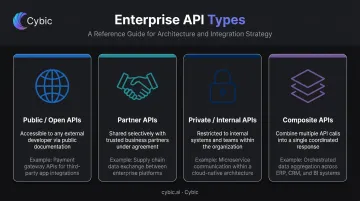
Four API Types Used in Enterprise Integration
| API Type | Description | Typical Use Case |
|---|---|---|
| Public/Open APIs | Accessible over HTTP, no special permissions | Third-party developer ecosystems |
| Partner APIs | Controlled access for business partners | B2B data exchange, supply chain |
| Private/Internal APIs | Internal system connectivity only | ERP-to-CRM sync, internal automation |
| Composite APIs | Combine multiple endpoints in a single call | Reducing latency in complex workflows |
API Integration vs. API Management
API integration is the act of connecting systems using APIs. API management covers the full lifecycle of creating, publishing, monitoring, securing, and scaling those APIs. Strong management practices support better integration outcomes, but they address separate concerns.
How Data and API Integration Works
The API Call in Enterprise Context
When System A needs data from System B, the calling system sends a request with authentication credentials - API keys or OAuth tokens. The API validates it, queries the appropriate data source or triggers a business process, then returns a formatted response, typically JSON or XML.
The entire exchange happens invisibly to end users. Yet it underpins everything from live inventory counts to real-time fraud detection.
API Protocols: Which to Use When
Postman's 2024 State of the API Report surveyed 5,600+ API professionals and found a genuinely mixed protocol landscape:
- REST - 87% adoption. HTTP-based, stateless, the default for most modern cloud and web integrations.
- Webhooks - 67% adoption. Event-triggered notifications rather than polling.
- SOAP - 29% adoption. XML-based with strict contracts, preferred in financial services and regulated industries.
- GraphQL - 24% adoption. Client-specified queries that avoid over-fetching; useful for complex data retrieval across multiple sources.
- gRPC - 14% adoption. Google's high-performance protocol over HTTP/2, suited for microservices and low-latency streaming.
Enterprise integration is not a REST-only problem. Regulated industries, high-throughput microservices, and complex data retrieval each pull toward different protocols - often within the same organization.
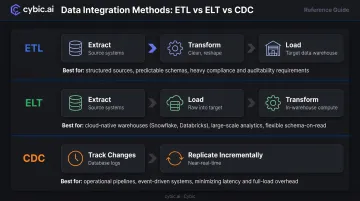
Core Data Integration Methods
- ETL (Extract, Transform, Load): Data is extracted from the source, transformed into the target format, then loaded into a warehouse. Best for structured data requiring complex transformation before storage.
- ELT (Extract, Load, Transform): Data loads raw into the target system first, then transforms within it. Well-suited for large-scale cloud warehousing on platforms like Snowflake, Databricks, or BigQuery.
- CDC (Change Data Capture): CDC identifies and tracks only incremental data modifications in source systems, enabling near-real-time replication with minimal latency impact on source databases.
Integration Patterns Worth Understanding
- Point-to-point: Direct connections between two systems. Simple to start, but creates sprawl as application counts grow.
- Hub-and-spoke: A central broker routes data between systems. Better governance than point-to-point but can become a bottleneck.
- API-led connectivity: Systems communicate through standardized APIs governed via a gateway. Most scalable for complex, multi-system environments.
- Event-driven integration: Systems react to real-time data events through message queues or streaming platforms. Critical for operational systems requiring immediate responses.
Salesforce/MuleSoft found 75% of organizations now have a top-down API integration strategy in place - a clear signal that API-led and event-driven patterns have moved from emerging practice to operational standard.
Business Benefits of Data and API Integration
Operational Automation
When systems exchange data automatically, multi-step workflows can trigger across applications without human intervention, eliminating manual handoffs entirely. Salesforce/MuleSoft found 92% of organizations had at least one department needing both integration and automation services - which reflects how tightly the two are connected in practice.
Cybic's integration work directly supports this, connecting CRMs, ERPs, data lakes, and AI platforms into unified operational systems so that automation logic has the data it needs, when it needs it.
AI and Machine Learning Readiness
This is where integration becomes strategic. AI models require access to large volumes of accurate, current data. Fragmented pipelines constrain what those models can see - and therefore what they can do.
Gartner reports that poor data quality costs organizations at least $12.9M annually on average. Degraded input data degrades model outputs - a direct tax on AI performance. Postman also found AI-related API traffic on its platform grew 73% in 2024, with security and compliance cited as the top integration pain points.
Cybic builds ETL/ELT pipelines designed for AI readiness, connecting data lakes, warehouses, and enterprise systems for low-latency, consolidated data flow across cloud and hybrid environments.
Breaking Data Silos
Without integration, different teams operate on inconsistent copies of the same data. Sales sees one version of customer records; finance sees another. Reports conflict. Decisions get made on stale information.
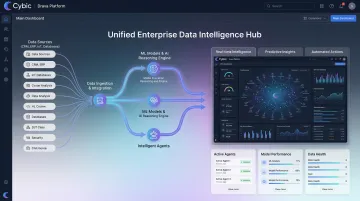
Integration consolidates these sources into a single, synchronized view. Cybic's Drava platform functions as an enterprise data intelligence layer, bringing together data, ML, AI reasoning, and intelligent agents so decisions draw from governed, unified data rather than isolated department stores.
Modernizing Legacy Systems Without Wholesale Replacement
Most enterprises - particularly in manufacturing, energy, and healthcare - have core legacy systems containing years of irreplaceable operational data. Replacing them entirely is expensive, disruptive, and often unnecessary.
AWS describes the strangler pattern: placing an API facade in front of legacy workloads to enable gradual migration without disrupting core operations. Cybic applies this directly, building API abstraction layers that connect legacy infrastructure to modern cloud platforms and AI tools. This covers systems including:
- Netezza and Teradata data warehouses
- Oracle and Vertica databases
- On-prem infrastructure requiring cloud or hybrid access
The legacy system keeps running. Modern systems gain access to its data.
Industry-Specific Integration Use Cases
Manufacturing and Supply Chain
Integration connects production monitoring systems, ERPs, and supply chain tools to give operators real-time visibility into line performance, inventory levels, and demand signals. When sensor and SCADA data flows into enterprise systems, predictive maintenance becomes possible - identifying equipment degradation before failure rather than responding to it after.
Cybic builds AI automation and predictive maintenance solutions for manufacturing clients, designed to operate within existing infrastructure and compliance requirements rather than requiring clean-slate environments.
Healthcare
Healthcare integration spans clinical systems (EHR, lab, billing), payer platforms, and health tech applications. The regulatory dimension is just as demanding as the technical one. The HIPAA Security Rule establishes national standards for protecting electronic health information, meaning every integration touching patient data must address encryption, access controls, and auditability before deployment.
FHIR-compliant APIs are increasingly the standard for interoperability between providers and payers. Cybic's healthcare work embeds HIPAA compliance into the integration architecture from day one:
- Role-based access controls scoped to data sensitivity
- Encryption applied to data in transit and at rest
- Full auditability of data movements across systems
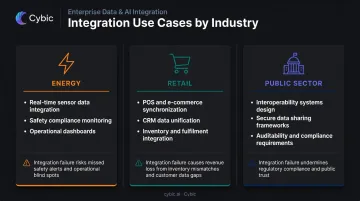
Energy, Retail, and Public Sector
Each of these sectors faces distinct integration pressures - but all share the same underlying risk when data flows break down:
- Energy: Real-time data from field sensors, safety compliance systems, and operational dashboards must flow without latency. Integration gaps create safety and regulatory risk.
- Retail: POS, e-commerce, CRM, and inventory systems need tight synchronization. Disconnected systems produce inaccurate stock counts and failed fulfillment.
- Public sector: The OECD's 2023 Digital Government Index found 83% of OECD countries now have a data interoperability system enabling public-sector data sharing - but secure, auditable integration remains a consistent requirement. Cybic serves government clients with architecture designed for strict auditability and inter-agency data governance.
What to Look for in a Data and API Integration Service Provider
Governance and Security at the Architecture Level
Security and governance should be built into integration architecture from the start - not retrofitted after deployment. Evaluate whether a provider addresses these by design:
- Role-based access controls (RBAC) for every integration layer
- Encrypted data in transit and at rest
- Full auditability of data flows and system actions
- Regulatory alignment for your industry (SOC 2, HIPAA, GDPR, ISO)
Cybic embeds all of these into every engagement. Compliance controls are architectural decisions from day one, not settings layered on after deployment.
Infrastructure Flexibility Without Vendor Lock-In
The integration service should work across cloud, on-premises, and hybrid environments without requiring migration to a single provider's ecosystem. Evaluate specifically:
- Can they connect to your current systems? (Legacy databases, specific SaaS tools, your chosen cloud providers)
- Do they support Snowflake, Databricks, or whichever warehouse you run?
- Will their solution work if your cloud strategy changes?
Cybic builds across AWS, Azure, and Google Cloud, and connects to legacy EDW platforms including Netezza, Teradata, Oracle, and Vertica. The goal is straightforward: your integration solution should reduce dependencies, not create new ones.
Engineering-Led Delivery
Many enterprise integration projects fail not from poor design but from the gap between what was designed and what actually gets built. Evaluate whether the provider:
- Deploys working systems or primarily delivers documentation
- Has engineers involved from architecture through deployment
- Integrates into existing teams and compliance requirements from day one
Every Cybic engagement is structured around engineers who own the full delivery cycle - from architecture through build and integration. There's no handoff between a design team and an implementation team. The measure of success is a working, deployed system.
Frequently Asked Questions
What are API integration services?
API integration services connect enterprise software applications through standardized interfaces, enabling automated data exchange and workflow coordination across systems in cloud, on-premises, and hybrid environments. They eliminate the need for custom point-to-point code for every system connection.
What are examples of API integrations?
Common examples: a CRM syncing contact and deal data with an ERP in real time; an e-commerce platform pulling live inventory counts from a warehouse management system; a healthcare platform exchanging patient records between providers via a FHIR-compliant API.
What is the difference between API integration and data integration?
API integration enables application-to-application communication through standardized interfaces. Data integration is the broader practice of consolidating and transforming data from multiple sources - using ETL, ELT, or CDC - for analytics, AI, or reporting. APIs are often the mechanism data integration pipelines use to retrieve data in real time.
What are the main types of API integration patterns?
Four primary patterns exist in enterprise architectures:
- Point-to-point - direct connections between two systems
- Hub-and-spoke - a central broker routes data between systems
- API-led connectivity - standardized APIs governed through a gateway
- Event-driven integration - systems react to real-time data events
Most modern architectures favor API-led or event-driven patterns for scalability.
How does API integration support AI and automation?
AI systems require large volumes of accurate, current data - which integration makes accessible by connecting siloed sources into unified pipelines. A well-integrated data infrastructure also lets intelligent automation trigger actions across enterprise tools in real time, driven by AI-generated decisions.
What should enterprises look for in an integration service provider?
Prioritize providers that deliver on three fronts:
- Governance and security built into the architecture from the start, not added afterward
- Infrastructure flexibility across cloud, on-premises, and hybrid environments without vendor lock-in
- Engineering-led delivery focused on deployed, working systems - not documentation