What types of government agencies does Cybic build custom software for?
Cybic builds custom software for a broad range of public sector entities, including federal agencies, state and local government bodies, regulatory authorities, and public infrastructure operators. Our solutions address case management, citizen services platforms, compliance reporting, data integration, and AI-powered decision support, all engineered to meet the specific security and procurement requirements of government environments.
How does Cybic ensure compliance with government security and data standards?
Governance is embedded at the architectural level, not added as an afterthought. Every solution we deliver includes role-based access controls (RBAC), end-to-end data encryption, comprehensive audit trails, and regulatory alignment with frameworks such as HIPAA, SOC 2, ISO, and GDPR. Our systems are also designed with no model training on proprietary government data, ensuring strict data sovereignty and confidentiality.
Can Cybic modernize legacy government systems without disrupting ongoing operations?
Yes. Cybic's legacy modernization methodology is specifically designed to minimize operational disruption. We perform phased migrations, re-engineer workflows incrementally, and integrate modern APIs alongside existing infrastructure. This approach allows government agencies to transition from outdated systems to cloud-ready architectures while maintaining continuity of critical public services throughout the process.
Does Cybic support cloud, on-premises, or hybrid government deployments?
Cybic designs infrastructure-agnostic solutions that operate across AWS, Microsoft Azure, Google Cloud, on-premises environments, and hybrid configurations. This flexibility ensures agencies are not locked into a single vendor ecosystem and can comply with data residency, sovereignty, or internal IT policy requirements while still benefiting from modern, scalable software architecture.
What is Cybic's approach to AI integration for government software?
We integrate AI capabilities including generative AI copilots, predictive models, intelligent automation, and NLP pipelines directly into government workflows via secure, governed pipelines. All AI systems are built with explainability, auditability, and responsible AI governance frameworks in place, ensuring that automated decisions can be traced, reviewed, and justified by agency staff and oversight bodies.
How does Cybic handle Section 508 accessibility compliance in government applications?
Accessibility is validated as part of our QA process. We test all government-facing applications against Section 508 accessibility standards, ensuring that web and mobile platforms are usable by individuals with disabilities. This includes screen reader compatibility, keyboard navigation, appropriate color contrast, and accessible form and content structures delivered as a standard component of every government application build.
What does the engagement process look like for a government software project with Cybic?
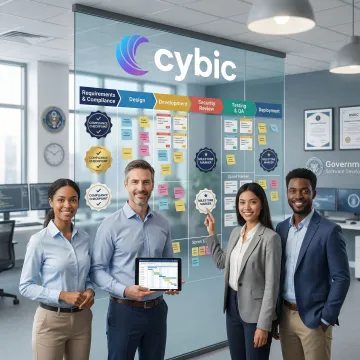
Our process begins with a structured discovery phase covering agency requirements, existing infrastructure, and compliance mandates. We then move through architecture design, agile development sprints with agency stakeholder feedback, rigorous QA and security testing, and a managed deployment. Post-launch, we provide ongoing maintenance, system updates, and support to keep the platform secure and aligned with evolving regulatory needs.
Can Cybic integrate new software with existing government systems and third-party platforms?
Integration is a core competency. Cybic builds custom APIs and uses modern integration patterns to connect new software with existing government databases, ERP systems, CRMs, data lakes, and third-party platforms. Whether connecting to legacy databases or modern SaaS tools, our integration approach ensures seamless, secure data exchange across agency systems with full audit capability.