Introduction
Procurement teams at enterprise organizations face a persistent structural problem: the work that consumes most of their time is not the work that creates the most value. Purchase order creation, invoice matching, vendor onboarding, and data reconciliation are essential but fundamentally transactional - and they crowd out the strategic work that CPOs are actually hired to do.
The pressure is real and growing. According to the Hackett Group, procurement workload rose 8.0% in 2024 while headcount and budgets remained largely flat - creating a 6.6% productivity gap that teams can't close by working harder.
Robotic process automation gives procurement leaders a direct path out of that trap. This guide covers what RPA in procurement actually is, which processes it should handle, how to implement it without the mistakes that kill most programs, and where it reaches its limits.
Key Takeaways
- RPA uses software bots to automate high-volume, rules-based procurement tasks - PO creation, invoice matching, vendor onboarding - without modifying existing ERP or procurement systems
- The strongest ROI comes from procure-to-pay workflows, where speed, accuracy, and audit compliance improve together
- Structured, rule-based tasks are RPA's core strength; pairing it with AI unlocks document intelligence and decision support for unstructured data
- Successful implementation starts with process standardization, cross-functional buy-in, and governance built in from day one
- Low-frequency, judgment-heavy, or poorly documented processes are poor automation candidates - automating them scales problems, not solutions
What Is RPA in Procurement?
RPA in procurement uses software bots to replicate what a human does across digital systems: logging in, extracting data, filling fields, and triggering approval workflows - all without requiring changes to the underlying ERP or procurement platform. Bots operate on top of existing systems, which is what makes deployment faster and less disruptive than traditional integration projects.
The goal is to remove manual effort and error from high-volume transactional work so procurement professionals can redirect their time toward supplier negotiations, category management, and risk oversight.
What RPA Is Not
Two distinctions are worth drawing:
- RPA vs. traditional automation: Traditional automation typically requires system-level changes or custom API development. RPA works through the UI layer - the same way a person would - so it can be deployed without touching the underlying platform.
- RPA vs. AI: RPA follows explicit, pre-defined rules and executes only what it's been told to do. AI learns from patterns and handles ambiguity; RPA cannot. If the logic isn't written in, the bot fails.
This matters because teams often deploy RPA expecting AI-level adaptability, then wonder why the bots break when invoice formats change or a supplier sends a non-standard document.
Core Procurement Processes RPA Can Automate
Not every procurement task belongs in an automation program. The qualifying test is simple: Is the task high-volume? Does it follow a predictable decision tree? Does it involve moving or verifying data across systems with minimal human judgment?
If yes to all three, it's a strong candidate. If the process is inconsistent, exception-heavy, or low-frequency, RPA is the wrong tool. The four processes below consistently clear that bar.
Purchase Order Processing
RPA automates the full PO lifecycle: receiving purchase requisitions, validating them against pre-configured approval rules, generating purchase orders, and routing them for sign-off - all without manual intervention.
The benchmark gap is significant. APQC data shows the median cost to process a purchase order is $55.00, with a median cycle time of 2.0 days from requisition to PO release. Roughly 10% of POs don't make it through error-free the first time, creating rework that compounds across thousands of orders annually.
Automation compresses cycle times, eliminates the rework loop, and frees approvers to focus on exceptions rather than routine transactions.
Invoice Matching and Reconciliation
Three-way matching - cross-referencing the purchase order, goods receipt, and supplier invoice - is repetitive, error-prone, and time-intensive at scale. RPA automates the comparison, flags discrepancies for human review, and routes compliant invoices through to payment automatically.
The volume problem is stark: APQC benchmarks show a median of 60% of supplier invoices are manually keyed into financial systems. At a median cost of $6.00 per AP invoice, the cost of manual processing compounds quickly at enterprise scale.
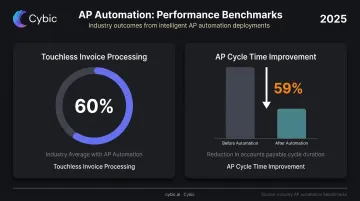
According to Hackett Group 2025 research, organizations deploying AP automation reach 60% touchless invoice processing rates on average - with AP cycle times improving by 59%.
Supplier Onboarding and Vendor Data Management
Manual supplier onboarding - fragmented emails, spreadsheets, phone calls - creates compliance blind spots. Without a structured process, vendor master data ends up incomplete, risk checks happen inconsistent, and new suppliers take weeks to activate.
RPA automates the intake: collecting registration documents, running compliance checks against predefined criteria, populating vendor master data in the ERP, and triggering sequential approval workflows.
One documented case - a major automotive manufacturer working with Deloitte and ServiceNow - achieved a 400% increase in onboarded suppliers per week after digitizing previously manual onboarding workflows.
Faster onboarding also has a compliance dimension. The Hackett Group found that only 39% of organizations include third-party risk management in senior management dashboards, which signals how easy it is for supplier risk to go unmonitored when the process is manual.
Contract and Spend Data Management
When spend data lives across disconnected systems, category managers lose visibility into what they're buying, from whom, and whether contracts are being honored. That gap has direct cost consequences.
RPA addresses this by:
- Extracting and consolidating spend data from multiple source systems into spend cubes for category-level analysis
- Monitoring contract databases for renewal and termination dates
- Triggering alerts before missed deadlines create financial or compliance exposure
- Flagging maverick spend - APQC benchmarks put the median at 1.2% of total purchases, rising to 2.5% or more at bottom-performing organizations
For large organizations, reducing maverick spend by even half a percentage point can translate to millions in recovered savings - making data consolidation one of the fastest-payback automation use cases in procurement.
How RPA Works in Procurement: From Assessment to Scale
The failure pattern for most RPA programs is consistent: teams identify a promising process, build a bot, and deploy it before anyone has standardized the underlying workflow. The bot then automates the chaos rather than eliminating it.
The implementation sequence matters as much as the technology.
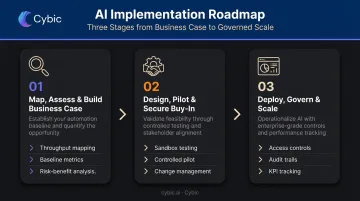
Step 1: Map, Assess, and Build the Business Case
Before writing a single line of bot logic, document the current state:
- Current throughput, error rates, and handoff points for each candidate process
- Baseline metrics for processing time, cost per transaction, and exception frequency
- A risk-benefit analysis that defines the KPIs the automation must achieve
The non-negotiable: standardize the process before automating it. If the manual process has inconsistencies - different approval paths, informal workarounds, exception logic in people's heads - those problems will be encoded into the bot and amplified at scale.
Step 2: Design, Pilot, and Secure Buy-In
This phase involves procurement, IT, finance, and any other function whose data or systems the bot will touch. Early cross-functional alignment prevents the most common technical failures: access permissions, data format conflicts, and governance gaps that surface mid-deployment.
Build and test bot scripts in a sandbox that mirrors production data, then run a controlled pilot on a bounded scope:
- One supplier group, one document type, or one process variant
- Test error-handling logic and exception escalation before broader rollout
- Validate that outputs match expected results against real transaction data
Change management is not optional here. Teams need to understand what they're gaining: capacity for higher-value work, not just awareness of what bots are taking over.
Step 3: Deploy, Govern, and Scale
Production deployment requires:
- Role-based access controls aligned to existing approval matrices
- Comprehensive audit trails for every automated transaction
- Defined exception-handling protocols with clear escalation paths
- Real-time KPI tracking covering touchless processing rate, PO cycle time, cost per invoice, and first-pass match rate
Performance data from the first wave informs which processes to automate next. Scaling is sequential, not simultaneous.
Common Misconceptions and When RPA Isn't the Right Fit
The most damaging assumption in procurement automation programs is that any process can be improved by automating it. That's not how RPA works. Bots execute the logic they're given - if the underlying process is broken, inconsistent, or poorly documented, the bot will run that broken process faster and at greater scale.
The RPA vs. AI Confusion
Teams often expect bots to handle unstructured inputs - supplier emails, contract clauses, non-standard invoices - or to adapt autonomously when exceptions arise. These are AI capabilities. RPA requires explicit rules and structured inputs. As Deloitte notes, 41% of organizations lack an enterprise-wide intelligent automation strategy and 22% have no clear vision - which helps explain why bots frequently get deployed against the wrong problems.
Processes Where RPA Is a Poor Fit
- Tasks that change frequently or lack documented decision logic
- Processes with high exception rates requiring contextual judgment
- Workflows spanning unstructured or variable data sources
- Negotiations, supplier relationship management, or anything requiring commercial acumen
Poor process selection is one failure mode. But even teams that pick the right processes hit a separate wall: scaling.
The Scaling Problem
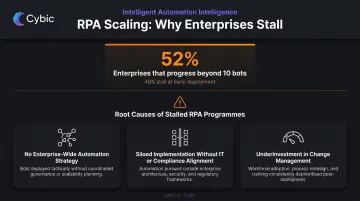
Forrester found that only 52% of enterprises that launched RPA initiatives progressed beyond their first 10 bots. Nearly half stalled at early-stage deployment. The root causes are consistent across organizations:
- No enterprise-wide automation strategy to guide prioritization
- Siloed implementation without IT and compliance alignment
- Underinvestment in change management and process ownership
Moving from RPA to Intelligent Automation in Procurement
Standalone RPA has a clear ceiling. It handles structured, rules-based tasks well - but procurement increasingly involves unstructured data: supplier emails, contract language, market intelligence, non-standard invoices. When input formats change or exceptions require contextual reasoning, rules-based bots fail.
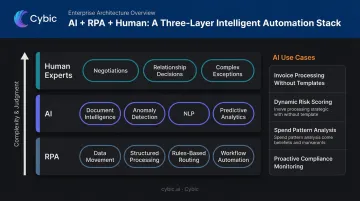
High-performing procurement teams are moving toward an orchestration model that combines three layers:
| Layer | Handles |
|---|---|
| RPA | Data movement, structured data processing, rules-based routing |
| AI | Pattern recognition, anomaly detection, unstructured document processing, decision support |
| Human experts | Relationship-based decisions, negotiations, complex exception resolution |
What AI Adds to the Stack
When RPA is paired with AI capabilities (intelligent document processing, natural language processing, predictive analytics) the use cases expand well beyond what rules-based bots can handle:
- Processing invoices and contracts without rigid templates, even as vendor formats change
- Dynamic supplier risk scoring based on real-time data patterns
- Spend pattern analysis that feeds category strategy rather than just reporting history
- Proactive compliance monitoring that runs continuously, not at quarter-end
Deloitte's 2022 intelligent automation survey found organizations expected an average 31% cost reduction over three years from this type of integrated approach - directly relevant to the procure-to-pay business case, even though the study spans functions beyond procurement.
Governance as an Architectural Requirement
Realizing those cost outcomes at scale depends on one condition: governance built in from the start. As automation grows more complex, audit trails, access controls, and compliance logging need to be embedded at the architectural level, not retrofitted after the fact.
This is where engineering decisions matter. Cybic builds intelligent automation systems for procurement and procure-to-pay workflows with governance controls, role-based access, and audit traceability built into the architecture from day one. Capabilities like intelligent document processing, LLM-powered contract analysis, and workflow orchestration are integrated together rather than bolted on separately - so the system remains auditable and compliant as procurement workflows grow in complexity.
Frequently Asked Questions
What is robotic process automation in procurement?
RPA in procurement uses software bots to automate repetitive, rules-based tasks - PO creation, invoice matching, vendor onboarding - by operating on top of existing ERP and procurement systems. No changes to underlying infrastructure are required; bots interact through the same interfaces a human would use.
What are the key phases of robotic process automation (RPA)?
The core phases are: process assessment and business case development, bot design and controlled piloting, and production deployment with governance controls and ongoing monitoring. Each phase builds on the previous. Skipping process standardization before bot development is the most common cause of project failure.
What procurement tasks are best suited for RPA?
The strongest candidates are high-volume, rules-based tasks involving data movement across systems with minimal judgment required: PO creation, three-way invoice matching, vendor data management, contract date monitoring, and spend data consolidation.
How is RPA different from AI in procurement?
RPA executes explicit, pre-defined rules against structured data. AI learns from patterns, handles unstructured inputs, and adapts to exceptions. Most advanced procurement teams use both: RPA handles data movement while AI manages cognitive processing and edge cases.
What are the most common reasons RPA implementations fail in procurement?
The top causes: automating broken or unstandardized processes, running programs in cross-functional silos without IT and compliance alignment, underinvesting in change management, and selecting low-frequency or judgment-heavy tasks as initial automation targets.